AI Code Generation: How to Tell If It Ships Better Code (2026)
October 21, 2026
Reza Vatani
10 min read

AI code generation is when a language model writes source code for you, and by now most engineering teams run at least one tool that does it. Turning it on takes an afternoon. Knowing whether it ships better software takes data most teams never connect. Abloomify imports usage from Cursor, Claude Code, and GitHub Copilot and ties it to PR flow and DORA metrics from GitHub.
Key Takeaways
Q: What is AI code generation?
A: AI code generation is a model writing code from a prompt, a comment, or the code around it. It shows up as autocomplete, chat, or an agent that edits several files and runs tests. Cursor, GitHub Copilot, and Claude Code are the common tools.
Q: Where does AI-generated code get lost?
A: Between suggestion and production. Code gets suggested, a fraction is accepted, a smaller fraction merges, and some of that comes back as a revert or a fix. Most vendor dashboards stop at the second step, which is why they flatter the tool.
Q: What should an engineering leader measure?
A: Four things: adoption, throughput, quality, and review load. In practice that means PR cycle time, time to first review, change failure rate, and rework, compared for AI-assisted work against everything else. Abloomify computes all four DORA metrics straight from GitHub.
Q: Is acceptance rate a good metric?
A: Not on its own. Acceptance rate tells you a developer clicked accept. It says nothing about whether that code was merged, reviewed quickly, or reverted two weeks later. Use it as an adoption signal and let delivery metrics carry the ROI argument.
Q: Can you measure this without reading source code?
A: Yes. Abloomify works from usage and delivery signals, such as PRs, reviews, and workflow runs, and it is privacy-first by design. It is SOC 2 Type II certified. No screenshots, no keyloggers, no screen recording.
What is AI code generation?
AI code generation is the use of a large language model to produce source code from a natural-language prompt, a partial snippet, or the files around the cursor. In 2026 it comes in three forms. Autocomplete finishes the line or block you are typing. Chat answers a question and hands back a function. Agents take a task, edit several files, run the tests, and open a pull request with little supervision. GitHub Copilot, Cursor, and Claude Code all offer some mix of the three. The form matters for measurement, because autocomplete changes how fast one person types while an agent changes who wrote the pull request in the first place.
If you want the tool landscape, our guide to AI coding tools covers it, and agentic AI coding tools goes deeper on the agent end. This piece is about the question that comes after you pick one: is it working?
Where does AI-generated code get lost on the way to production?
AI-generated code gets lost at four points between the editor and production: it is suggested and ignored, accepted and later deleted, merged and then reverted, or shipped and then patched. Each stage is a smaller number than the one before it, and the gap between "suggested" and "still running in production a month later" is the part nobody reports. Vendor dashboards cover the first two stages because that is where the tool itself can see. The last two live in your Git history and your deploy pipeline, which is where Abloomify already looks. A team can have a high acceptance rate and a rising rework rate at the same time, and both numbers will be true.
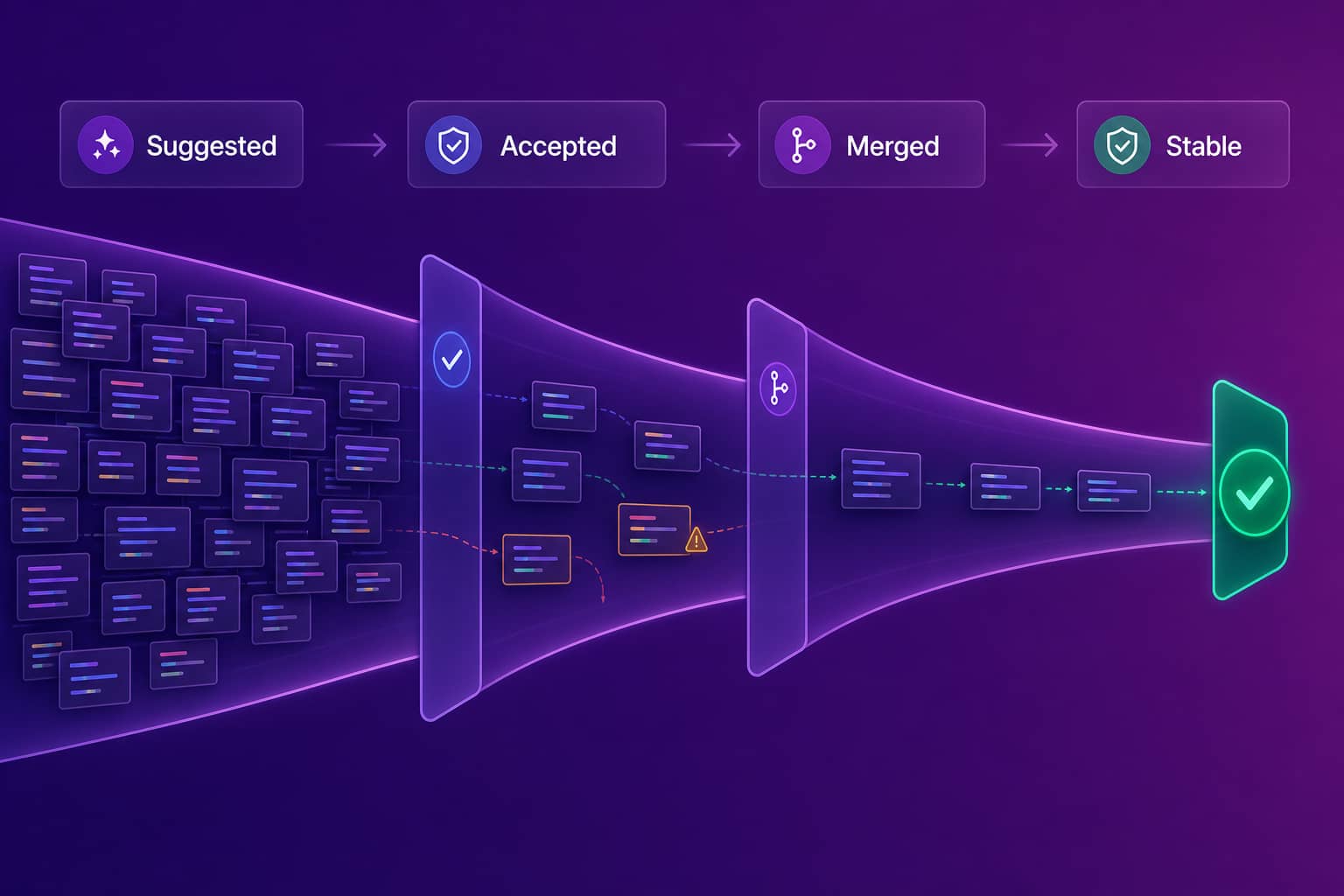
I think this is the most underrated problem with AI coding rollouts. Nobody lies about it. The data that would answer the question just sits in four different systems.
Why acceptance rate is the wrong scoreboard
Acceptance rate is the wrong scoreboard for AI code generation because it measures developer approval of a suggestion at the moment it appears, which is the cheapest and earliest point in the life of a line of code. It rewards autocomplete that is easy to accept, such as boilerplate, imports, and obvious next lines, and it says nothing about the harder question of whether the change survived review and stayed in production. Two teams can post the same acceptance rate while one ships faster and the other spends a week untangling generated code nobody fully read. Acceptance is an adoption signal, and a useful one for finding who has not tried the tool yet. As proof of ROI it has nothing behind it.
What to measure instead: four signals for AI code generation
The four signals worth tracking for AI code generation are adoption, throughput, quality, and review load, each compared for AI-assisted work against the rest of your codebase. Adoption is who uses which tool and how often. Throughput is PR cycle time and PR size. Quality is change failure rate and rework, meaning how often shipped code needs a fix or a revert. Review load is time to first review and how many comments a diff draws. Look at them together. Throughput that improves while quality drops is borrowed time, and quality that holds while review load balloons means you moved the bottleneck without removing it.
| Signal | What to track | What a bad trend looks like |
|---|---|---|
| Adoption | Active users per tool, sessions per engineer | Three tools in use, no shared baseline |
| Throughput | PR cycle time, PR size, merge frequency | Faster merges driven by larger, less-reviewed diffs |
| Quality | Change failure rate, rework, reverts | Failures rising in the AI-assisted cohort only |
| Review load | Time to first review, review comments per PR | Reviewers falling behind on generated diffs |
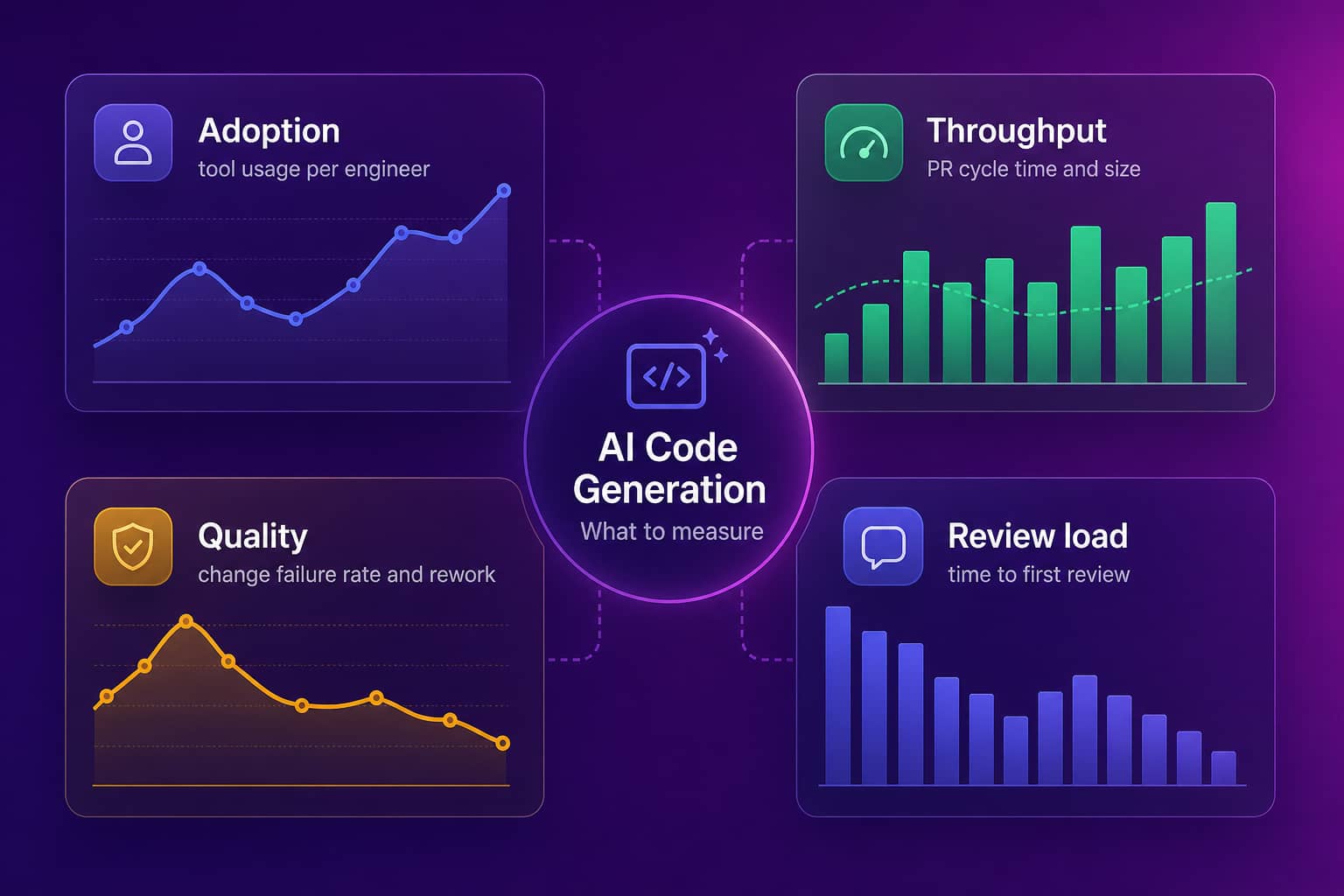
PR size deserves a special mention. Generated diffs run big, and big diffs are slow to review, which is how a speed gain at the keyboard turns into a queue at the review step. Our piece on code churn covers the rework side in more detail.
How Abloomify measures AI code generation
Abloomify measures AI code generation by importing usage data from Cursor, Claude Code, and GitHub Copilot and correlating it with the delivery data it already pulls from GitHub, so the comparison is between cohorts of real work instead of opinions. The four DORA metrics (deployment frequency, lead time, change failure rate, and MTTR) are computed directly from GitHub and banded Elite, High, Medium, or Low, with automatic change-failure detection from failed deploys and reverts. PR flow analytics add cycle time, time to first review, review health, self-merge rate, and PR size. Human vs AI agent contribution is separated across tasks, code, PRs, and reviews, and an AI-vs-human cohort view shows whether heavy adopters ship more and review faster. AI Leverage is one tunable pillar in the Engineering Velocity Score.
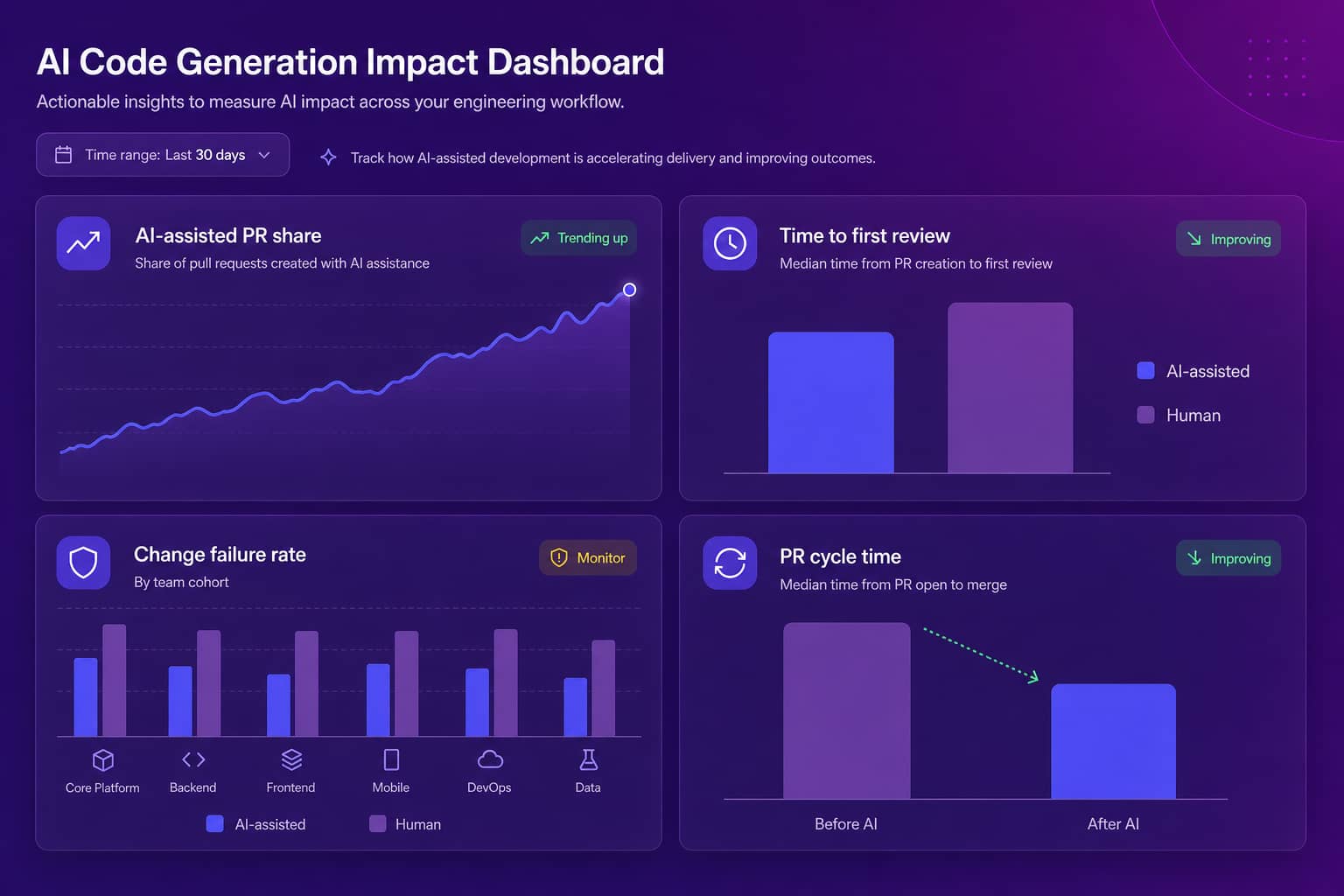
We run this on ourselves. We moved from GitHub Copilot to Cursor and the change felt big, but a feeling is not a number, and it is the reason we built the cohort view. If you want the head-to-head on tools, see Cursor vs Claude Code and our write-up on GitHub Copilot metrics.
How to roll out AI code generation without losing code quality
A rollout that keeps code quality intact starts with a baseline, one standard tool, and a cap on diff size, and it ends with a renewal decision made on delivery data. Before you hand out licenses, record the current PR cycle time, time to first review, and change failure rate, because you cannot show improvement against a number you never wrote down. Standardize on one primary tool so usage data stays comparable. Put a soft limit on PR size so reviewers are not handed a thousand-line generated diff. Keep human review mandatory for AI-assisted pull requests, and consider an AI code review pass as a first filter, not a replacement. Then review the cohort comparison at 30 and 90 days.
- Baseline PR cycle time, time to first review, and change failure rate before rollout.
- Pick one primary tool and keep the others on a short leash.
- Cap PR size, and keep a human on every review.
- Compare AI-assisted and human PRs at 30 and 90 days.
- Decide at renewal using delivery data and license cost together.
Every vendor will keep shipping a better acceptance-rate chart. The teams that win the budget conversation will be the ones holding a change failure rate.
FAQ
What is AI code generation?
AI code generation is the use of a large language model to write source code from a prompt, a comment, or the surrounding code. Tools like Cursor, GitHub Copilot, and Claude Code do it as autocomplete, chat, or multi-step agents that edit several files and run tests.
Is AI-generated code reliable enough for production?
It can be, with the same gates you apply to human code: review, tests, and CI. The risk is skipping those gates because the output looks clean. Watch change failure rate and rework on AI-assisted pull requests to see whether quality holds in your own codebase.
How do you measure AI code generation ROI?
Compare AI-assisted work against the rest of your codebase on PR cycle time, time to first review, change failure rate, and rework, then set that against license cost. Acceptance rate alone shows developers liked the suggestions, and does not show the code shipped faster or safer. See our guide to AI ROI for the wider framework.
Does AI code generation make code review slower?
Often, yes. Generated diffs tend to be larger, and reviewers spend longer on code they did not watch being written. Track time to first review and PR size for AI-assisted work, and cap diff size before the review queue becomes the bottleneck. Our guide to reducing code review cycle time has the tactics.
How does Abloomify measure AI code generation?
Abloomify imports usage data from Cursor, Claude Code, and GitHub Copilot and correlates it with PR flow, review health, and DORA metrics from GitHub. It separates human and AI agent contribution, so the comparison is cohort against cohort. It is privacy-first and PII-free by architecture, with no screenshots or keyloggers. See engineering productivity analytics.

Reza Vatani
Co-Founder & CAIO
AI-driven entrepreneur with a strong background in robotics and advanced analytics. PhD from Old Dominion University and former Product Development leader at Nasdaq Verafin.