AI ROI: How to Measure the Return on Your AI Tool Spend
July 7, 2026
Reza Vatani
10 min read

Most engineering leaders cannot answer one question their board is about to ask: what is the AI ROI on the tools we bought? You approved Cursor, GitHub Copilot, and Claude Code. The invoices are real. The output gain is a feeling. Abloomify exists to turn that feeling into a number by connecting AI tool usage to what your team actually ships.
Key Takeaways
Q: What is AI ROI?
A: AI ROI is the return your company gets on AI tool spend, measured as output gained against the total cost of licenses, usage credits, and adoption effort. For AI coding tools like Cursor and GitHub Copilot, real ROI ties usage to delivery, not seat counts.
Q: How do you calculate AI ROI?
A: Divide the measurable output gain (more PRs merged, faster cycle time, features shipped) by total AI cost (licenses plus usage credits). The hard part is the numerator. You need usage data correlated with engineering output, not self-reported satisfaction.
Q: Why do most AI ROI numbers fall apart?
A: They rely on license utilization or engineer surveys. A paid seat proves someone can open a tool, not that it moved output. Surveys collect confident opinions. Neither connects AI usage to what actually shipped, which is where Abloomify starts.
Q: How does Abloomify measure AI ROI?
A: Abloomify imports usage from Cursor, Claude Code, and GitHub Copilot, correlates it with engineering output, and separates human from AI-agent contribution across code, PRs, and reviews. AI Leverage becomes a tunable pillar of the Engineering Velocity Score.
Q: What counts as good AI ROI?
A: Good AI ROI shows heavy adopters shipping more and reviewing faster than light adopters, at a defensible cost per developer. There is no universal benchmark. The number that matters is your own cohort comparison, measured the same way every period.
What is AI ROI?
AI ROI is the measurable return your organization earns on money spent on AI tools, expressed as output gained divided by the fully loaded cost of those tools. The cost side is easy: license fees, usage credits, and the hours spent rolling the tools out. The output side is where every honest AI ROI calculation gets hard. A seat license tells you someone can open Cursor. It says nothing about whether that engineer merged more code, reviewed pull requests faster, or shipped a feature sooner because of it. Real AI ROI connects the two. It asks whether the developers using AI heavily are demonstrably more productive than the ones who are not, at a cost you can defend to a CFO. That comparison, run on your own team with your own delivery data, is the only AI ROI number worth reporting.
Abloomify treats AI ROI as an engineering measurement problem, not a procurement one. The platform imports usage signals directly from Cursor, Claude Code, and GitHub Copilot and lines them up against real output from GitHub: PR cycle time, review health, code velocity, and delivery. That is the difference between knowing your adoption rate and knowing your return.
Why most AI ROI numbers are guesses
Most AI ROI numbers are guesses because they measure inputs that feel like proof but are not. Three approaches dominate, and all three break the same way. License utilization tells you 82 percent of seats logged in last month, which proves people can access the tool, not that it changed anything they shipped. Engineer surveys ask "is Copilot helping?" and collect confident yeses, and a confident yes is exactly the kind of answer a large language model is best at producing in the person using it. Surface-level app tracking, the kind bolted onto monitoring tools, records that an AI window was open without knowing whether the suggestion was accepted or thrown away. None of these touch output. You end up with an adoption story dressed as an ROI story, and the gap between the two is where budgets quietly leak.
One 3,500-person enterprise we worked with learned the cost of single-source data the hard way. They ran a diagnostic on one system in isolation, and the usage signals showed low correlation to their internal performance metrics. The lesson was not that the data was wrong. The lesson was that one stream of usage data, disconnected from delivery outcomes, under-proves value every time. AI ROI has the same failure mode. Usage without output is a number you cannot stand behind.
How to calculate AI ROI in four steps
Calculating AI ROI reliably takes four steps, and the order matters because each one feeds the next. The math itself is simple division: output gain over total cost. The work is assembling a numerator you can trust. Skip the correlation step and you are back to guessing. Here is the sequence Abloomify follows when it builds an AI Tool ROI Diagnostic for a customer, and the same sequence works whether you run it manually in a spreadsheet or connect your systems and let the platform compute it.
- Define the output you care about. Pick delivery metrics that leadership already trusts: PRs merged, cycle time, review turnaround, features shipped. These become your numerator.
- Capture real usage. Pull actual usage from Cursor, Claude Code, and GitHub Copilot (acceptance, active use, credits consumed), not seat assignments.
- Correlate usage to output. Line usage up against delivery over the same window. Do heavy adopters move the delivery metrics more than light adopters?
- Compare cohorts against cost. Divide the output difference by the fully loaded cost per developer. That ratio, tracked every period the same way, is your AI ROI.
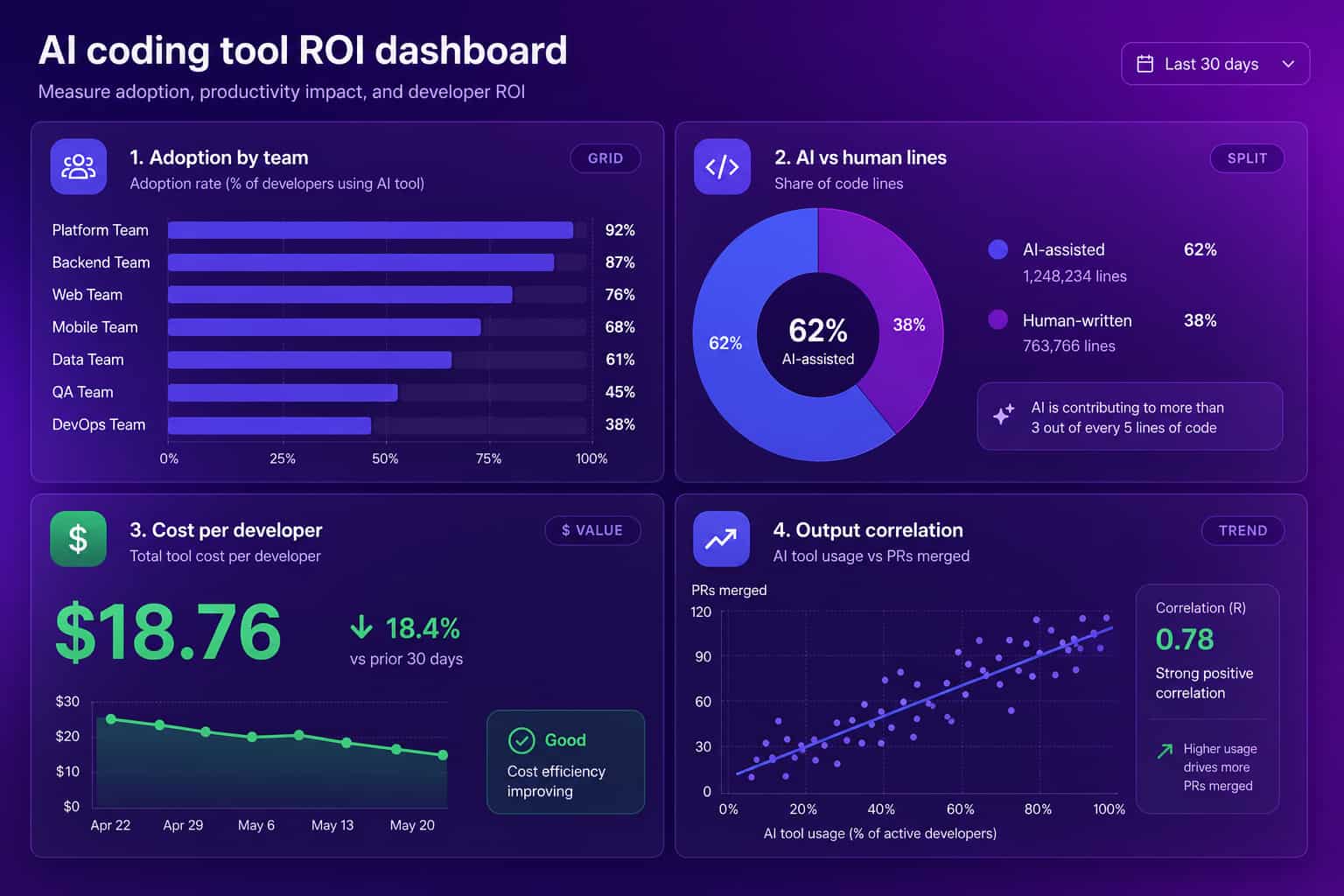
Measuring AI coding tool ROI for Cursor, Copilot, and Claude Code
Measuring AI coding tool ROI means correlating what your engineers spend on Cursor, GitHub Copilot, and Claude Code with the code and reviews those tools helped produce, then pricing the difference per developer. Abloomify imports metrics from each tool and correlates them with engineering output, so you can see adoption by team, AI-assisted lines versus human-written lines, and whether the teams leaning hardest on AI actually ship and review faster. This is where an AI-vs-human cohort comparison earns its keep. If your heaviest Cursor users close PRs faster and carry more reviews without a quality drop, you have a defensible ROI story. If adoption is high but output is flat, you have found a coaching problem or a tool that is not paying off, and either way you now know before renewal instead of after.
The same connection surfaces waste on the cost side. AI licenses are SaaS licenses, and unused ones drain budget like any other. Abloomify's license and waste detection has surfaced meaningful savings for customers looking at their broader tool spend, and AI seats belong in that same view.
Human vs AI contribution: the metric that changes the math
Human versus AI contribution is the measurement that most AI ROI calculations miss entirely, and it changes the math because it tells you what the tools actually did rather than what your engineers were near. Abloomify separates human work from AI-agent work across tasks, code, pull requests, and reviews. When an autonomous agent opens a PR and a human reviews and merges it, those are two different contributions with two different costs, and lumping them together hides where the leverage really came from. Pure engineering analytics tools do not do this. Jellyfish and LinearB give you DORA dashboards, but they do not split human from AI-agent contribution or quantify AI coding-assistant ROI. That split is the signal that turns "we adopted AI" into "here is exactly how much of our throughput is AI-driven, and what it cost."
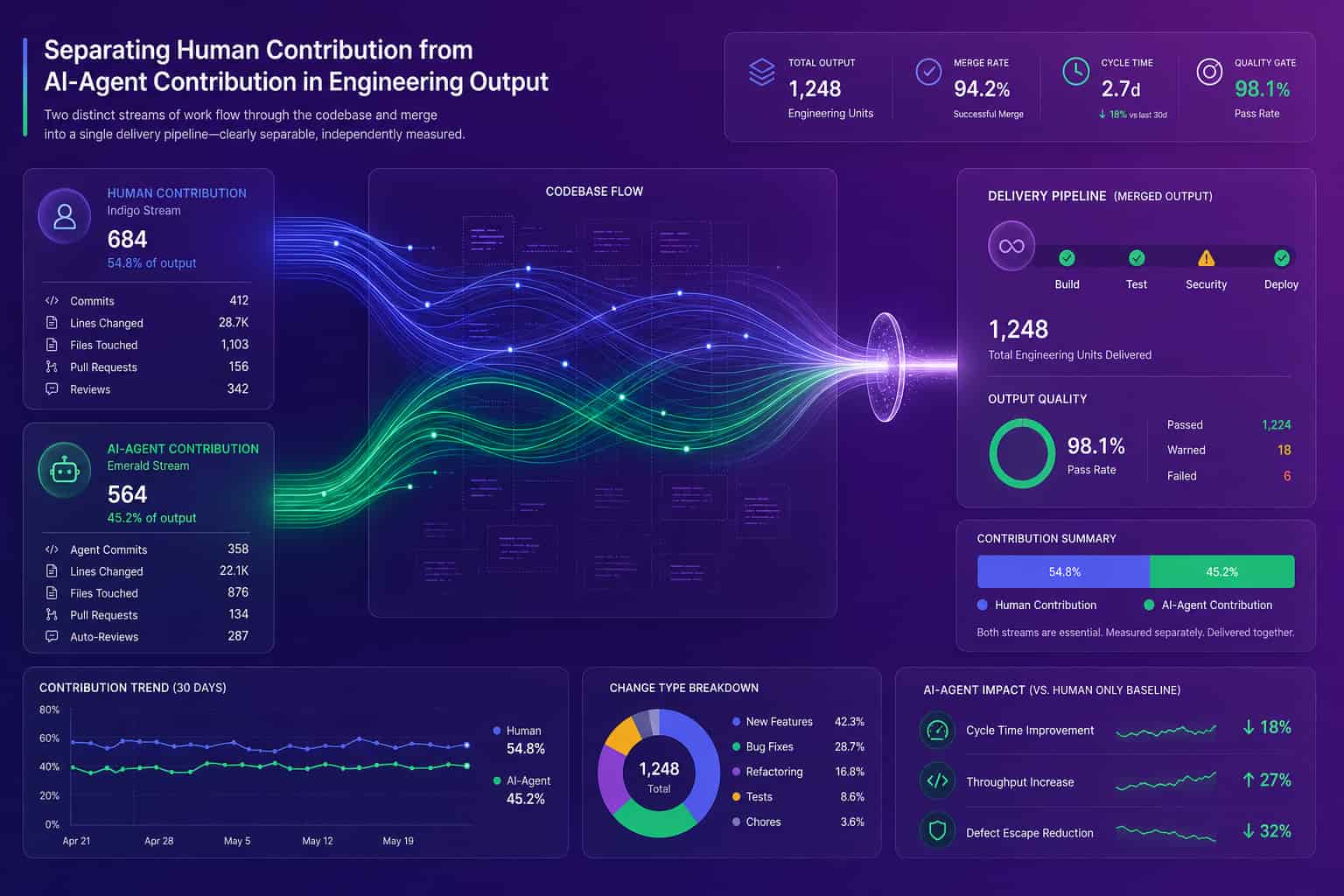
Abloomify even makes AI Leverage a tunable pillar of its Engineering Velocity Score, so the impact of AI adoption is a first-class input to how you measure the team, not a footnote. The whole analysis stays privacy-first and PII-free. Abloomify reads usage and output signals, never the content of your code.
Raise AI ROI, do not just report it
Reporting AI ROI is table stakes; the better move is raising it, and the fastest lever is making the tools you already pay for smarter instead of buying more of them. Through Abloomify's External AI Access, an MCP server, you connect Cursor, Claude Code, ChatGPT, and any tool built on the open standard to your company's own knowledge and work data. Same licenses, same seats, better answers, because the assistant now draws on your connected context instead of generic training data, scoped to exactly what each person is already allowed to see and revocable in a click. That raises the return on spend you have already committed. Then Bloomy, the AI analyst, keeps the measurement alive: schedule a recurring AI-adoption brief and a decision-ready report lands in your inbox on your cadence, each run resumable as a conversation you can push on.
The companies that win the AI budget argument are not the ones with the most tools. They are the ones who can prove which tools paid off. Measure the return. Then raise it.
FAQ
How do you measure AI ROI for coding tools?
Measure AI ROI for coding tools by correlating usage from Cursor, GitHub Copilot, and Claude Code with real engineering output like PR cycle time and code velocity, then dividing the output gain by cost per developer. Abloomify imports this usage and runs the correlation automatically, including an AI-versus-human cohort comparison so you can see whether heavy adopters actually ship faster.
Is adoption rate the same as AI ROI?
No. Adoption rate tells you how many people use a tool. AI ROI tells you whether that usage changed output at a defensible cost. A team can have 90 percent adoption and flat delivery, which is a spend problem, not a win. Abloomify separates the two by tying usage to GitHub delivery metrics rather than seat counts.
What is a good AI ROI benchmark?
There is no universal AI ROI benchmark, because output baselines differ by team, stack, and product. The number that matters is your own cohort comparison over time: do your heaviest AI adopters ship and review more than light adopters, measured the same way each period? A consistent, defensible internal trend beats any borrowed industry figure.
Can you measure AI ROI without monitoring employees?
Yes. Abloomify is privacy-first and PII-free by architecture, with no screenshots, no keyloggers, and no screen recording. It reads usage and output signals from connected tools like GitHub, Cursor, and Claude Code, never the content of code or messages. You get the AI ROI numbers without the surveillance or the employee trust damage.

Reza Vatani
Co-Founder & CAIO
AI-driven entrepreneur with a strong background in robotics and advanced analytics. PhD from Old Dominion University and former Product Development leader at Nasdaq Verafin.