How to Reduce Code Review Cycle Time Without Sacrificing Quality
June 3, 2026
Reza Vatani
20 min read

A pull request waiting for review is finished work that is not shipping yet. When that wait stretches from a few hours to a couple of days, the whole delivery pipeline slows down, and developers lose the thread on code they wrote earlier in the week. Most engineering leaders can feel this happening but cannot point to where the time actually goes. That is the gap Abloomify's engineering productivity analytics closes: it reads review-health signals from your version control and reports them at the team level, so you can find the delays without putting a single developer under a microscope.
Key Takeaways
Q: What is code review cycle time?
A: It is the time a pull request takes to move from opened to merged. The two sub-metrics that matter most are time to first review (how long before anyone looks) and time to approval (the full round trip including revisions).
Q: What slows code reviews down the most?
A: Four things, usually together: oversized PRs, uneven reviewer load that turns one senior engineer into a bottleneck, fuzzy review standards that cause back-and-forth, and reviewers buried in meetings with no focused time to review well.
Q: How do you speed reviews up without dropping quality?
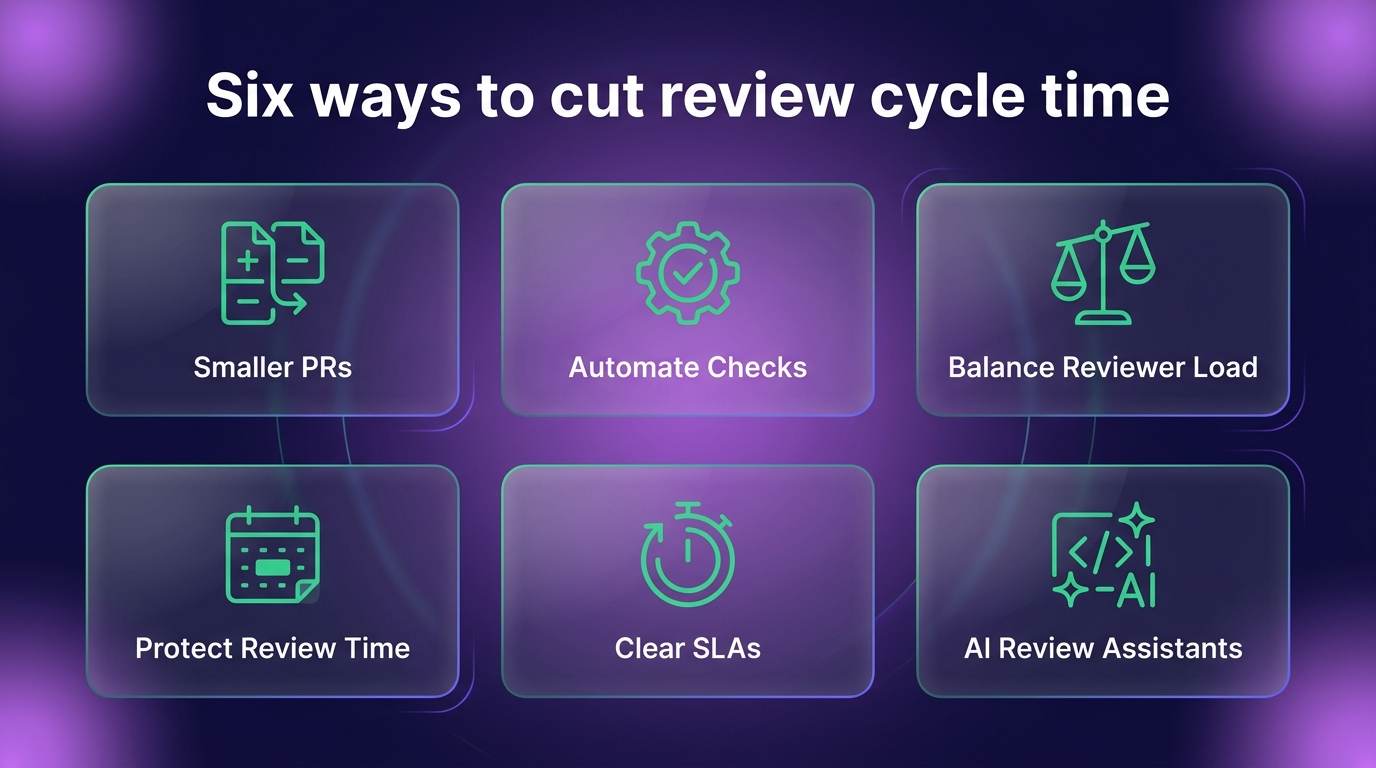
A: Shrink PRs, automate the objective checks, balance reviewer load, protect dedicated review time, set explicit SLAs, and keep quality metrics like post-merge defect rate in view so speed does not come at quality's expense.
Q: How do you measure it without surveillance?
A: Read aggregated PR metadata from GitHub or GitLab at the team and project level. No screenshots, no keystroke tracking, no individual scorecards, just the timing and distribution patterns that reveal where the process is stuck.
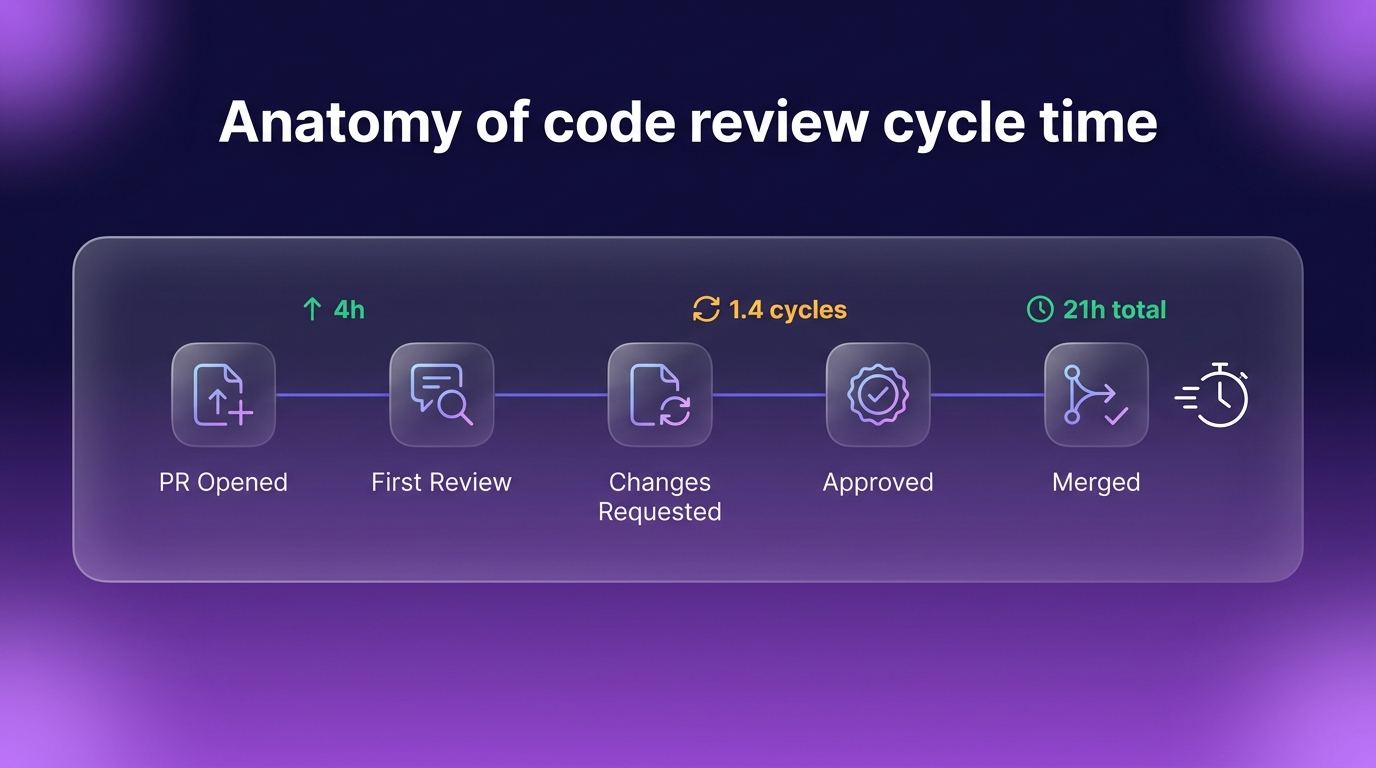
Why code review cycle time matters for engineering velocity
Every hour a pull request sits waiting for review is delayed value to customers. When cycle time stretches from hours to days, the whole software delivery pipeline slows with it. Developers lose context on their own work while waiting, then burn extra time re-familiarizing themselves with code they wrote days earlier. That re-orientation is wasted effort, and it tends to lower the quality of the next round of revisions too.
Long cycles also wear on the team. Engineers who routinely wait days for feedback feel like their throughput is capped by the process, not their own ability, and that is a quiet motivation killer for exactly the high performers you least want to lose. Over time it feeds burnout and turnover among people who have options elsewhere.
From the business side, slow reviews push out feature releases, bug fixes, and competitive responses. In a fast-moving market, shipping quality code quickly is a real edge. Teams that cut cycle time without cutting quality iterate faster, respond to customers sooner, and hold higher engineering velocity than competitors stuck in slow review loops.
What causes long code review cycle times?
Understanding the root causes helps you apply targeted fixes instead of generic process changes that miss the actual bottleneck.
Pull request size and complexity
Large pull requests take much longer to review than small, focused ones. A 500-line PR that touches many files and bundles several features forces reviewers to load a lot of context, test broadly, and think hard before giving useful feedback. The cognitive load is high enough that reviewers often delay starting, or rush through and approve superficially.
The practical problem with oversized PRs is that a good review means understanding the original problem, the proposed solution, the alternatives, the edge cases, and the blast radius on the rest of the system. That needs a focused block of time, which is hard to find when PRs are large and frequent. You can track PR size patterns through Abloomify's GitHub integration to spot when developers are consistently shipping diffs too big to review well.
Reviewer availability and workload
When reviewers are buried in meetings or juggling competing priorities, cycle time climbs. A common pattern in growing teams is uneven review load. Senior developers get assigned to most PRs and become bottlenecks, while other qualified reviewers sit with spare capacity. Seeing that distribution clearly is the first step to rebalancing it.
Availability also depends on context. A developer deep in their own feature work pays a high switching cost to review someone else's code: pause, load different context, give thoughtful feedback, switch back. Those transitions cost real time and energy, especially for reviewers handling several reviews a day.
Lack of clear review standards
Teams without agreed review guidelines, coding standards, or automated checks tend to churn through back-and-forth cycles. When expectations are vague, feedback gets inconsistent. One reviewer fixates on style, another on architecture, a third on test coverage, and the author ends up chasing subjective preferences instead of objective quality issues.
Clear standards plus automation cut the ambiguity. With formatting, linting, security scanning, and coverage thresholds enforced automatically, human reviewers can spend their attention on logic, design, and architecture. The machine catches the objective stuff before a person ever opens the PR, which removes a whole category of revision cycles.
Context switching and meeting overload
Developers fragmented by back-to-back meetings take longer to give thoughtful reviews, because quality review needs an uninterrupted block they simply do not have. When they finally find a gap, they tend to rush the queue before the next meeting, miss issues, and generate the kind of shallow feedback that triggers more cycles. Protecting deep work time for authors and reviewers alike improves both speed and quality. You can find meeting-overload patterns with Abloomify's meeting optimization software and open up space for real reviews.
How to measure code review cycle time effectively
You cannot fix a review process you cannot see. Engineering leaders need clear visibility into review-health metrics to spot problems, test fixes, and track progress, and the trick is getting that visibility without invasive surveillance that damages trust.
Key metrics to track
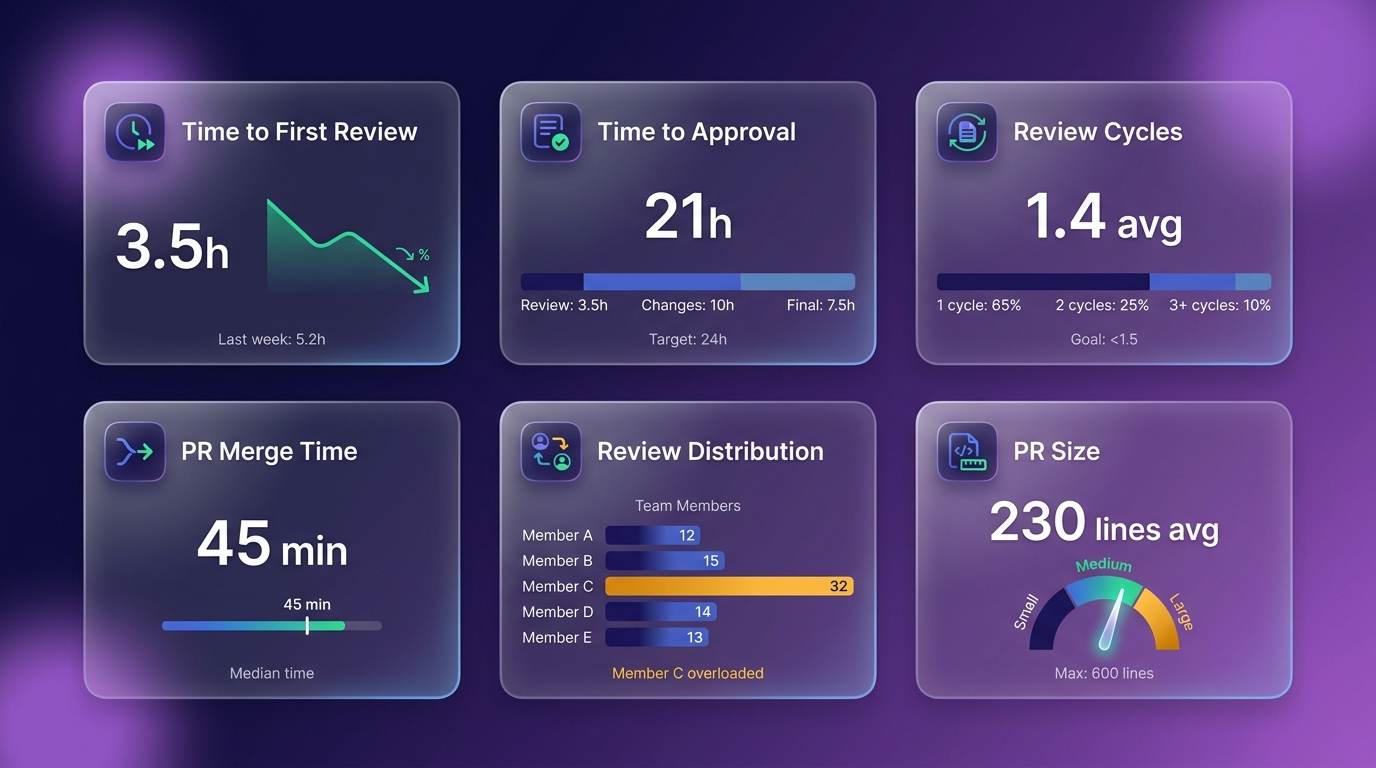
Effective measurement means tracking a few connected metrics, each revealing a different part of review health. Time to first review is how long a PR waits before anyone gives initial feedback. A long time here usually means review assignment is not working, reviewers are overloaded, or the team has no shared SLA. Time to approval is the full duration from PR creation to final sign-off, the end-to-end experience for the author, and it is worth splitting by PR type since architectural changes naturally run longer than bug fixes.
Number of review cycles counts the back-and-forth iterations before approval. Lots of cycles points to unclear requirements, thin PR descriptions, or missing automated checks. PR merge time, from approval to landing on main, looks trivial but delays there often expose process friction, unclear ownership, or gaps in CI/CD automation. Review distribution shows how load spreads across the team, and uneven distribution is where bottlenecks and burnout start.
| Metric | Healthy target | Warning sign |
|---|---|---|
| Time to first review | Under 4 hours | Over a day |
| Time to approval | Under 24 hours | Several days |
| Review cycles per PR | 1 to 2 | 4 or more |
| PR size | 200 to 400 lines | 600+ lines |
| Review load distribution | Spread across the team | Concentrated on 1 to 2 people |
Using privacy-first analytics for review health
Privacy-first workforce intelligence platforms connect to GitHub, GitLab, and other version control systems to surface aggregated review-health metrics without tracking individuals invasively. They analyze PR metadata, review timing, and approval patterns to flag systemic issues like uneven distribution, prolonged queues, or bottlenecked reviewers, all while keeping a PII-free architecture.
The point is team and project-level patterns, not individual performance tracking. You can see that Team A runs longer cycles than Team B, or that PRs touching the authentication system take twice as long to review as anything else. That visibility drives targeted process changes without breeding surveillance anxiety. See how Abloomify's GitLab integration provides review-health visibility while respecting developer privacy.
Proven strategies to reduce code review cycle time
Cutting cycle time takes a mix of process, automation, culture, and data. The approaches that actually work tend to hit several root causes at once instead of betting on a single fix.
Enforce smaller pull request sizes
Set a team guideline for maximum PR size, usually 200 to 400 lines depending on your codebase, and break large features into smaller chunks that merge incrementally. Smaller PRs lower reviewer cognitive load, shorten review time, and make issues easier to catch. They also reduce merge-conflict risk and make rollback simpler if something breaks after deploy.
Use automated checks to flag oversized PRs before they hit the queue. Many teams configure CI to warn or block PRs over a size threshold, which nudges authors to self-regulate without manual policing. When people know a 700-line PR will get flagged, they plan work into smaller increments. For big refactors or migrations that genuinely cannot be split, feature flags let you merge incomplete work safely while keeping each PR small. Our PR churn and right-sizing guide goes deeper on the tracking side.
Automate code quality checks
Automate linting, formatting, security scanning, and coverage checks before human review. This shifts reviewer attention to logic, architecture, and design instead of style nits. Automated checks run consistently and catch objective problems instantly, which removes whole categories of feedback. When reviewers trust that code already passed the automated gate, they can focus on the parts that need human judgment.
Modern CI/CD pipelines can enforce these as required status checks that must pass before review begins, so nobody wastes time reviewing code that fails the basics. ESLint, Prettier, SonarQube, Snyk, and language-specific analyzers cover formatting, code smells, security holes, and coverage gaps automatically. Time spent building out solid automated checks pays itself back in faster cycles and higher quality.
Balance reviewer workload
Use analytics to spot when specific developers are drowning in review requests while others have capacity, then spread the load more evenly to prevent bottlenecks and burnout. Many teams drift into a pattern where senior developers or tech leads become default reviewers on everything, which creates dependencies and delays. Rotating assignments builds review skill across the team and shares the load.
Consider a reviewer assignment system that accounts for current workload, domain expertise, and availability. Some teams use round-robin within an expertise area, others let authors pick from an available pool. What matters is making distribution visible and shared. Teams can identify and fix engineering bottlenecks by analyzing review distribution and rebalancing assignments.
Protect dedicated review time blocks
Schedule specific blocks for reviews to cut context switching. Many strong teams set certain hours as review time, when developers focus on feedback rather than writing code. It treats the switch between writing and reviewing as the expensive operation it is, and batches the similar work together. Some teams put review blocks in the morning when people are fresh, others prefer the afternoon.
Look at meeting patterns with Abloomify's meeting analytics to find time to protect for focused review. Trimming and consolidating meetings creates room for quality reviews without extending the day. When developers know they have protected review time, they stop letting PRs sit and stop rushing feedback between interruptions.
Establish clear review SLAs
Set expectations for turnaround, like first review within 4 hours and approval within 24 hours for standard PRs, then make the SLAs visible and track adherence to create accountability without surveillance. Clear targets help authors plan and know when to nudge a pending review, and they help reviewers prioritize and flag capacity problems early.
Different PR types warrant different SLAs. A hotfix might target two hours while a large architectural change allows 48. The exact numbers matter less than having explicit, shared expectations the team commits to. When SLAs get missed consistently, dig into root causes like workload imbalance or unclear standards rather than leaning on individuals to just go faster.
Use AI-powered review assistants
AI coding tools like GitHub Copilot, Cursor, and Claude Code can do initial code analysis, suggest improvements, and flag issues before human review. They are good at catching common bugs, surfacing security concerns, and even drafting review comments a human can refine, and they shine on large codebases where it is easy to miss patterns in manual review.
Track adoption and impact with Abloomify's AI adoption analytics to understand ROI and tune usage. Some teams find AI assistants cut cycle time by catching issues earlier, others find AI-generated code needs more careful review. Measuring the real outcome is how you tell which is happening on your team.
How to use workforce intelligence to optimize review processes
Workforce intelligence platforms give you the data to improve review continuously. By connecting to your dev tools and analyzing patterns across teams, they reveal optimization opportunities that no single developer can see from their own seat.
Identify review bottlenecks with data
Connect GitHub or GitLab to a privacy-first platform to surface patterns like reviewers who consistently delay approvals, PRs that sit idle for days, or teams with systematically longer cycles. When the data shows PRs touching the payment system take three times longer to review than anything else, you can investigate whether that code needs refactoring, the docs need work, or the team needs more expertise there.
Bottleneck data also catches process issues individuals would not notice. If PRs opened on Friday afternoon sit until Monday, you can adjust submission norms or deployment timing. If some reviewers respond in hours and others in days, you can find out whether the slow ones are overloaded, need training, or just are not prioritizing reviews.
Measure the impact of process changes
After you roll out smaller-PR guidelines or dedicated review blocks, measure whether cycle time actually moves. Data-driven feedback loops let you keep what works and drop what does not. Plenty of changes sound great in theory and deliver nothing in practice, and without measurement you keep paying for the ones that do not help.
Compare cycle-time metrics before and after, accounting for confounders like team size changes, project complexity, or seasonal patterns. Track several metrics at once so a win in one place does not hide a loss in another. If smaller PRs cut cycle time but triple the number of PRs per feature and balloon total review load, the net gain might be close to zero.
Ask your AI Chief of Staff about review health
Modern platforms include AI analysts that take natural language questions like "Which team has the longest code review cycle time?" or "How has our PR merge time changed since we adopted AI coding tools?" That conversational layer makes the data usable for leaders who do not have time to build queries or stare at dashboards. More on Abloomify's AI Chief of Staff capabilities for natural language workforce intelligence.
A good analyst also surfaces things you would not think to ask, finds correlations across metrics, and suggests specific actions based on the patterns, which helps you get ahead of problems instead of reacting after they have already cost the team.
How AI coding tools impact code review cycle time
AI coding assistants like Cursor, GitHub Copilot, and Claude Code can shorten cycle time by helping developers write cleaner first drafts, catch errors before submitting, and get automated suggestions during review. Used well, they mean PRs arrive with fewer obvious bugs, better coverage, and clearer structure, which trims both the number of cycles and the time per PR.
They also introduce new challenges that can push cycle time the other way. AI-generated code may follow patterns unfamiliar to reviewers, need extra security scrutiny, or hide subtle bugs that tests miss. Some teams report that reviewing AI-assisted code takes longer, because the reviewer cannot assume the author understands every line. I would not take either outcome on faith. The honest move is to instrument it and look at what your own cycle-time data does after adoption, rather than trusting the vendor's velocity claim or the skeptic's gut.
Privacy-first platforms like Abloomify connect to Cursor, ChatGPT, and other AI tools to measure adoption and its impact on velocity metrics including PR cycle time. That tells you where AI usage is helping, where it needs training, and where human review still has to carry the load. For a fuller treatment of the options, see our guide to AI coding tools.
Balancing speed and quality in code reviews
Cutting cycle time should never mean cutting quality. The goal is to strip waste and friction out of review while holding a high bar for what gets merged. Teams that optimize for speed alone ship bugs, pile up technical debt, and create maintenance drag that slows future work anyway.
Quality metrics to maintain
While you reduce cycle time, watch defect rates, post-merge bug reports, and production incidents to make sure faster reviews are not quietly degrading quality. If cycle time drops 30% but post-merge bugs climb 50%, you have made things worse, not better.
Track test coverage, security-vulnerability detection rates, code complexity, and technical-debt accumulation alongside cycle time. These give early warning when a process change is hurting quality. Many teams put speed and quality metrics on one dashboard so the trade-off stays visible and nobody optimizes one dimension into the ground.
When thorough review takes priority
Security-sensitive code, architectural changes, and high-risk features deserve more thorough review regardless of cycle time. Use tagging and priority systems to set the right expectations for each type. A documentation typo can merge in minutes; a change to authentication logic might need multiple reviewers and extensive testing.
Communicate clearly which changes need extra scrutiny and set SLAs to match. Labels like "quick-review," "standard-review," and "architecture-review" tell everyone how long review should take and how deep it should go. That keeps low-risk changes from getting stuck in unnecessary process while making sure the risky ones get the attention they need.
How to build a culture that values fast, quality reviews
Reducing cycle time takes cultural commitment, not just process. Culture decides whether developers prioritize reviewing others' code, how fast they respond, and whether they treat review as a chore or a real collaboration. Without that, even good processes and tools fall flat.
Recognize the developers who give timely, helpful reviews. Plenty of orgs celebrate authorship and treat review as invisible work. Making review contributions visible in team meetings, performance conversations, and promotion decisions signals that the work matters. Some teams track review contributions in their analytics and call out top reviewers in retrospectives.
Make review speed and quality visible in retrospectives. Share cycle-time trends, distribution, and quality outcomes. When a team sees its own practices improving and delivery getting faster, it keeps the habits going, and when the data shows a problem, the team can solve it together instead of waiting for a top-down mandate.
Use analytics to connect review velocity to overall engineering productivity and product delivery: deployment frequency, time to market, customer satisfaction. When people see how review practices move results the business cares about, they invest in improving them. It is also worth watching burnout signals so faster reviews never come at the cost of sustainable work.
If you want to keep trust intact while you optimize, measuring productivity without invasive monitoring lays out the privacy-first approach, and our guide to protecting deep work time covers how to give developers the capacity for quality reviews in the first place. For the integration setup, Abloomify's GitHub integration and GitLab integration provide review-health visibility while respecting developer privacy, and the AI Chief of Staff turns it into executive-level answers about engineering velocity.
FAQ
What is a good code review cycle time for engineering teams?
A healthy code review cycle time for most teams is 4 to 8 hours for time to first review and 24 to 48 hours for complete approval. The right number varies with team size, PR complexity, and time zones. High-performing teams often hold median cycle time under 24 hours for standard PRs while allowing longer windows for architectural or security-sensitive changes. Track your own baseline and aim for steady improvement rather than chasing an external benchmark that may not fit your context.
How do I measure code review cycle time without monitoring individual developers?
Use aggregated team and project-level metrics from GitHub or GitLab. Privacy-first workforce intelligence platforms analyze PR metadata, timestamps, and approval patterns to calculate average cycle time, review distribution, and bottleneck patterns without tracking individual activity. Focus on team trends and systemic issues, not individual scorecards. That keeps the data actionable and the team trusting it.
What causes code review bottlenecks in distributed teams?
Distributed teams add time zone gaps, async communication friction, and less informal collaboration. A PR opened at 5 PM in San Francisco may wait until European reviewers start the next morning. Cultural differences in communication and review expectations can stretch cycle time too. Mitigate it with clear async norms, review responsibilities spread across time zones, thorough PR descriptions, and short recorded demos for complex changes.
How can AI coding tools reduce code review cycle time?
AI coding tools help authors ship cleaner first drafts with fewer obvious bugs, automate identification of common issues, and provide initial analysis reviewers can build on. Copilot, Cursor, and Claude Code help authors write better code faster, while AI review assistants flag potential security issues, code smells, and style problems automatically. The catch is that AI-generated code sometimes needs more careful review, so measure the real impact on your cycle time instead of assuming a win.
How do I balance fast code reviews with maintaining quality standards?
Automate the objective checks (linting, tests, security scanning), set clear standards that separate critical issues from nitpicks, track quality metrics like post-merge defect rate alongside cycle time, and adjust review intensity by risk level. Point human attention at architecture, logic, and design decisions that need judgment. Accept that some PRs, like changes to authentication, warrant thorough review regardless of time pressure.
What metrics should I track to improve review health?
Track time to first review, total time to approval, number of review cycles, PR merge time after approval, review load distribution, PR size, and post-merge defect rate. Pair the speed metrics with the quality ones so a faster pipeline does not quietly ship more bugs. Distribution metrics catch the common failure mode where one or two people become the whole team's review queue.
How can workforce intelligence help optimize code review processes?
Workforce intelligence platforms connect to GitHub, GitLab, and other development tools to surface review-health patterns, identify bottlenecks, measure whether process changes actually worked, and answer natural language questions. They expose systemic issues like uneven review distribution or PRs sitting idle for days, all at the team level so you get visibility for optimization without surveillance that erodes trust.

Reza Vatani
Co-Founder & CAIO
AI-driven entrepreneur with a strong background in robotics and advanced analytics. PhD from Old Dominion University and former Product Development leader at Nasdaq Verafin.