Sprint Planning: How to Plan Sprints That Actually Ship
July 8, 2026
Amir Tavafi
14 min read

Every sprint planning session, the team commits to 40 story points and delivers 25. Sprint planning is the meeting that starts a sprint and decides what the team will build, yet in most teams it sets the team up to miss. The gap is rarely effort or skill. It is a plan built on theoretical hours and last sprint's velocity, not the capacity a team has after meetings, reviews, and the work that never reaches Jira.
This guide covers what sprint planning is, how to run the meeting so it holds up, and how to size commitments against real data using Abloomify.
Key Takeaways
Q: What is sprint planning?
A: Sprint planning is the Scrum event that opens a sprint. The team reviews a prioritized backlog, agrees on a sprint goal, and pulls in the work it can realistically finish. The output is a sprint backlog the team commits to, ideally forecast from velocity and true capacity rather than optimism.
Q: How long should sprint planning take?
A: Timebox it to roughly two hours per week of sprint, so about four hours for a two-week sprint. Well-refined backlogs run shorter. When planning drags, the cause is usually unrefined items or estimates nobody trusts, not the meeting length.
Q: How much should a team commit to?
A: Commit to what fits real capacity, which for most teams is 50 to 60 percent of theoretical hours after meetings, code reviews, and unplanned work. Reserve 15 to 20 percent for bugs and incidents. Use recent velocity as a forecast, then adjust for PTO, ramping hires, and meeting load.
Q: How does data improve sprint planning?
A: Connected work data shows where hours actually go: meeting density, review load, cross-team waits, and off-ticket work that velocity alone hides. Abloomify surfaces the gap between planned Jira work and real GitHub and calendar activity, so commitments match delivery instead of hope.
What is sprint planning?
Sprint planning is the Scrum event where a team decides what it will build in the next sprint and how much it can commit to. It sits at the start of every sprint, before the daily scrum, sprint review, and retrospective. A product owner brings a prioritized backlog and a proposed goal. The developers pull items into the sprint backlog based on what they can realistically finish, and the group leaves with a shared sprint goal and a plan for the first few days. In the 3-5-3 shorthand for Scrum, planning is the event that turns the product backlog into a sprint backlog. The Scrum Guide suggests a timebox of up to eight hours for a one-month sprint, which scales to about four hours for the two-week sprints most software teams run. The meeting answers two questions: what is worth doing next, and how much of it fits.
Two roles do most of the work in the room. The product owner owns the "what" and the priority order. The developers own the "how much," because they are the ones who have to deliver it. A scrum master keeps the meeting inside its timebox and unblocks disagreements. When those responsibilities blur, planning turns into a negotiation where the loudest stakeholder wins and the team commits to a number it cannot hit.
Good planning depends on refinement that happens before the meeting. Backlog items that arrive vague, oversized, or missing acceptance criteria force the team to design on the spot, which is why planning runs long. Teams that refine the top of the backlog earlier in the sprint spend planning deciding scope, not deciphering it.
Why most sprint planning misses
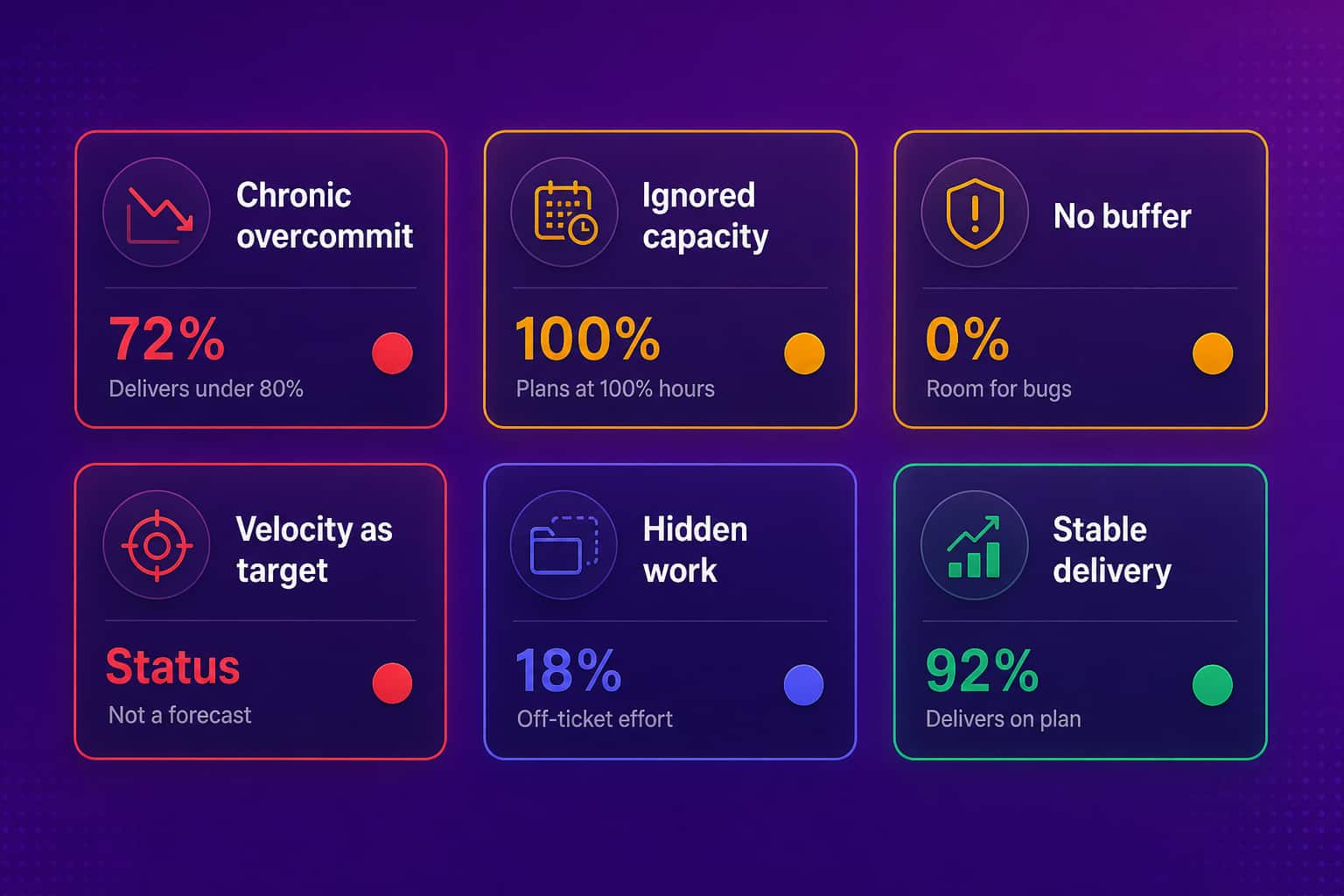
Most sprint planning misses because teams plan against theoretical hours and treat velocity as a target instead of a forecast. A five-person team looks like 400 hours over a two-week sprint, so planning fills 400 hours of work. In practice, after standups, planning, one-on-ones, code reviews, incident response, and the Slack questions that never become tickets, the hours available for new story-point work are closer to 160. Committing to the theoretical number guarantees a miss, and the miss gets blamed on the team rather than the plan. Then the pattern repeats, trust erodes, and engineers quietly start working evenings to make the sprint look green. Sprint planning that ignores where the week actually goes is not planning. It is optimism with a calendar invite.
The second failure is using last sprint's velocity as a goal to beat. Velocity counts what was delivered, not how it was delivered. A team that shipped 30 points last sprint by skipping reviews and working a weekend does not have a 30-point baseline. It has a warning. Velocity is useful as a range with variance, not a high score.
The third failure is invisible work. Engineers close three Jira tickets and also fix five unreported bugs, review fifteen pull requests, answer forty questions, and get pulled into an incident. Jira shows three items. The other work was real, it consumed capacity, and none of it was in the plan. LLMs are good at making you feel confident about a shaky estimate. The cure is not a better gut. It is data on where the hours went last time.
How to run a sprint planning meeting that holds up
Run sprint planning as a short, structured meeting with the backlog refined beforehand, capacity calculated up front, and a single sprint goal everyone agrees on. The meeting should feel like confirming a forecast, not building a plan from scratch. Before the session, the product owner orders the backlog and the team refines the top items so they are small, clear, and estimated. In the room, the team confirms available capacity for the sprint, agrees on a goal, pulls in the highest-priority work that fits, and breaks the first items into tasks. Anything that does not fit stays in the backlog, visible and prioritized, so nobody pretends it will happen. A tight agenda keeps a four-hour meeting from sprawling into a full day.
A practical agenda for a two-week sprint:
- Confirm capacity (15 min). Start with real available hours: subtract PTO, holidays, known meeting load, and a buffer for unplanned work. This number caps the commitment.
- Set the sprint goal (15 min). One sentence the team can rally behind. If you cannot state it, the sprint lacks focus.
- Pull and estimate work (90 min). Walk the prioritized backlog top-down. Estimate with the team, usually in story points via planning poker, and stop pulling when capacity is full.
- Break down the first items (45 min). Decompose the top stories into tasks so day one starts clean.
- Confirm and commit (15 min). Read back the sprint backlog, check it against capacity, and name any risks or dependencies.
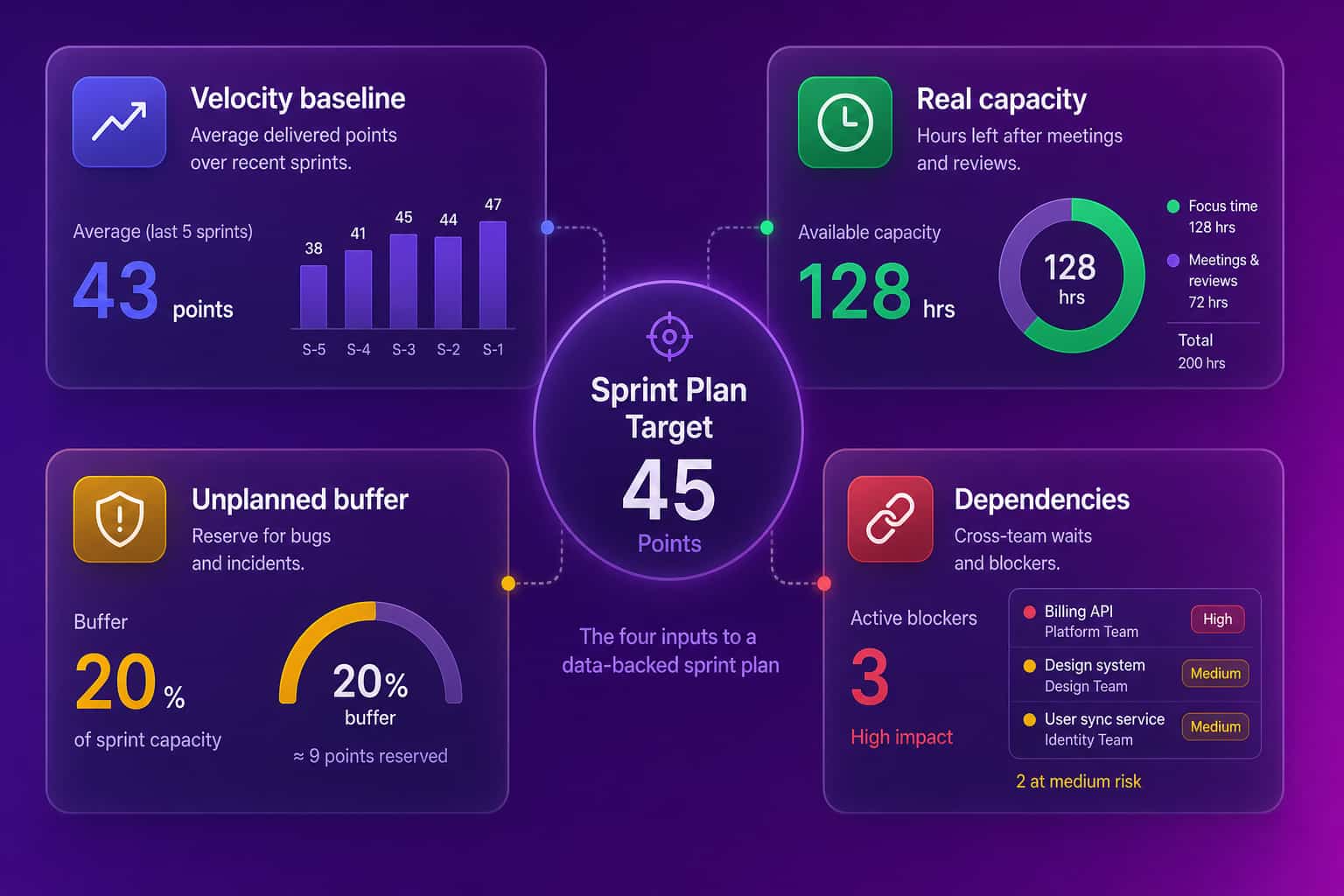
| Input | Question it answers | Where the number comes from |
|---|---|---|
| Velocity baseline | How much does this team usually deliver? | Average delivered points over the last 6 to 8 sprints |
| Real capacity | How many hours are actually free? | Total hours minus meetings, reviews, PTO, and buffer |
| Unplanned buffer | How much reactive work is normal? | Historical share of time on bugs and incidents |
| Dependencies | What could block us? | Cross-team waits, reviews, and external approvals |
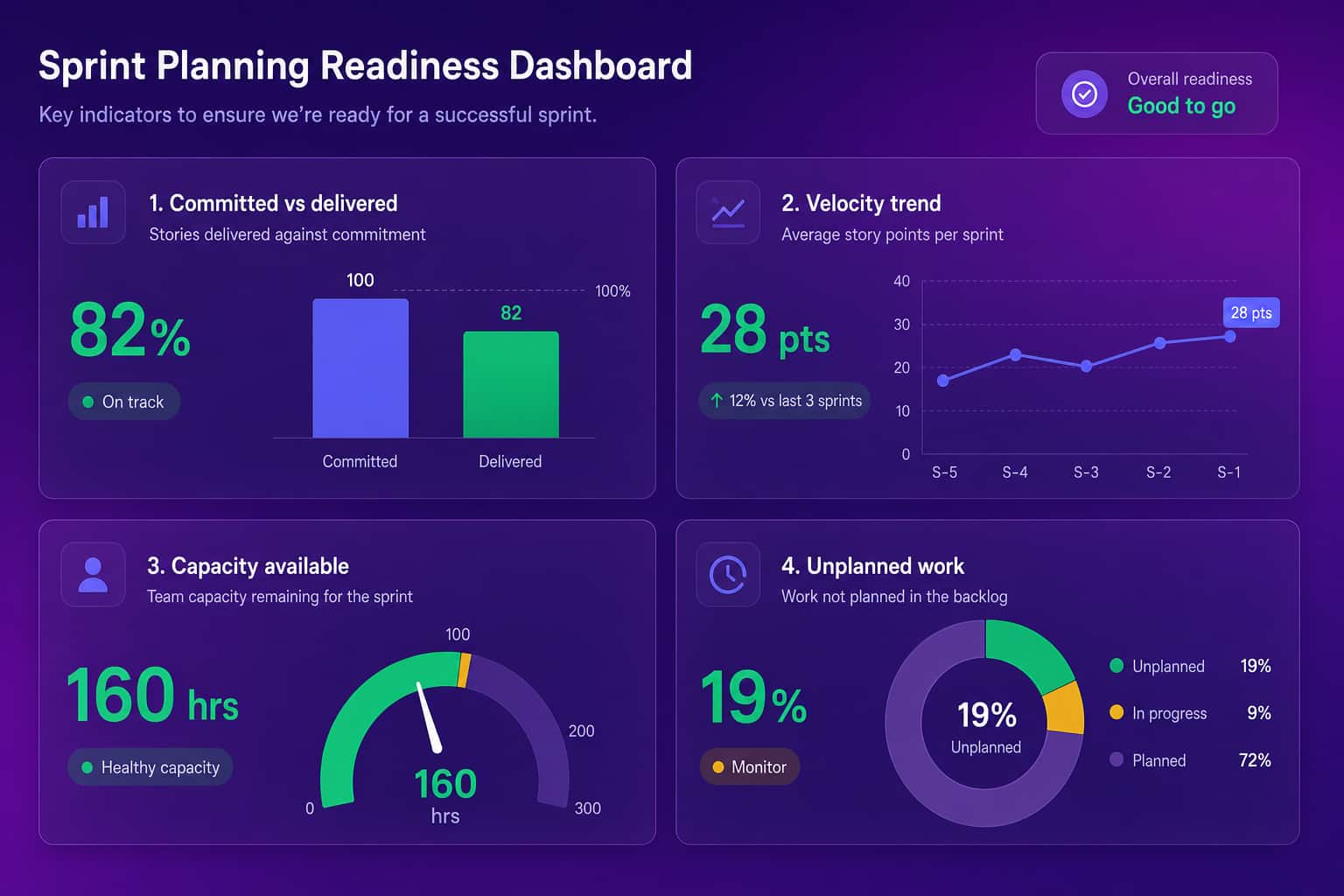
Estimation deserves one caution. Story points are a shared forecast, not a stopwatch. The value is the conversation that surfaces hidden complexity, not the number itself. Track how committed points compare to delivered points over several sprints, and let that variance set the next commitment. For a deeper look at what velocity does and does not tell you, see what team velocity measures and what it hides.
Ground the plan in real capacity, not gut feel
The single biggest upgrade to sprint planning is replacing assumed hours with real capacity. Real capacity is what remains after every competing demand on engineering time: meetings, code reviews, incident response, documentation, context switching, and the interruptions that fragment a day. For most teams that is 50 to 60 percent of theoretical hours, which means a team that looks like 400 hours has closer to 160 to 200 for new story-point work. Planning to the lower, honest number feels like committing to less. It actually means delivering more of what you commit to, because the plan finally matches the week. Capacity waste that nobody plans around adds up: unaccounted meeting load, review bottlenecks, and hidden rework are how organizations quietly lose $500K to $2M a year in engineering capacity.
Two adjustments matter most. First, reserve 15 to 20 percent of capacity for unplanned work, calculated from your own history rather than a guess. Review the last eight to ten sprints, measure the average time on urgent bugs, incidents, and mid-sprint requests, and hold that much back. Second, adjust for who is actually available. A junior engineer in week one delivers a fraction of a senior's output, PTO subtracts hours directly, and two seniors on architecture are not two seniors on features. The deep dive on right-sizing sprint capacity without overcommitting walks through the full calculation. Meeting overload is the quietest drain of all, and reducing context switching across the team recovers hours that never show up in a story point.
How workforce intelligence sharpens sprint planning
Workforce intelligence closes the gap between the plan and reality by showing where engineering time actually goes. Traditional planning sees story points in Jira, commits in GitHub, and notes from the last retro. Roughly 30 to 40 percent of the work stays invisible in those tools alone: off-ticket bug fixes, ad-hoc support, documentation, review load, and cross-team dependency waits. Abloomify is a privacy-first workforce intelligence platform that connects to Jira, GitHub, Google Workspace, and calendars to surface those patterns, so planning starts from what the team can really do. Instead of arguing about whether 40 points is realistic, leaders can look at delivered velocity, meeting density, and unplanned-work share from the last quarter and set a commitment the data supports.
The signal comes from combining sources. Abloomify's Jira integration tracks sprint completion, velocity trends, and story-point distribution, while the GitHub integration tracks commits, pull requests, and review load. Put together, they show the gap between planned Jira work and actual GitHub activity, plus the meeting and collaboration overhead that eats the rest. Bloomy, the platform's AI analyst, answers questions in plain language: "What is our realistic capacity next sprint given current meeting load and recent velocity?" or "Which engineers are overloaded with reviews right now?" It can also run on a schedule and email a Monday planning brief before the meeting, so the team walks in with the numbers instead of assembling them by hand.
The architecture is the part engineers accept. Abloomify uses PII-free signals and aggregated metrics: no screenshots, no keyloggers, no screen recording, no reading of code content. A 50-person SaaS customer validated Abloomify's engineering data against their own manual spreadsheet analysis, and the app-hours matched, which is what turned the data into something the team planned against. When measurement is fair, people trust the capacity number, and planning stops being a negotiation.
Metrics that tell you the sprint plan was right
You know a sprint plan was right when the team delivers what it committed to, sprint after sprint, without overtime. A handful of leading indicators tell you whether commitments match capacity before misses become a habit. Sprint completion rate is the anchor: healthy teams finish 85 to 95 percent of committed points. Consistently below 80 percent signals over-commitment, and 100 percent every single time can mean the team is sandbagging or quietly working late. Velocity variance measures predictability, since a low standard deviation across the last eight to ten sprints means capacity is stable enough to plan on. Unplanned-work percentage shows whether your buffer is right, and a rising trend means you either increase the reserve or fix the root cause. Watching these together turns planning into a feedback loop instead of a recurring argument.
Two more metrics catch problems that completion rate alone misses. Pull request cycle time and review wait time reveal review bottlenecks that shrink effective capacity even when headcount is flat: if cycle time climbs from two days to four across three sprints, review is silently stealing capacity. Meeting hours per engineer tracks the overhead that fragments deep work, and past ten to twelve hours a week, output drops fast. These are the same signals that show up in a healthy delivery system, and the DORA metrics guide covers how they connect to overall performance. For teams that want to measure velocity without turning it into a stick, measuring engineering velocity without morale loss is the companion read.
Big meetings bring ceremony. Good planning brings delivery. The difference is whether the plan is built on data or on hope.
FAQ
What is sprint planning?
Sprint planning is the meeting that starts a sprint, where the team decides what to build next and how much they can commit to. The product owner brings a prioritized backlog, the team pulls in what fits their capacity, and everyone agrees on a sprint goal. Done well, it is a forecast grounded in real velocity and available hours, not a wish list.
How long should sprint planning take?
A common timebox is about two hours per week of sprint, so roughly four hours for a two-week sprint. Shorter is fine when the backlog is well refined ahead of time. If planning routinely runs long, the problem is usually unrefined backlog items or estimates the team does not trust, not the meeting itself.
What is the 3-5-3 rule in Scrum?
The 3-5-3 structure is a shorthand for the Scrum framework: 3 roles (product owner, scrum master, developers), 5 events (the sprint plus sprint planning, daily scrum, sprint review, and retrospective), and 3 artifacts (product backlog, sprint backlog, and the increment). Sprint planning is the event that turns the product backlog into a sprint backlog.
What is the difference between sprint planning and sprint capacity?
Sprint planning is the meeting where a team commits to a sprint goal and pulls work into the sprint backlog. Sprint capacity is one input to that meeting: the hours realistically available after meetings, reviews, and unplanned work. Good planning uses capacity to decide how much to commit, so the plan matches what the team can actually deliver.
How do you estimate work in sprint planning?
Most teams estimate in story points using relative sizing, often with planning poker, then use recent velocity to decide how many points fit the sprint. The point of estimation is a shared forecast, not a precise time prediction. Track how committed points compare to delivered points over several sprints and let that variance, not optimism, set the next commitment.
Why do teams over-commit in sprint planning?
Teams over-commit because they plan against theoretical hours instead of real capacity, treat last sprint velocity as a target rather than a forecast, and ignore the meetings, reviews, and unplanned work that consume 40 to 50 percent of the week. The fix is planning with data on where time actually goes, not planning harder.

Amir Tavafi
Co-Founder & CEO
Product leader and innovator with over 15 years of experience in the tech sector, grounded in AI and robotics. Previously led product development in fraud detection and AI solutions at Nasdaq Verafin.