Technical Debt: What It Costs and Where to Find It (2026)
June 19, 2026
Amir Tavafi
9 min read

Technical debt is the gap between the code you have and the code the business now needs. Most teams log it in a backlog nobody grooms, then wonder why velocity quietly erodes. At Abloomify we see the same pattern across engineering data: debt is invisible on a board and obvious in the delivery signals. Slipping PR cycle time. Rising rework. Review pileups. This is what technical debt actually costs, and where to find it before it finds you.
Key Takeaways
Q: What is technical debt?
A: Technical debt is the future cost of shortcuts, aging code, and design decisions that no longer fit. Like financial debt, it carries interest: every change gets slower and riskier until you pay down the principal. It is normal, and only dangerous when it stays invisible.
Q: How do you know if technical debt is hurting you?
A: Watch delivery signals, not the debt backlog. Rising PR cycle time, growing code churn and rework, review pileups, and a climbing change-failure rate are how debt surfaces. Abloomify reads these from GitHub, GitLab, and Jira without touching code content.
Q: Can you measure technical debt directly?
A: Not cleanly. There is no single debt number. You measure its symptoms: cycle time, rework, review latency, and DORA metrics like change-failure rate. Abloomify's Engineering Velocity Score tracks these trends so debt becomes a line on a chart instead of a gut feeling.
Q: How do you pay it down without stalling features?
A: Budget a fixed slice of every sprint for debt, target the files with the highest churn and longest review times, and verify the payoff in the same metrics. Treat it as continuous maintenance, not a one-time debt sprint that never gets scheduled.
What is technical debt?
Technical debt is the future work you take on when you ship code that is easier to write now but harder to live with later. Ward Cunningham coined the metaphor in 1992, and the financial framing still holds up: you borrow speed today and pay interest on every future change until you refactor. That interest is real. It looks like a one-line feature that takes three days because the surrounding code is tangled, a release that slips because one risky module breaks in unexpected ways, and an onboarding ramp that stretches because nobody understands the original design. Some debt is a deliberate, smart trade to learn faster. The problem is the debt you never named, never tracked, and never scheduled to repay.
For a deeper map of what to track alongside it, see our engineering velocity metrics guide.
The main types of technical debt
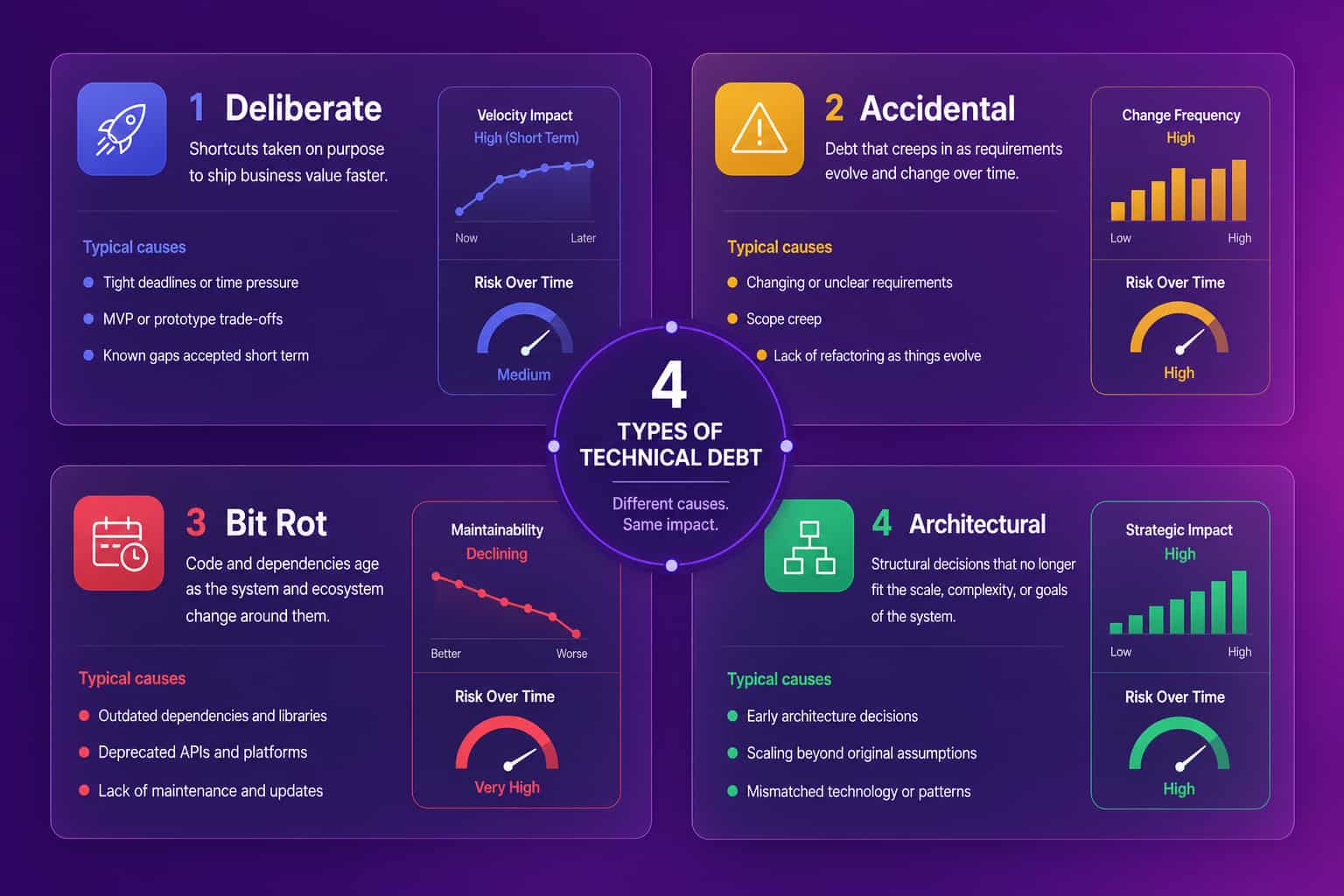
Most technical debt falls into four buckets, and naming the type tells you how worried to be. Deliberate debt is a conscious shortcut taken to ship and learn, the kind a good team takes on purpose and pays back fast. Accidental debt accumulates as requirements evolve and yesterday's reasonable design no longer fits today's product. Bit rot is the slow decay that happens as dependencies, platforms, and teammates change around code that nobody touched. Architectural debt is the heaviest: structural decisions, like a monolith that should have been split or a data model that outgrew its assumptions, that now tax every team downstream. The first two are usually cheap to manage if you catch them early. The last two compound.
Concrete examples of technical debt:
- A "temporary" auth workaround that three services now depend on
- Copy-pasted logic that has drifted into five slightly different versions
- A test suite so flaky that engineers stopped trusting it
- A library two major versions behind, blocking a security patch
- A hot file that every feature has to edit, so every change risks a conflict
Why technical debt stays invisible in your backlog
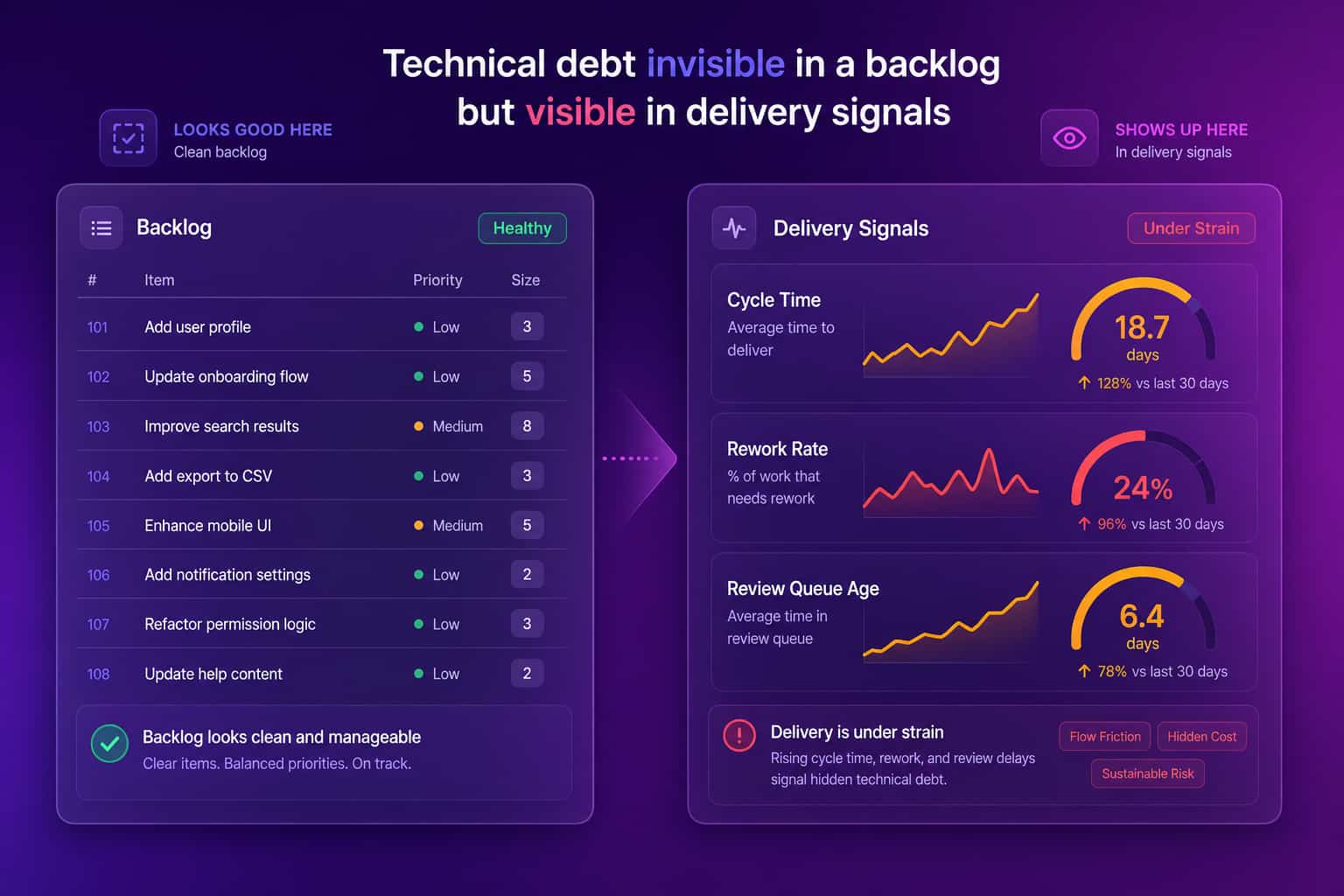
The debt backlog is where good intentions go to die. Teams create a "tech debt" label, file a few tickets, and then watch them sink under feature work that always looks more urgent. The backlog tells you what someone remembered to write down, which is a tiny and biased sample of the real debt. Worse, it measures nothing. A column of stale tickets cannot tell you whether debt is growing or shrinking, which parts of the codebase are bleeding the most time, or whether last quarter's refactor actually helped. So leaders fall back on vibes: an engineer says the code is "a mess," a manager nods, and nothing changes because there is no number to defend a maintenance budget with.
Where technical debt actually shows up: the delivery signals
The honest way to see technical debt is to stop hunting for a debt metric and start reading the delivery signals it leaves behind. Abloomify connects to GitHub, GitLab, Bitbucket, Jira, and Linear and trends the patterns that debt produces, without reading a line of your code content. When cycle time on a service creeps up quarter over quarter, when code churn spikes because the same lines get rewritten again and again, when reviews pile up on the one engineer who understands a fragile module, that is debt charging interest in plain sight. AI coding tools make this sharper: Cursor, Copilot, and Claude Code can generate far more code, which means more to review and more places for debt to hide if you are not watching output quality alongside volume.
Here is how common signals map to the debt underneath them:
| Delivery signal | What a rising value often means |
|---|---|
| PR cycle time | Changes are getting harder to make and verify |
| Code churn / rework | The same code is being rewritten, design is unstable |
| Review latency | Knowledge is concentrated, fragile areas slow everyone |
| Change-failure rate | Fragility is leaking into production |
| Workload skew | One person owns the risky module everyone depends on |
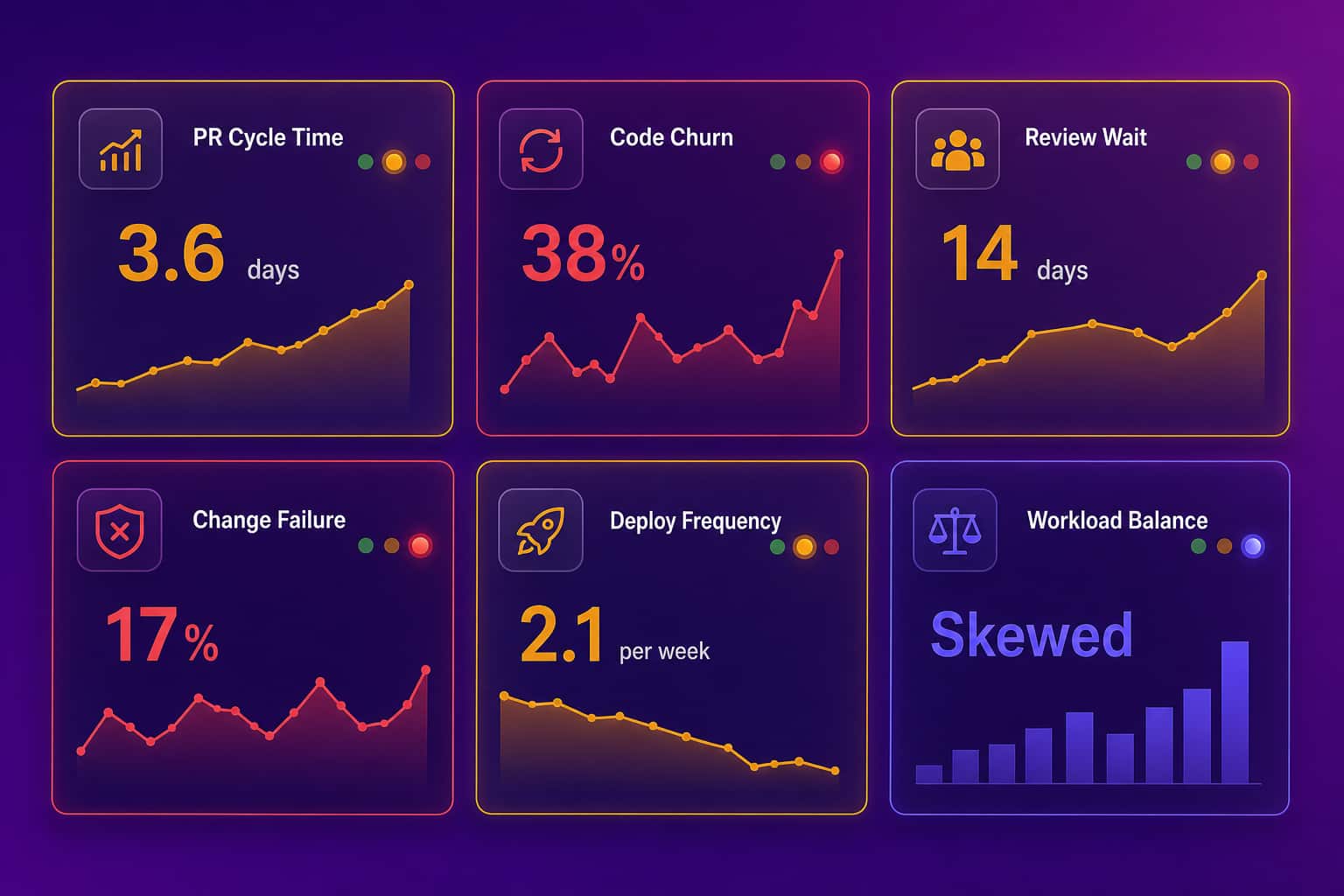
Two of these deserve their own read. Code churn is one of the earliest tells that a design has not settled, and review cycle time shows where knowledge bottlenecks are quietly taxing the whole team. If you already track DORA metrics, change-failure rate and lead time are your debt thermometer.
How to manage technical debt without stalling delivery
You manage technical debt the way you manage any recurring cost: budget for it, target the worst of it, and verify the payoff. A "debt sprint" that you schedule once a year and cancel under deadline pressure is theater. Continuous, protected maintenance is what actually moves the numbers. The teams that stay fast are not the ones with zero debt, they are the ones who keep the interest payments small and never let any single module become the thing everyone is afraid to touch.
A practical loop that works:
- Reserve capacity. Protect a fixed slice of every sprint, often 15 to 20 percent, for maintenance and debt paydown. Make it recurring and non-negotiable.
- Target by data, not opinion. Rank candidates by churn, review latency, and change-failure rate. Pay down the files that are costing the most delivery time first, not the ones that annoy the loudest engineer.
- Right-size the change. Prefer small, verifiable refactors tied to features you are already shipping over a heroic rewrite that risks the quarter.
- Verify the payoff. After the work, check the same signals. Did cycle time drop on that service? Did churn settle? If the numbers did not move, you targeted the wrong debt.
- Watch the trend, not the ticket count. Track whether debt's interest is rising or falling across the codebase, so you can defend the maintenance budget with evidence.
This is the loop Abloomify is built to close. Our engineering productivity analytics turn PR cycle time, review health, churn, and workload balance into trends a VP of Engineering can act on, and a board can understand. Slow is expensive. Invisible slow is worse.
FAQ
What is technical debt in software development?
Technical debt in software development is the implied future cost of choosing a faster or easier solution now over a more robust one. It accumulates from shortcuts, evolving requirements, and aging dependencies, and it charges interest as every later change to that code becomes slower, riskier, or more expensive to make.
What are examples of technical debt?
Common examples include a temporary workaround that becomes load-bearing, duplicated logic that has drifted into several versions, a flaky test suite engineers no longer trust, a dependency stuck several versions behind a needed security patch, and a single hot file that every feature must edit. Each one quietly raises the cost of the next change.
How is technical debt handled in agile?
In agile teams, technical debt is best handled as continuous maintenance rather than a separate phase. Reserve a fixed share of each sprint for paydown, rank work by delivery data like churn and review latency, keep refactors small and tied to features, and verify the result in the same metrics so debt stays visible on every board.
Can Abloomify measure technical debt?
Abloomify does not assign a single debt score or read your source code. It measures the delivery signals debt produces, including PR cycle time, code churn, review latency, change-failure rate, and workload balance, pulled from GitHub, GitLab, Jira, and Linear. That turns debt from a hunch into a trend you can act on.

Amir Tavafi
Co-Founder & CEO
Product leader and innovator with over 15 years of experience in the tech sector, grounded in AI and robotics. Previously led product development in fraud detection and AI solutions at Nasdaq Verafin.