Story Points: What They Measure, and Why Output Metrics Fall Short
October 12, 2026
Amir Tavafi
10 min read

Story points are a team's shorthand for how big a piece of work is compared to other work. Not hours, not days. They are useful for planning one sprint with one team, and they break the moment someone uses them to compare teams or judge people. Abloomify's engineering productivity analytics read PR cycle time and sprint completion from GitHub and Jira, so the numbers sit next to your points.
Key Takeaways
Q: What is a story point in agile?
A: A story point is a relative estimate of how much effort, complexity, and uncertainty a user story carries. Teams compare each story to ones they have already done. A 5 is roughly bigger than a 3 and smaller than an 8, with no fixed link to hours.
Q: How do you convert story points to hours?
A: Only per team, and only roughly. Divide the hours actually worked on finished stories by the points finished over several sprints. That gives a rough hours-per-point for that team. It changes as the team and codebase change, so use it as a sanity check.
Q: Why do story points fail as a performance metric?
A: Because the team that gets measured also sets the numbers. Estimates inflate, velocity climbs, and nothing ships faster. Points describe plans. PR cycle time, review speed, and completed work describe delivery, and Abloomify reads those from GitHub and Jira.
Q: What should I track alongside story points?
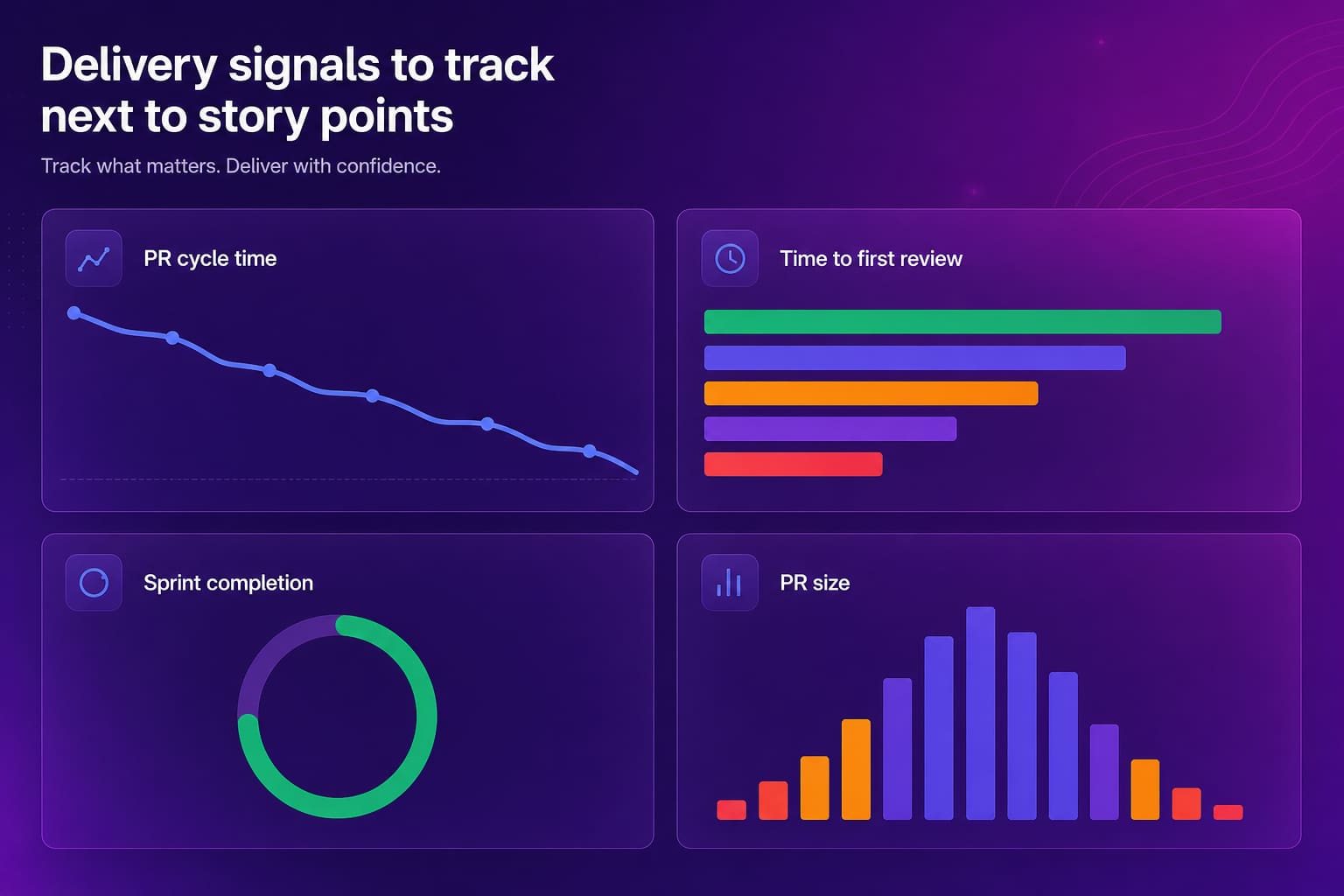
A: Start with PR cycle time, time to first review, PR size, and sprint completion. These come from real activity in your repos and ticket system, so nobody has to estimate them, and nobody can quietly inflate them.
What are story points in agile?
Story points are a relative unit of estimation. Instead of guessing that a task will take eleven hours, the team asks whether it is bigger or smaller than a task they already finished, and then assigns a number from an agreed scale. The number folds in three things at once: how much work there is, how complicated it is, and how much the team does not yet know. A small login-button fix with no unknowns might be a 1. A change that touches payments, a third-party API, and an unfamiliar service might be an 8 or a 13. The point of the exercise is the conversation that produces the number, because disagreement between a 3 and a 13 usually means someone found a hidden risk.
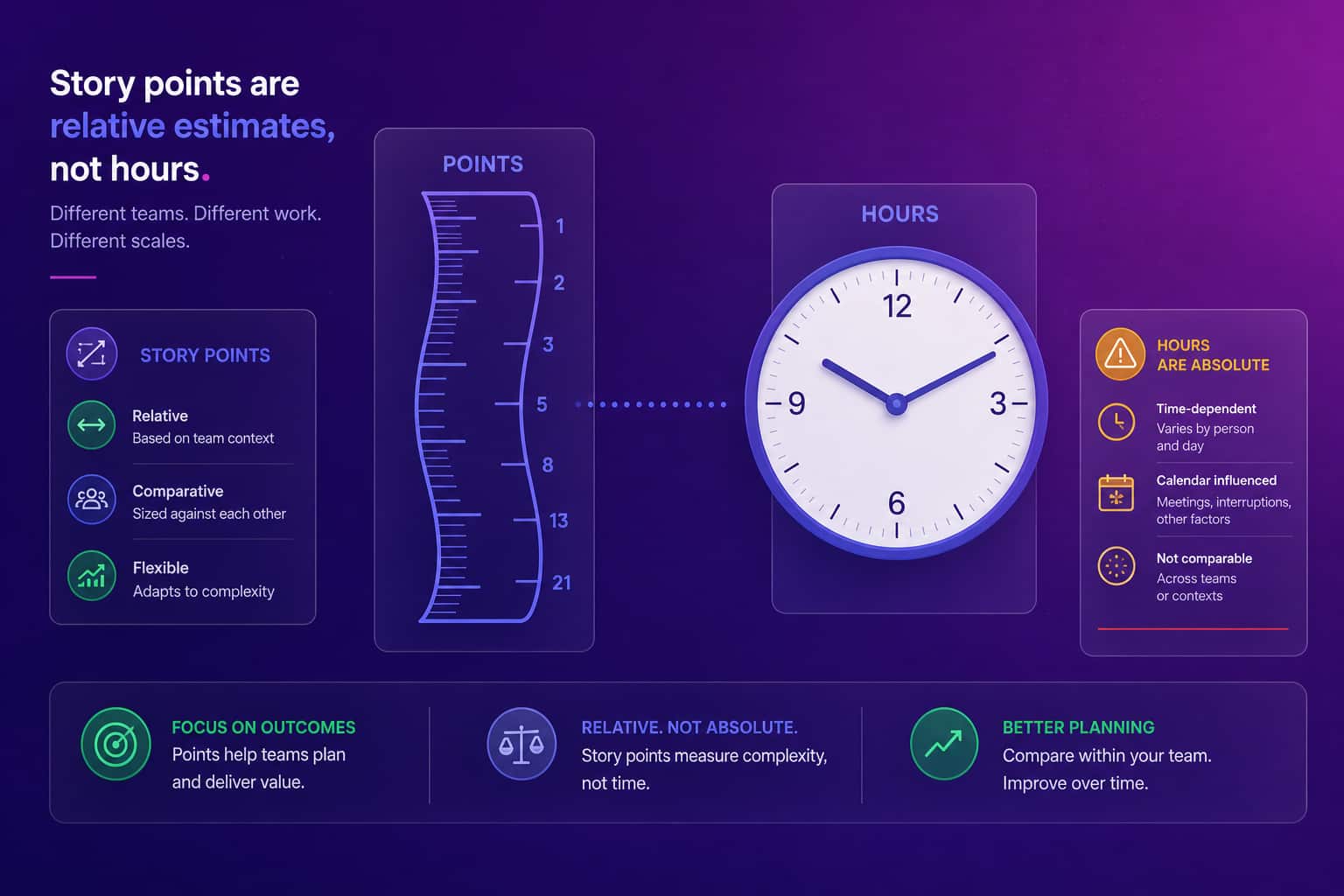
Teams that adopt points usually do it for one reason. Hour estimates are almost always wrong, and they are wrong in a way that feels like a personal failure, so engineers pad them and managers distrust them. Points let a team skip that argument. The tradeoff is that points only mean something inside the team that set them.
How do story points work, and what is the Fibonacci scale?
Most teams estimate with a modified Fibonacci scale: 1, 2, 3, 5, 8, 13, and sometimes 21. The gaps widen on purpose. The bigger a story is, the less you really know about it, so the scale refuses to let you pretend the difference between a 20 and a 21 exists. Teams usually run this through planning poker, where everyone reveals a number at the same time so the loudest voice does not anchor the room. If the numbers differ a lot, the high and low estimators explain their reasoning, and the team votes again. Anything at 13 or above usually gets split before it enters a sprint.
| Points | Rough meaning | Typical example |
|---|---|---|
| 1 | Trivial, no unknowns | Copy change, config flag |
| 2 | Small and well understood | Add a field to an existing form |
| 3 | Moderate, one clear path | New endpoint on a familiar service |
| 5 | Real work, some unknowns | Feature touching two components |
| 8 | Large, meaningful risk | Integration with a new third-party API |
| 13 | Too big, split it | Anything where the team cannot explain the steps |
Treat the table as a starting point, since no standard exists. Your team's 5 will not be my team's 5, and that is exactly how the system is supposed to work. If you want a deeper walk through how estimation feeds a sprint, our guide on sprint planning covers the mechanics.
How do you convert story points to hours?
You can convert story points to hours for one team, after the fact, and only roughly. Pull the last four to six sprints. For each one, take the total hours the team actually worked on stories that were completed, and divide by the points on those stories. Say a team logs 400 hours across completed stories worth 50 points in a sprint. That gives about 8 hours per point for that team, in that period. Use that number to sanity check a plan, for example when a sprint is loaded with points that would need far more hours than the team has. Do not publish it as a conversion rate. The ratio drifts when people join or leave, when the codebase gets harder, and when a team starts estimating differently.
There is a second reason to be careful. The moment a points-to-hours rate is written down, someone will use it to decide who is "slow." Nothing in the original idea supports that use.
Where do story points go wrong?
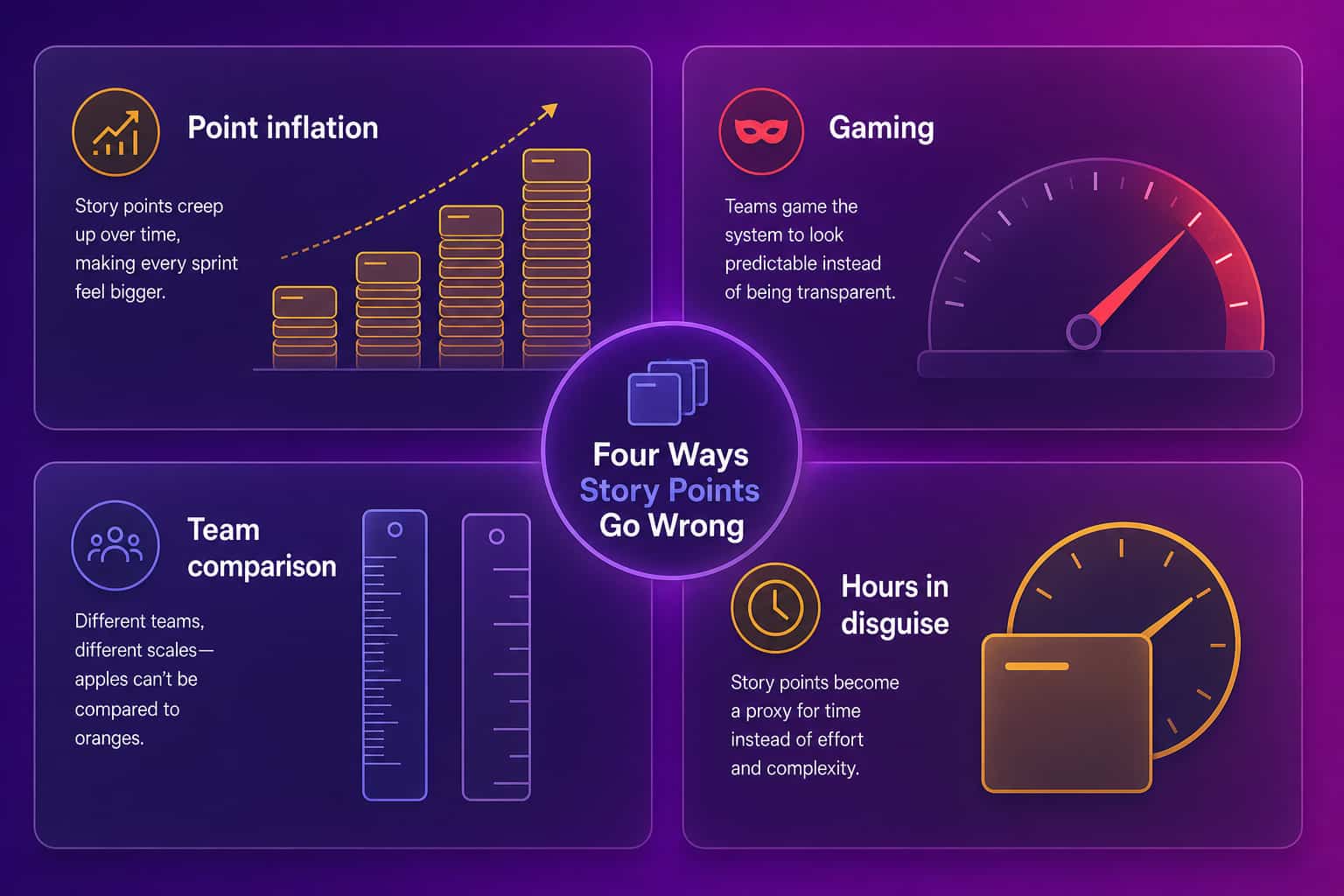
Story points go wrong when they leave the team that created them. Inside one team, a point is a planning aid. Outside it, a point is a number that someone can reward, compare, or punish, and people respond to that exactly as you would expect. Estimates creep upward, because a higher estimate makes next sprint's commitment safer. Teams start gaming completion so the burndown looks smooth. Leaders compare Team A's velocity to Team B's even though the two scales have nothing in common. And the whole thing quietly turns into hours again when a manager asks "how long is a 5?" I think this is the most common failure, and it is almost never malicious. It is people responding sensibly to an incentive.
For a closer look at the velocity side of this, our piece on team velocity explains what the number hides and what a team can read from it honestly. The short version: velocity is a forecast for one team's next sprint, and it was never an output score.
What should you track instead of story points?
Track what comes out of your repos and your ticket system, because nobody estimates it and nobody can quietly inflate it. Start with PR cycle time (opened to merged), time to first review, PR size, and sprint completion (stories done against stories committed). Then add the four DORA metrics once you want an outside-in view of delivery. Each one is measurable directly from GitHub and Jira activity. None of them needs engineers to enter anything, and none requires reading code or messages. That matters, because the answer to point inflation is not a stricter estimating process. It is measuring delivery from signals the team cannot game without actually shipping.
Abloomify connects to GitHub and Jira through API integrations and reports PR cycle time, review health, PR size, and DORA metrics, with the bands Elite, High, Medium, and Low on the DORA side. It is privacy-first by architecture: PII-free signals only, no code content, no screenshots, no keyloggers. If you are weighing which clock to read first, cycle time vs lead time explains where each starts, and what are DORA metrics covers the four numbers.
How do you use story points without hurting your team?
Keep points inside the team and keep them out of anyone's review. Use them for sprint planning and nothing else. Do not roll them up to a department dashboard, do not put them in a performance conversation, and do not compare velocity across teams. Re-baseline when the team changes. If the team asks to stop estimating altogether, take that seriously, since many strong teams just split work into similar-sized stories and count them. Pair the estimate with something that cannot be inflated. Small PRs reviewed fast are a better sign of a healthy team than any velocity chart, and our guide to right-sizing diffs and work in progress shows how to get there.
A good test is simple. Ask whether anyone on the team would behave differently if the points were shown to the CEO. If yes, the points are already doing damage.
FAQ
What exactly is a story point?
A story point is a unit teams use to estimate how big a piece of work is relative to other work. It blends effort, complexity, and uncertainty into one number. A 5 is bigger than a 3 and smaller than an 8. It does not map to a fixed number of hours.
Does 1 story point mean 1 day?
No. A story point has no fixed duration, and that is the whole idea. Two teams can both call a task a 3 and finish it in different amounts of time. If you force 1 point to equal 1 day, you have rebuilt hour estimates with a different label.
How do you convert story points to hours?
You can only do it for one team, after the fact. Take several sprints, divide the hours actually worked on completed stories by the points completed, and you get a rough hours-per-point for that team. It drifts over time, so treat it as a sanity check and never as a promise.
Why do teams use the Fibonacci sequence for story points?
Because the gaps get wider as work gets bigger. Estimating a 20 versus a 21 is false precision, while 13 versus 21 is a real argument worth having. The wider gaps push the team to split large stories instead of debating small differences.
Should story points be used to measure developer performance?
No. Points are a planning tool for one team. Once they feed a performance review or a cross-team comparison, people inflate estimates and the numbers stop meaning anything. Measure delivery with PR cycle time, review speed, and completed work instead.

Amir Tavafi
Co-Founder & CEO
Product leader and innovator with over 15 years of experience in the tech sector, grounded in AI and robotics. Previously led product development in fraud detection and AI solutions at Nasdaq Verafin.