Sprint Retrospective: Run One Your Team Will Not Dread
October 19, 2026
Amir Tavafi
10 min read

A sprint retrospective is the one meeting where a team looks at how it worked instead of what it built, and it is also the meeting engineers are most likely to skip in their heads. I have sat in retros that produced a wall of sticky notes and zero changes. At Abloomify we use engineering productivity analytics to bring sprint data into the room, so the retro starts from facts.
Key Takeaways
Q: What is a sprint retrospective?
A: A sprint retrospective is a recurring meeting at the end of a sprint where the team reviews how it worked together, then commits to one or two specific changes for the next sprint. It is about process and teamwork, not about reviewing the product.
Q: Why do most retros fail?
A: Most retros collect complaints and never close the loop. The same three topics come back every sprint because no one owned a change. A retro that ends without an owner and a date is a vent session, however well facilitated.
Q: What should you bring to a retrospective?
A: Bring the sprint's own data: PR cycle time, time to first review, scope added mid-sprint, and carried-over items. Abloomify pulls these from GitHub and Jira, so the team argues about a number instead of a memory.
Q: How many actions should a retro produce?
A: One or two. Three is already too many, because teams that agree to five things do none of them. Pick the change with the highest cost to the team, name an owner, and check it at the start of the next retro.
What is a sprint retrospective?
A sprint retrospective is a team meeting held at the end of every sprint, after the sprint review and before the next sprint planning, where the team inspects its own way of working and agrees on improvements. The Scrum Guide describes it as a chance to look at individuals, interactions, processes, tools, and the team's definition of done, and it timeboxes the meeting at a maximum of three hours for a one-month sprint, with shorter sprints getting shorter meetings. The sprint review is about the product. The retro is about the people building it and the friction between them. That difference matters, because a retro that drifts into debating features is a second review, and the team never gets to the thing that is actually slowing it down. Attendees are the developers, the product owner, and the Scrum Master. Nobody else needs to be there.
Most teams already know the format and have run it for years. The problem is rarely that nobody knows what a sprint retrospective is. The problem is that it turns into a ritual with nothing at stake.
Why do most sprint retrospectives fail?
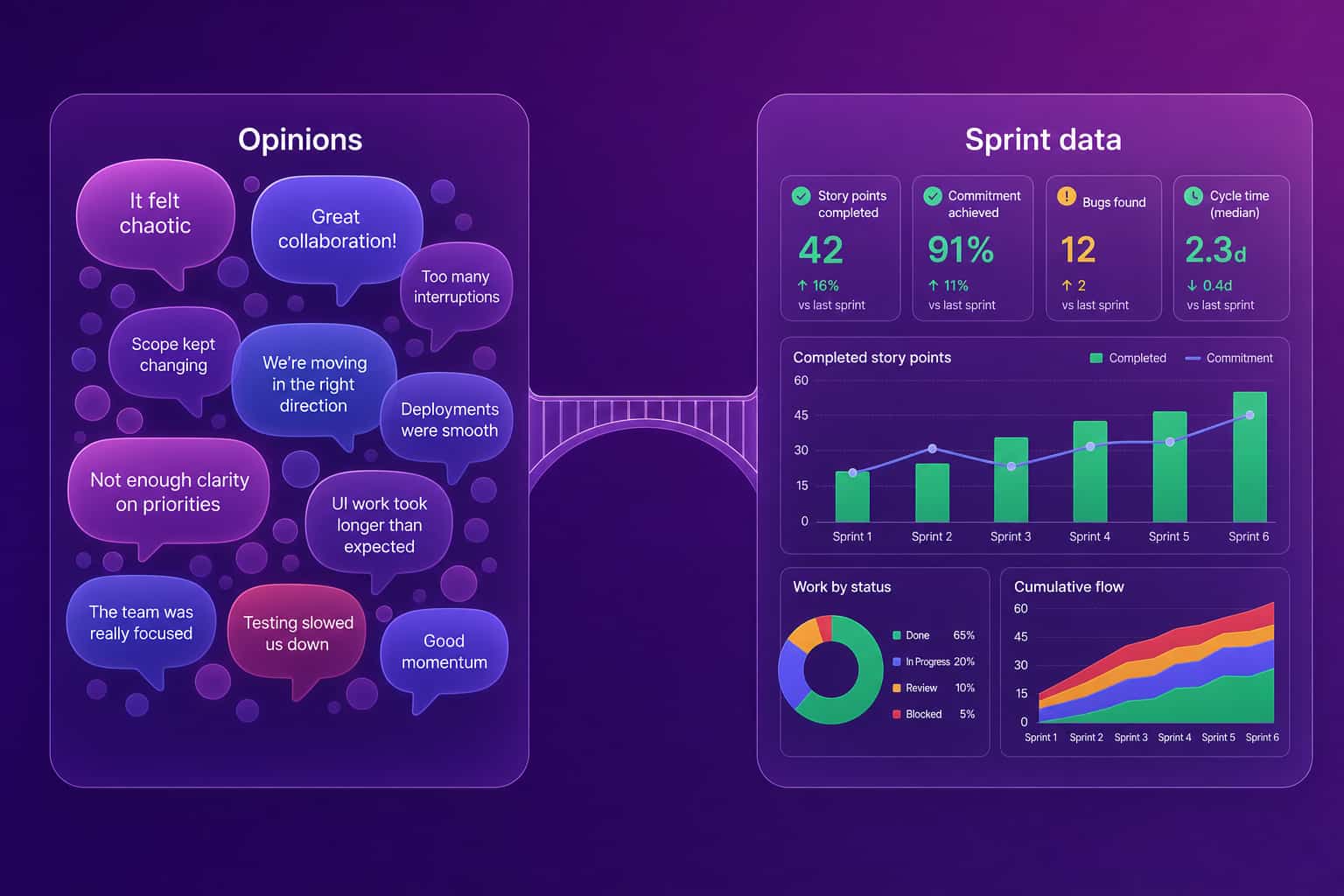
Most sprint retrospectives fail because they end without a change someone owns. The team spends 45 minutes surfacing real frustrations, such as slow reviews, unclear tickets, and surprise scope, and then everyone goes back to work. Two weeks later the same notes appear on the board with different handwriting. Over time people learn that the meeting changes nothing, so they stop saying anything true, and the retro becomes a polite status update. A second failure is that the loudest person sets the agenda, so the quiet engineer who is quietly overloaded never speaks. A third is that opinions go unchecked: someone says reviews are slow and half the room nods, but nobody knows whether reviews took one day or four. I used to think this was a facilitation problem. Now I think it is mostly an evidence problem.
If your team keeps repeating the same retro, the quick test is whether last sprint's action items were mentioned at the start of this one. If they were not, you have your answer.
What format should you use for a sprint retrospective?
Use the simplest format that gets honest answers, and for most teams that is three prompts: what slowed us down, what helped, and what do we change. Start, Stop, Continue works, and so do Mad, Sad, Glad and the 4Ls (Liked, Learned, Lacked, Longed for). Pick one and keep it for a few sprints, because the format matters much less than the follow-through. A 60-minute retro for a two-week sprint can run like this: five minutes to read last sprint's actions and check if they happened, ten minutes of silent writing so the quiet people get heard, fifteen minutes grouping the notes and voting, twenty minutes on the top one or two topics with the sprint data on screen, and the last ten minutes to write actions with owners and dates. Rotate who facilitates. When the same manager runs it every time, the meeting starts to feel like a performance review.
| Format | Prompts | Best for |
|---|---|---|
| Start, Stop, Continue | Three simple columns | New teams, quick retros |
| Mad, Sad, Glad | Emotional temperature | Teams after a rough sprint |
| 4Ls | Liked, Learned, Lacked, Longed for | Teams that want learning-focused retros |
| Timeline | Plot the sprint day by day | Sprints with a clear incident or scope change |
Do not change the format every sprint to keep things fresh. Novelty is a poor substitute for honesty.
What data should you bring to a sprint retrospective?
Bring four pieces of data: PR cycle time, time to first review, scope added or removed after the sprint started, and the number of items carried over. Each one answers a question the room will otherwise argue about from memory. PR cycle time shows whether work flowed or sat. Time to first review shows whether the review queue is the bottleneck. Scope change shows whether the plan held, and carryover shows whether the team commits to more than it finishes. A plain sprint summary with these four numbers, compared to the previous two sprints, takes about five minutes to read and usually changes the conversation from "I feel like reviews are slow" to a statement with a number in it, such as "reviews waited two days this sprint, up from one" (an example, not a benchmark). Keep the numbers at team level. If the retro starts naming individuals, people stop trusting it, and they will be right to.
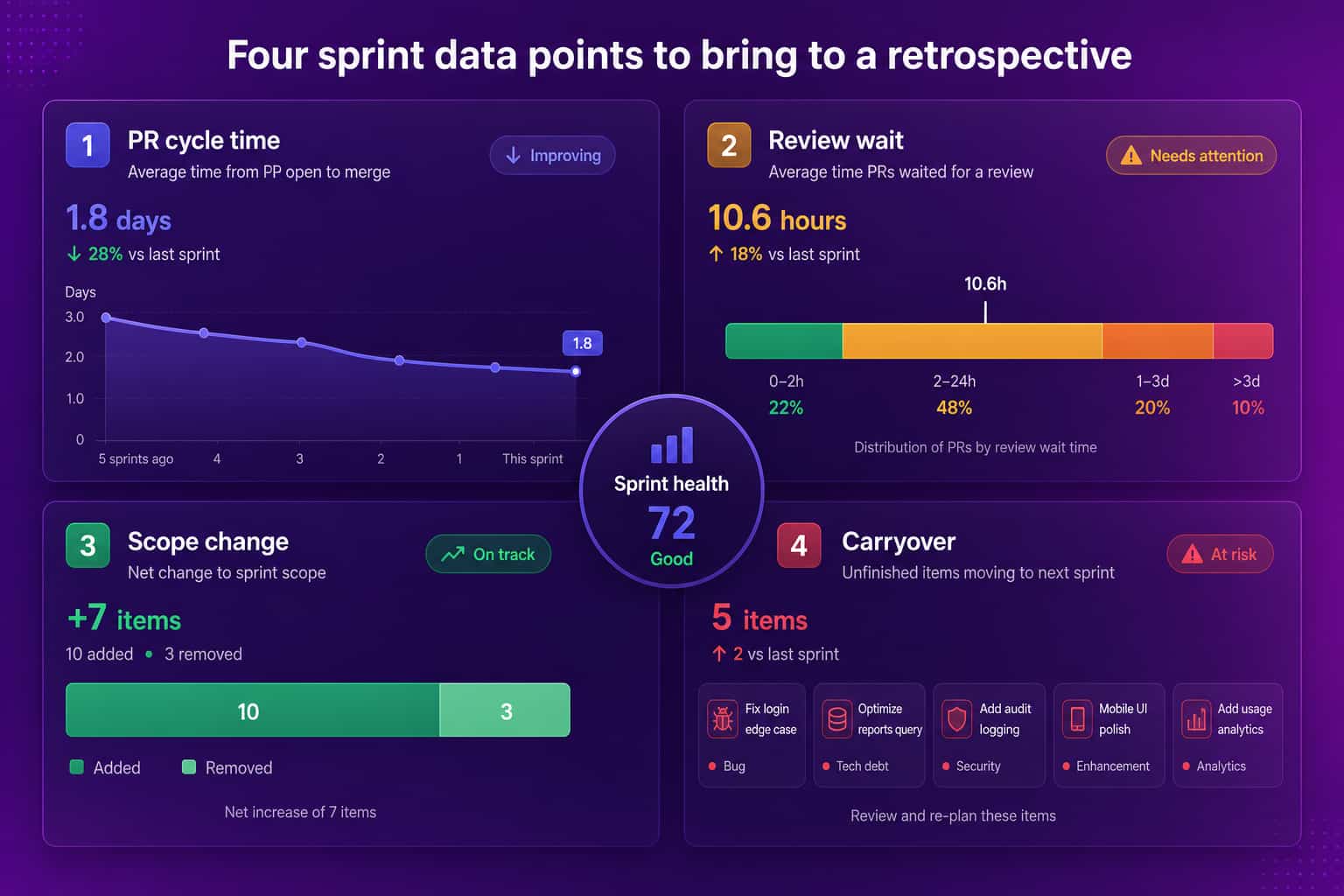
Abloomify connects to GitHub and Jira through API integrations and reports PR cycle time, time to first review, review health, PR size, and sprint delivery. It is privacy-first by architecture: PII-free signals only, with no code content, no screenshots, and no keyloggers. Bloomy, the AI Chief of Staff, can run on a schedule and email a report before the retro so nobody has to build the slide by hand. For the metric definitions behind these, see flow metrics and team velocity.
How do you turn a retrospective into real change?
Turn a retrospective into real change by limiting it to one or two actions, writing each as a small experiment with an owner and a date, and reviewing them at the start of the next retro. "Improve code review" is a wish. "Reviewers pick up any PR older than one day before starting new work, tried for one sprint, one named owner" is an experiment. Write down how you will know it worked, using a number from the data pack where you can. If the number moves, keep the change. If it does not, drop it without drama and try the next idea. Most good retro changes are small: a WIP cap on the review column, a rule that tickets need acceptance criteria before they enter a sprint, or a standing 15-minute review block. See WIP limits for the first, and sprint planning for the second.
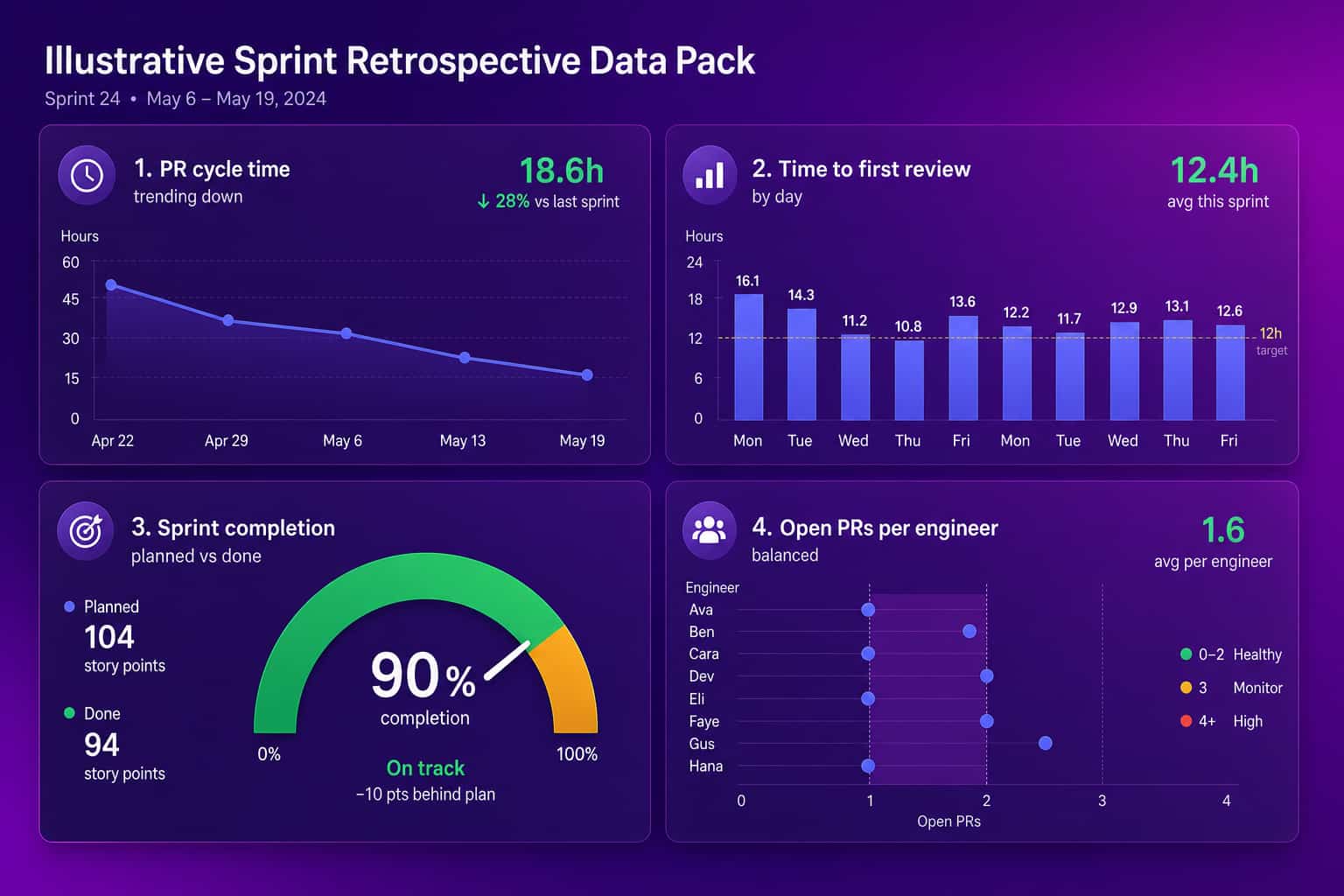
The values in the dashboard above are illustrative. The point is the habit: the same four views, every sprint, in the same order, so trends are visible. When the same item shows up in three retros in a row, treat it as a structural problem rather than a team failing. A single overloaded reviewer or a service only one person understands will not be fixed by another sticky note. If the retro keeps surfacing exhaustion, developer burnout is the next thing to read.
How do you handle a retrospective that goes silent?
Handle a silent retrospective by making it safer to speak and easier to start. Silence usually means one of three things: people do not trust that anything will change, someone senior is in the room, or the format rewards the loudest voice. Fix the first with visible follow-through on last sprint's actions. Fix the second by asking managers outside the team to skip it. Fix the third with silent writing before any discussion, and anonymous input if the team is new or the sprint was rough. A good facilitator can also name the silence out loud: "We had a hard sprint and nobody wants to say why. I'll go first." I have done that, and it works more often than a clever icebreaker.
I do not think every sprint needs a deep retro either. After a calm two weeks, a 20-minute check-in is fine. Keep the full format for sprints that had friction, and say so, so no one feels the meeting is padding.
Pick one change this sprint, give it an owner, and look at the numbers again in two weeks.
FAQ
What is a sprint retrospective?
A sprint retrospective is a meeting at the end of a sprint where the team looks at how it worked, not what it built, and picks one or two changes to try next sprint. In Scrum it comes after the sprint review and before the next sprint planning.
How long should a sprint retrospective be?
The Scrum Guide caps it at three hours for a one-month sprint and says it is usually shorter for shorter sprints. For a two-week sprint, 45 to 60 minutes is enough for most teams. If you regularly run out of time, you are probably trying to fix too many things.
Who should attend a sprint retrospective?
The whole Scrum team: developers, the product owner, and the Scrum Master. Managers outside the team should usually stay out, because their presence changes what people are willing to say. Invite a stakeholder only when the team asks for one.
What questions should you ask in a sprint retrospective?
Start with what slowed us down, what helped, and what we would change. Then bring one or two data questions, such as where pull requests waited longest and how much scope changed mid-sprint. End by asking who owns each change and how you will know it worked.
How do you stop retrospectives from repeating the same complaints?
Limit actions to one or two, give each an owner, and open the next retro by checking them. Back the discussion with sprint data such as PR cycle time and carryover so the topic is a measurable thing. Abloomify reads these signals from GitHub and Jira.

Amir Tavafi
Co-Founder & CEO
Product leader and innovator with over 15 years of experience in the tech sector, grounded in AI and robotics. Previously led product development in fraud detection and AI solutions at Nasdaq Verafin.