Developer Burnout: The Data Signals Managers Miss (2026)
September 7, 2026
Amir Tavafi
10 min read

Developer burnout rarely shows up as a missed deadline first. It shows up as a PR that used to get three thoughtful comments now getting none, a senior engineer merging their own code at 11pm because waiting for review feels like too much friction, and a sprint board that looks fine because the tickets still close. Abloomify reads PR cycle time, commit timing, and review health from GitHub and Jira to catch developer burnout in the pattern, not the resignation letter.
Key Takeaways
Q: What is developer burnout, exactly?
A: Developer burnout is chronic exhaustion from sustained overload that shows up in an engineer's work patterns before it shows up in their words. It is not a bad day or a hard sprint. It is weeks of PR cycle time drifting, after-hours commits climbing, and review engagement dropping while the ticket count still looks normal.
Q: Can you catch developer burnout before someone quits?
A: Yes, usually. Abloomify's engineering intelligence flags burnout risk 60 or more days early by reading PR flow, commit timing, and workload signals from GitHub and Jira as trends. A 50-person Canadian SaaS company we work with connected GitHub and Jira specifically to stop relying on a manager's gut feel for this.
Q: Do AI coding tools like Cursor and Copilot make burnout harder to see?
A: They can. Heavy AI-assisted output looks like productivity on a dashboard that only counts lines shipped or PRs merged. The fatigue sits underneath, in shrinking review comments and rising self-merge rates, which is exactly the layer a pure output metric never checks.
Q: Is monitoring software the way to detect developer burnout?
A: No. There is no evidence that monitoring improves performance (Personnel Psychology meta-analysis), and roughly 1 in 6 workers say they would quit over surveillance. Developer burnout is a workload and pattern problem, and it shows up in PII-free signals like PR cycle time and after-hours commits without a single screenshot.
What developer burnout looks like in the data, not the vibes
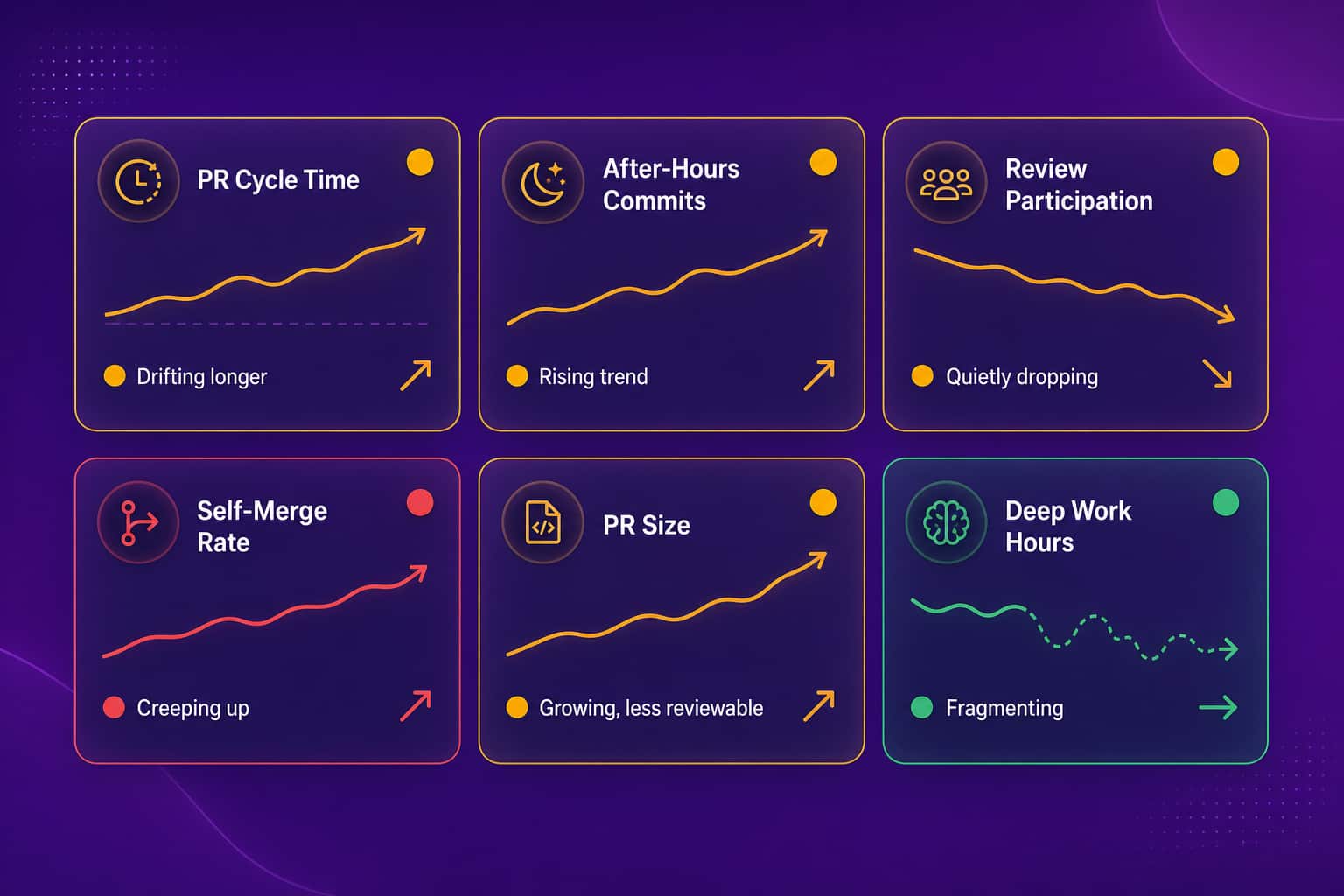
Developer burnout is a trend in work patterns, not a mood you can eyeball in a standup. The standard advice, more PTO, more swag, an occasional "no-meeting Friday," treats burnout like a morale problem you fix with a gesture. It is not. Burnout is chronic overload that changes how someone works, and those changes show up first in the artifacts engineering teams already generate: pull requests, commits, and reviews. A burned-out senior engineer does not usually announce it. They start merging their own PRs instead of waiting on a reviewer who is also swamped. They push code at midnight because that is the only quiet hour left in their day. They stop leaving comments on other people's PRs, not because they stopped caring, but because they no longer have the spare attention to give. None of these show up on a sprint burndown chart. All of them show up in GitHub.
Retros do not catch this either, because retros are self-report, and the person who is quietly drowning is the least likely to raise a hand in a room full of peers. By the time someone says "I'm burned out" out loud, the pattern has usually been running for a couple of months. The data was always there. Nobody was reading it as a system.
We covered the general version of this problem in quiet cracking: people who keep delivering while silently burning out. Developer burnout is that same pattern with an engineering-specific fingerprint, written in commits and pull requests instead of Slack replies and meeting cameras.
The engineering signals that flag burnout early
The signals that flag developer burnout early are the ones already sitting in your Git history and your task tracker, just never read together as one trend line. PR cycle time drifting longer is the first one, especially when it is not tied to harder tickets. After-hours and weekend commits creeping up week over week is the second, particularly from someone who used to keep clean boundaries. Review participation quietly dropping, both giving and receiving fewer substantive comments, is the third, and it is easy to miss because the PRs still get merged. A rising self-merge rate is the fourth: an engineer who stops waiting for review is often an engineer who has decided asking for help costs more than it is worth right now. Growing PR size that gets harder to review honestly is the fifth, since burnout kills the discipline to break work into small, reviewable chunks. None of these five is proof on its own. Together, sustained across four to six weeks, they are close to a diagnosis.
How AI coding tools complicate the picture
AI coding tools make developer burnout harder to see because they inflate the metric everyone still defaults to: raw output. Cursor, Copilot, and Claude Code let one tired engineer generate two engineers' worth of code, and a dashboard that only counts lines shipped or PRs merged reads that as a great week. The strain does not disappear. It moves to the layer AI tools do not touch: review quality, collaboration, and judgment. An engineer leaning hard on AI-assisted output while their review comments thin out and their self-merge rate climbs is not necessarily more productive. They may be substituting AI throughput for the human bandwidth to properly vet their own work, which is a burnout pattern wearing a productivity costume. This is the same reason we built AI-vs-human contribution tracking into Abloomify's engineering intelligence instead of a single velocity number: raw output was already an unreliable signal before AI tools, and it is worse now.
I have watched this play out with our own team. When we moved from Copilot and ChatGPT to Cursor, our product velocity jumped, and it would have been easy to just celebrate the number and stop looking. The number that actually mattered more was whether the people producing it were still doing their best work three months later, not just their fastest work that week.
Detecting developer burnout without turning into a surveillance shop
Detecting developer burnout does not require reading anyone's screen, code content, or private messages, and reaching for a monitoring tool to do it is the wrong instinct twice over. First, there is no evidence that monitoring improves performance (Personnel Psychology meta-analysis), so a screenshot tool bought to "catch burnout" mostly just catches resentment. Second, roughly 1 in 6 workers say they would quit over surveillance, which means the fix can create the exact attrition it was meant to prevent. Abloomify reads PII-free signals instead: PR cycle time, review participation, commit timing, and workload distribution pulled from GitHub, GitLab, and Jira through API integrations, plus an optional device agent that reports aggregated activity with no screenshots, keyloggers, or screen recording. This is the same posture behind our burnout detection software more broadly. The goal is never to catch anyone doing something wrong. It is to give an engineering manager an honest, early signal that a specific person's pattern has been unsustainable for weeks, while there is still time to do something about it.
Jellyfish and other engineering-analytics tools will show you DORA metrics and PR flow at the team level. Abloomify does that too, plus the full-org context: how engineering capacity connects to the rest of the business, and whether the AI tools a team pays for are actually helping or just producing more code to review. Full-org intelligence catches the pattern a tool that only watches one repo can miss.
What to do when the signals show up
The right response to a developer burnout pattern is a workload conversation, not a performance conversation, because the data is describing a capacity problem, not a character flaw. Start by confirming the trend is real: look at four to six weeks of PR cycle time, after-hours commits, and review participation for the person in question, not one bad sprint. If the pattern holds, look at what changed in their workload before you look at the person. Did a teammate leave and their tickets land on this engineer by default? Did they inherit an on-call rotation nobody rebalanced? A 50-person Canadian SaaS company we work with connected GitHub and Jira for exactly this: to replace a manager's spreadsheet guess about who was overloaded with an answer that updates itself. Have the conversation early, and frame it around the workload you are seeing, not an accusation about effort. Then check whether your fix worked by watching the same signals bend back toward normal. A number on a dashboard is not the win. An engineer who is still your best engineer six months from now is.
Sprint boards measure what shipped. They were never built to measure what it cost the person shipping it.
FAQ
What are the first signs of developer burnout?
PR cycle time drifting longer, after-hours and weekend commits creeping up, review participation quietly dropping, and self-merge rate rising as an engineer stops waiting for feedback. Any one alone means little. The pattern across several weeks is what separates a rough sprint from real developer burnout.
How is developer burnout measured without spying on engineers?
Abloomify reads PII-free signals from GitHub, GitLab, and Jira, plus optional aggregated device metrics with no screenshots, keyloggers, or screen recording. It tracks PR flow, commit timing, and review health as trends and can flag burnout risk 60 or more days before it shows up in a review or a resignation.
Does using Cursor or Copilot hide developer burnout?
It can. AI coding tools push output up (more code, more PRs merged) while the fatigue behind that output stays invisible to a dashboard that only counts throughput. Pairing AI-assisted output with review health and after-hours load catches the gap that raw output metrics miss.
What's the difference between a slow sprint and developer burnout?
A slow sprint is a single bad stretch with an obvious cause: a hard bug, a blocked dependency, a vacation. Developer burnout is a sustained trend across weeks, usually with effort holding steady or rising while review quality, collaboration, and after-hours boundaries erode underneath it.
Can engineering managers use GitHub and Jira data they already have to detect burnout?
Yes. The signals already exist in commit timestamps, PR review threads, and sprint history. The problem is not missing data, it is that nobody is watching the trend across tools. Abloomify connects GitHub, GitLab, Jira, and Linear so the pattern surfaces automatically instead of requiring a manager to notice.

Amir Tavafi
Co-Founder & CEO
Product leader and innovator with over 15 years of experience in the tech sector, grounded in AI and robotics. Previously led product development in fraud detection and AI solutions at Nasdaq Verafin.