Quiet Cracking: How to Spot Silent Burnout Before People Quit
July 9, 2026
Amir Tavafi
10 min read

Somewhere on your team, one of your most reliable people is quietly cracking. They still ship. They still say "all good" in the standup. But their nights-and-weekends work has crept up for two months, their focus time is in pieces, and their answers have gone from thoughtful to terse. Quiet cracking is the 2026 name for this pattern, and it costs more than quiet quitting because it hides inside your best performers until they resign.
Key Takeaways
Q: What does quiet cracking mean?
A: Quiet cracking means an employee keeps working, and often overworking, while silently burning out from stress, overload, or job insecurity. Unlike quiet quitting, they have not disengaged. They are still trying, which masks the strain until performance drops or they quit.
Q: How is quiet cracking different from quiet quitting?
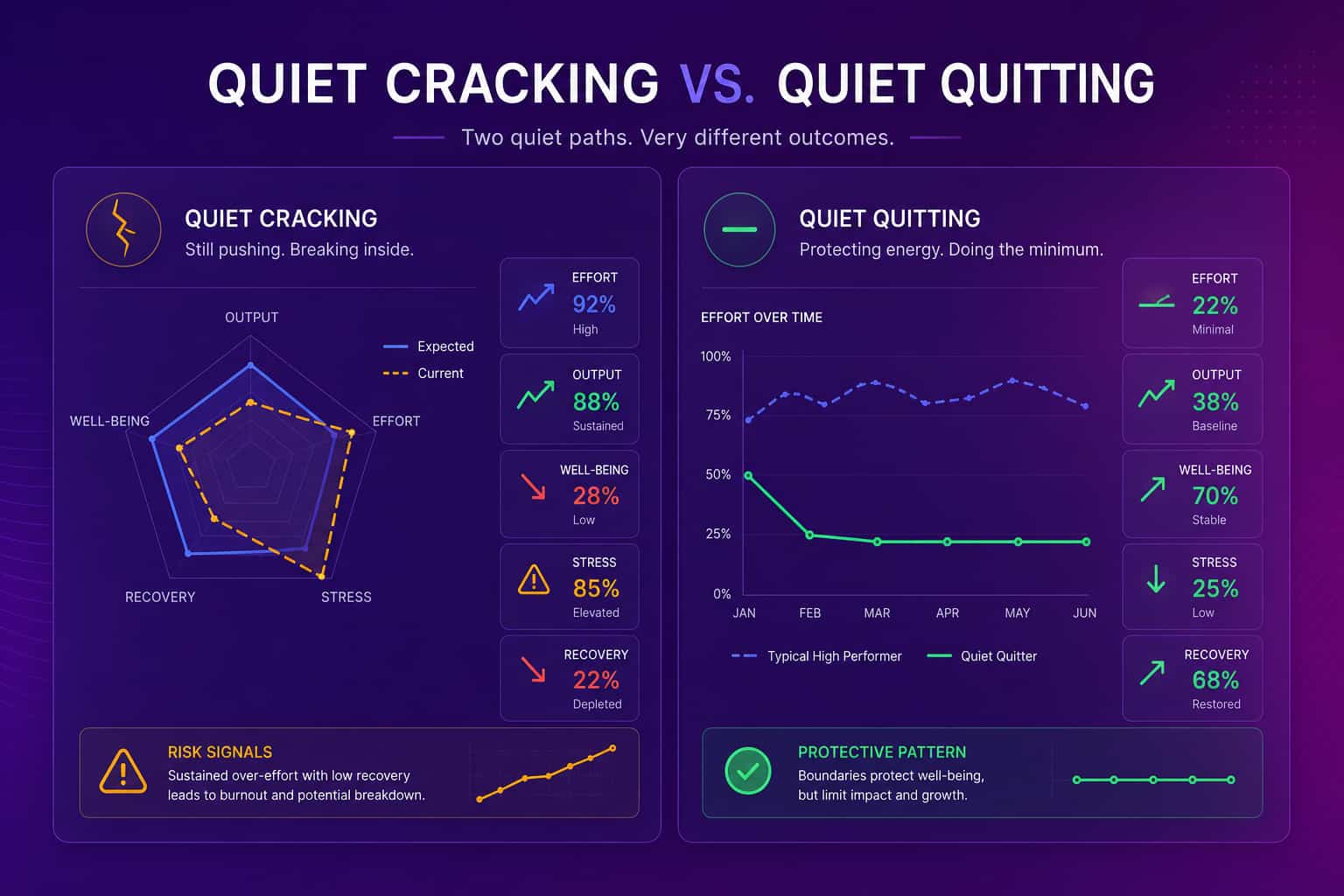
A: Quiet quitting is doing the bare minimum by choice. Quiet cracking is doing too much while falling apart. One is a motivation problem you can see in the output. The other is a wellbeing problem hidden behind output that still looks fine.
Q: What are the early signs of quiet cracking?
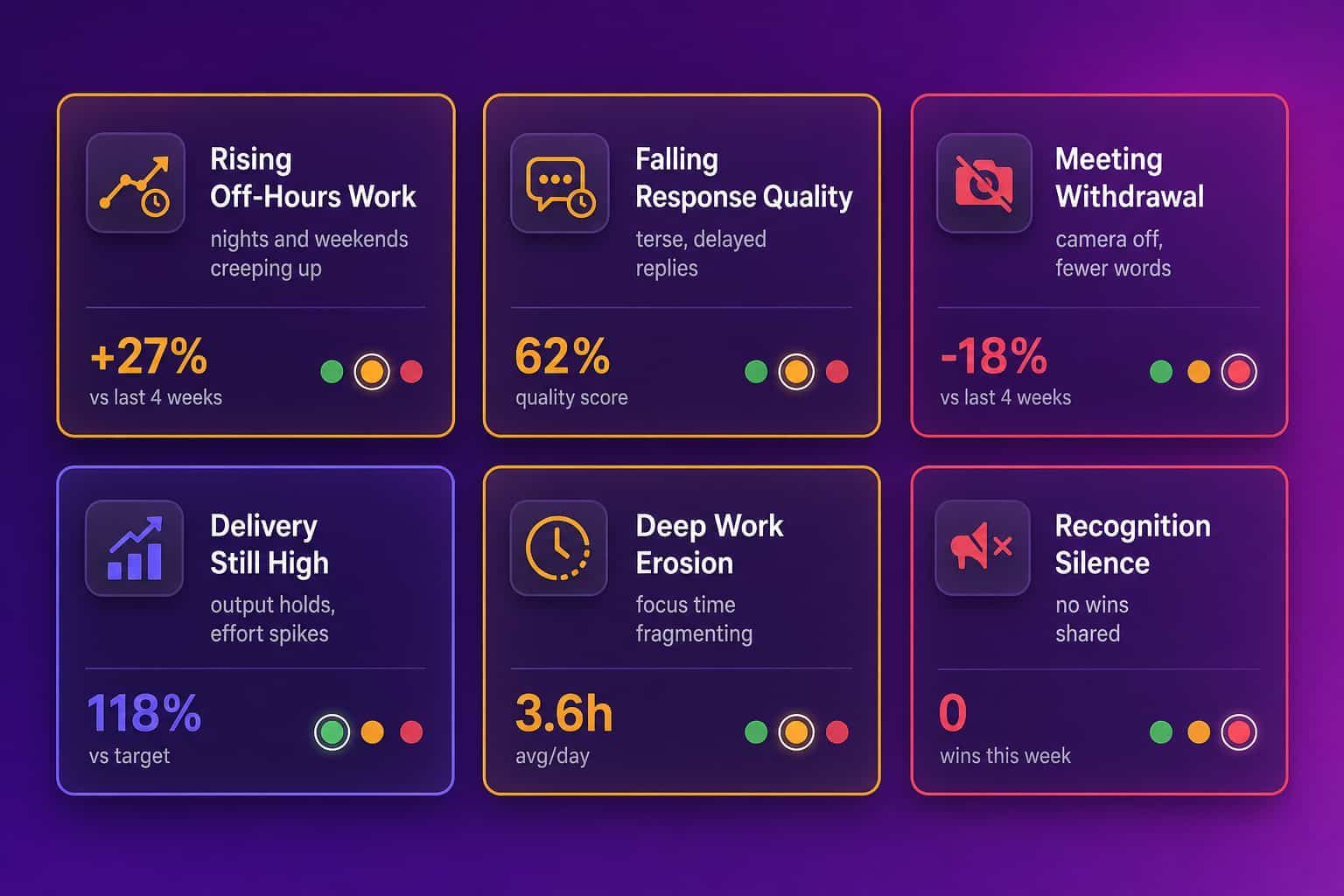
A: After-hours work rising week over week, deep-work time fragmenting, response times and quality slipping, meeting withdrawal, and effort climbing while delivery stays flat. The signal is the trend across weeks, not any single bad day.
Q: Can you spot quiet cracking without spying on people?
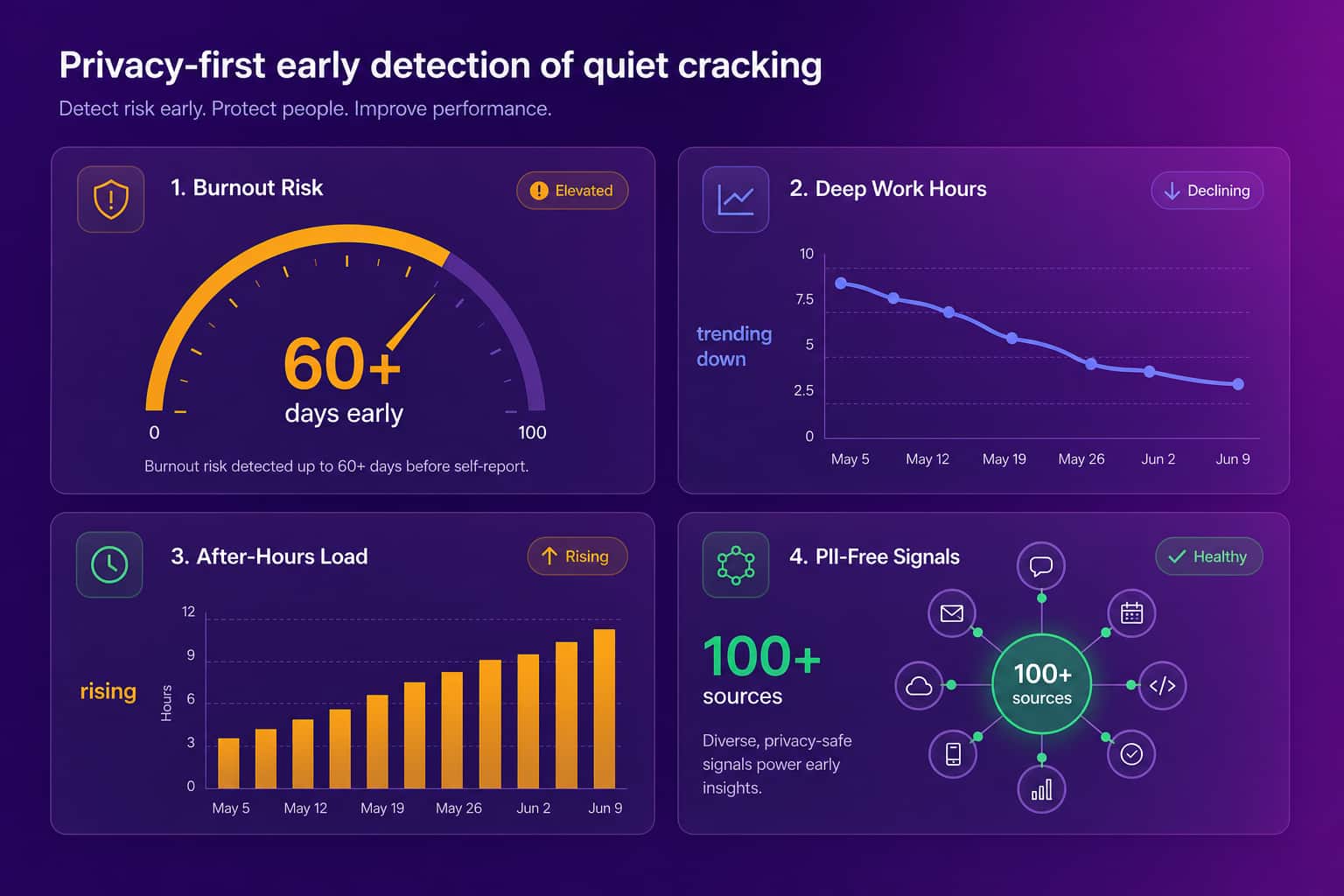
A: Yes. Abloomify reads PII-free work signals from 100+ integrations and optional aggregated device metrics, with no screenshots or keyloggers. It flags burnout risk 60 or more days early from work patterns, so you catch the crack before the resignation.
What is quiet cracking?
Quiet cracking is a state where an employee stays fully engaged in their work while quietly burning out underneath it, usually from chronic overload, unclear expectations, or fear about their job security. The term entered the workplace vocabulary in 2025 and spread fast in 2026 because it named something managers kept seeing but could not label. A quiet cracker is not coasting. They are the opposite of a quiet quitter. They answer the late email, pick up the dropped task, and stay in the group chat long after they should have logged off. That is what makes it dangerous. Their output holds steady, sometimes even rises, so every dashboard says the person is fine while the person is not. By the time it shows up as missed work or a resignation letter, the cracking has been happening for months. The cost is not just one departure. It is the institutional knowledge, the team morale, and the backfill cost that follow a strong performer out the door.
Quiet cracking vs quiet quitting: what is the difference?
The difference between quiet cracking and quiet quitting is direction of effort: a quiet quitter pulls back to the minimum, while a quiet cracker pushes past their limit and hides the cost. Both trends describe disengagement, but they are almost opposites in how they show up in the data. Quiet quitting looks like output flattening to the floor of the job description, cameras staying off because someone stopped caring, and Slack going quiet because they clocked out mentally. Quiet cracking looks like effort spiking, after-hours work climbing, and delivery holding right up until it collapses. If you only watch output, you will catch the quiet quitter and completely miss the quiet cracker, because the cracker's numbers look great. That is the trap. The person most likely to quietly crack is often your highest performer, the one nobody worries about because they always come through.
We wrote a companion piece on how to spot quiet quitting without monitoring for the disengagement side of this. Quiet cracking needs the opposite lens. You are not looking for someone doing less. You are looking for someone doing too much for too long.
Why quiet cracking is spiking in 2026
Quiet cracking became a common pattern in 2026 because three pressures landed on the same people at once: heavier workloads after hiring freezes, constant reorganization anxiety, and the always-on nature of remote and AI-accelerated work. When a company freezes headcount but not its roadmap, the work does not disappear. It redistributes onto whoever is dependable, and dependable people rarely say no. Add a year of layoff headlines and AI-will-replace-you noise, and your best performers start over-delivering out of fear rather than motivation. Remote work removes the visible cues a manager used to catch in a hallway. AI coding and writing tools let one stressed person produce two people's worth of output, which looks like productivity and reads like a red flag once you know what you are seeing.
I have felt versions of this running Abloomify. Some weeks it feels like we are just putting out small fires across the product, and the temptation is to keep grinding rather than admit the load is unsustainable. Founders do it, and so do the senior engineers and managers on your team. The instinct to push through is exactly why quiet cracking stays invisible. Nobody raises their hand. The pattern raises it for them, if you are actually reading the pattern.
The signs of quiet cracking at work
The signs of quiet cracking show up as effort rising while wellbeing signals fall, spread across systems and weeks rather than in one obvious moment. The common ones are after-hours and weekend work creeping upward, deep-work blocks fragmenting into scattered minutes, response times lengthening while replies get shorter and flatter, meeting presence shrinking to cameras-off and few words, and delivery staying high while the effort behind it climbs. Any one of these has an innocent read. A single late night is nothing. A quiet week could be a heads-down sprint. What separates a healthy stretch from quiet cracking is the trend line: the same person, the same signals, all pointing the wrong way for six, eight, ten weeks straight. That is the shape burnout makes before it becomes a resignation, and it is measurable long before anyone fills out an engagement survey.
Surveys will not catch this in time. They run quarterly, people answer them the way they think they should, and the person quietly cracking is the least likely to admit it on a form. By the time a pulse survey turns red, the cracking is old news. You need signals that update continuously and do not depend on someone in distress choosing to raise their hand.
How to spot quiet cracking without surveys or surveillance
You can spot quiet cracking without a single survey or screenshot by reading the work patterns your team already generates and watching how they move over time. Abloomify connects to Google Workspace, Microsoft 365, GitHub, Jira, calendars, and more through 100+ PII-free API integrations, plus an optional device agent on Mac or Windows that reports aggregated usage with no screenshots, no keyloggers, and no screen recording. It tracks after-hours load, deep-work erosion, collaboration latency, and workload balance as trends, then flags burnout and disengagement risk 60 or more days before it typically surfaces in reviews or exits. The point is not to catch anyone. It is to give a manager an early, honest heads-up that a specific person's workload has been unsustainable for weeks, so the conversation happens while it can still change the outcome.
This is the same privacy-first posture behind our burnout detection software and workforce analytics. One signal layer, read continuously, without turning your company into a surveillance operation. The reflex to install a monitoring tool is worse than useless here. There is no evidence that monitoring improves performance (Personnel Psychology meta-analysis), and roughly 1 in 6 workers say they would quit over surveillance, per 2026 survey research. Watching a stressed person's screen does not un-stress them. It just adds being watched to the list of reasons they are cracking.
What leaders can do about quiet cracking
The move against quiet cracking is to treat it as a workload and capacity problem first, and a wellness problem second, because a resilience webinar does nothing for someone carrying two people's work. Start by rebalancing load: if the data shows one engineer's after-hours work climbing while a peer with the same scope stays flat, that gap is your action item, not a personality trait. Protect deep work by cutting the meeting overload that fragments it. Have the direct conversation early, framed around what you are seeing in the workload rather than an accusation about attitude. And measure whether your changes worked, because "we care about wellbeing" is a slogan until the after-hours line actually bends back down. This is where employee retention software earns its keep: not by predicting who quits, but by showing you the workload changes that keep them.
Surveys and surveillance
Privacy-first work signals (Abloomify)
A 400-person fintech we work with gained capacity visibility across a distributed team for exactly this reason: to see where load was piling up before it turned into attrition. Quiet quitting is a motivation problem you can coach. Quiet cracking is a capacity problem you have to fix. Catch it early. Fix the workload. Keep the person.
FAQ
What is quiet cracking?
Quiet cracking is when an employee keeps showing up and delivering while slowly burning out under stress, overload, or job insecurity. They have not checked out like a quiet quitter. They are still trying hard, which is exactly why the strain stays hidden until they break or resign.
What is the difference between quiet cracking and quiet quitting?
Quiet quitting is doing the minimum on purpose. Quiet cracking is doing too much while quietly falling apart. A quiet quitter has emotionally stepped back. A quiet cracker is still committed but running on empty, so their output often looks fine right up until they leave.
What are the signs of quiet cracking at work?
Rising nights-and-weekends work, fragmenting deep-work time, shorter and slower replies, cameras off and fewer words in meetings, and output that holds steady while effort climbs. No single sign is proof. Quiet cracking shows up as effort rising while wellbeing signals fall across weeks.
How do you detect quiet cracking without surveys or surveillance?
Abloomify reads PII-free work patterns from 100+ integrations plus optional aggregated device signals, with no screenshots or keyloggers. It tracks after-hours load, deep-work erosion, and collaboration shifts over time, surfacing burnout risk 60 or more days before a resignation, without spying on anyone.
Can quiet cracking be reversed?
Often, if you catch it early. The fix is usually workload rebalancing, protecting focus time, and a direct manager conversation, not a wellness webinar. Because quiet cracking is a capacity and workload problem first, the same PII-free signals that flag it also show you which changes actually moved the numbers.

Amir Tavafi
Co-Founder & CEO
Product leader and innovator with over 15 years of experience in the tech sector, grounded in AI and robotics. Previously led product development in fraud detection and AI solutions at Nasdaq Verafin.