OKR vs KPI: The Difference, With Examples for Tech Teams
November 17, 2026
Amir Tavafi
14 min read

OKR vs KPI is a question I get from COOs more than you would expect, usually right after a quarter where every key result was green until the last week. KPIs tell you whether the machine is healthy. OKRs are the bets you make to change the machine. At Abloomify, where we build workforce intelligence with Goals and OKRs built in, I've watched most of the confusion come from tracking both by hand.
Key Takeaways
Q: What is the difference between an OKR and a KPI?
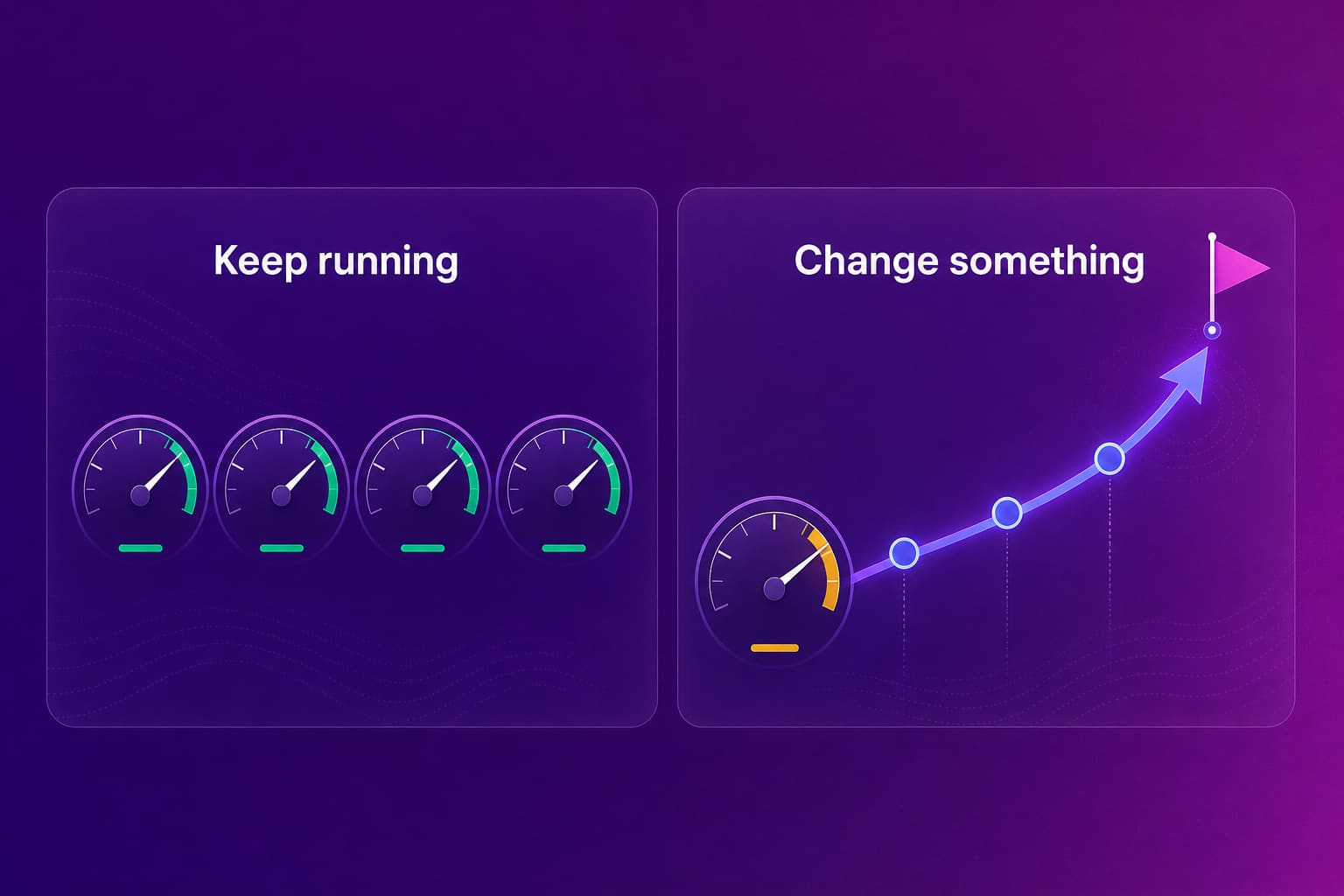
A: A KPI is an ongoing health metric, like deployment frequency or churn, that you watch every week with no end date. An OKR is a quarterly bet: an objective describing a change you want, plus two to four measurable key results. KPIs keep running. OKRs finish.
Q: Do OKRs replace KPIs?
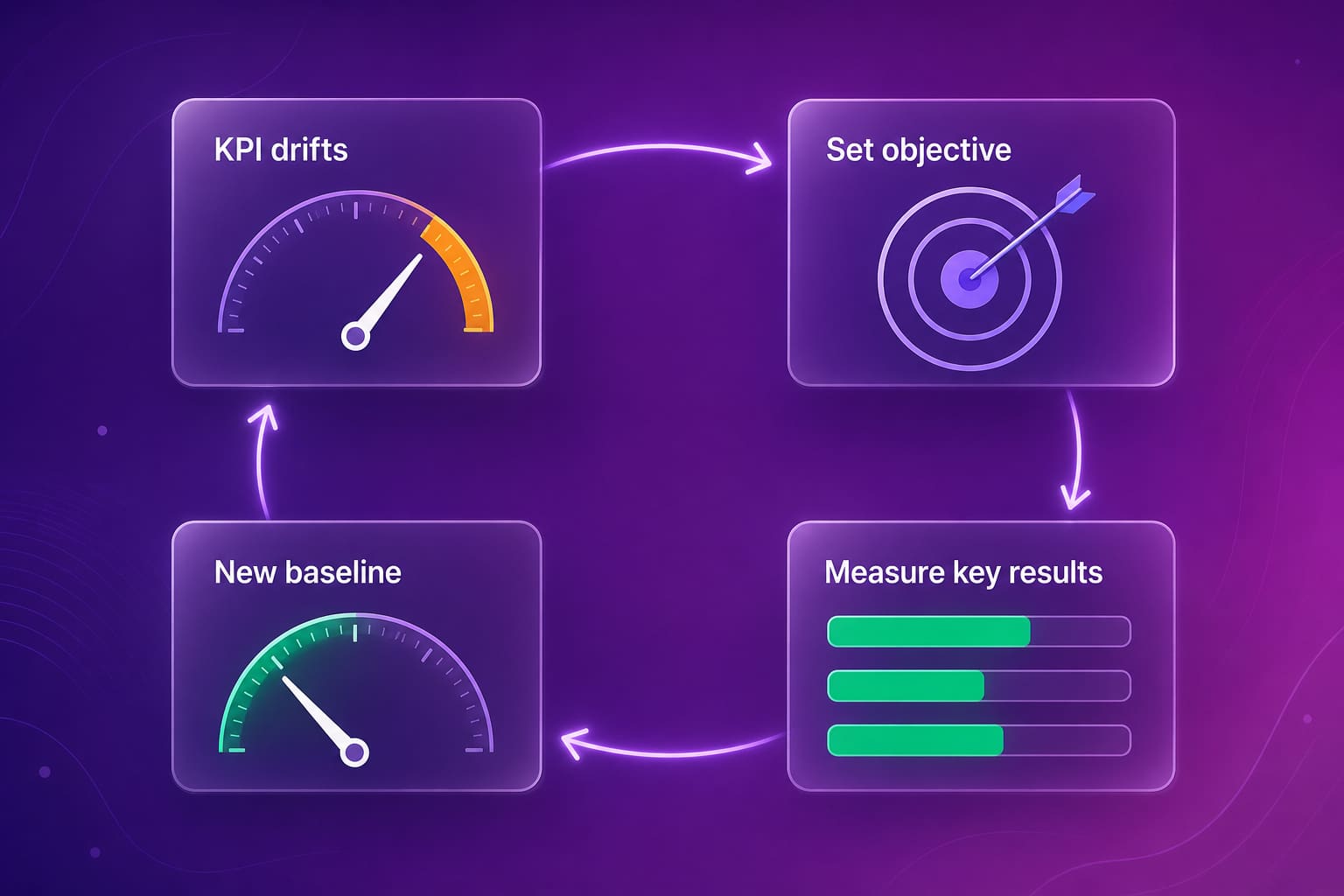
A: No. OKRs sit on top of KPIs. You notice a KPI drifting, or you want to move one to a new level, and you write an OKR to do it. When the OKR ends, the KPI keeps being tracked at its new baseline. Companies that drop KPIs for OKRs lose sight of the basics.
Q: Can a key result be a KPI?
A: The best ones usually are. "Cut median time to first review from about a day to under eight hours this quarter" is a KPI with a target and a deadline. Key results that are tasks ("launch the new review policy") measure effort, so they turn green whether or not anything improved.
Q: Why do OKR programs fail at tech companies?
A: Mostly because progress is self-reported. A manager types a percentage into a spreadsheet on Friday, and the number reflects mood more than reality. Tying key results to data already in Jira, GitHub, or the CRM removes that guesswork. Abloomify reads those systems through 100+ API integrations, PII-free.
Q: How many OKRs and KPIs should a team have?
A: One to three objectives per team per quarter, each with two to four key results. KPIs are a separate, longer list, usually five to ten per function, reviewed weekly. If you have more objectives than that, you have a task list with better branding.
What is the difference between an OKR and a KPI?
The difference between an OKR and a KPI is time and intent: a KPI (key performance indicator) is a metric you track continuously to confirm that something already working is still healthy, such as deployment frequency, gross margin, ticket backlog, or regretted attrition, while an OKR (objectives and key results) is a time-boxed commitment to change something, made of a qualitative objective that names the destination and two to four quantitative key results that prove you arrived, usually over a quarter. KPIs answer "are we okay?" and they never really end. OKRs answer "what are we pushing on right now?" and they expire on a date. The framework came out of Intel under Andy Grove and spread through John Doerr's work with Google, which is why so many tech companies treat OKRs as the serious version of goals. KPIs are older and less glamorous, and I'd argue they matter more.
A simple way to hold it in your head: KPIs are the gauges on the dashboard. OKRs are the route you plan when you decide to drive somewhere new. You need the gauges on every trip.
One nuance that trips people up. A KPI can be "bad" for years without anyone writing an OKR about it, because nobody decided it was worth the push. That's a legitimate choice. An OKR is how you make the choice explicit.
OKR vs KPI at a glance
OKR vs KPI comes down to a handful of practical differences that show up the moment you try to run either one in a real company, and the table below is the version I'd hand to a new manager on their first day: KPIs are ongoing, owned by a function, reviewed weekly or monthly, and judged on staying inside a healthy range, while OKRs are quarterly, often shared across teams, reviewed weekly during the quarter, and judged on how far they moved a number that matters, with ambitious OKRs expected to fall short now and then. The table also shows the failure mode of each. KPIs fail quietly when nobody looks at them. OKRs fail loudly when people turn them into a list of projects and mark them green for effort.
| KPI | OKR | |
|---|---|---|
| Purpose | Confirm something is healthy | Change something on purpose |
| Time frame | Ongoing, no end date | Usually one quarter |
| Structure | One metric with a healthy range | One objective plus 2 to 4 key results |
| Typical count | 5 to 10 per function | 1 to 3 objectives per team |
| Who owns it | The function that runs the process | Often shared across teams |
| What "good" looks like | Stays in range | Moves the number, stretch goals can miss |
| Common failure | Nobody looks until it breaks | Tasks dressed up as results, self-reported green |
| Engineering example | Change failure rate | "Make releases boring" with measurable KRs |
When should you use a KPI, and when an OKR?
Use a KPI when you want to know, continuously, that a process you already run is working, and use an OKR when you have decided that one of those KPIs, or something nobody measures yet, needs a concentrated push from one or more teams over a fixed period, because OKRs cost real attention and should be spent only where the business needs a change it won't get by default. Revenue, burn, uptime, deployment frequency, hiring pipeline, and attrition are KPIs at almost every tech company. "Get enterprise deals through security review in half the time" is an OKR, because it needs sales, IT, and engineering to change behaviour together, and it has a finish line.
Some rules of thumb I use:
- If it should be true every week forever, it's a KPI.
- If it needs two or more teams to change how they work, it's probably an OKR.
- If you can't name the number that proves success, it's neither yet. It's a project.
- If a key result can be completed by one person ticking a box, rewrite it.
Smaller companies can skip OKRs entirely for a while. A 50-person SaaS company with clean KPIs and one company-level priority per quarter is in better shape than a 400-person company with 60 OKRs nobody reads.
How do OKRs and KPIs work together?
OKRs and KPIs work together as a loop: a KPI drifts out of its healthy range, or leadership decides a KPI needs to sit at a new level, so a team writes an objective about that change and picks key results that are mostly the same KPI (or its leading indicators) with a target and a deadline, then works the quarter, and when the OKR closes, the KPI keeps getting tracked at its new baseline, which is how a one-time push turns into a permanent improvement instead of a slide in a quarterly review. Without the KPI underneath, an OKR has nothing to stand on. Without OKRs on top, KPIs tend to sit in a dashboard while everyone agrees they should be better.
Here is what that looks like for an engineering team. The KPI is time to first review on pull requests, and it has crept up as the team grew. The OKR for the quarter:
- Objective: Code review stops being the thing everyone waits on.
- KR1: Median time to first review drops from about a day to under 8 hours.
- KR2: Share of PRs over 400 changed lines falls by half.
- KR3: Self-merged PRs without review stay under 5%.
Every key result is a number that already exists in GitHub. Nobody has to report it. If you want the background on why those signals predict delivery, our piece on engineering KPIs that predict delivery goes deeper, and DORA metrics cover the delivery side.
OKR vs KPI examples for tech teams
The clearest OKR vs KPI examples pair one ongoing KPI with the OKR you would write if that KPI needed to move, because seeing both side by side shows that the OKR is temporary and targeted while the KPI is permanent and broad, and the examples below cover the functions that usually sit on a COO's weekly agenda at a 100 to 500 person tech company: engineering, sales, customer success, operations, and people. The numbers in the key results are illustrations of shape, not benchmarks. Your baseline decides your target.
| Function | KPI (always on) | OKR (this quarter) |
|---|---|---|
| Engineering | Change failure rate | O: Releases become boring. KR: change failure rate under 10%, rollbacks per month down by half |
| Engineering | Time to first review | O: Review stops blocking delivery. KR: median first review under 8 hours |
| Sales | Win rate | O: Enterprise deals stop stalling in security review. KR: median review time halved, SOC 2 package sent in first call |
| Customer success | Net revenue retention | O: Fix onboarding for mid-size accounts. KR: time to first value under 14 days for new accounts |
| Operations | SaaS spend per employee | O: Cut licenses nobody uses. KR: unused seats reclaimed across the top 10 tools |
| People | Regretted attrition | O: Keep senior engineers. KR: after-hours work trend down on the two most overloaded teams |
Notice the last row. Retention is a KPI people love and rarely move, because the causes (overload, meeting creep, no focus time) live in calendars and Jira, not in the HRIS. That's where measured key results earn their keep.
Why most OKR programs drift into theater
Most OKR programs drift into theater because the key results are graded by the people who own them, in a spreadsheet, once a week or once a quarter, so progress ends up reflecting optimism, politics, and how busy the manager was on Friday rather than what actually happened in the systems where the work lives, and the classic symptom is a wall of green that flips to red in the final two weeks of the quarter when someone finally checks the real numbers. Add the hours managers spend chasing updates and copy-pasting metrics into decks, and the framework starts costing more than it returns. I don't blame managers for this. The process asks them to be a human ETL pipeline.
One of our customers, the COO of a 50-person SaaS company, said it better than I can after comparing our data with their own analysis: "What I did manually this week in a spreadsheet is exactly what I think Abloomify should be doing automatically." That sentence describes most OKR check-ins I've seen.
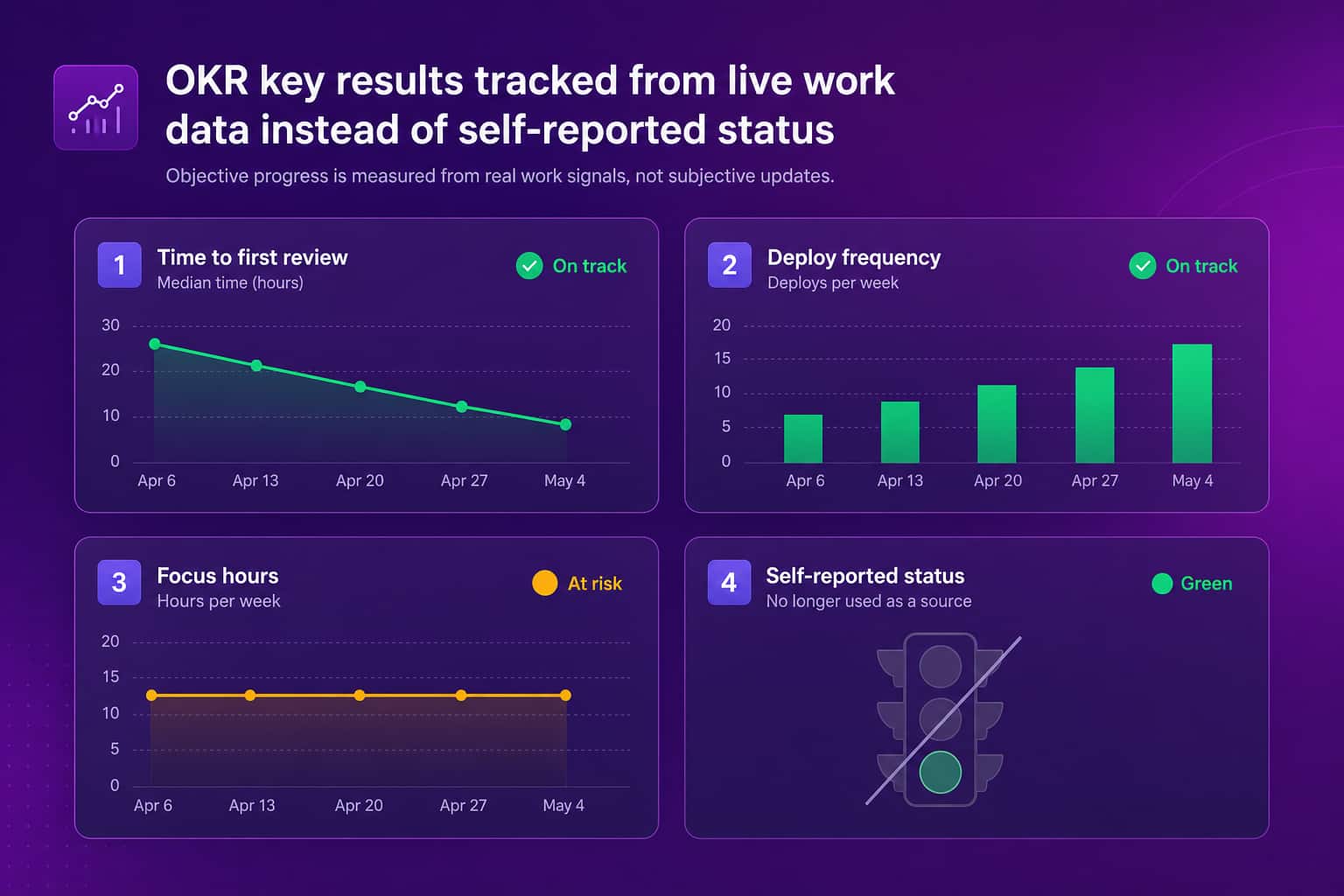
The fix is boring. Write key results as numbers that already exist somewhere, then let software read them. That's the approach behind tracking OKR progress with real-time data, and it's how Goals and OKRs work inside Abloomify's performance management layer: key results sit next to delivery, capacity, and collaboration signals from Jira, GitHub, calendars, and CRM, so a review conversation starts from what happened.
How to set up OKRs and KPIs without a spreadsheet ritual
To set up OKRs and KPIs without a spreadsheet ritual, start from the KPIs you already trust, pick the one or two that genuinely need to move this quarter, write an objective for each in plain language, choose key results that are numbers your tools already produce, and then automate the weekly read so nobody has to type progress into a cell, which keeps the check-in focused on decisions instead of status. The whole setup takes an afternoon if your KPIs are clean. If they aren't, fix that first, because OKRs built on fuzzy metrics just make the fuzz more official.
- List your KPIs by function. Five to ten each. Write down where each number lives (GitHub, Jira, HubSpot, Salesforce, Workday, BambooHR).
- Pick what needs to move. One to three company priorities, not twelve.
- Write the objective as a sentence a new hire would understand. "Releases become boring" beats "Optimize deployment excellence."
- Make key results measurable from a system. If a key result needs a human to report it, ask whether a leading indicator exists that doesn't.
- Automate the weekly read. In Abloomify, you can schedule Bloomy to run a weekly OKR brief: each run pulls fresh numbers from connected tools and goals, emails a short report, and keeps a chat thread attached so leadership can ask follow-ups. Dashboards you check. Bloomy checks in on you.
- Close the OKR, keep the KPI. At quarter end, grade the key results, retire the OKR, and keep watching the KPI at its new level.
If you're at the stage of writing goals for individuals rather than teams, our SMART goals examples are a better starting point than OKRs. And if you're a COO who wants company OKRs read from live data instead of decks, the Abloomify for executives page shows how that comes together.
KPIs keep you honest about today. OKRs are how you decide what tomorrow looks like. Measure both from the work, and the quarterly scramble mostly disappears.
FAQ
What is the main difference between an OKR and a KPI?
A KPI is a number you watch continuously to know whether something that already works is still healthy, like deployment frequency or net revenue retention. An OKR is a time-boxed bet to change something: an objective that says where you want to go, plus two to four measurable key results that prove you got there.
Can a KPI be a key result?
Yes, and it often should be. The best key results are KPIs with a target and a deadline attached, for example moving median time to first review from about a day to under eight hours this quarter. When the quarter ends, the key result goes away and the KPI keeps running at its new baseline.
Should a company use OKRs or KPIs?
Both, for different jobs. Every company needs KPIs, because you have to know whether the business is healthy. OKRs are optional and earn their place when you need a few teams to push hard on the same change. A 50-person company can run fine on KPIs plus one or two company OKRs per quarter.
How many OKRs should a team have?
Fewer than you think. One to three objectives per team per quarter, each with two to four key results, is plenty. If a team has six objectives, it has a task list with nicer names. The KPIs you already track do not count against that limit, because they are not bets.
How do you track OKR progress without manual status updates?
Tie each key result to a number that already lives in a system: Jira, GitHub, your CRM, or your HRIS. Abloomify reads those through 100+ API integrations, PII-free, and Bloomy can run a scheduled weekly OKR brief by email, so progress comes from the work itself instead of a Friday spreadsheet.

Amir Tavafi
Co-Founder & CEO
Product leader and innovator with over 15 years of experience in the tech sector, grounded in AI and robotics. Previously led product development in fraud detection and AI solutions at Nasdaq Verafin.