SMART Goals Examples Real Teams Actually Track
August 14, 2026
Amir Tavafi
12 min read

SMART goals examples online are mostly personal life goals wearing a work costume: run a marathon, learn French, read more books. Real teams need goal examples that map to what they actually do all quarter: PR cycle time, SaaS spend, capacity gaps, retention. Abloomify built a goals module because most SMART goals get written once during planning week and never opened again until the next one.
Key Takeaways
Q: What is an example of a SMART goal for work?
A: A SMART goal names a specific target, a number, and a deadline. For engineering: "Cut PR cycle time from 72 hours to under 30 hours by the end of Q3, tracked weekly in GitHub." For operations: "Reduce unused SaaS licenses by $50K over two quarters, verified against login data, not vendor seat counts."
Q: What makes a goal SMART instead of just a wish?
A: Five things, all present at once: a Specific outcome, a Measurable number, something Achievable given real constraints, Relevant to what the team is actually accountable for, and Time-bound with a real deadline. Drop any one of the five and it reverts to a wish with good intentions.
Q: Are SMART goals the same thing as OKRs?
A: No. An OKR pairs a directional, often unreachable Objective with several Key Results that measure progress toward it. A SMART goal is one measurable target with a deadline. Abloomify's goals and OKR tracking lets teams run both, writing OKR key results as SMART goals underneath a larger objective.
Q: Why do so many SMART goals fail even when they're written correctly?
A: The framework was never the weak point. The weak point is tracking: a goal written well in January and never revisited until the December review isn't a goal, it's a paragraph. Teams that keep goals alive check them against real, current data on a schedule, not from memory during a hallway conversation.
Q: How do you track a SMART goal without a weekly spreadsheet ritual?
A: Connect the goal to the system where the work actually happens. Abloomify pulls goal progress from GitHub, Jira, Google Workspace, and 100+ other connected tools, so a PR-cycle-time goal updates itself instead of someone manually checking GitHub every Friday and typing a number into a doc.
What actually makes a goal SMART
A SMART goal is Specific, Measurable, Achievable, Relevant, and Time-bound, and it only counts as SMART if all five are true at once, not three out of five with good vibes filling the gap. Specific means naming the exact outcome, not the general direction ("reduce PR cycle time" beats "improve engineering velocity"). Measurable means a number that two people would calculate the same way if they checked it independently. Achievable means grounded in real constraints, current headcount, current tooling, current baseline, not an aspirational number pulled from a competitor's blog post. Relevant means it connects to what the owner is actually accountable for, not a metric that happens to be easy to pull. Time-bound means a real date on a real calendar, not "this quarter" left vague enough to slide into the next one. The framework traces back decades to management writing on objective-setting, and it has survived because it is genuinely simple, not because it is sophisticated. The failure mode isn't the framework. It's what happens to the goal after the kickoff meeting, which the rest of this article spends more time on than the acronym does.
SMART goals examples for engineering and product teams
The first sentence of a SMART goal for an engineering team should read like something you could pull straight from GitHub, because that is exactly where the evidence lives. "Cut PR cycle time from 72 hours to under 30 hours by the end of Q3, measured weekly against the team's GitHub data" is specific, has a real number, and has an obvious source of truth. A few more that hold up the same way: "Bring flaky test rate under 5% across the three highest-traffic CI pipelines by August 30, verified through pipeline health data." "Move deployment frequency from the High to the Elite DORA band by shipping at least once per business day for six consecutive weeks." "Reduce self-merge rate on the payments repo from 22% to under 10% by adding a second-reviewer requirement, tracked over the next full sprint." "Raise AI-assisted PR review coverage from 40% to 80% of merged PRs within 60 days, without an increase in change-failure rate." Each one is boring in the best way: nobody has to argue about whether it happened.
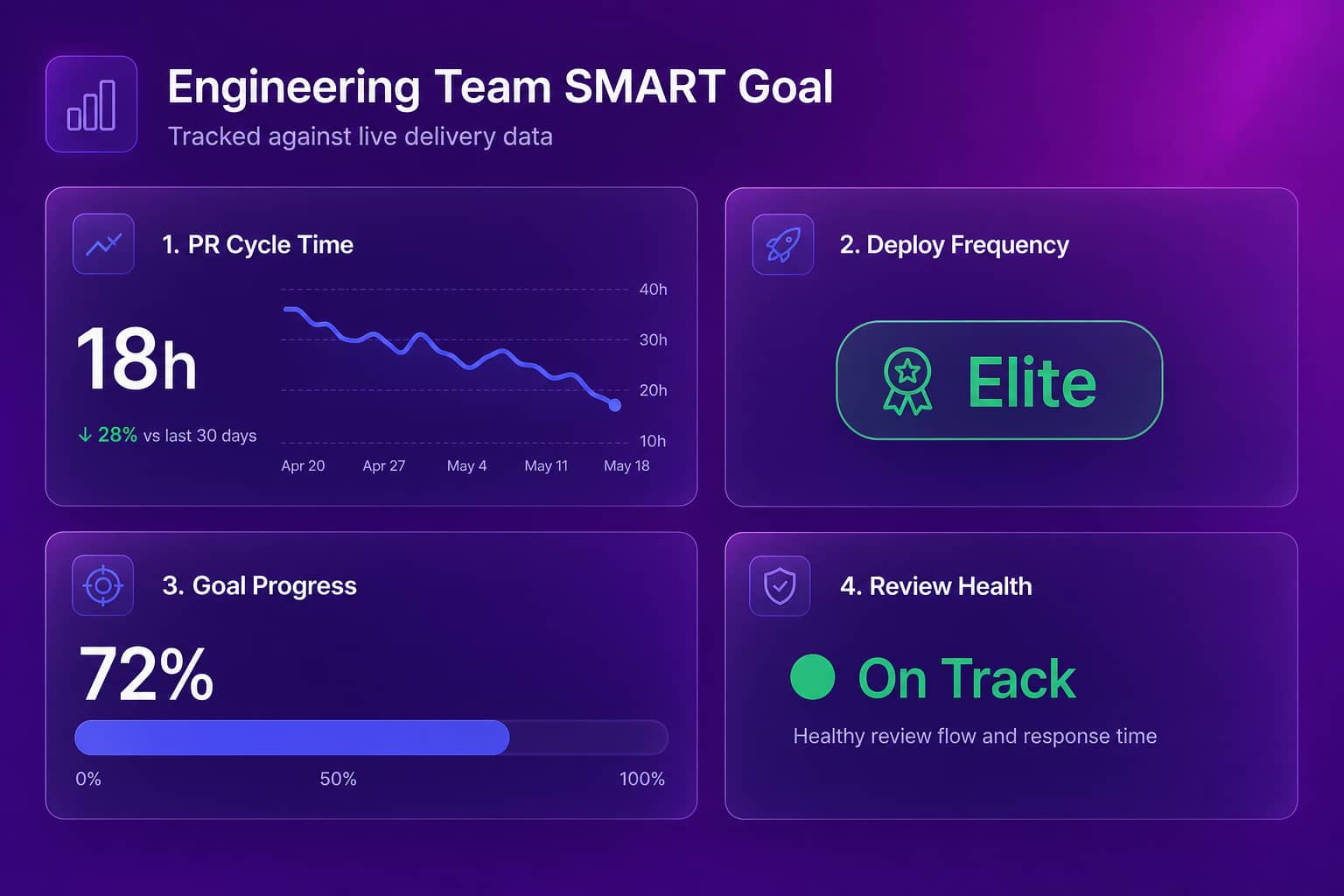
Abloomify's engineering KPI tracking computes DORA metrics, PR cycle time, and review health straight from GitHub, so a goal like the ones above has a real baseline before anyone writes it down, and an automatic answer to "are we on pace" every week after.
SMART goals examples for operations and executive teams
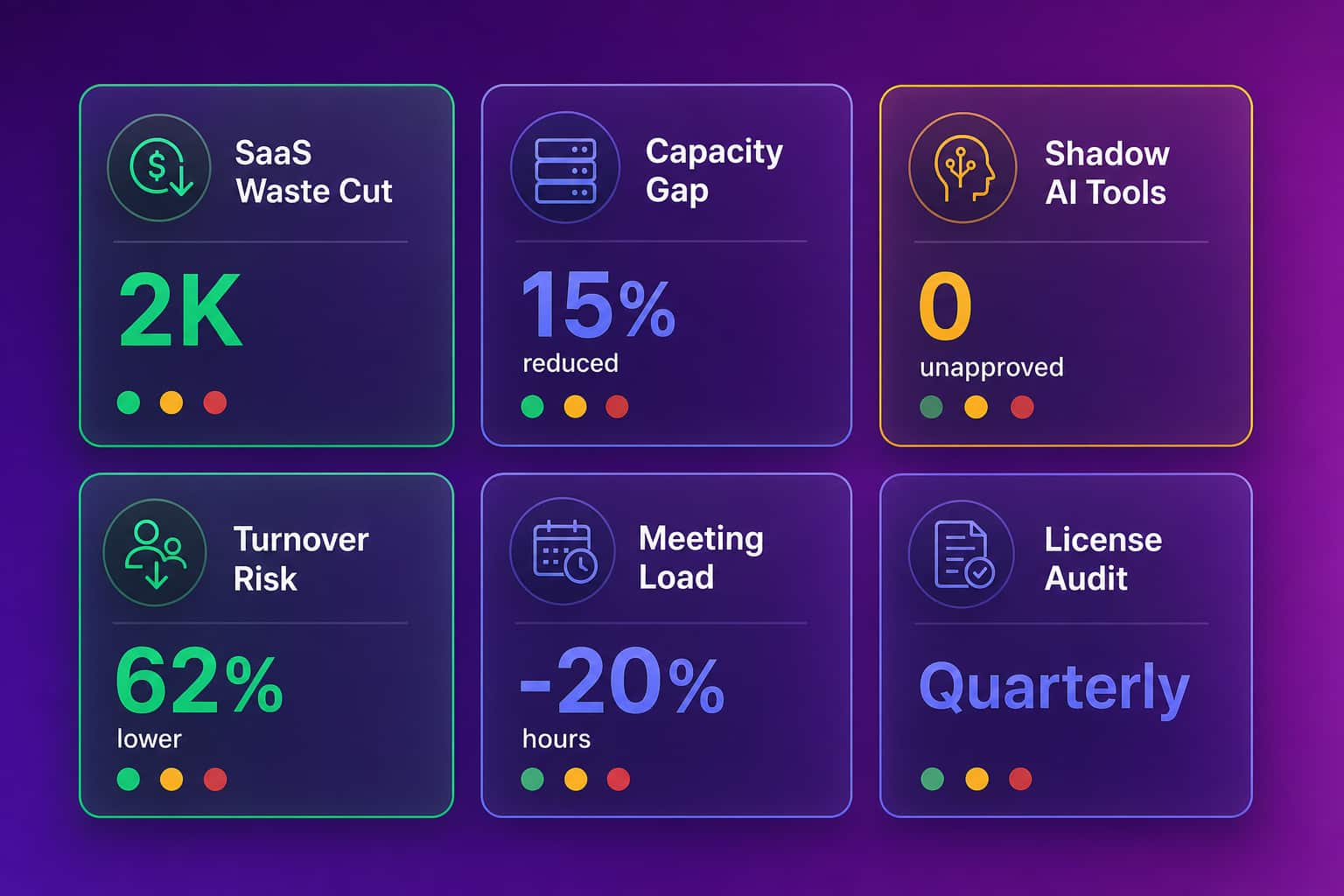
Operations and executive goals should target the two things a COO gets asked about every board meeting: cost and capacity. "Reduce unused SaaS licenses by $50K over the next two quarters, verified against actual login and usage data instead of vendor seat counts." "Cut average meeting hours per employee from 11 a week to 7 a week by the end of Q4, tracked through calendar data." "Close the capacity gap on the platform team from 30% idle time to under 15% by reallocating two roles by November 1." "Reduce revenue-per-employee variance across departments to within 10% of the company average within two quarters." Every one of these is a real line item leaders already argue about in a spreadsheet once a quarter. The difference between a good version and a vague one is the source of truth attached to it.
SMART goals examples for IT and people teams
IT and HR goals tend to fail the "Measurable" test more than any other category, because the underlying problem (shadow AI, disengagement, attrition risk) resists a clean number until someone builds the tracking first. A few that hold up: "Identify and shut down every unapproved AI tool with access to customer data within 45 days, verified through a SaaS usage audit." "Get 90% of engineering managers running structured 1:1s with documented notes within 60 days." "Reduce voluntary regrettable attrition in customer success from 18% to 12% over two quarters, tracked monthly against a retention dashboard." "Cut time spent assembling quarterly performance review packets from four hours per manager to under one hour by connecting review data automatically." These work because each one names the system that will answer "did this happen," not just the outcome someone hopes for.
SMART goals vs OKRs: when to use which
A SMART goal and an OKR answer different questions, and the first sentence of any comparison should say so plainly: a SMART goal is one specific, measurable target with a deadline, usually owned by a person or a small team, while an OKR pairs a broader, often deliberately ambitious Objective ("become the fastest-shipping team in the company") with several Key Results that measure whether the objective is actually happening. Use a SMART goal when the outcome is narrow and the owner is clear, a single engineer's code review turnaround, a single manager's 1:1 cadence. Use an OKR when you need to align multiple teams behind a shared direction that no single metric fully captures. The two are not competitors. Most disciplined teams write OKR key results as SMART goals underneath them, which is the cleanest way to run both without maintaining two separate systems of record.
For teams already running OKRs, our guide on tracking OKR progress with real-time data covers the same tracking problem from the objective-and-key-result side instead of the individual-goal side.
Why most SMART goals die in a shared doc
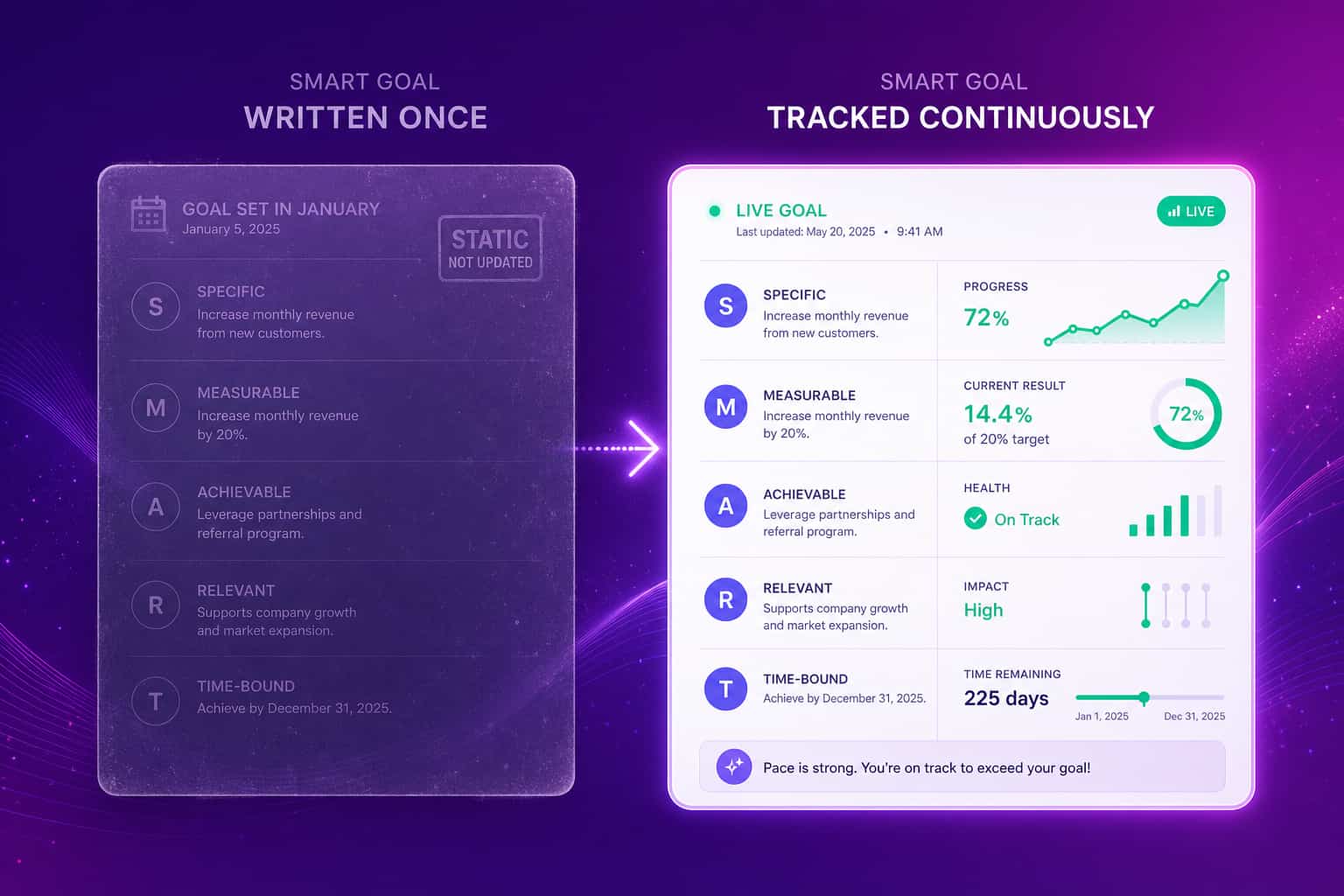
Most SMART goals die in a shared doc because the framework only covers how a goal gets written, not what happens to it afterward, and what happens to it afterward is usually nothing. When we started building Abloomify, I thought the job was giving managers better AI tools. The longer we've been at it, the clearer it gets that most of a leader's week is admin wearing a leadership costume: chasing people for goal updates, copy-pasting last quarter's numbers into a new slide, digging across five systems to answer a question as basic as "are we actually on pace." A SMART goal is supposed to kill that scramble by making progress obvious at a glance. Written once in a doc during planning week and never revisited, it just adds a sixth tab nobody opens, which means the team is back to guessing by the time it actually matters.
This is the actual failure mode, and it has nothing to do with the framework. A goal gets written carefully during planning week, everyone nods, and then the doc sits untouched until the week before the review, when whoever owns it scrambles to reconstruct three months of progress from memory and a few Slack searches. That reconstruction is where the goal quietly becomes fiction. Recency bias fills in the gaps, the number gets rounded in whichever direction makes the story cleaner, and the review conversation ends up debating impressions instead of the actual record. The same evidence problem shows up later in performance improvement plans built from memory instead of data, which is the same disease with worse stakes.
How to write a SMART goal that survives past the kickoff meeting
Writing a SMART goal that survives starts with the baseline, not the target, because a target with no real starting number attached is a guess wearing a costume. Pull the actual current number first, from GitHub, the CRM, the SaaS billing console, wherever the work actually happens, instead of estimating it from memory. Set the target as a specific figure with a real deadline, since "improve" is not a target but "72 hours to 30 hours by September 30" is. Name the exact source of truth before the goal gets finalized, so nobody is arguing about where the number came from at check-in time. Put check-ins on the calendar now, every two to four weeks, because a goal reviewed once at the deadline is being graded, not managed. Then connect the goal to live data instead of a manual update ritual, so the Tuesday-morning "where are we" question has an answer that took zero minutes to produce.
- Pull the actual current number first. Not an estimate, the real one, from GitHub, the CRM, the SaaS billing console, wherever the work happens. A goal built on a wrong baseline is wrong before anyone starts working toward it.
- Set the target as a specific number with a real deadline. "Improve" is not a target. "72 hours to 30 hours by September 30" is.
- Name the exact source of truth before the goal is finalized. If nobody can say precisely where the number will come from at check-in time, the goal will get graded on vibes.
- Put check-ins on the calendar now, every two to four weeks. A goal reviewed once, at the deadline, is not being managed. It's being graded after the fact.
- Connect the goal to live data instead of a manual update ritual. Abloomify's performance management module pulls goal progress from connected tools automatically, so the Tuesday-morning "where are we on this" question has an answer that took zero minutes to produce.
A SMART goal written in a doc and forgotten is a wish with a deadline attached. A SMART goal tied to live data is just a goal.
FAQ
What is an example of a SMART goal for work?
A SMART goal names a specific target, a number, and a deadline. For an engineering team: "Cut PR cycle time from 72 hours to under 30 hours by the end of Q3, tracked weekly in GitHub." For an operations team: "Reduce unused SaaS licenses by $50K over the next two quarters, verified against actual login data."
What is the difference between SMART goals and OKRs?
A SMART goal is one measurable target with a deadline, usually owned by an individual or a small team. An OKR is a directional objective (often ambitious and not fully achievable) paired with several key results that measure progress toward it. Many teams write OKR key results as SMART goals, which is where the two frameworks overlap.
How often should SMART goals be reviewed?
Every two to four weeks for anything tied to a quarterly target, and monthly at minimum for longer goals. A goal reviewed once at the deadline is not being managed, it is being graded. Abloomify pulls goal progress from connected tools automatically so a check-in takes minutes instead of a data-gathering afternoon.
Do SMART goals work for roles that are hard to measure, like creative or support work?
Yes, but the measure has to be honest about what it is standing in for. A designer's SMART goal might track review turnaround time or the number of components shipped to the design system rather than trying to quantify creativity directly. The goal is finding a real proxy, not forcing a number onto something that resists one.
What is the SMARTER goal framework?
SMARTER adds Evaluated and Reviewed to the original five letters, making the check-in cadence part of the framework instead of an afterthought. In practice it describes what disciplined teams already do: set the SMART goal, then actually look at it on a schedule instead of rediscovering it the week before the deadline.

Amir Tavafi
Co-Founder & CEO
Product leader and innovator with over 15 years of experience in the tech sector, grounded in AI and robotics. Previously led product development in fraud detection and AI solutions at Nasdaq Verafin.