Performance Improvement Plan: A Guide Built on Evidence, Not Memory
August 10, 2026
Amir Tavafi
12 min read

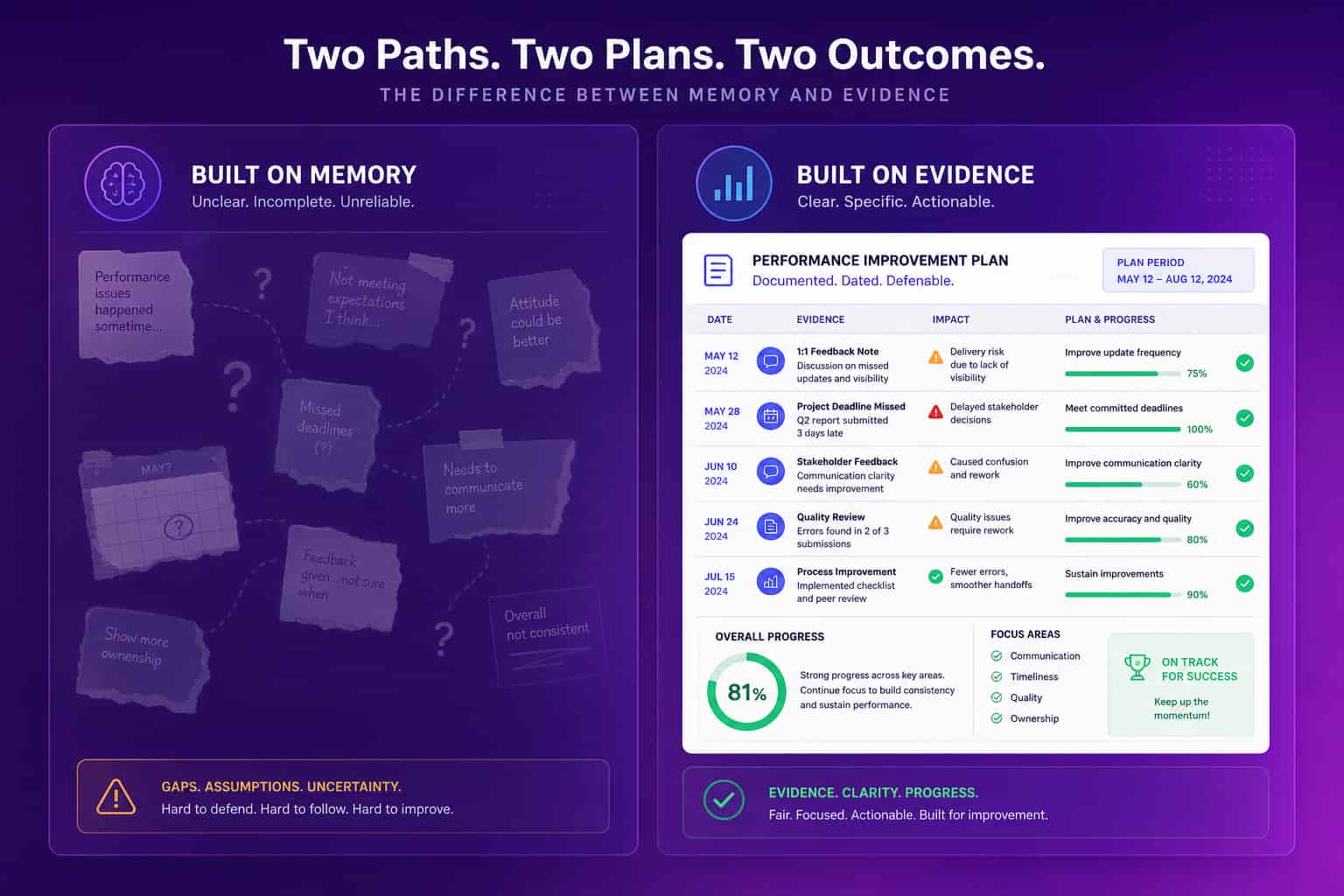
A performance improvement plan only works if it is built on what actually happened, not what a manager remembers happening. Most PIPs get written from memory under deadline pressure, which is why employees roll their eyes at the phrase and lawyers scrutinize every line of it. Abloomify builds the evidence trail (delivery data, review history, goal progress) automatically, so the plan a manager writes matches the record instead of the last two weeks.
Key Takeaways
Q: What is a performance improvement plan?
A: A formal, written document that names a specific performance gap, sets measurable goals with a deadline (usually 30, 60, or 90 days), defines the support a manager will provide, and states the consequence if goals go unmet. It is not a warning email and it is not a vibe.
Q: When should you start a performance improvement plan?
A: After a documented pattern, not a single bad week. If you cannot point to at least three dated instances of the same gap across a real time window, you do not have a pattern yet, you have a manager's frustration looking for a form to live in.
Q: What makes a PIP legally defensible?
A: Specific, dated evidence tied to job requirements, consistent application across similar cases, and documented support offered during the plan. Vague language like "attitude" or "not a team player" is the first thing an employment lawyer flags, because it cannot be measured or disproven.
Q: How do you know if a PIP is working?
A: Track the same metrics you used to justify it, at the same cadence, for the full window. A PIP with no mid-point check-in and no comparison against the original baseline is not a plan, it is a delay tactic dressed as one.
Q: What is the alternative to a PIP built from memory?
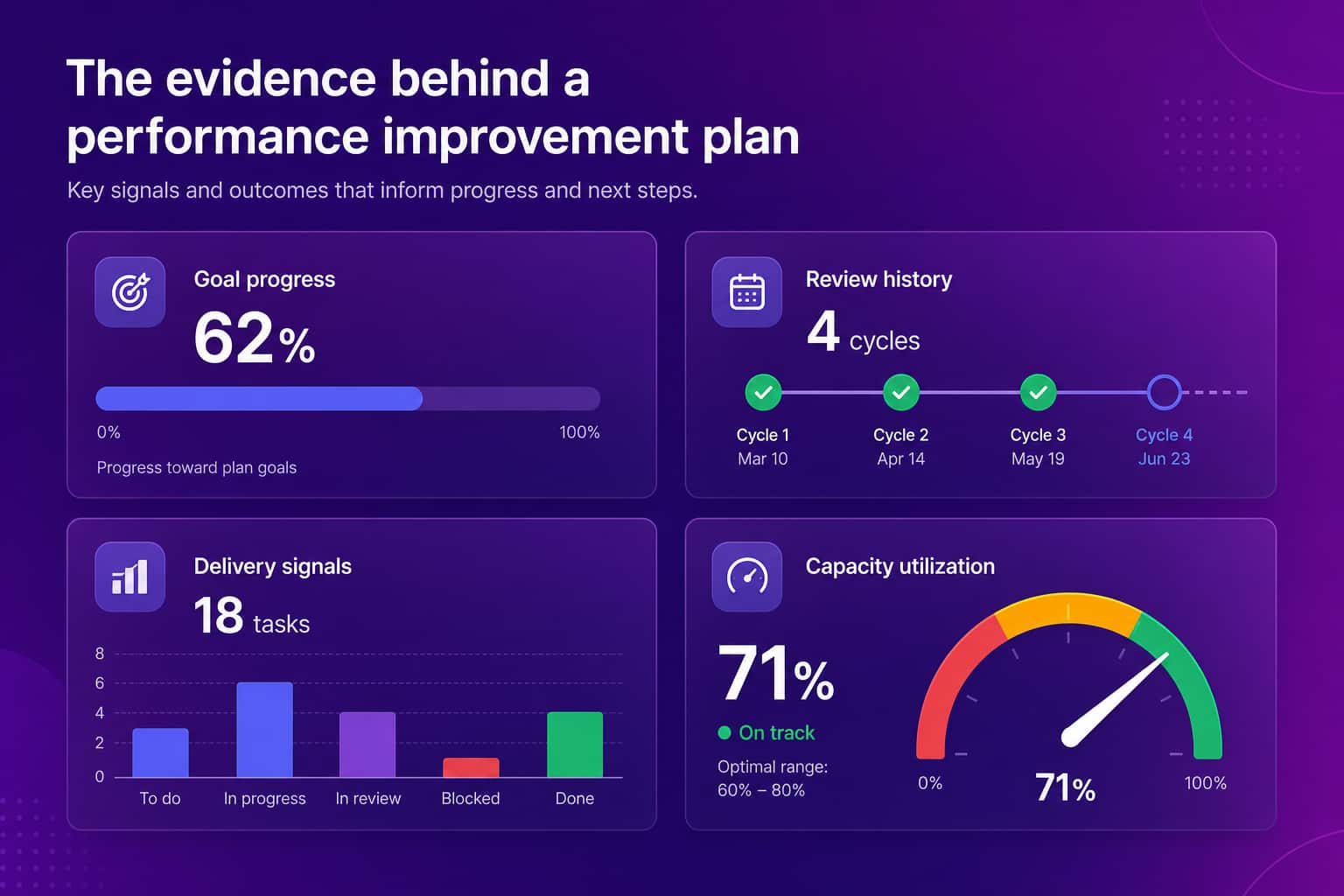
A: A PIP built from recorded work signals. Abloomify pulls goal progress, review history, delivery data, and capacity utilization from the tools a team already uses (Jira, GitHub, Google Workspace, the performance review module) so the gap described in the plan is the gap in the data, not the gap in a manager's recall.
What a performance improvement plan actually is
A performance improvement plan is a formal, time-boxed document that names a specific performance gap, sets measurable goals to close it, spells out the support a manager commits to providing, and states plainly what happens if the goals are not met. It is not the same thing as a verbal warning, a rough performance review, or a manager venting in a 1:1. Most run 30, 60, or 90 days depending on how long the underlying gap realistically takes to fix: a pattern of missed deadlines can show real change in a month, while a skills gap like weak code review quality needs practice reps and usually runs longer. The document typically covers four things: the specific gap (with dates and examples, not adjectives), the target outcome, the check-in schedule, and the consequence path. Skip any one of those four and the plan stops being a plan and becomes paperwork nobody, including the manager, actually believes in.
The problem with most PIPs: they are written from memory
Here is the uncomfortable part. Most performance improvement plans get written the same way most leadership admin gets done: under time pressure, from whatever the manager remembers, assembled the night before a scheduled HR meeting. When we started building Abloomify, I thought the job was giving managers better AI tools. What we actually kept running into is that a huge share of a manager's week is admin in disguise, digging across five systems to answer a question as basic as "was this actually a three-month pattern, or did I just have a rough conversation with this person two weeks ago and it's coloring everything." Recency bias is the quiet killer here. A strong two quarters followed by one bad sprint reads, from memory, like a pattern. It usually is not one.
This matters because the plans that survive legal review and actually change behavior share a trait: the gap named in the document is the gap in the record, not the gap in a manager's mood that week. A PIP assembled from selective memory is weak in two directions at once. It is legally weak, because "seemed disengaged lately" is not evidence a lawyer or an HR partner can defend. And it is practically weak, because an employee who senses the plan does not match their actual output will not trust the process enough to try to improve against it.
How to write a performance improvement plan that holds up
Writing a performance improvement plan that holds up starts before the document, with a real evidence review across the full window you are evaluating, not just the last two weeks. Pull the actual record: goal progress against the targets that were set, review scores and written feedback across every cycle in the window, delivery data if the role has any (PRs, tickets closed, deals worked, whatever the job produces), and any prior documented conversations about the same issue. Compare that record against the standard expected for the role, not against a peer who happens to be a top performer, since that comparison sets an unfair bar from the start. Only once the evidence is assembled and reviewed should a manager sit down to write the plan itself, because a PIP drafted before the record is pulled together tends to fit the conclusion the manager already reached rather than the data.
- Name the specific gap with dates. Not "communication issues," but "missed the stated deadline on three of the last four sprint commitments (dates: ___), each flagged in the sprint retro."
- Set a measurable target. A number, a rate, or a binary outcome the employee and manager both agree describes success. "Improve attitude" fails this test. "Ship committed sprint work on time in 4 of the next 5 sprints" passes it.
- Define the support you are actually providing. Extra 1:1 time, pairing with a senior teammate, a training budget line, whatever is real. A PIP with no support line reads as a paper trail for a decision already made, because that is often exactly what it is.
- Set the check-in cadence and put it on the calendar now. Weekly or biweekly, not "we'll touch base." A plan without scheduled check-ins gets forgotten by both sides until the deadline, which defeats the point of a 30, 60, or 90-day window in the first place.
- State the consequence path plainly. What happens if the goals are met, and what happens if they are not. Ambiguity here helps nobody, including the manager who has to follow through.
Where the evidence should come from
The evidence behind a performance improvement plan should come from the systems where the work actually happened, not a manager's notes app. Goal progress lives in the goals and OKR tool. Review history lives in the performance review cycles, including the written comments, not just the score. Delivery data lives in GitHub or Jira for engineering roles, in the CRM for sales, in the project tracker for everyone else. Capacity and workload context (was this person quietly overloaded, or coasting) lives in calendar and collaboration data. Pulling all of that together by hand, across four or five tools, the week before an HR meeting is exactly the kind of low-value chore that eats a manager's calendar and produces a worse document than the data actually supports.
Abloomify's performance management module keeps goals, reviews, and feedback in one connected record, and pulls in delivery and capacity signals from the tools already connected through Abloomify's 100+ integrations, so that record exists before anyone needs it for a PIP.
Signs a performance improvement plan is working (or isn't)
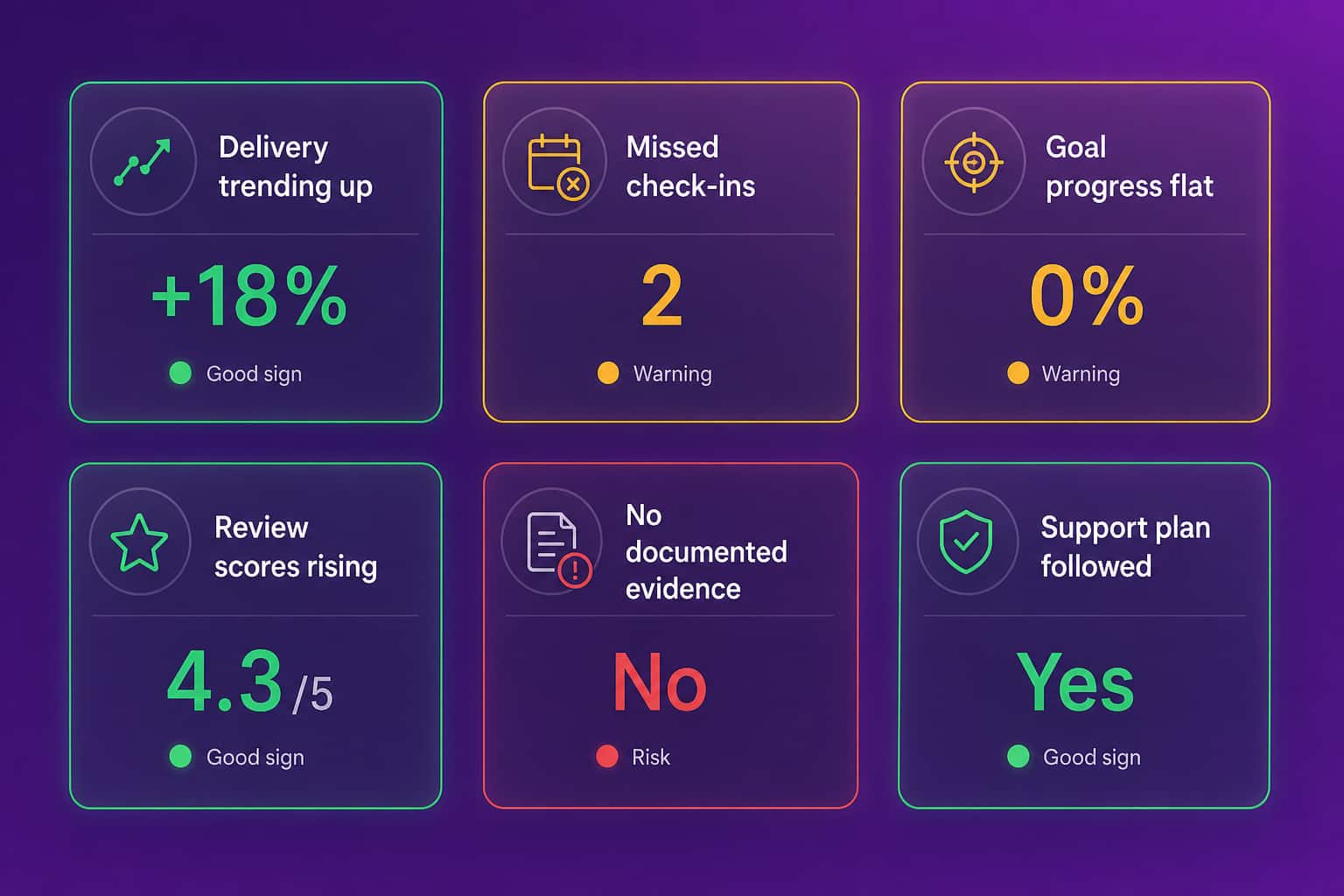
A performance improvement plan is working when the same metrics that justified it start moving in the stated direction, checked at the cadence you set, against the original baseline. It is not working, or was never real, when check-ins get skipped, when the employee hits the stated targets and the goalposts move anyway, or when there is simply no record to compare against because nobody tracked anything after week one. Watch for the honest signals in both directions: delivery trending up and review scores improving are real progress. Missed check-ins, flat goal progress, and a support plan that was promised but never delivered are the signals that the plan is drifting into a formality, or worse, into a document built to justify an outcome that was already decided.
Common performance improvement plan mistakes
The mistakes that sink a PIP tend to repeat across companies, which is why they are worth naming plainly instead of dancing around them.
- Writing the gap in adjectives instead of evidence. "Not a team player" cannot be measured, disputed fairly, or improved against. "Missed three of four sprint commitments" can.
- Basing the plan on the last two weeks. Recency bias turns one rough sprint into a false pattern. A real PIP evidence window covers the full period being evaluated, usually the prior quarter.
- Skipping documented check-ins. A plan with no scheduled, recorded touchpoints is a deadline with no process behind it, and it reads that way to HR, legal, and the employee alike.
- Applying the standard inconsistently. If two employees show the same gap and only one gets a PIP, the inconsistency itself becomes the story, not the performance issue.
- Treating the PIP as the first conversation about the problem. If the employee is hearing about this gap for the first time on the PIP document, the plan has already failed one of its jobs, which is to give someone a real chance.
For the broader case on building performance evidence that holds up outside a PIP specifically, see our guide to building fair performance reviews and how continuous performance management keeps that evidence current instead of reconstructed once a year.
Performance improvement plan vs termination: how to decide
The honest answer to "PIP or termination" starts with a question most managers skip: is the gap something the evidence shows started recently and has a plausible fix, or is it a pattern that has been visible for two or more review cycles with no real change despite prior conversations? A PIP makes sense for the first case. It is a genuine tool for a real, fixable gap, backed by evidence and real support, with a fair shot at success. It is the wrong tool, and often a liability, for the second case, where everyone including the employee already knows how this ends and the document exists mainly to create a paper trail.
Rough performance distribution across most teams tends to hold steady over time: a small share are doing exceptional work, a larger share are solid and dependable, and a meaningful share are quietly not adding much. AI is making that spread harder to hide behind busy calendars and vague self-reports, because delivery and output data now surface it faster than a manager's gut used to. That shift cuts both ways. It should make PIPs fairer, built on real evidence instead of who a manager happens to remember clearly. It should also make leaders more honest about which cases were never fixable to begin with. A real plan gives someone a genuine chance. A fake one wastes everyone's quarter and tells the rest of the team exactly how seriously to take the next one.
If turnover from a failed PIP is part of the calculation, our employee turnover cost calculator estimates the real cost of a departure, replacement, and ramp time before that decision gets made.
FAQ
What is a performance improvement plan?
A performance improvement plan (PIP) is a formal, time-boxed document that names a specific performance gap, sets measurable goals to close it, defines support the manager will provide, and states what happens if the goals are not met. Typical timelines run 30, 60, or 90 days.
How long should a performance improvement plan last?
30, 60, or 90 days, matched to how long the gap actually takes to fix. A missed deadline pattern can show improvement in 30 days. A skills gap, like an engineer who needs to raise code review quality, usually needs 60 to 90 days with real practice reps in between.
Does a performance improvement plan mean termination?
Not automatically, but a large share of PIPs end that way, which is why employees treat the phrase as a euphemism. The plans most likely to end in genuine improvement share one trait: the goals are tied to specific, evidenced gaps, not a general sense that someone underperformed.
What should a manager avoid when writing a PIP?
Avoid vague language ("improve communication"), goals with no measurable target, evidence pulled only from the last two weeks, and skipping documented check-ins. Each of these is either legally weak or practically useless, and often both at once.
Can a good employee end up on a performance improvement plan by mistake?
Yes, more often than most managers admit. Recency bias means a strong quarter followed by one rough sprint can read as a pattern when it is not. This is the strongest argument for a PIP built on a full evidence trail instead of what a manager remembers from the last standup.

Amir Tavafi
Co-Founder & CEO
Product leader and innovator with over 15 years of experience in the tech sector, grounded in AI and robotics. Previously led product development in fraud detection and AI solutions at Nasdaq Verafin.