Employee Engagement Strategies That Show Up in the Work (2026)
November 11, 2026
Amir Tavafi
12 min read

Employee engagement strategies usually get planned in a survey cycle and judged in the next one, a year later. By then the people who were checked out have either quit or settled in. At Abloomify, our only cold-outbound deal closed on a subject line about quiet quitters, so I have spent a lot of time on how leaders try to fix engagement and why most of it misses.
Key Takeaways
Q: What are employee engagement strategies?
A: Employee engagement strategies are deliberate changes to how work is designed and managed so people care about the outcome and stay. The useful ones change workload, focus time, manager attention, goal clarity, and growth. Perks and events are activities. They can support a strategy, but they rarely are one.
Q: Why do most engagement strategies fail?
A: They treat engagement as a mood to lift instead of a result of working conditions. Teams run an annual survey, launch a few initiatives, and wait a year to learn if anything changed. Overload, meeting creep, and missing one-on-ones keep running in the background the whole time.
Q: How do you know an engagement strategy is working?
A: Pick signals before you start and watch them monthly: meeting hours, focus blocks, after-hours work, one-on-one cadence, and review wait time. Abloomify reads these from tools like Google Workspace, Microsoft 365, GitHub, and Jira, PII-free, so nobody's messages or screens get read.
Q: Can work data alone tell you who is disengaged?
A: Not reliably. One of our customers, a 3,500-person enterprise, started with Google Workspace data alone and saw low correlation to their internal performance metrics. A single data source under-proves engagement. You need several sources, plus conversations, before acting on any pattern.
What is an employee engagement strategy?
An employee engagement strategy is a planned set of changes to the way work is assigned, scheduled, managed, and recognized, aimed at getting people to care about their work and stay with the company, and it is judged by whether behavior and retention change rather than by whether people enjoyed an event. That last part is where most plans drift. Search for the term and you will find lists of 25 or 30 ideas, most of them activities: lunches, wellness challenges, swag, shout-out channels. Some of those are nice. None of them fix a team where three people carry the load for eight, or where engineers spend half their week in meetings. Engagement is mostly a downstream result of whether the job is doable, whether the manager pays attention, and whether the work leads somewhere. Strategy means changing those inputs on purpose.
For a deeper definition of the concept itself, our piece on workforce engagement covers the signals in more detail.
Why do most employee engagement strategies fail?
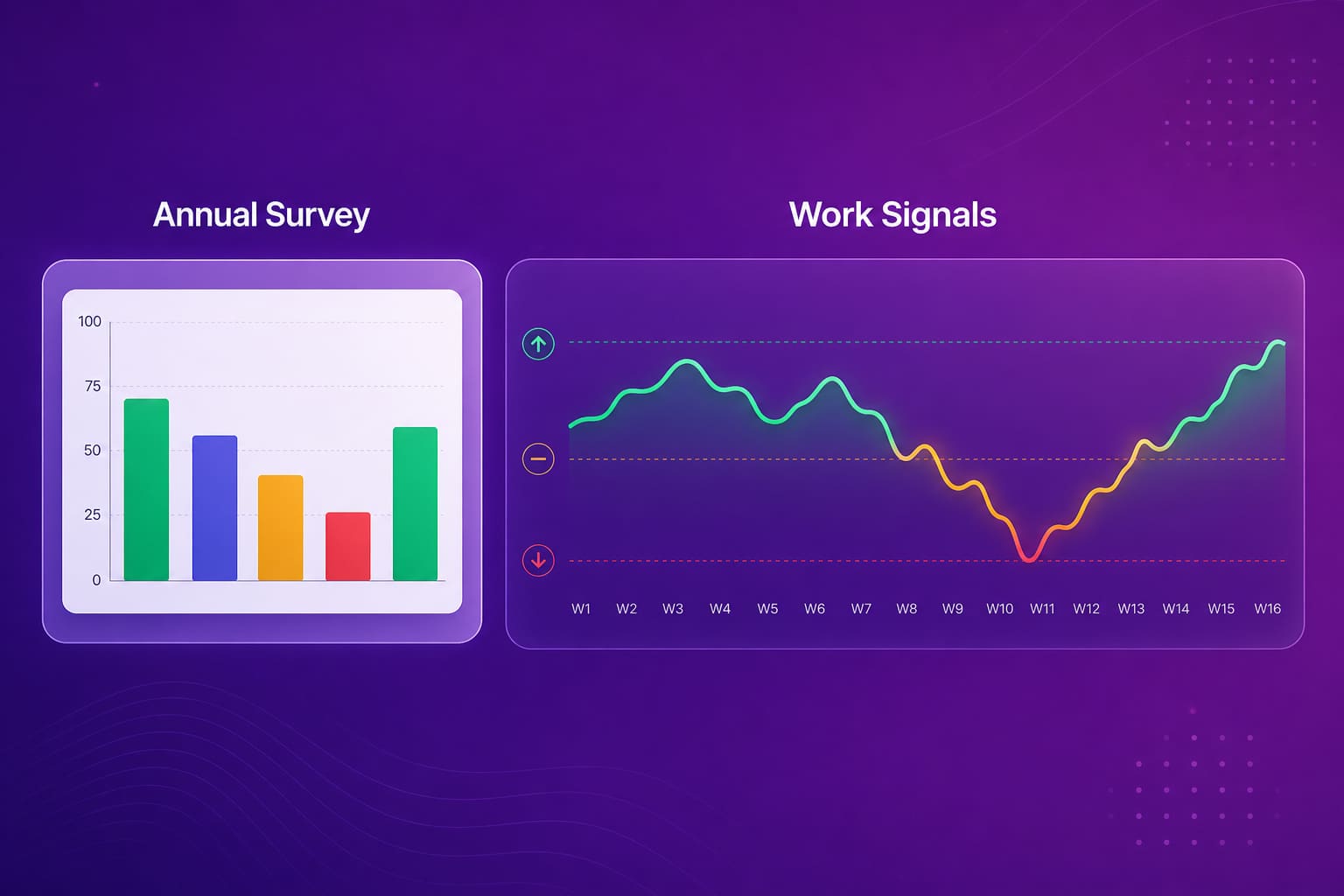
Most employee engagement strategies fail because they are built on a once-a-year measurement and aimed at mood, while the things that actually drain engagement (uneven workload, meeting overload, absent managers, unclear priorities) change week to week and never show up in the survey until it is too late to act. The survey says engagement dropped in the platform team. It does not say the platform team lost two people in March and absorbed their on-call shifts. So the response is generic: a recognition program, a town hall, maybe a team offsite. Six months later the same team has the same load and a worse score. I do not think surveys are useless. They tell you how people feel, which nothing else does. They are just slow, and they describe a symptom without pointing to the cause.
The other failure is quieter. Leaders ask for visibility, someone suggests monitoring software, and now the engagement strategy includes screenshots. That backfires fast. 2026 research found 1 in 6 workers would quit over surveillance, and a Personnel Psychology meta-analysis found no evidence that monitoring improves performance. You cannot build trust with a tool that signals the opposite.
Which employee engagement strategies actually work?
The employee engagement strategies that hold up are the ones that change the conditions people work in, and there are six I would put money on for a tech company: rebalance workload so it is not concentrated on a few people, protect focus time from meeting creep, keep one-on-ones regular and useful, make goals and priorities clear enough that people can say no, recognize specific contributions instead of generic effort, and show people where their growth comes from. Each of these is something a manager can actually change this quarter, and each has a signal you can watch to see if the change stuck. That second part matters. A strategy without a signal turns into a slide.
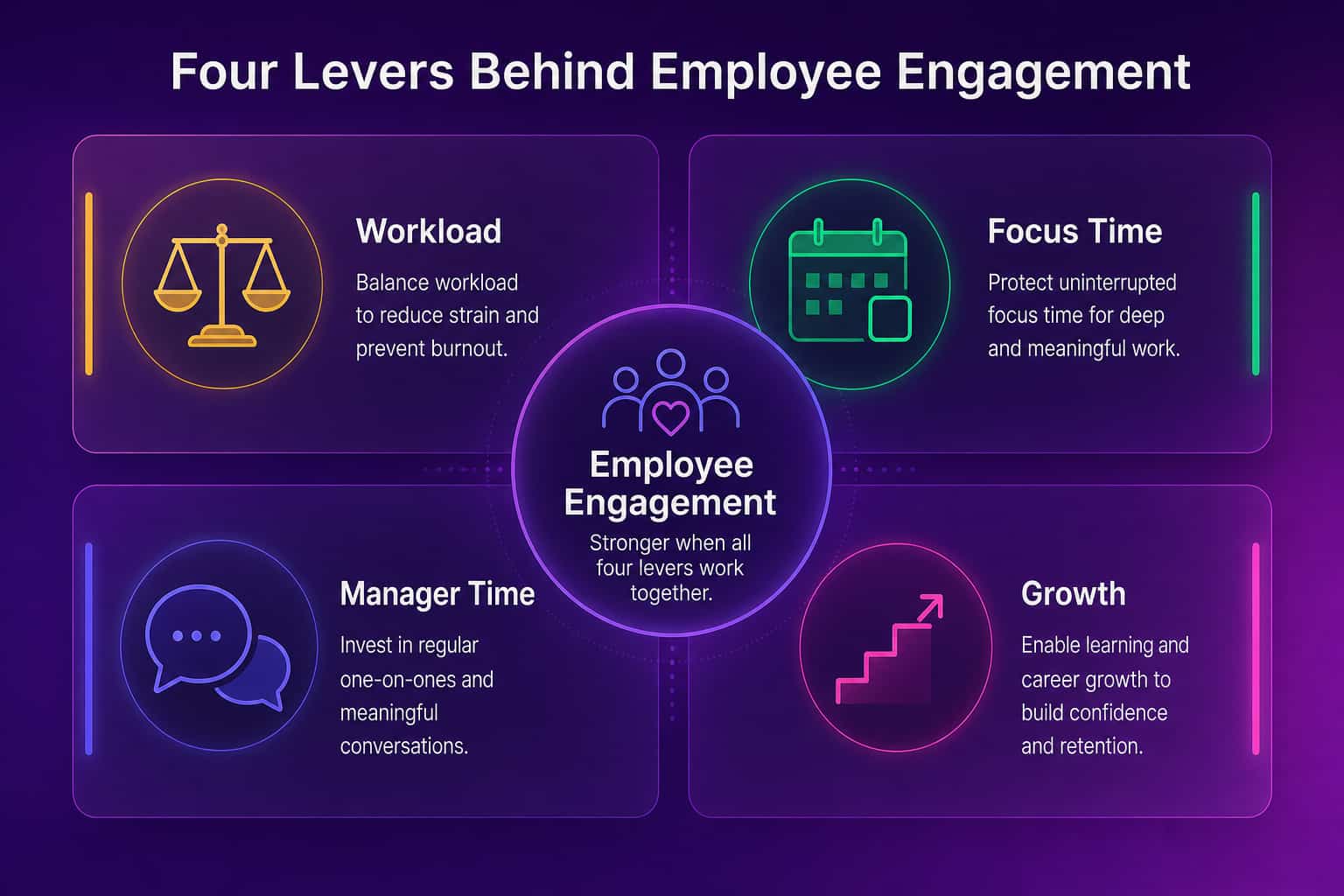
| Strategy | What to change | Signal to watch |
|---|---|---|
| Rebalance workload | Move tickets and on-call off the people carrying the most | Work concentration per person, after-hours activity |
| Protect focus time | Cut recurring meetings, set meeting-free blocks | Meeting hours per person, length of focus blocks |
| Keep one-on-ones regular | Fixed cadence, agenda prepared ahead | One-on-one cadence per manager |
| Clarify priorities | Fewer active projects, explicit "not now" list | Work in progress per person, context switching |
| Recognize real work | Name the shipped thing, not the effort | Recognition tied to delivered work |
| Show the growth path | Stretch assignments, visible criteria for the next level | Breadth of collaboration, new areas touched |
A few notes from what I have seen.
- Start with workload. If you only do one thing, do this one. Overload is the fastest path from engaged to burned out, and burnout often looks like disengagement from the outside. Our burnout detection software is built to flag burnout 60+ days early from work patterns, without surveys or surveillance.
- One-on-ones are the cheapest engagement tool you own, and they get cancelled first when things get busy. A good one-on-one agenda makes them easier to keep.
- Stay interviews beat exit interviews. Ask people what would make them leave while they are still here. Our guide to the stay interview has the questions.
- Recognition has to be specific. "Great job this quarter" lands as noise. "The migration you finished cut our deploy failures" lands.
Notice what is missing: offsites, swag, and wellness apps. They are fine as extras. They are not where engagement is won or lost.
Do employee engagement activities still matter?
Employee engagement activities still matter as a way to build relationships across a team, especially remote or hybrid ones where people rarely meet, but they work as a supplement to a strategy and never as a replacement for one, because an activity cannot fix workload, priorities, or a manager who has not held a one-on-one in two months. A virtual coffee pairing or a demo day where people show what they shipped can help. The demo day is the better example, honestly, because it ties the activity to real work and gives people visibility for what they built. The activities that fail are the ones that ask exhausted people for more time. If your team is already working evenings, a mandatory social hour feels like another meeting. Run activities after you have fixed the load, not instead of fixing it.
How do you measure whether an engagement strategy is working?
You measure an engagement strategy by choosing a small set of work signals before you start, reading them at the team level every month, and pairing them with direct conversations, because a pulse survey alone is too slow and a single data source alone can mislead you about who is or is not engaged. The useful signals for most tech companies are meeting hours per person, the length of uninterrupted focus blocks, after-hours activity, one-on-one cadence, pull request review wait time, and how widely people collaborate across the org. When engagement is improving, focus blocks get longer, after-hours work comes down, and one-on-ones happen on schedule. When it is slipping, the opposite shows up weeks before anyone resigns.
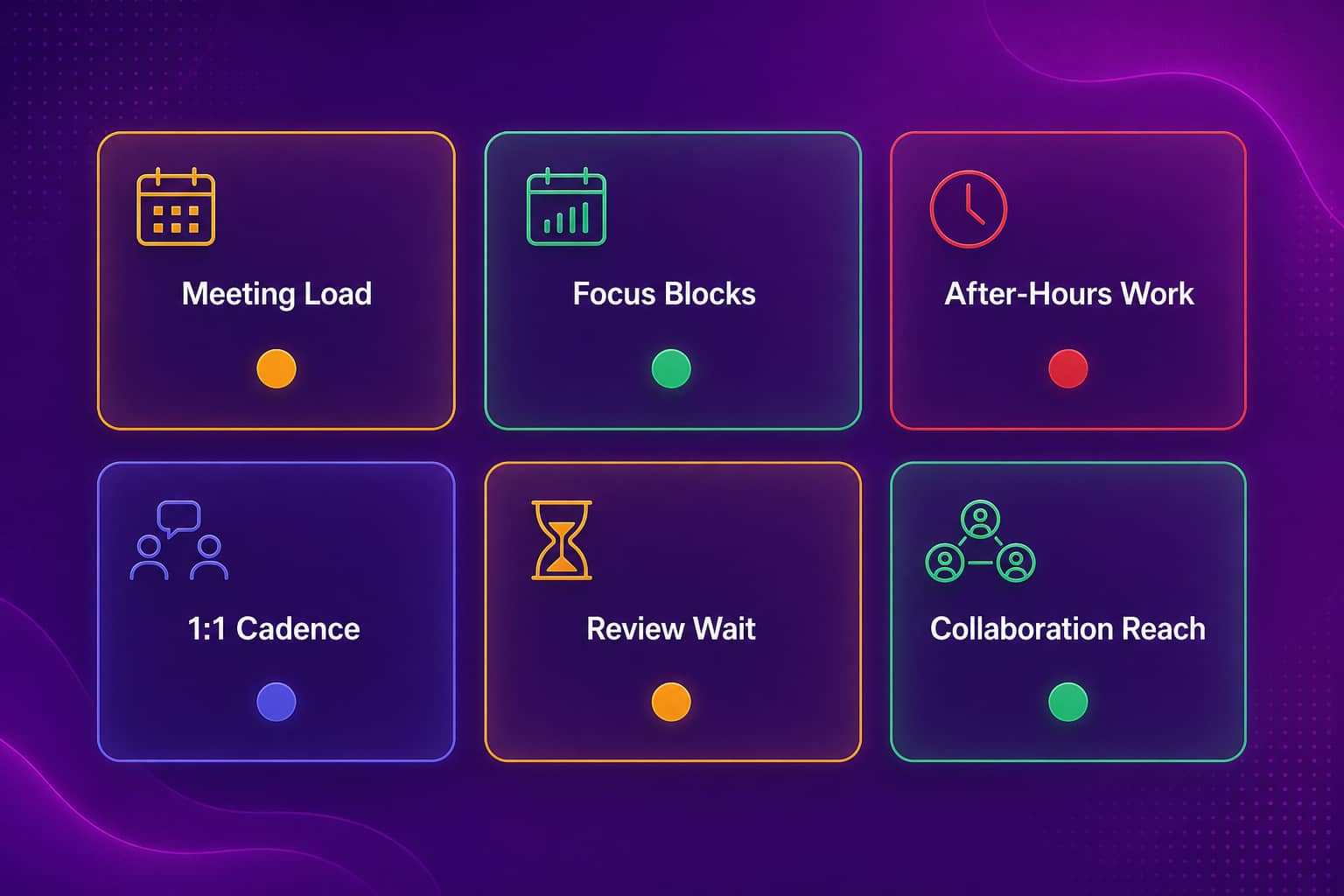
This is the part I care about most, because it is where engagement measurement usually turns into surveillance. Abloomify does it with two data layers: 100+ API integrations that pull PII-free signals (no email content, no message content, no file content), and optional privacy-first device agents that report aggregated usage with no screenshots, no keyloggers, and no screen recording. Leaders see the trend. Nobody reads anyone's chat. If you want the step-by-step, our guide on spotting quiet quitting without monitoring walks through it.
How do you build an employee engagement plan?
Build an employee engagement plan as a one-page document that names a specific problem, picks one or two changes to fix it, assigns an owner to each, lists the signals you will watch, and sets a date to check them, because a short plan with clear owners gets executed while a long list of initiatives gets presented once and forgotten. Start with the data, not with ideas. Find the team with the worst meeting load or the most after-hours work, talk to the manager, and agree on a change. Then wait long enough for the signal to move. A month is usually too short to judge. A quarter is about right.
Here is the shape I would use:
- Problem: "The payments team is averaging long weeks and two engineers are covering all on-call."
- Change: move on-call to a rotation across the wider group and cancel two recurring status meetings.
- Owner: the engineering manager, with the VP checking in monthly.
- Signals: after-hours activity, focus block length, review wait time.
- Check date: end of the quarter, plus a stay interview with the two engineers.
That is the whole plan. If you want a survey in the mix, our piece on engagement surveys for the workplace covers how to run one that people trust. And if you want to put a dollar figure on what losing people costs, the employee turnover calculator takes about a minute.
I will admit the uncomfortable part. Some disengagement is not fixable with better management. Sometimes the person is in the wrong role, or the company changed and they did not want the new version. A good strategy helps you see that sooner, so the conversation happens in month two instead of after the resignation letter.
If you want to see your team's workload, focus time, and one-on-one patterns before deciding where to start, book a demo and we will walk through it on your own data.
FAQ
What are the most effective employee engagement strategies?
The strategies that hold up change the conditions of the work itself: fixing uneven workload, protecting focus time, keeping one-on-ones regular, making goals clear, recognizing real contributions, and giving people a visible growth path. Perks and events help morale for a day. Workload and manager attention move engagement for months.
What is the difference between employee engagement activities and strategies?
Activities are events: a team lunch, a trivia night, a volunteering day. Strategies are changes to how work is designed and managed, such as rebalancing load or protecting focus time. Activities can support a strategy, but a team that is overloaded and blocked will not be re-engaged by a pizza Friday.
How do you measure employee engagement without surveys?
Look at work patterns at the team level: meeting load, uninterrupted focus time, after-hours activity, one-on-one cadence, review wait time, and how widely people collaborate. Abloomify reads these from calendar, GitHub, Jira, and other tools through API integrations, PII-free, with no screenshots and no keyloggers. Surveys still help explain the why.
What should an employee engagement plan include?
A short employee engagement plan names the problem you are fixing, the one or two changes you will make, who owns them, which signals you will watch, and when you will check. Keep it to a page. A plan with fifteen initiatives usually means none of them get finished.
Why is employee engagement important?
Disengagement shows up as slower delivery, quiet quitting, and resignations that surprise managers. Replacing people is expensive, and the knowledge that leaves with them is hard to rebuild. Abloomify claims a 62% turnover reduction on its HR leaders page, which is the outcome most leaders are really buying when they invest in engagement.

Amir Tavafi
Co-Founder & CEO
Product leader and innovator with over 15 years of experience in the tech sector, grounded in AI and robotics. Previously led product development in fraud detection and AI solutions at Nasdaq Verafin.