The One-on-One Agenda That Actually Moves Outcomes (2026)
May 19, 2026
Amir Tavafi
10 min read

Most one-on-one agendas in tech look like a status meeting in a trench coat. Project, blocker, project, blocker, "anything else?", goodbye. The keyword "one-on-one agenda" attracts buyers who want a template, but a template is rarely the problem. The problem is what gets on the agenda in the first place. After three customers and a few hundred leadership calls at Abloomify, here is the agenda structure that actually moves outcomes, what to cut, and how to fill it in 5 minutes from real work data.
Key Takeaways
Q: What is a good one-on-one agenda?
A: Short, predictable, weighted toward the employee. Employee topics first (10 min), career and feedback (8 min), 2 to 3 data-driven manager topics (8 min), commitments and follow-up (4 min). Status updates belong in Jira or a written update, not on the one-on-one agenda.
Q: What is the biggest mistake with one-on-one agendas?
A: Filling 25 of 30 minutes with status. If the employee narrates their commits and you nod, the meeting is doing the wrong job. Status is dashboard work. Coaching, blockers, feedback, and career are human work. The agenda has to protect the second half from the first.
Q: How do you prep a one-on-one agenda quickly?
A: Pull the work signal first, then write the agenda. Abloomify generates a one-on-one prep brief from GitHub, Jira, Slack, Google Workspace, and 100+ other integrations, without screenshots or content capture, so a manager picks 2 to 3 topics in 5 minutes instead of digging across five tools.
Q: Who should own the one-on-one agenda?
A: Both. The employee brings the first half (topics, blockers, career questions). The manager brings the second half, anchored in 2 to 3 specific work signals. Shared ownership keeps the meeting from collapsing into either a status check-in or an unstructured vent.
What a one-on-one agenda is actually for
A one-on-one agenda is the contract between a manager and a direct report for what their 30 minutes will earn them, and what it will not. In 2026 the meeting carries a heavier job than it used to, because async tools have eaten almost everything else: status lives in Jira and GitHub, project decisions live in linear docs, sentiment lives in Slack reactions, even peer recognition has moved out of the 1:1. What is left is the human work, coaching, feedback, removing blockers, career direction, repairing trust, and catching the early signals of burnout or disengagement before they become resignations. A good agenda makes sure those topics actually get airtime instead of getting bulldozed by status. The manager's job is to defend the meeting from itself. The agenda is the lever for that defense, not a checklist.
The phrase "we have great 1:1s" usually translates to "the meeting feels nice and we both leave on time." That is a low bar. The meaningful bar is whether the meeting produced a decision, a behavior change, a removed blocker, or a real piece of feedback. If you cannot point to one of those after the meeting, the agenda did not work.
The 4 problems with most one-on-one agendas
Most one-on-one agendas in tech share four predictable failures, and the agenda template never fixes them. The first failure is status creep, where 70 to 80% of the time gets spent narrating tickets the manager could have read in 90 seconds. The second is recency bias, where both people talk about whatever happened yesterday and nothing structural ever gets surfaced. The third is the missing data, where the manager wants to coach but has no idea their direct report has been past 9 PM commits four days in a row, has had zero deep-work blocks this sprint, or is suddenly dropping out of review threads. The fourth is the follow-up gap, where the meeting produces an action item that nobody captures and nobody revisits next week. None of these are personality problems. They are structural problems with how the agenda is built.
A one-on-one agenda template that actually works
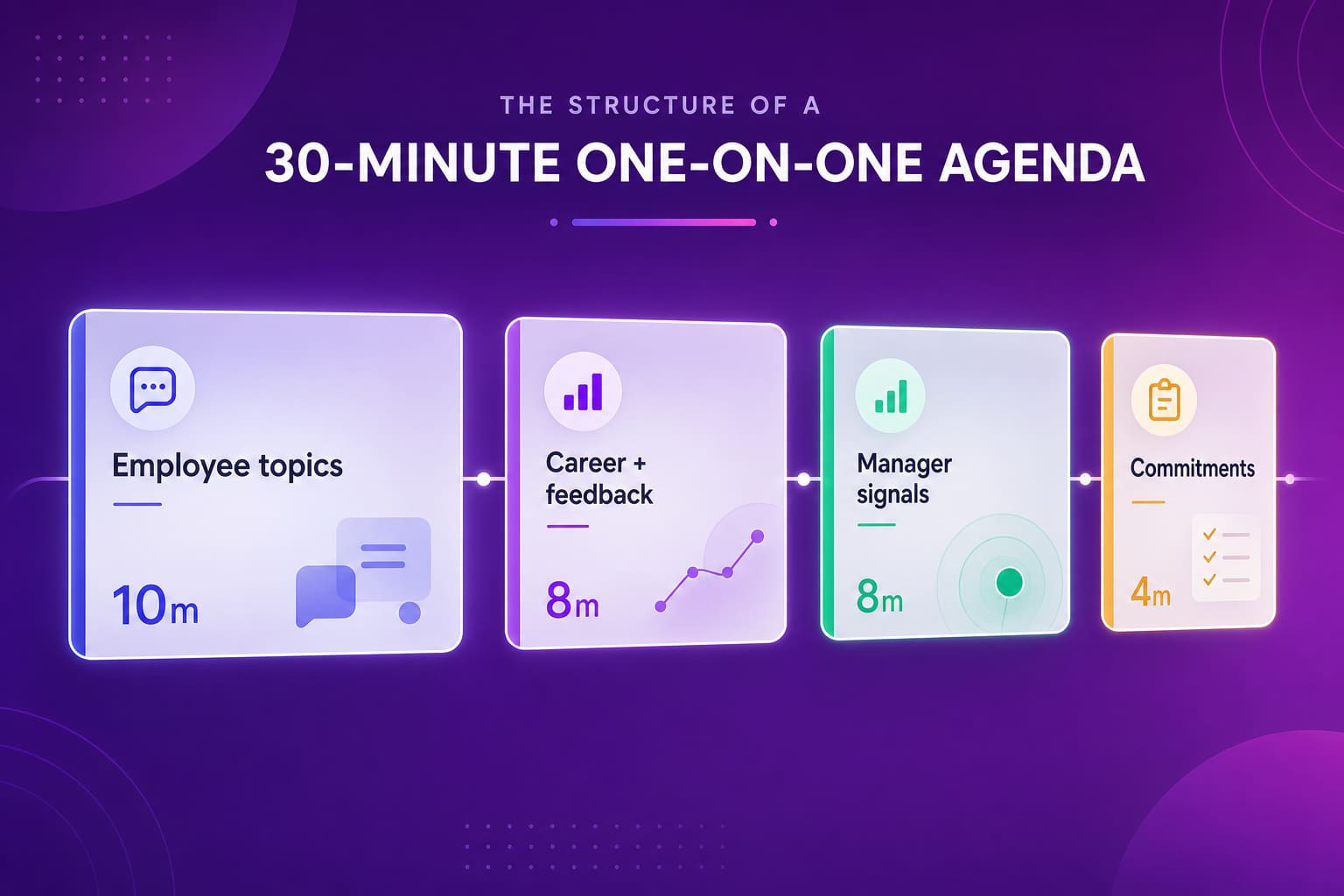
The one-on-one agenda template that holds up across 50, 400, and 3,500-person tech companies is short, weighted to the employee, and disciplined about cutting status. 30 minutes weekly, four blocks. Block 1 (10 min) is the employee's. They bring 2 or 3 topics, blockers, or questions, in whatever order. Block 2 (8 min) is career and feedback. Even a one-sentence exchange counts. Block 3 (8 min) is manager-led, 2 to 3 specific topics rooted in real work signals from the last week, not vibes. Block 4 (4 min) is commitments, the 1 or 2 things either person will own before next week, written down. The agenda is the same every week, which is the point. Predictability is what makes it possible for an employee to bring a hard topic without rehearsing it.
The reason this works is that it forces the manager to do the data work outside the meeting. If you walk in cold, you default to status by gravity. If you walk in with 2 to 3 specific topics already noted (a PR cycle trend, a meeting load spike, an unread review, a customer call), you skip the 20 minutes of "tell me what you have been doing" and go straight to the conversations that matter.
How to fill the agenda in 5 minutes using real work data
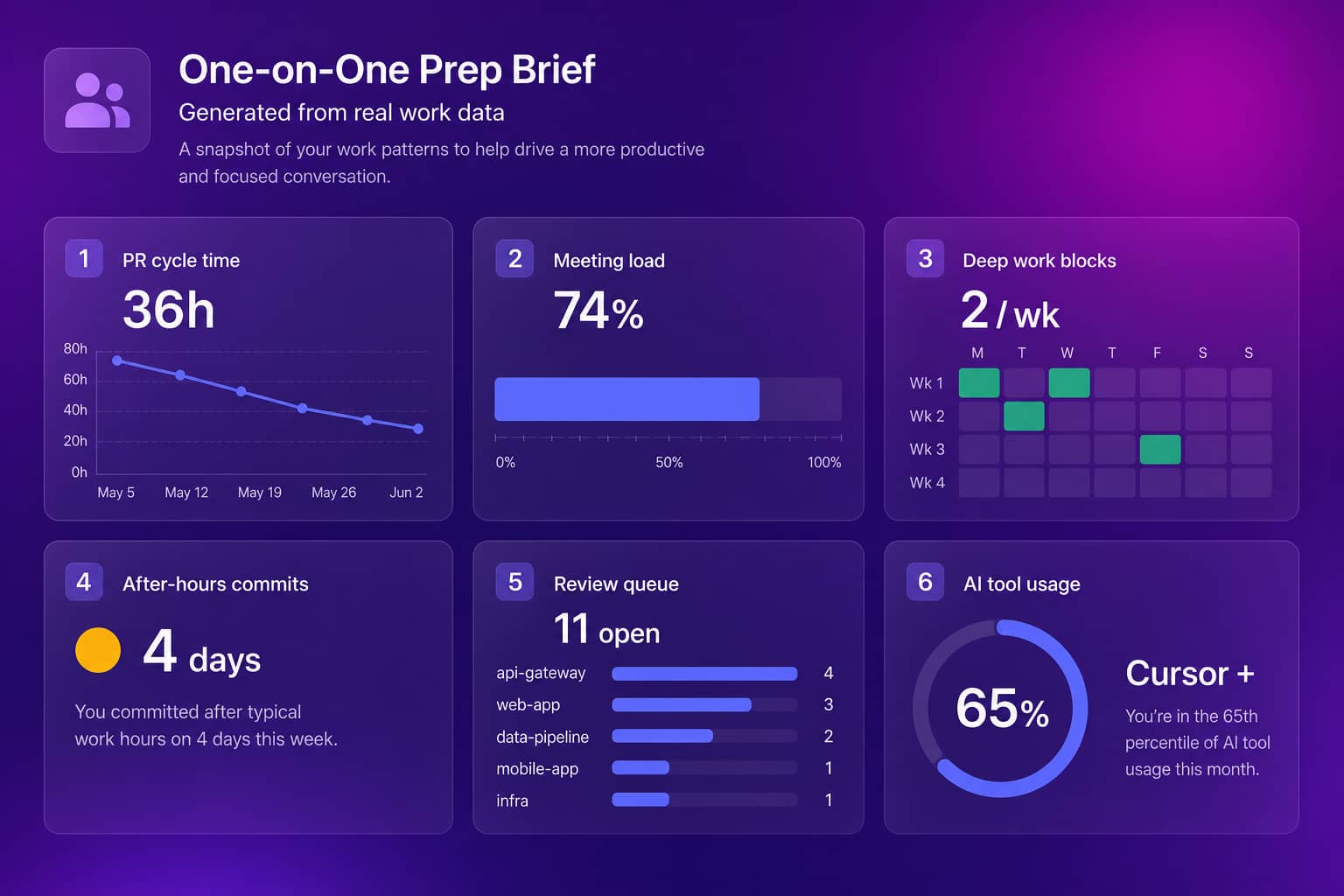
The hard part of running this agenda is not the meeting itself. It is the 30 minutes a week per direct report that a thoughtful manager spends digging through Jira, GitHub, Slack, and the calendar to find the 2 to 3 topics worth a Block 3. For a manager of 8, that is 4 hours a week, every week, just on prep. Most managers give up by month two and the meeting slides back into status. The fix is to let the work systems surface the signals automatically, instead of hunting for them by hand. Abloomify pulls PR cycle time, review queue health, meeting load, deep-work blocks, after-hours patterns, and AI coding tool usage from 100+ integrations like GitHub, Jira, Google Workspace, M365, and Cursor, then generates a one-on-one prep brief for each direct report. No screenshots, no keyloggers, no screen recording, no content capture. Just the work signal the manager would have found if they had 4 hours a week to look for it.
The benefit is not "1:1 prep automation" for its own sake. The benefit is that the manager arrives with 2 to 3 specific, defensible topics instead of one generic question. Specific topics build trust. "How is the project going?" does not. "How to Prep Effective 1:1s in 5 Minutes" covers the prep workflow in more detail. For the data-pattern side, the employee burnout detection guide explains which signals are worth surfacing in a 1:1 before they become a resignation.
What to drop from your one-on-one agenda
The shortest path to a better one-on-one agenda is to delete things, not add them. Drop status updates first. If the employee is narrating their commits and tickets, you are using a 30-minute synchronous channel to do the work a Jira board or GitHub PR feed already does. Drop project tracking ceremony. The 1:1 is not a stand-up. Drop "anything I can do to help?" as the closer if you never come back to it the next week. Drop the rotating "skill of the week" templates that some performance management vendors push, because they turn the meeting into a quiz. Drop the practice of taking your own notes silently while the employee talks. Drop the part where you write the recap in the next 24 hours instead of the next 5 minutes. Each of these is a small leak, and together they explain why managers who run 8 one-on-ones a week still cannot tell you what is going on with their team.
How the one-on-one agenda fits into the rest of performance management
A one-on-one agenda is the operating system for weekly coaching, but it is not a substitute for the rest of the performance management stack. The 1:1 catches the day-to-day pattern. The monthly career conversation handles the medium-term direction. The quarterly review handles outcomes and compensation conversations. The annual review handles role and band. If a manager tries to do all of this inside a 30-minute weekly agenda, the meeting collapses, and the conversation that should have been a quarterly review at 60 minutes becomes a rushed 8 minutes squeezed between status updates. Each meeting has a job. The one-on-one's job is the weekly pattern and the human signal.
The other place the agenda intersects with the broader stack is the performance review. Reviews go badly when the manager has to reconstruct nine months of context from memory. They go well when the 1:1 has produced a usable signal trail every week. The agenda is the trail. If you run it well, the review writes most of itself.
FAQ
What is a good agenda for a 1:1 meeting?
A good one-on-one agenda is short, predictable, and weighted toward the employee. The structure that holds up across 50 to 3,500-person tech companies: employee topics first (10 min), career and feedback (8 min), 2 to 3 specific data-driven topics from the manager (8 min), then commitments and follow-up (4 min). Status updates do not belong on the agenda. Move them to async.
What should you not put on a one-on-one agenda?
Cut status updates, project tracking ceremony, and anything answerable from a dashboard. Status belongs in Jira, GitHub, or a written update. A one-on-one agenda is for coaching, blockers, feedback, career, and the conversations that need a human. If half your 1:1 is the employee narrating their commits, the meeting is doing the wrong job.
How long should a one-on-one meeting be?
30 minutes weekly is the strong default for tech teams. Some engineering leaders run 25 minutes weekly to leave a buffer. 60 minutes monthly works only if you also have lightweight async check-ins. Skip-level 1:1s run 45 to 60 minutes, every 6 to 8 weeks. If your 30 minutes is filling with status, the cadence is fine and the agenda is the problem.
Who owns the one-on-one agenda, the manager or the employee?
The employee owns the first half of the agenda. They bring topics, blockers, and direction questions. The manager owns the second half, with 2 to 3 specific topics rooted in real work signals (a PR cycle trend, a meeting load spike, a customer call). Shared ownership beats either extreme. If the manager owns 100%, it becomes a status meeting. If the employee owns 100%, coaching disappears.
How do you prep a one-on-one agenda in 5 minutes?
Stop manually reviewing Jira, GitHub, and Slack before each meeting. Use a tool that pulls work-pattern data from connected systems (commits, PR cycle time, meeting load, deep-work blocks, AI tool usage) and surfaces the 2 to 3 things worth talking about. Abloomify generates a 1:1 prep brief from 100+ integrations without screenshots or content capture, so prep takes minutes, not half an hour.

Amir Tavafi
Co-Founder & CEO
Product leader and innovator with over 15 years of experience in the tech sector, grounded in AI and robotics. Previously led product development in fraud detection and AI solutions at Nasdaq Verafin.