Employee Burnout Detection: A Data-Driven Guide for Remote Teams
April 8, 2026
Walter Write
4 min read

Why relying on surveys alone misses burnout
Periodic engagement surveys are a common tool for measuring employee wellbeing. As the only early-warning system, they are deeply flawed for burnout detection—even though structured surveys still matter for sentiment and program cadence:
- They are periodic (quarterly at best). Burnout develops between surveys.
- They rely on self-reporting. Burned-out employees often mask their state or do not complete surveys.
- Response rates average 40-60%. The most disengaged employees are least likely to respond.
- They measure sentiment, not behavior. Someone can say they are "fine" while working 60-hour weeks.
Continuous work-pattern analytics detects burnout from behavioral signals that are always on, always honest, and do not depend on someone filling out a pulse at the right moment. On Abloomify, that layer sits alongside native surveys, continuous and anonymous feedback, and recognition on every plan—so leaders get both sentiment programs and always-on behavioral risk signals. Bloomy, the AI agent, can explain trends and cohort risk in natural language on live dashboards whenever you need clarity between formal review cycles.
The 6 burnout signals in work data
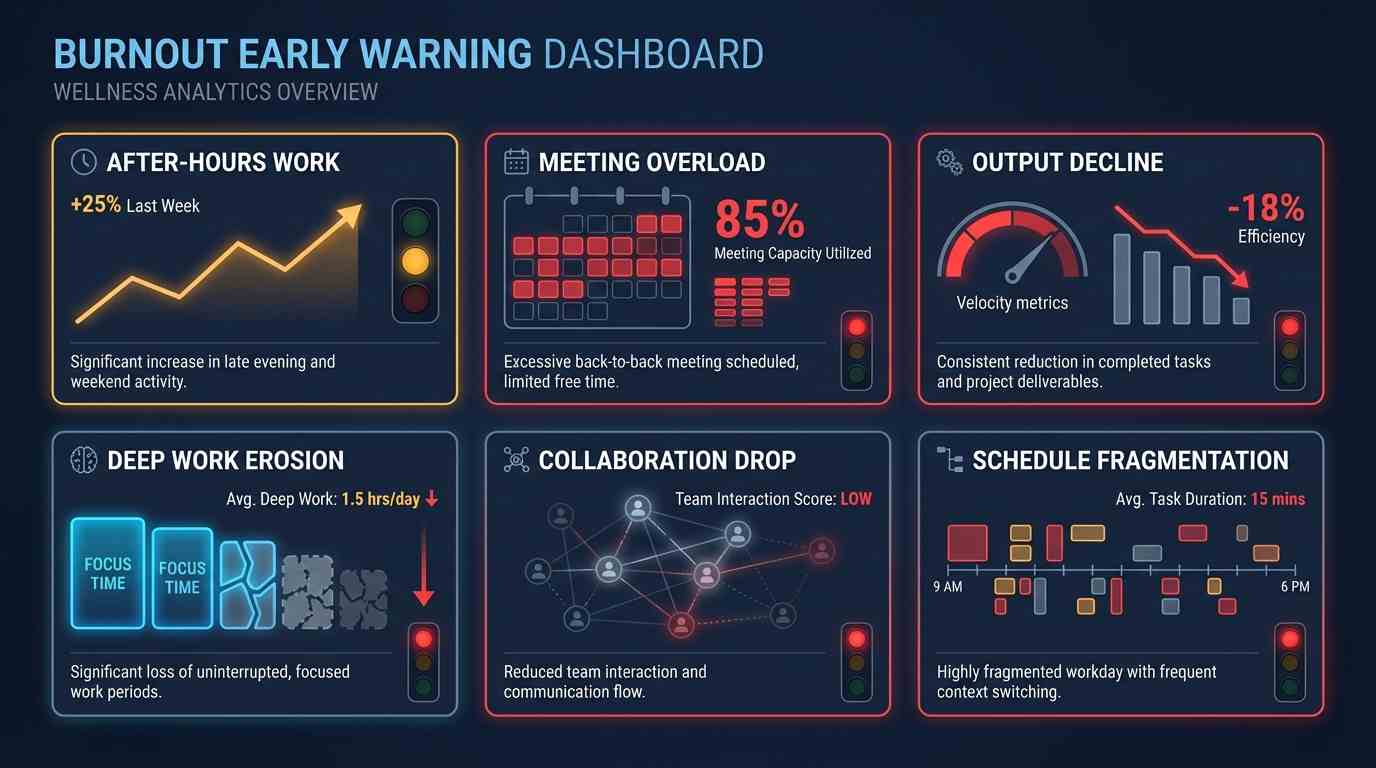
1. After-hours work creep
Gradual increase in work activity after 6 PM and on weekends. A sustained pattern of 10+ hours/week of after-hours work is a strong burnout predictor.
2. Meeting overload
When meeting hours exceed 20/week, burnout risk doubles. The employee has no time for the actual work, so they do it after hours, creating a death spiral.
3. Output velocity decline
A previously productive employee whose delivery velocity drops 20%+ over 4 weeks is showing disengagement or exhaustion. This is measurable from Jira and GitHub data.
4. Deep work erosion
When uninterrupted focus time drops below 8 hours/week, the employee cannot do meaningful work during business hours. Everything important gets pushed to nights and weekends.
5. Collaboration withdrawal
Declining Slack activity, fewer PR reviews, and reduced cross-team interactions signal social withdrawal, a classic burnout symptom.
6. Schedule fragmentation
When an employee's calendar has no block longer than 30 minutes, every day is a series of context switches. This is exhausting and unsustainable.
Remote teams are more vulnerable
Remote teams face higher burnout risk because:
- No visible cues (managers cannot see fatigue, body language, or social withdrawal).
- Always-on culture (no physical separation between work and home).
- More meetings (remote teams compensate for lack of hallway conversations with calendar invites).
- Isolation (less social connection, fewer informal check-ins).
This makes data-driven detection even more critical for remote-first companies.
What managers should do with burnout signals
When Abloomify flags an employee as high-risk:
- Do not say "the algorithm says you are burned out." Instead, use data as conversation context.
- Reduce meeting load: cancel or shorten 2-3 recurring meetings.
- Protect deep work: block 2-3 hours of uninterrupted focus time on their calendar.
- Adjust workload: temporarily reduce sprint commitments.
- Acknowledge contributions: recognition reduces burnout by validating effort.
FAQ
How is this different from an engagement survey?
Pulse and engagement surveys ask how people feel at a point in time. Continuous work-pattern analytics monitors behavioral signals that predict burnout between survey waves. It catches roughly the 40% of cases that surveys alone miss because it does not depend on self-reporting or response rates. Abloomify runs both: native surveys and feedback for program cadence, plus behavioral early warning so managers are not flying blind between pulses.
Is burnout detection privacy-safe?
Yes. Abloomify analyzes metadata (calendar timing, activity patterns, output trends) without reading message content or taking screenshots. Burnout risk is surfaced to direct managers only, with coaching guidance.
How quickly can we start detecting burnout?
Connect calendar and project management tools and data begins flowing immediately. Risk views update as new signals arrive; baseline calibration for stable scoring typically settles within about two weeks depending on volume.
Bloomy: ask about burnout risk on live data
Use Bloomy for instant, privacy-safe explanations of team patterns and recommended manager actions—alongside always-updating analytics.
See Bloomy in action
Capacity Planning

Do we have capacity to take on the Q3 roadmap?
How can I help?
What to read next

Walter Write
Staff Writer
Tech industry analyst and content strategist specializing in AI, productivity management, and workplace innovation. Passionate about helping organizations leverage technology for better team performance.