Engagement Surveys for the Workplace That Actually Work (2026)
August 12, 2026
Amir Tavafi
12 min read

Engagement surveys for the workplace usually die the same way: a form goes out, scores come back, and nothing visibly changes before the next one lands in everyone's inbox. Abloomify's customers taught us the fix comes down to three things: a tighter question set, a cadence people can actually sustain, and a real habit of closing the loop.
Key Takeaways
Q: What is an employee engagement survey?
A: An employee engagement survey asks people how committed, motivated, and supported they feel at work, usually through scaled questions plus a couple of open-ended prompts. Treat it as one input, not the whole picture: self-reported sentiment paired with observed work patterns like collaboration and delivery rhythm.
Q: What questions should an engagement survey for the workplace include?
A: Cover five areas: purpose and alignment, trust in leadership, growth and development, workload and capacity, and one open-ended prompt. Ten to fifteen well-chosen questions beat thirty. Each question should map to something you're actually willing to act on if the score comes back bad.
Q: How often should you run engagement surveys?
A: Most companies do best with one deep annual survey plus short quarterly pulses of three to five questions. Continuous, always-on pulse tools suit larger orgs with a dedicated people-analytics function. Running full-length surveys more than twice a year usually buys fatigue, not better data.
Q: What's the biggest mistake companies make with engagement surveys?
A: Not closing the loop. People give up 15 minutes to a survey, wait weeks, then never hear what changed. That's the fastest way to tank next year's response rate. A published, specific action plan matters more than another wave of questions.
Q: Do engagement surveys tell you the whole story?
A: No. Surveys are self-reported and land once or twice a year, so they lag reality by months. One Abloomify customer, a 3,500-person enterprise, found a single data source correlated poorly with actual performance. Pair survey sentiment with observed work signals for the fuller read.
What actually goes wrong with engagement surveys for the workplace
Most engagement surveys for the workplace fail for reasons that have nothing to do with the questions on the page: response rates erode year over year because people remember the last survey and the silence that followed it, scores skew toward whoever happens to be paying attention that week, leadership treats the results as a scorecard to defend instead of a map to act on, and the whole exercise gets handed to HR as a once-a-year compliance ritual instead of owned by the managers who are actually in a position to change anything, none of which is a tooling problem, since Culture Amp, Qualtrics, and 15Five all ship perfectly capable survey builders, which means the failure sits upstream, in the design and the follow-through, exactly where most companies stop paying attention.
Watch for three tells that a program is already broken: response rate has dropped two years running, nobody outside HR can name last year's top action item, and managers see a company-wide average but never their own team's breakdown. Any one of those means the survey has become theater. Fix the theater before you touch the question bank.
What questions to ask in an engagement survey for the workplace
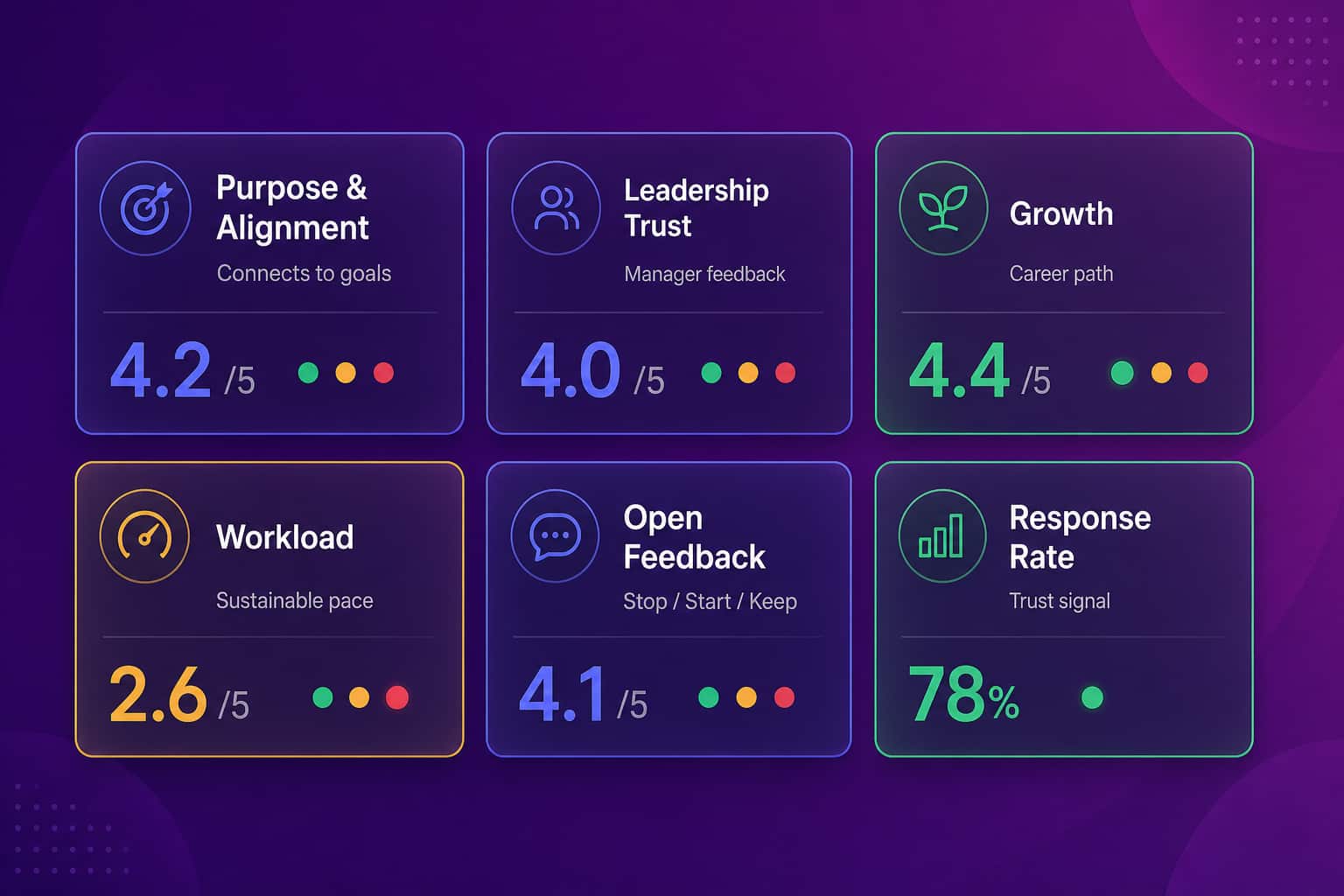
A good engagement survey for the workplace asks fewer questions than most HR templates suggest, because response quality drops fast after question fifteen and each additional item buys diminishing signal at a rising completion-time cost, so the workable target is ten to fifteen questions split across five categories: purpose and alignment (does my work connect to something that matters), trust in leadership and managers (do I believe what leadership tells me, does my manager have my back), growth and development (can I see a path forward here), workload and capacity (is the pace sustainable), and one genuinely open-ended prompt that lets people say the thing a five-point scale can't capture. Every question should map to something your company is actually willing to change if the answer comes back bad. A question nobody plans to act on is decoration, not data.
A workable starting bank, five categories, two to three questions each:
- Purpose and alignment: "I understand how my work connects to the company's goals." / "I would recommend this company as a place to work."
- Trust in leadership: "I trust the decisions senior leadership makes." / "My manager gives me useful, honest feedback."
- Growth and development: "I have opportunities to learn and grow here." / "I can see a path for my career at this company."
- Workload and capacity: "My workload is sustainable most weeks." / "I have the tools and time I need to do my job well."
- Open-ended: "What's one thing we should stop, start, or keep doing?"
Score each on a 5-point scale, not a 10-point one. More granularity feels rigorous and mostly adds noise; people don't reliably distinguish a 7 from an 8.
How often to run engagement surveys for the workplace
The right cadence for engagement surveys for the workplace depends less on best practice and more on whether you can realistically act between waves, which is why a deep annual survey, 25 to 40 minutes across all five categories, works well when paired with two or three short pulse checks of three to five questions spaced through the year, giving leadership a full baseline once a year and an early-warning trend line in between, while a fully continuous, always-on pulse model, pushing one or two questions a week, suits larger companies with a dedicated people-analytics function that can actually keep up with the incoming data, and the failure mode to avoid either way is running full-length surveys more than twice a year, since response rates drop and the fatigue shows up as shorter, less honest answers exactly when you need the opposite.
| Cadence | Length | Best for | Watch out for |
|---|---|---|---|
| Annual deep survey | 25-40 min, all five categories | Baseline read, board reporting | Only one or two data points a year |
| Quarterly pulse | 3-5 questions | Trend lines between deep surveys | Needs a fast, visible action loop |
| Continuous / always-on | 1-2 questions a week | Larger orgs with dedicated analytics capacity | Survey fatigue if scope creeps |
How to get a response rate people take seriously
People stop filling out engagement surveys for the workplace for reasons that are almost always about trust, not survey length: they don't believe the last one changed anything, the survey eats a real chunk of a workday, it lands during a crunch week, or they suspect "anonymous" doesn't actually mean anonymous at a 40-person company, and fixing the response rate means fixing those four things before you touch a single word of question wording, which in practice looks like keeping the survey under 10 minutes, sending it when the team isn't mid-sprint or mid-close, guaranteeing anonymity and meaning it, including in how results get reported back (aggregate any team under five people), and making it genuinely mobile-friendly, since a meaningful share of your workforce will open the link on a phone between meetings.
The fastest lever most companies ignore: tell people what happened with last cycle's results before you ask for this cycle's answers. A two-line email, "here's what we heard, here's what we did," done before the new survey goes out, moves response rates more than any incentive program.
How to act on engagement survey results without another deck nobody reads
An engagement survey that ends in a slide deck circulated to leadership and nowhere else was never worth running, because the people who answered the questions are the ones who need to see something move, and a lot of what eats a leader's week instead is exactly this kind of low-value follow-through: chasing team leads for their completion numbers, copy-pasting scores into a board deck, turning open-ended comments into action items nobody assigns an owner to, which is admin dressed up as leadership and the reason so many engagement programs quietly die after year two, so the fix has to be mechanical rather than inspirational, meaning every manager publishes two or three specific actions for their own team within two weeks of results landing, each with an owner and a date, and the next survey cycle opens by reporting what actually happened against last cycle's list.
If a team's score doesn't move and the manager can't point to a specific thing they tried, that's a signal in itself, worth a real conversation before the next survey even goes out.
Where engagement surveys for the workplace fall short
Engagement surveys for the workplace have a real limitation worth naming honestly: they're self-reported and arrive once or twice a year at best, which means they describe how people felt in the window they answered rather than how the work has been going since, people also tend to answer the way they think is safe rather than the way they actually feel, especially on anything touching leadership trust, and a healthy company-wide average can sit directly on top of two or three teams that have quietly checked out, all of which argues for treating a survey as one instrument among several, best read next to how the work is actually moving, rather than as the only number in the room.
For the deeper argument on why observed work patterns catch drift months before a survey does, see our workforce engagement definition guide. And if you're deciding between building this program in-house or buying dedicated survey software, our review of employee engagement software covers where tools like Culture Amp fit versus a lighter DIY approach.
Pairing survey data with real work signals
Pairing survey data with work signals means reading the survey's sentiment score next to what the connected work tools are already showing about focus time, collaboration breadth, and delivery rhythm for that same team, so a dip in trust-in-leadership answers either gets confirmed by slipping delivery and rising after-hours activity, or gets flagged as noise worth a follow-up conversation before anyone overreacts to one bad quarter, which Abloomify does by pulling those signals PII-free across 100+ connected tools, including Google Workspace, Microsoft 365, GitHub, Jira, and Slack, with optional device agents that capture aggregated metrics only, never screenshots or keystrokes, so the survey still asks people how they feel while the work data shows whether that feeling is actually showing up in how the team operates.
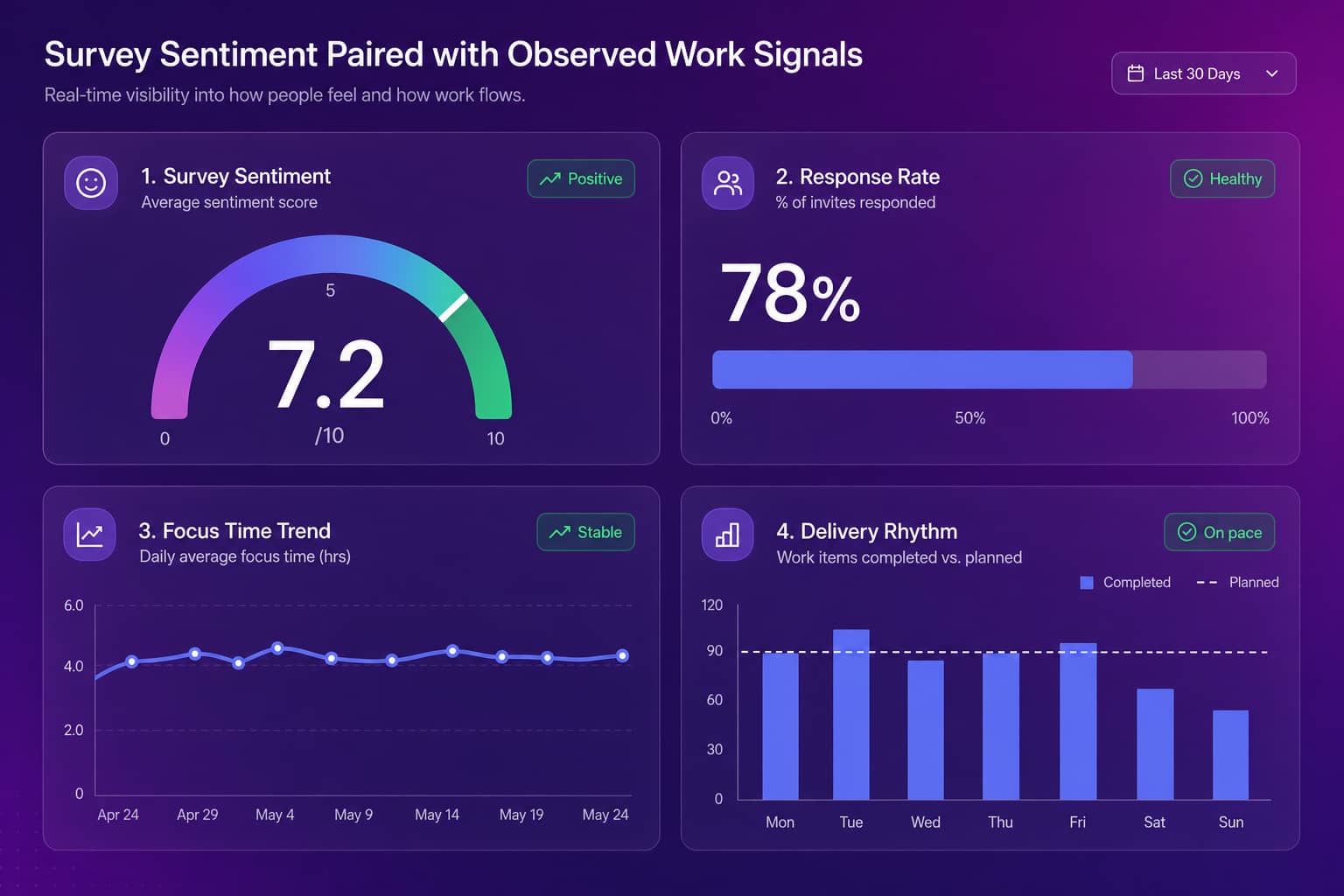
This is the practical version of what our for HR leaders page covers in more depth: a survey program that doesn't stand alone, feeding a manager conversation that already has context instead of a blank scorecard.
How to evaluate your engagement survey program for 2026
Here's a simple test: if you can't name what changed for employees because of last year's engagement survey, the program needs fewer questions and more follow-through rather than a bigger vendor contract, so before your next cycle run through four checks, is the question count under fifteen with each one mapped to a real action, is the cadence realistic for your team to actually respond to, is last cycle's action plan published somewhere people can check it, and does every manager see their own team's breakdown rather than one company-wide number, and if any answer is no, fix that before adding a single new question. A survey that gets acted on beats a longer survey every time. Big companies run engagement programs like compliance exercises. The ones that get real signal treat every cycle like a promise they intend to keep.
Disengagement gets expensive quietly, well before it shows up as a resignation letter. If you want a sense of what it's costing your team right now, our turnover cost calculator is a fast way to put a number on it.
FAQ
What is a good employee engagement survey response rate?
Above 70% is strong for an internal workplace survey. Below 50% usually means people have stopped believing anything happens with the results. Response rate is itself a leading indicator of trust, so if it's falling year over year, fix the follow-through before you touch the question set.
How long should an engagement survey be?
Ten to fifteen questions for an annual deep survey, three to five for a quarterly pulse. Completion time should stay under 10 minutes. Every question past that adds drop-off risk without adding much real signal, especially on mobile.
Should engagement surveys be anonymous?
Yes, for the core survey. Anonymity is the difference between someone rating "trust in leadership" honestly and rating it the way they think is safe. Keep manager-level breakdowns aggregated at five or more responses so no individual answer can be reverse-identified.
What's the difference between an engagement survey and a pulse survey?
An engagement survey is the deep, multi-category read, usually annual. A pulse survey is short and frequent, often three to five questions, tracking trend rather than depth. Most workplace programs need both: the pulse catches drift, the deep survey explains it.
Is an engagement survey the same as measuring workplace engagement?
Not quite. A survey measures self-reported sentiment at a point in time. A fuller workplace engagement definition includes how people actually work: focus time, collaboration, delivery rhythm. Our workforce engagement definition guide covers how survey data and observed work signals fit together.

Amir Tavafi
Co-Founder & CEO
Product leader and innovator with over 15 years of experience in the tech sector, grounded in AI and robotics. Previously led product development in fraud detection and AI solutions at Nasdaq Verafin.