Employee Engagement Software for Tech Companies (2026 Picks)
May 6, 2026
Amir Tavafi
15 min read

Most employee engagement software in 2026 still asks the same question every quarter: "On a scale of 1 to 10, how happy are you?" The smarter buyers I talk to (COOs and VPs of People at 100 to 500-person tech companies) have stopped trusting that number alone. They want engagement signals that match what their teams actually do, not just what they say in a survey nobody finishes.
Key Takeaways
Q: What is employee engagement software in 2026?
A: A platform that measures how connected and committed employees are through pulse surveys, recognition, performance check-ins, and now observed work-signal data from tools like GitHub, Jira, Google Workspace, and Slack. Lattice, 15Five, Culture Amp, and Abloomify all play here, with very different architectures.
Q: Which employee engagement software is right for a tech company?
A: If you want survey-led engagement plus performance management, Lattice and 15Five are the obvious defaults. If you want recognition-led, Bonusly. If you want survey science, Culture Amp. If you want engagement signals tied to real work data (capacity, PR cycle, meeting load), Abloomify is the privacy-first option.
Q: How is engagement software different from monitoring software?
A: Engagement software collects voluntary input (surveys, kudos, check-ins). Monitoring software (ActivTrak, Hubstaff, Time Doctor) captures screenshots, keystrokes, and screen recordings. They are opposite philosophies. About 1 in 6 workers say they would quit over surveillance, per 2026 research, so most tech companies pick engagement, not monitoring.
Q: Do pulse surveys actually predict turnover?
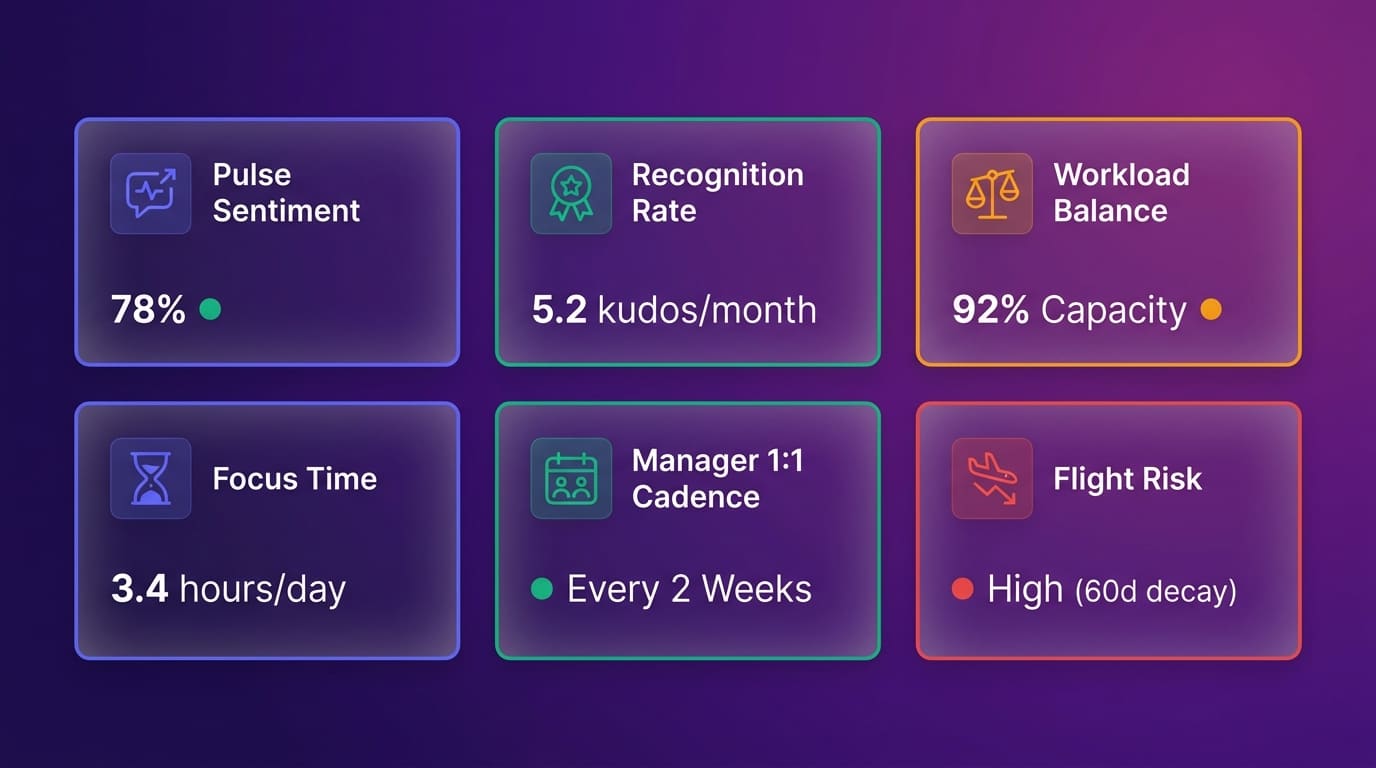
A: Surveys help but have a lag. People answer "OK" right up until the day they resign. Pairing surveys with observed signals (workload imbalance, recognition rate, focus-time decay, manager 1:1 cadence) detects burnout and flight risk 60+ days earlier, which is how Abloomify positions its burnout detection layer.
Q: How much does employee engagement software cost?
A: Most platforms in this category land between $4 and $12 per seat per month on annual plans. Abloomify is $9 per seat per month annually with engagement included alongside engineering velocity, AI tool ROI, and capacity analytics, so you are not paying for a single-purpose tool.
What employee engagement software actually does (and where the category is going)
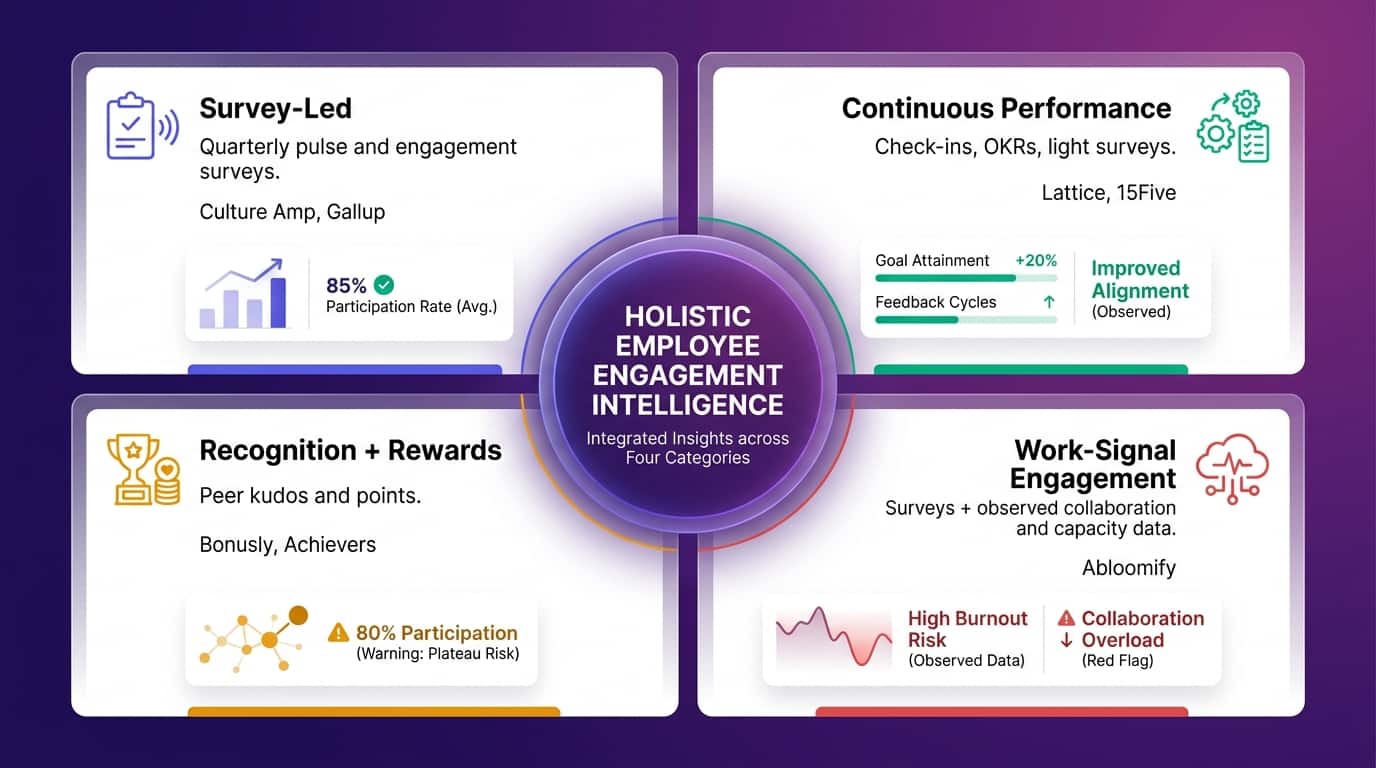
Employee engagement software is a platform that captures, measures, and improves how connected, motivated, and committed employees feel about their work, their team, and their company. The original category, born in the survey era of the 2010s, was built on quarterly engagement surveys and an annual benchmark report. Culture Amp and Gallup defined the playbook. The current category, redefined by Lattice and 15Five through the late 2010s and early 2020s, blended surveys with continuous performance management (check-ins, OKRs, manager 1:1s, recognition). The 2026 wave (where Abloomify sits) goes one step further: it pairs voluntary engagement input with observed work signals from the systems people already use, so you can see engagement decay in workload, focus time, collaboration patterns, and recognition rate, not just the next quarterly survey. The buyer in 2026 is a COO, VP of People, or VP of Engineering at a 100 to 500-person tech company who has been burned at least once by a surprise resignation that "the survey scores did not predict."
A few hard tells that the category is shifting:
- Lattice's positioning page now leads with "AI-powered" engagement, not "surveys."
- 15Five's recent product pushes are about manager workflow automation, not new survey instruments.
- ActivTrak (a monitoring tool, not an engagement tool) added "engagement insights" in 2025, validating that the buyer wants a single signal layer.
- Abloomify and a small group of work-signal platforms position engagement as a downstream metric of capacity and recognition, not the primary survey instrument.
If your only data on engagement is what people typed into a survey three weeks ago, your engagement program is one quarter behind reality. That is the gap modern engagement software is racing to close.
The shift: from quarterly surveys to observed work signals
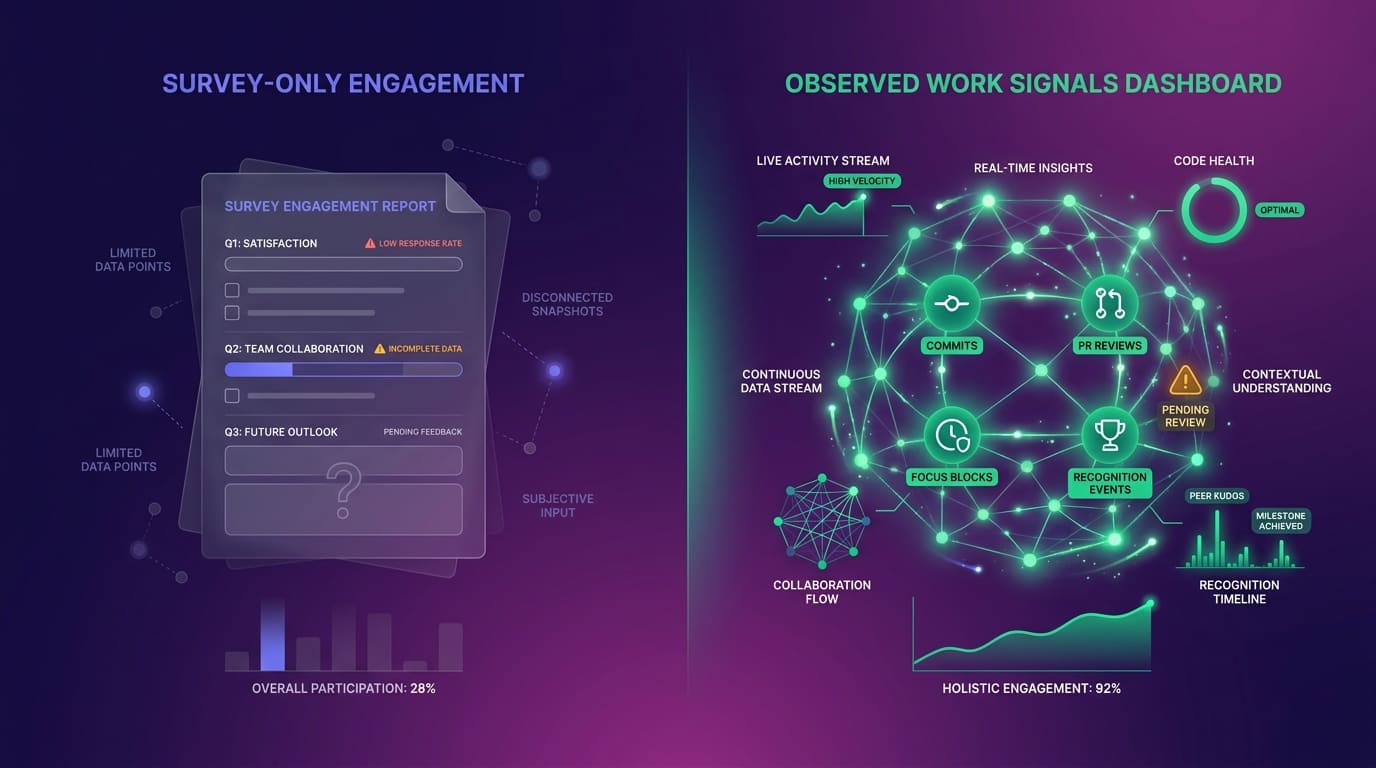
The strongest 2026 engagement programs are not survey-led, they are signal-led with surveys as a confirmation layer. There are a few practical reasons. Surveys lag. People answer them honestly until they have decided to leave, and then they answer them politely. Survey response rates at most tech companies sit between 50 and 75 percent, and the people who skip the survey are disproportionately the people you are most worried about. Recognition is a much faster engagement signal than sentiment, and it is observable: peer kudos, public shout-outs, comments on PRs, mentions in meeting notes. Workload balance is observable too, in Jira ticket counts, GitHub PR throughput, calendar load, after-hours commits. Manager 1:1 cadence is observable in calendar metadata. None of those signals require a screenshot, a keylogger, or a screen recording. They sit in tools your team already uses, and a privacy-first integration layer can read them without invading content. That is the shift, and it changes which engagement software you buy. Survey-only tools work less well as the only instrument every quarter. Tools that combine surveys with observed signals work better, and they detect engagement decay weeks earlier.
The honest caveat: signals on their own are not enough either. We learned this at a 3,500-person enterprise customer where Google Workspace data alone showed low correlation to internal performance metrics. Single-source data under-proves engagement, in either direction. The pattern that works is multi-source: surveys plus collaboration plus delivery plus recognition, with each one acting as a check on the others. If you still need the survey itself, our guide to engagement surveys for the workplace covers what to ask, how often to run it, and how to close the loop on results.
8 employee engagement software picks for tech companies in 2026
The eight platforms below are the ones I see most often in evaluations at 100 to 500-person tech, fintech, and SaaS companies. Each is opinionated about a different theory of engagement. Pick the theory before you pick the tool.
1. Lattice
The default for tech companies that want continuous performance management with engagement included. Strong on goals, OKRs, reviews, and lightweight engagement surveys. Decent recognition module. Best fit when the buyer is HR or People Ops and the program is review-cycle anchored. Less strong if your engagement question is really a workforce intelligence question (capacity, AI tool ROI, engineering velocity). For a deeper teardown see Abloomify vs Lattice.
2. 15Five
The default if your program is anchored on weekly check-ins and manager-employee conversations. Strong workflow design, good engagement pulse surveys, solid HRIS integrations. Best fit for a 100 to 500-person company where managers are the main lever you want to pull. Same survey-led architecture as Lattice. See Abloomify vs 15Five for the work-signal contrast.
3. Culture Amp
The most credible survey-science platform. Strong benchmarks, good question banks, mature analytics. Best fit when your CHRO wants survey rigor and external benchmarks for the board. Less of a continuous platform and more of a survey-cycle platform. See Abloomify vs Culture Amp.
4. BetterWorks
OKR-led performance and engagement. Best fit for companies where the engagement program is downstream of strategy and goals. Less feature density on surveys than Culture Amp, less workflow tooling than Lattice, but better OKR depth than either.
5. Leapsome
A European challenger that combines performance, engagement, and learning into one suite. Best fit for fast-growing tech companies that want a single platform across the people stack and like the all-in-one packaging. Engagement features are competitive with Lattice and 15Five.
6. Bonusly
A recognition-led engagement tool. Peer kudos with points and rewards. Best fit when your theory is that engagement follows recognition frequency. Easiest to deploy of any tool on this list. Worst fit if your buyer wants survey rigor or performance management in the same platform.
7. Microsoft Viva (Glint + Insights)
Microsoft's bundled engagement and productivity analytics layer for M365 customers. Glint covers engagement surveys; Viva Insights covers M365-derived productivity signals. Best fit if you are a deep Microsoft 365 shop and want engagement included in your existing stack. Less useful if you run on Google Workspace or want engineering and AI tool ROI signals in the same view.
8. Abloomify
Privacy-first workforce intelligence with engagement built on top of observed work signals plus surveys. Connects to 100+ tools (Jira, GitHub, Google Workspace, Microsoft 365, Slack, Salesforce, HubSpot, Workday, BambooHR, Cursor, Claude Code, GitHub Copilot, and many more) for PII-free signals, plus optional privacy-first device agents (no screenshots, no keyloggers, no screen recording). Engagement signals include workload balance, recognition rate, focus time, manager 1:1 cadence, and pulse sentiment. Performance reviews, goals, and recognition are included on every plan. Best fit when the buyer is a COO or VP Engineering who wants engagement signals tied to actual work data, not a separate quarterly survey product. SOC 2 Type 2 certified, EU AI Act and GDPR compliant by design.
How to evaluate employee engagement software (a buyer's checklist)
A useful evaluation checklist for employee engagement software in 2026 covers four categories: data sources, manager workflow, intervention loop, and trust architecture. Data sources is the biggest 2026 differentiator: ask whether the platform reads only what employees type into surveys, or whether it also pulls observed signals from systems people already use. Manager workflow is whether the tool actually changes what your front-line managers do every week (running 1:1s, sending recognition, drafting reviews) or whether it just produces a quarterly engagement report nobody acts on. Intervention loop is what happens when a signal flags a problem: does the tool surface a specific manager, team, or person, and recommend a next action, or does it stop at "engagement is down 4 points"? Trust architecture is the question that gets skipped in too many evaluations: how does this tool collect data, what does it store, and would a senior engineer on the receiving end be comfortable defending the data flow? Survey tools clear that bar easily because employees opt in. Monitoring tools fail it because they capture screenshots and keystrokes. Work-signal engagement platforms (like Abloomify) sit in the middle, and the right vendor will explain in plain English what is collected and what is not.
A short checklist to score each tool on:
- Survey instruments and benchmarks (Culture Amp leads, Lattice and 15Five solid, Abloomify covers basics)
- Continuous performance + 1:1 workflow (Lattice and 15Five lead, Leapsome competitive)
- Recognition (Bonusly leads as a single-purpose tool, others bundle it)
- Observed work-signal coverage (Abloomify leads, Microsoft Viva for M365-only stacks)
- Engineering and AI tool ROI included in the same product (only Abloomify on this list)
- Privacy-first architecture (Abloomify by design, others by policy)
- Pricing transparency (Abloomify $9/seat annually published, most others gated)
Why survey-only engagement is losing ground (the data-backed engagement case)
Survey-only employee engagement software is losing ground because the underlying assumption (that an annual or quarterly survey, plus a benchmark report, plus an action-planning workshop, will move engagement) is increasingly wrong for tech companies running quarterly OKR cycles and weekly delivery loops. The signal latency is the problem. A tech company shipping every two weeks is making 26 product-cycle decisions a year, and a quarterly engagement instrument gives you four data points to tune against. The engineering teams I talk to also have specific engagement signals (PR review delays, CI failure rates, on-call rotations, AI coding tool adoption) that no engagement survey instrument captures and that no HR-only tool can read. When you connect those signals to engagement data, the picture sharpens. A team whose PR cycle time has crept from 18 hours to 72 hours over six weeks, whose recognition rate has dropped, and whose engagement score is "5 out of 10, same as last quarter" is a team where the next resignation is already booked. Survey-only tools cannot see that. Work-signal tools can, and they raise the alert before HR has to do exit interviews.
This is also where Abloomify's privacy-first architecture matters. The engagement signals above (PR cycle, recognition rate, capacity utilization, focus time, 1:1 cadence) are all observable from API integrations alone. No screenshots, no keyloggers, no screen recording, no content capture. The two data layers (100+ API integrations plus optional privacy-first device agents) give you a richer engagement picture than survey software, without the trust damage of monitoring software.
Picking the right employee engagement software for your 2026 program
Picking the right employee engagement software for a tech company in 2026 comes down to three questions: who is the primary buyer, what is the primary signal, and how fast do you need the loop? If the primary buyer is HR and the primary signal is survey sentiment, Culture Amp or Lattice are the most defensible picks. If the primary buyer is HR and the primary signal is manager workflow, 15Five is the cleanest answer. If the primary buyer is the COO or VP Engineering and the primary signal is observed work behavior plus surveys, Abloomify is the only platform on this list that ships engagement, performance, engineering velocity, AI tool ROI, and capacity analytics in one place, with privacy-first architecture and SOC 2 Type 2 certification. If the primary signal is recognition frequency, Bonusly is the best single-purpose tool. If you are deep on M365 and want engagement bundled with productivity insights, Microsoft Viva is rational. The fastest loop on this list is a recognition tool because feedback is real-time. The slowest loop is a quarterly-survey-only tool. The most accurate loop is a multi-source platform that combines surveys, recognition, and observed signals.
For tech companies in the 100 to 500-employee range, my bias (as a founder shipping in this category) is that engagement is no longer a standalone purchase. It is one layer in a workforce intelligence stack that also has to answer questions like "who is overloaded right now," "is our Cursor adoption actually shipping more code," and "where is capacity quietly leaking." If you can answer those in the same tool you run engagement in, you stop paying for five point solutions and you stop chasing five different definitions of "how is the team doing." Big companies bring ceremony. Tech companies that want speed bring outcomes.
If you want to see what engagement looks like with observed work signals plus surveys, book a demo or explore the AI People Manager solution for the HR-led path. If your engagement question is really a burnout question, the burnout detection solution shows the 60-day early signal pattern.
FAQ
What is employee engagement software?
Employee engagement software is a platform that measures and improves how connected, motivated, and committed employees feel through pulse surveys, recognition, manager check-ins, and (in 2026) observed work-signal data from systems people already use. Lattice, 15Five, Culture Amp, Bonusly, Microsoft Viva, and Abloomify are common picks for tech companies.
How is employee engagement software different from performance management software?
Performance management software runs goals, OKRs, and reviews. Engagement software measures sentiment and connection. The line has blurred: most modern platforms (Lattice, 15Five, Leapsome, Abloomify) ship both. Pure-play survey tools like Culture Amp focus on engagement, while pure-play OKR tools like BetterWorks focus on performance. Abloomify ships both layered on workforce intelligence.
How much does employee engagement software cost?
Most engagement platforms charge between $4 and $12 per seat per month on annual contracts, with enterprise pricing custom. Lattice and 15Five publish from around $4-$11 per seat depending on modules. Abloomify charges $9 per seat per month annually for the full platform (engagement, performance, engineering velocity, AI tool ROI, capacity analytics) with no feature gatekeeping.
Is employee engagement software the same as employee monitoring software?
No, and the difference matters. Engagement software collects voluntary input (surveys, kudos, check-ins) and increasingly observed signals from work systems via API. Monitoring software (ActivTrak, Hubstaff, Insightful, Time Doctor) captures screenshots, keystrokes, and screen recordings. Roughly 1 in 6 workers say they would quit over surveillance per 2026 research, so most tech companies pick engagement, not monitoring.
Can employee engagement software actually predict turnover?
On its own a quarterly survey predicts turnover poorly because of response bias and lag. Combining survey data with observed signals (workload imbalance, recognition decay, manager 1:1 cadence drops, after-hours commits) gives a multi-source signal that detects flight risk 60+ days earlier. That is the pattern Abloomify uses for its retention and burnout detection layer.
Which employee engagement software has the best privacy story?
Abloomify is the only platform on this list with PII-free architecture by design (no screenshots, no keyloggers, no screen recording, no content capture from email or messaging) and SOC 2 Type 2 certification. Survey tools (Culture Amp, Lattice, 15Five, Bonusly) are also privacy-respecting because employees opt into the data. Monitoring tools sit at the opposite end of this spectrum.

Amir Tavafi
Co-Founder & CEO
Product leader and innovator with over 15 years of experience in the tech sector, grounded in AI and robotics. Previously led product development in fraud detection and AI solutions at Nasdaq Verafin.