AI Pair Programming: What It Is and How to Measure ROI (2026)
September 22, 2026
Reza Vatani
11 min read

AI pair programming means a developer writes code with an AI coding assistant suggesting, completing, or editing alongside them in the same session, not an AI working alone on a ticket. Cursor, GitHub Copilot, and Claude Code all support it. Abloomify imports usage from all three and ties it to PR cycle time and review health, so "is AI pair programming working" gets an answer instead of a vendor adoption number.
Key Takeaways
Q: What is AI pair programming?
A: AI pair programming is writing code with an AI assistant, like Cursor, GitHub Copilot, or Claude Code, suggesting completions or edits in the same session as the developer, turn by turn. It differs from agentic coding, where the AI works through a task largely on its own.
Q: How is AI pair programming different from agentic AI coding tools?
A: AI pair programming keeps a human in the loop on every suggestion, turn by turn. Agentic coding tools plan, edit across files, and run tests with less human review per step. Abloomify's guide to agentic AI coding tools covers that category in depth.
Q: Does AI pair programming actually make developers faster?
A: It can, but adoption numbers alone don't prove it. Abloomify's own engineering team switched from GitHub Copilot to Cursor and saw a real velocity jump, but the only way to know for any team is to connect usage data to PR cycle time and review health, not self-reported feel.
Q: How do you measure whether AI pair programming is working?
A: Connect AI tool usage to delivery data instead of scoring the tool alone. Abloomify imports usage from Cursor, Claude Code, and GitHub Copilot and correlates it with PR cycle time, review health, and human vs AI-agent contribution, with AI Leverage as a pillar of one Engineering Velocity Score.
Q: What AI pair programming tools do companies use in 2026?
A: Cursor and GitHub Copilot lead adoption, with Claude Code and Windsurf also common at engineering-heavy companies. Most teams run more than one, often without knowing which one is actually moving delivery metrics. Abloomify's 100+ integrations cover all three of the major ones.
What is AI pair programming?
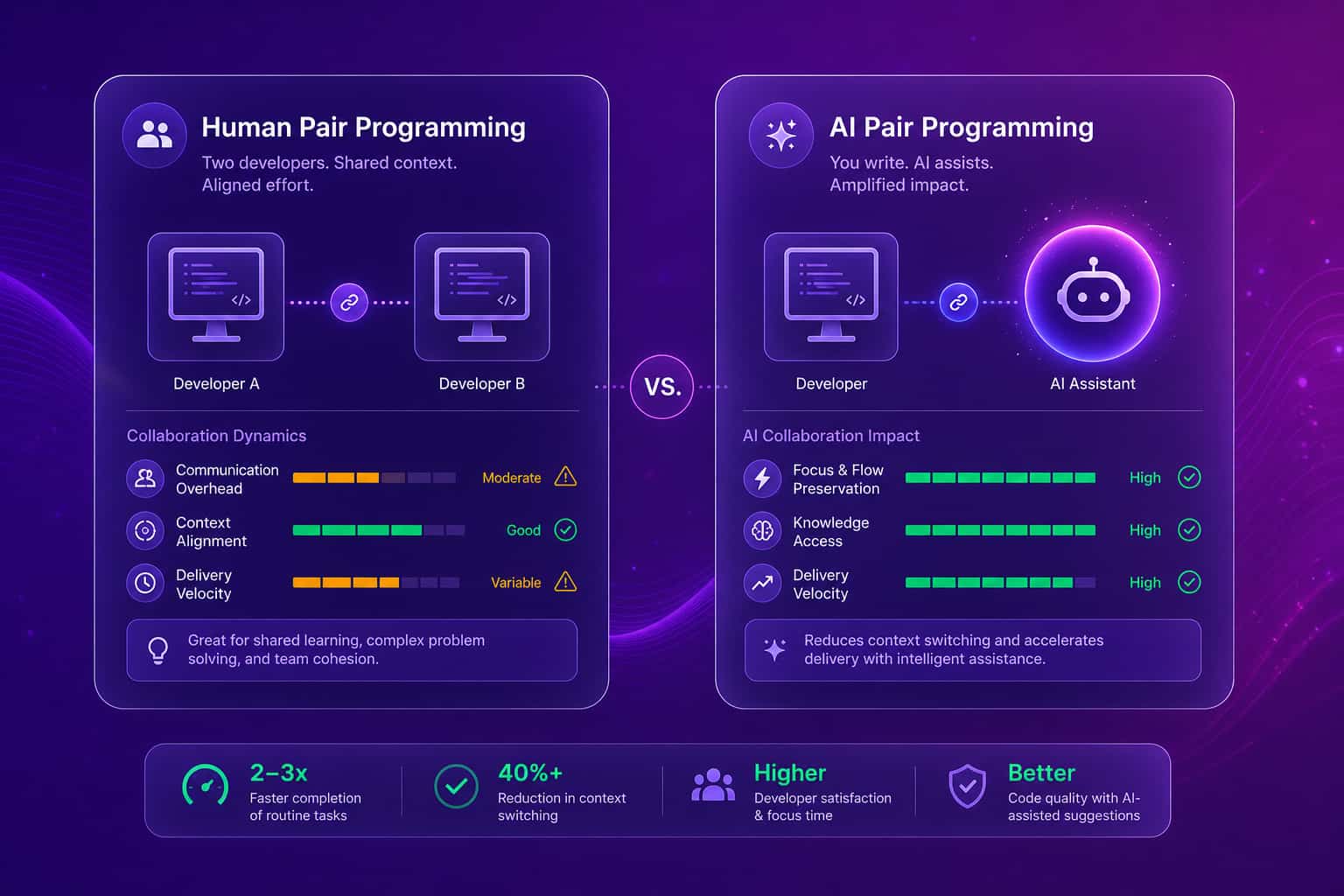
AI pair programming is a coding workflow where a developer writes and edits code with an AI assistant actively suggesting completions, refactors, or fixes inside the same session, turn by turn, the same rhythm as two developers pairing at one keyboard except one half of the pair is a model. The term borrowed its name from traditional pair programming, where two engineers share one screen and trade the keyboard, but the mechanics changed: the AI doesn't get tired, doesn't need context repeated, and responds in milliseconds instead of a beat of human latency. Cursor, GitHub Copilot, Windsurf, and Claude Code's inline mode are the tools most engineering teams reach for. What makes it "pairing" rather than "automation" is the loop: the human proposes direction, the AI suggests code, the human accepts, edits, or rejects it, and the cycle repeats every few lines rather than every few hours.
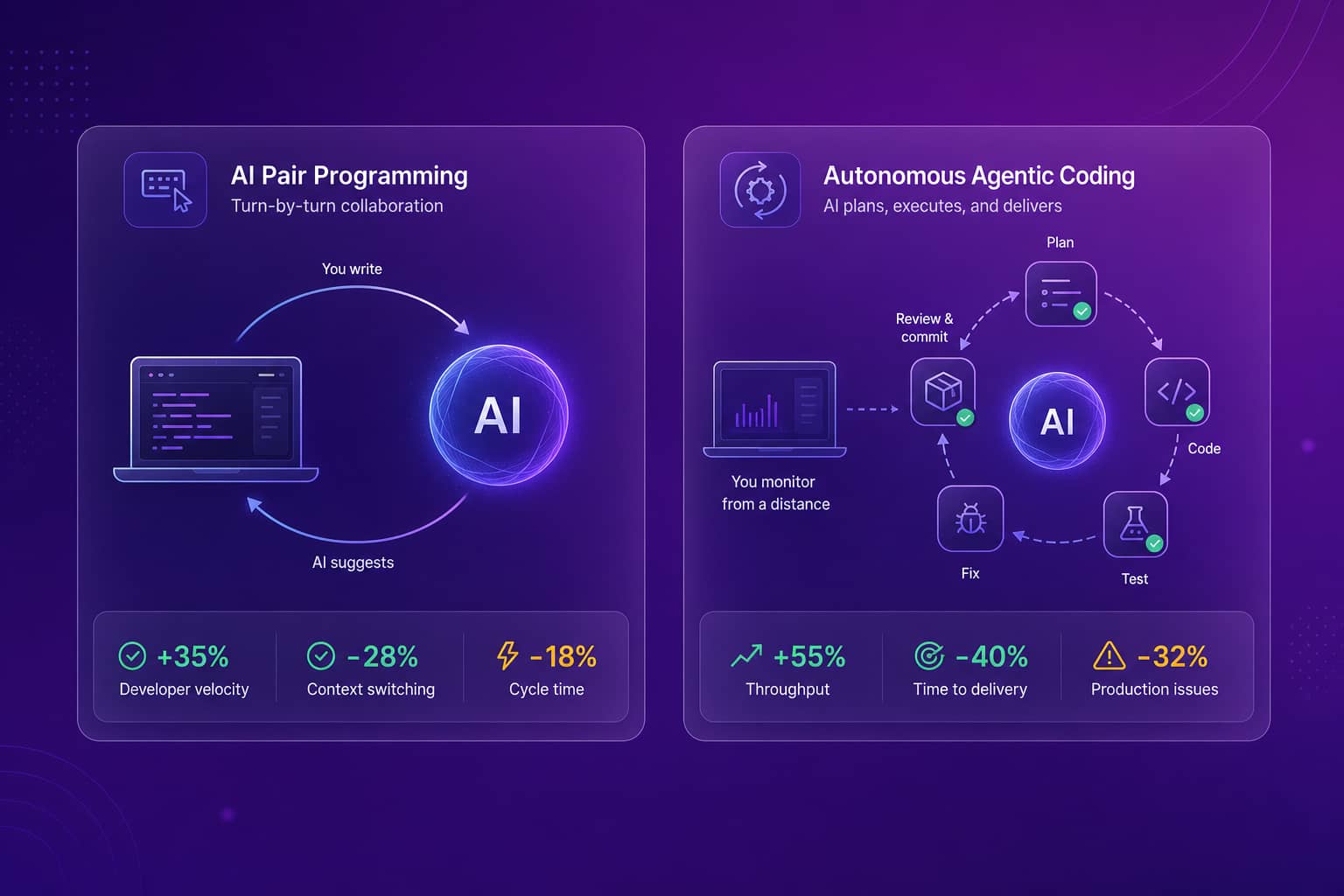
That loop is the distinction that matters for measurement later in this piece. AI pair programming lives inside the editor, one suggestion at a time. It's a different category from agentic AI coding, where the model works through a multi-step task with far less supervision per step.
AI pair programming vs agentic AI coding vs traditional pair programming
AI pair programming, agentic AI coding, and traditional two-person pair programming solve overlapping problems with three different amounts of human control per step, and conflating them is why so many "is AI coding working" conversations go in circles. Traditional pair programming puts two humans on one keyboard, trading control every few minutes, optimized for shared context and catching mistakes as they happen, not raw output speed. AI pair programming replaces the second human with a model that suggests at the line or function level and waits for the developer to accept, edit, or reject each one, keeping a human decision in the loop on effectively every change. Agentic AI coding removes that per-line checkpoint: tools like Claude Code's agent mode or Cursor's agent mode take a task description, plan the approach, edit across multiple files, run tests, and present a finished diff for review, closer to delegating a ticket than pairing on one.
| Traditional pairing | AI pair programming | Agentic AI coding | |
|---|---|---|---|
| Who controls each step | Two humans, alternating | Human accepts or rejects each suggestion | AI plans and executes, human reviews the result |
| Review cadence | Continuous, verbal | Every few lines | Per task, after the diff |
| Best for | Complex problems, onboarding, shared context | Routine code, boilerplate, familiar patterns | Well-scoped tasks with clear tests |
| What Abloomify measures | Not directly tracked | AI Leverage, PR cycle time impact | Human vs AI-agent contribution split |
Why AI pair programming adoption numbers hide the real question
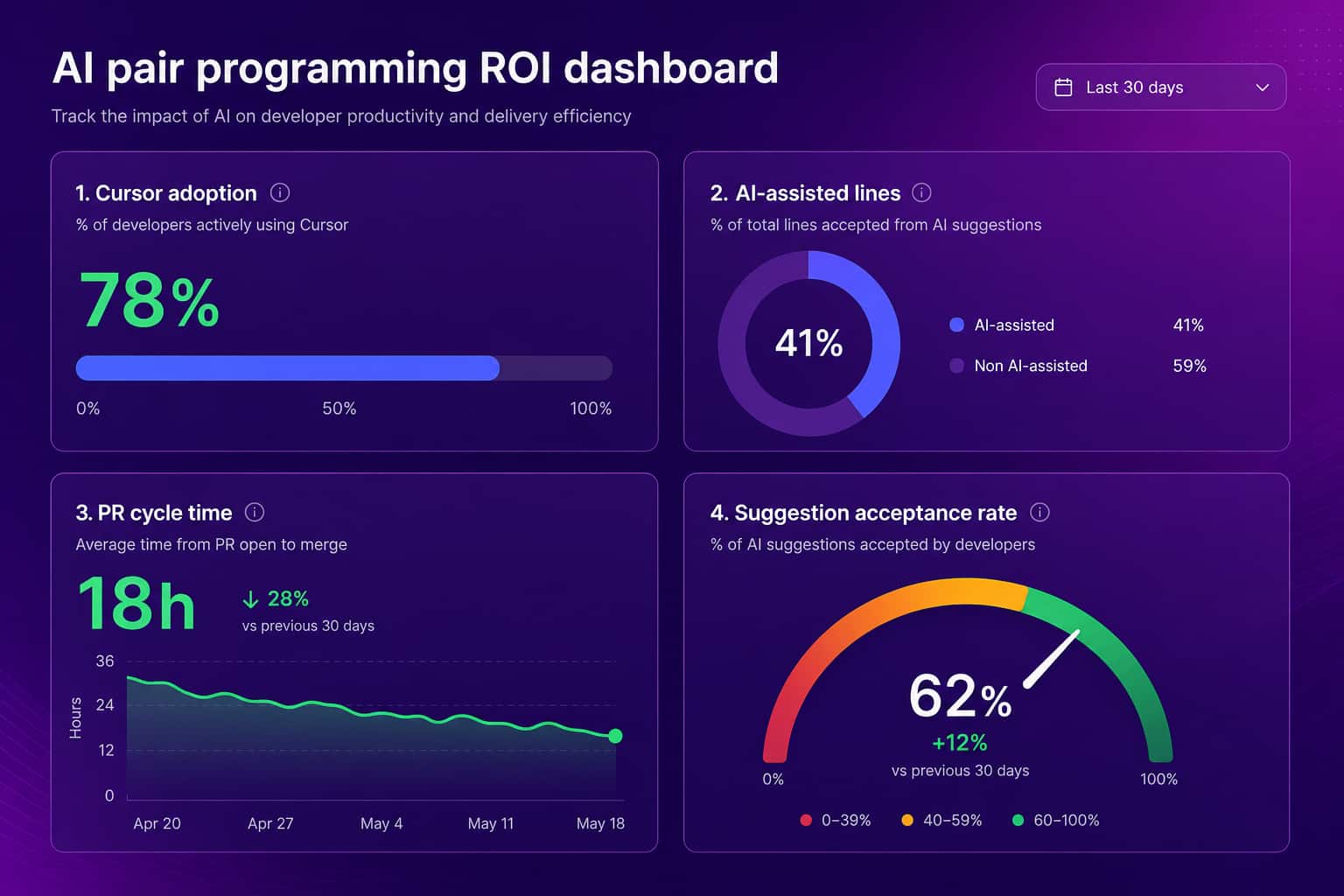
Adoption numbers for AI pair programming, seat counts, suggestion volume, acceptance rate, tell you whether developers turned the tool on, not whether the company is getting anything back for the license. Cursor and GitHub Copilot both report acceptance rate inside their own dashboards, and it's an easy number to put in a board slide, but acceptance rate measures whether a developer liked a specific suggestion in the moment, not whether that suggestion shipped faster or safer code, or just added lines that make the next code review longer. A team can show a high acceptance rate and still have PR cycle time creeping up, because accepting more AI suggestions and merging faster aren't the same thing unless someone connects the two. Vendor dashboards were built to prove their own product is being used, not to answer the question a CTO has to answer at renewal: is this line item buying us anything measurable.
Abloomify's own engineering team ran this experiment on itself. The switch from GitHub Copilot to Cursor was, in the founders' telling, one of the best calls made for the product's velocity that year, and it happened because someone was willing to try a smaller, AI-native tool instead of sticking with the incumbent. But "it felt faster" is exactly the kind of claim this article is arguing against measuring by feel. The only way to know for certain is the same data Abloomify sells every AI Tool ROI customer: usage correlated with PR cycle time, review health, and output, not a gut check from the team that made the switch.
What actually shows AI pair programming is working
AI pair programming is working when AI-assisted code moves through the same delivery pipeline faster or safer than code written without it, not when usage numbers go up on their own. The signals worth watching are PR cycle time for AI-assisted work compared to the rest of the codebase, review time and rework rate on AI-suggested code (does it come back with more review comments, not fewer), and the human vs AI-agent contribution split across commits, so a team can see which parts of delivery actually shifted. None of these live in Cursor's or Copilot's own dashboard, because neither tool can see a company's Jira board, GitHub review history, and CI pipeline at the same time it sees its own suggestion log. That correlation, usage data plus delivery data in one place, is the layer most engineering orgs are missing, and it's the difference between reporting adoption and reporting ROI.
How Abloomify measures AI pair programming ROI
Abloomify measures AI pair programming ROI by importing usage data directly from Cursor, Claude Code, and GitHub Copilot and correlating it with the delivery signals those tools are supposed to improve: PR cycle time, review health, DORA metrics banded Elite through Low, and the human vs AI-agent contribution split across code and reviews, so AI Leverage becomes one tunable pillar of a single Engineering Velocity Score instead of a separate vendor login nobody checks. A 50-person SaaS customer validated this approach by running Abloomify's engineering numbers against a spreadsheet they were already building by hand. "What I did manually this week in a spreadsheet is exactly what I think Abloomify should be doing automatically," their COO said, the same problem AI pair programming ROI has today: teams doing this math by hand, once, right before a renewal, instead of continuously. All of it reads usage and delivery signals, never code content: PII-free, API-connected, SOC 2 Type II certified.
The same layer that measures adoption also governs it. Abloomify's AI governance tools add role-based access, audit logs, and shadow AI detection on top of the usage data, so IT can see which AI pair programming tools are actually connected to company repositories without blocking engineers from the tools that make them faster.
How to roll out AI pair programming without losing code quality
Rolling out AI pair programming without a quality regression takes a few practical steps, not a blanket policy that either bans the tools or hands out licenses with no follow-up. Pick one tool company-wide so usage data stays comparable instead of splitting across three. Connect that tool's usage data to existing PR and review metrics before the rollout, so there's a baseline to compare against later. Watch review comment volume and rework rate on AI-assisted PRs for the first month, not just merge speed, since a faster merge with more rework isn't a win. Revisit the decision at renewal with correlated usage and delivery data instead of a survey asking engineers if they liked it. Skipping the baseline step is the most common mistake: teams turn on Cursor or Copilot, wait a quarter, and have no "before" number to compare against, so the renewal conversation defaults back to the vendor's own acceptance-rate slide.
- Standardize on one AI pairing tool before scaling company-wide licensing.
- Baseline PR cycle time and review health before rollout, not after.
- Track rework rate and review comment volume on AI-assisted PRs, not just merge speed.
- Revisit at renewal with correlated usage and delivery data, not a survey.
Every AI coding vendor will keep shipping a shinier acceptance-rate number. The teams that win the renewal argument are the ones who can point to a delivery metric instead.
FAQ
What is AI pair programming?
AI pair programming is writing code with an AI assistant, such as Cursor, GitHub Copilot, or Claude Code, suggesting completions or edits inside the same session as the developer, turn by turn, rather than working through a task unsupervised.
Is AI pair programming the same as vibe coding?
No. Vibe coding usually describes generating code from a prompt with light review of the output, closer to agentic coding. AI pair programming keeps a developer accepting or rejecting each suggestion as it's written.
Which AI pair programming tool should engineering teams choose?
There's no universal answer, but standardizing on one tool company-wide, rather than letting each engineer pick their own, is what makes usage data comparable. Abloomify's guide to AI coding tools compares Cursor, GitHub Copilot, and Claude Code on adoption, and Cursor vs Claude Code covers that specific pairing directly.
Does AI pair programming replace agentic AI coding tools?
No, they solve different problems. AI pair programming suits routine, in-editor work where a developer wants to stay in control line by line. Agentic AI coding fits well-scoped tasks with clear tests, where delegating the whole task is faster than supervising every line. Most engineering teams end up running both.
How does Abloomify measure AI pair programming without reading code content?
Abloomify imports usage signals, adoption, suggestion volume, acceptance patterns, from Cursor, Claude Code, and GitHub Copilot's own APIs and correlates them with delivery metrics already pulled from GitHub and Jira. No code content is read. PII-free architecture, SOC 2 Type II certified, the same standard applied everywhere else in the platform.

Reza Vatani
Co-Founder & CAIO
AI-driven entrepreneur with a strong background in robotics and advanced analytics. PhD from Old Dominion University and former Product Development leader at Nasdaq Verafin.