SPACE Metrics: How to Measure Developer Productivity in 2026
July 2, 2026
Reza Vatani
11 min read

SPACE metrics measure developer productivity across five dimensions: Satisfaction, Performance, Activity, Communication, and Efficiency. The framework exists because a single number, whether lines of code, story points, or commit counts, tells you almost nothing about whether an engineering team is shipping value. Abloomify tracks the SPACE dimensions from the tools your team already uses, with no screenshots, no keyloggers, and no surveillance.
Key Takeaways
Q: What does SPACE stand for in developer productivity?
A: SPACE stands for Satisfaction and well-being, Performance, Activity, Communication and collaboration, and Efficiency and flow. The framework, published in 2021 by Nicole Forsgren and co-authors, argues that productivity is multidimensional and cannot be captured by any one metric.
Q: Why not just count commits or lines of code?
A: Activity counts are easy to game and easy to misread. A developer refactoring 2,000 lines into 200 shows negative "activity" while improving the codebase. SPACE pairs Activity with Performance and Efficiency so volume never stands alone as a productivity signal.
Q: How is SPACE different from DORA?
A: DORA measures delivery with four metrics: deployment frequency, lead time, change failure rate, and time to restore. SPACE is wider and includes the human dimensions DORA skips, like satisfaction and collaboration. Abloomify computes both, scoring DORA metrics with performance bands next to SPACE signals.
Q: Can SPACE metrics be tracked without surveillance?
A: Yes. Abloomify derives SPACE signals from GitHub, Jira, Linear, and AI coding tools through 100+ API integrations, PII-free by architecture. There are no screenshots or keyloggers, and results are aggregated at the team level, which is how the SPACE authors intended the framework to be used.
What are the SPACE metrics?
SPACE is a framework for measuring developer productivity across five dimensions instead of one number, introduced in the 2021 ACM Queue paper "The SPACE of Developer Productivity" by Nicole Forsgren, Margaret-Anne Storey, Chandra Maddila, Thomas Zimmermann, Brian Houck, and Jenna Butler. The core argument is that productivity is not a single quantity you can put on a leaderboard. It shows up across satisfaction, the quality of outcomes, raw output, how people communicate, and how smoothly work flows. A team can look busy on Activity while scoring poorly on Efficiency because engineers wait days for code review. Another can ship less code but deliver more value. The framework asks you to pick metrics from at least three of the five dimensions so no single signal, especially Activity, gets treated as the whole story.
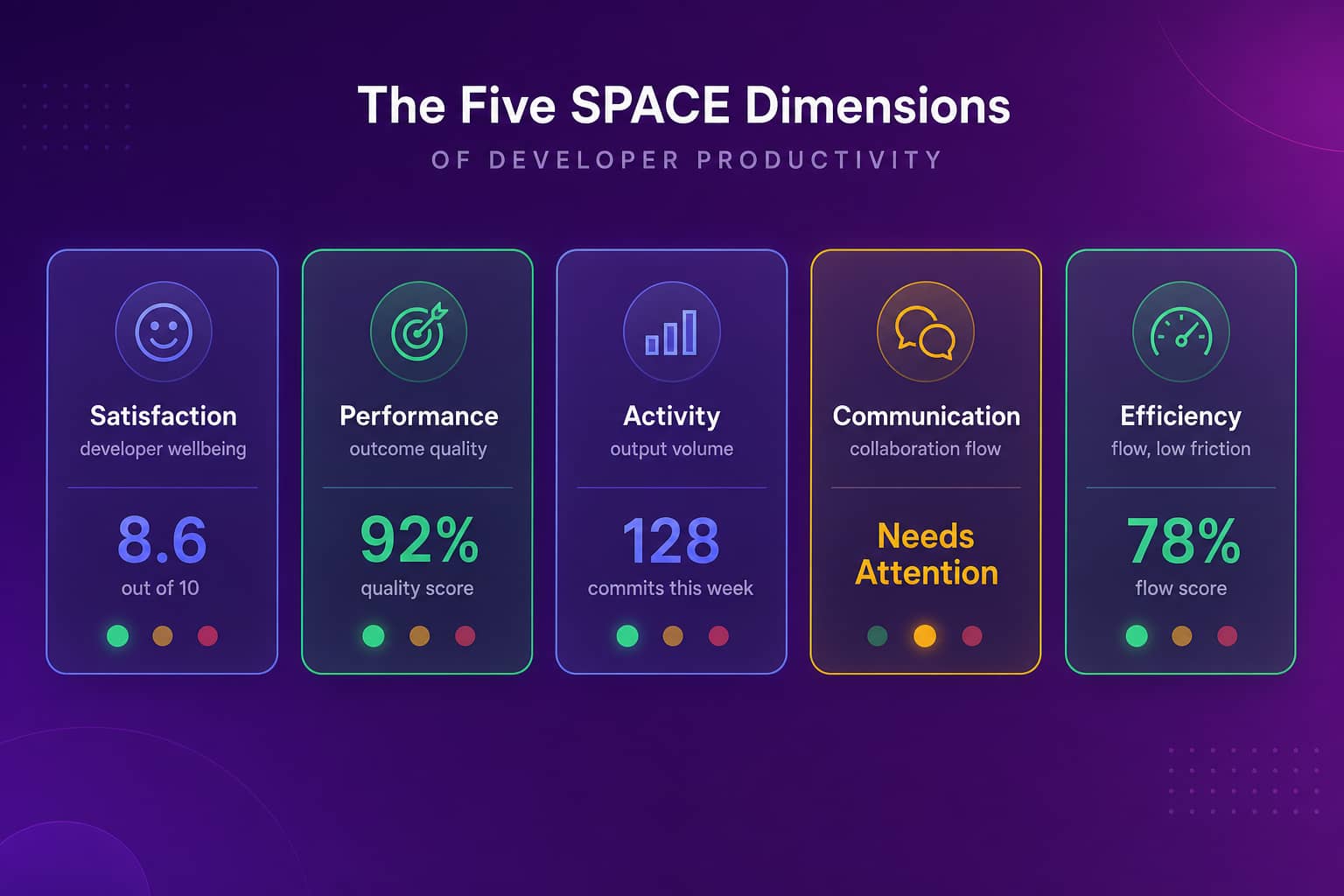
The five dimensions are deliberately broad. Here is what each one covers and the kind of signal that fits it.
| Dimension | What it measures | Example signal |
|---|---|---|
| Satisfaction | Developer well-being, morale, retention risk | Pulse survey scores, burnout and overwork signals |
| Performance | Outcomes of the work, not the output itself | Change failure rate, review quality, delivered value |
| Activity | Volume of outputs | PRs merged, deploys, code review actions |
| Communication | Collaboration and knowledge flow | Review participation, time to first review, meeting load |
| Efficiency | Flow and low friction | PR cycle time, wait time, context switching |
The rule that matters most: never report a single dimension in isolation. Activity without Performance and Efficiency is how teams end up rewarding people for looking busy.
The five SPACE dimensions, explained
Each SPACE dimension answers a different question about how engineering work actually happens, and the framework only works when you read them together. Satisfaction asks whether the people doing the work are healthy enough to keep doing it well, since a team that ships fast for one quarter and burns out in the next is not productive. Performance asks whether the output produced the intended result, measured through outcomes like change failure rate and review quality rather than raw volume. Activity counts the tangible outputs, which is useful context but dangerous alone. Communication captures how work moves between people, from review participation to meeting load. Efficiency measures friction: how long a change waits, how often engineers get pulled off task, and how smoothly value flows from commit to production.
Satisfaction is the dimension most teams skip because it feels soft, and that is a mistake. There is no evidence that squeezing more raw activity out of a stressed team improves outcomes, and monitoring tools that try tend to make it worse. Abloomify reads Satisfaction two ways: optional pulse surveys from the performance suite, and PII-free burnout and disengagement signals derived from work patterns like sustained overwork and collapsing focus time. Neither approach reads message content or screens.
SPACE vs DORA: which framework should you use?
Use both, because they answer different questions. DORA measures software delivery performance through four metrics (deployment frequency, lead time for changes, change failure rate, and time to restore service) and is the sharper tool for delivery health and reliability. SPACE is the wider lens: it keeps the delivery signals DORA covers under Performance and Efficiency, then adds Satisfaction, Activity, and Communication so you can see the human system that produces the delivery numbers. DORA tells you the deployment pipeline is slow. SPACE helps you understand whether that is a tooling problem, a review bottleneck, or a team running on empty. Teams that adopt only DORA get a clean delivery scorecard and miss the burnout building behind it. Teams that adopt only SPACE risk vague dashboards with no delivery teeth. Together they cover both.
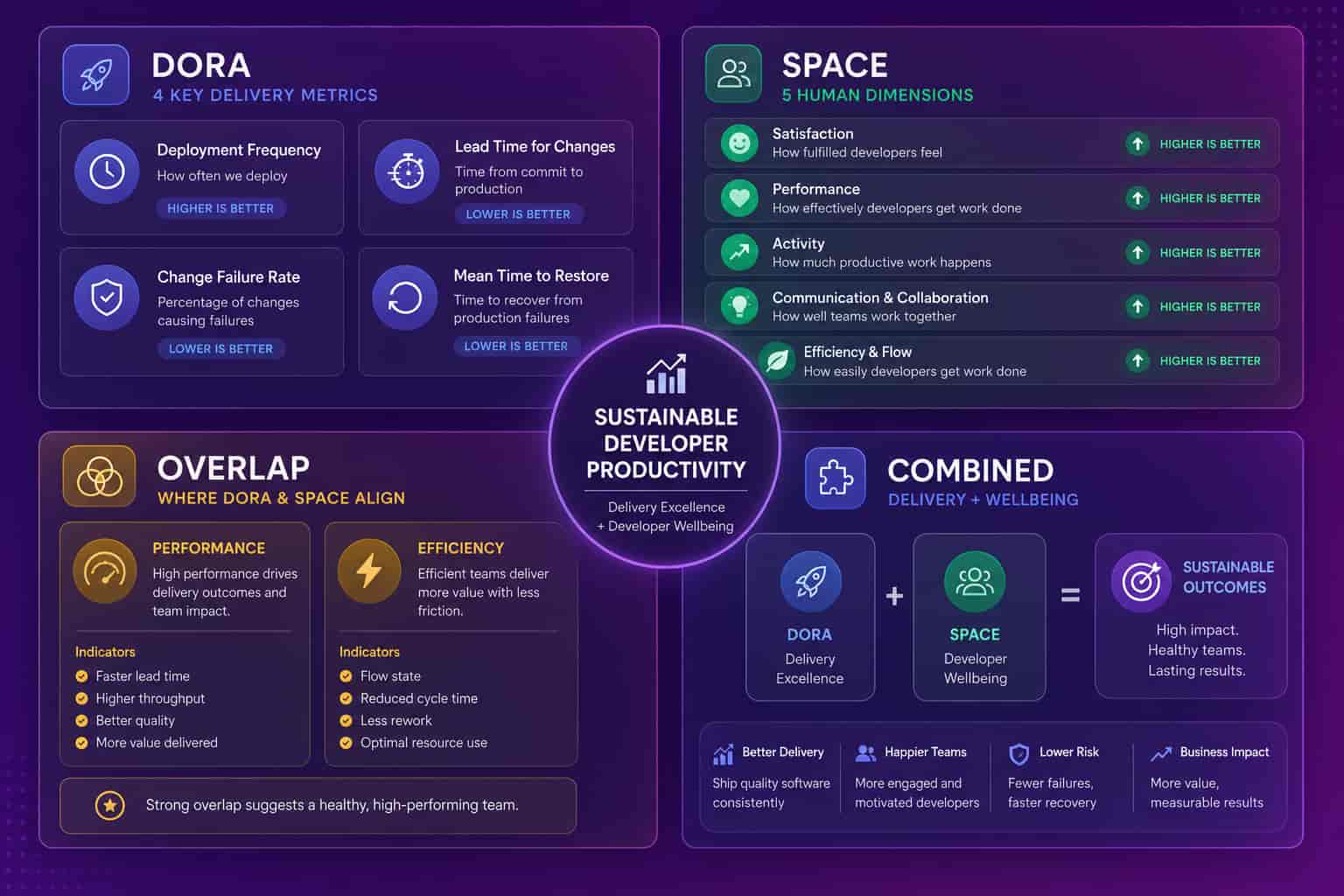
Abloomify computes the four DORA metrics with Elite-to-Low performance bands and automatic failed-deploy and revert detection, then places them alongside SPACE signals like PR cycle time, review health, and workload balance. You get the delivery rigor of DORA and the fuller context of SPACE in one view, without stitching two tools together. For a deeper look at the delivery side, see our guide to engineering velocity metrics.
How to measure SPACE metrics without surveilling engineers
The fastest way to break a SPACE rollout is to measure it with surveillance, and it is also unnecessary. You do not need screenshots or keyloggers to know a team's PR cycle time, review participation, or deploy frequency, because those signals already live in GitHub, Jira, Linear, and your CI system. Abloomify connects to those tools through 100+ API integrations and reads signals only, never code content, message content, or file content. That matters for adoption: 1 in 6 workers say they would quit over surveillance, and there is no evidence from the Personnel Psychology meta-analysis that monitoring improves performance. A SPACE program built on monitored screens starts by damaging the Satisfaction dimension it is supposed to measure.
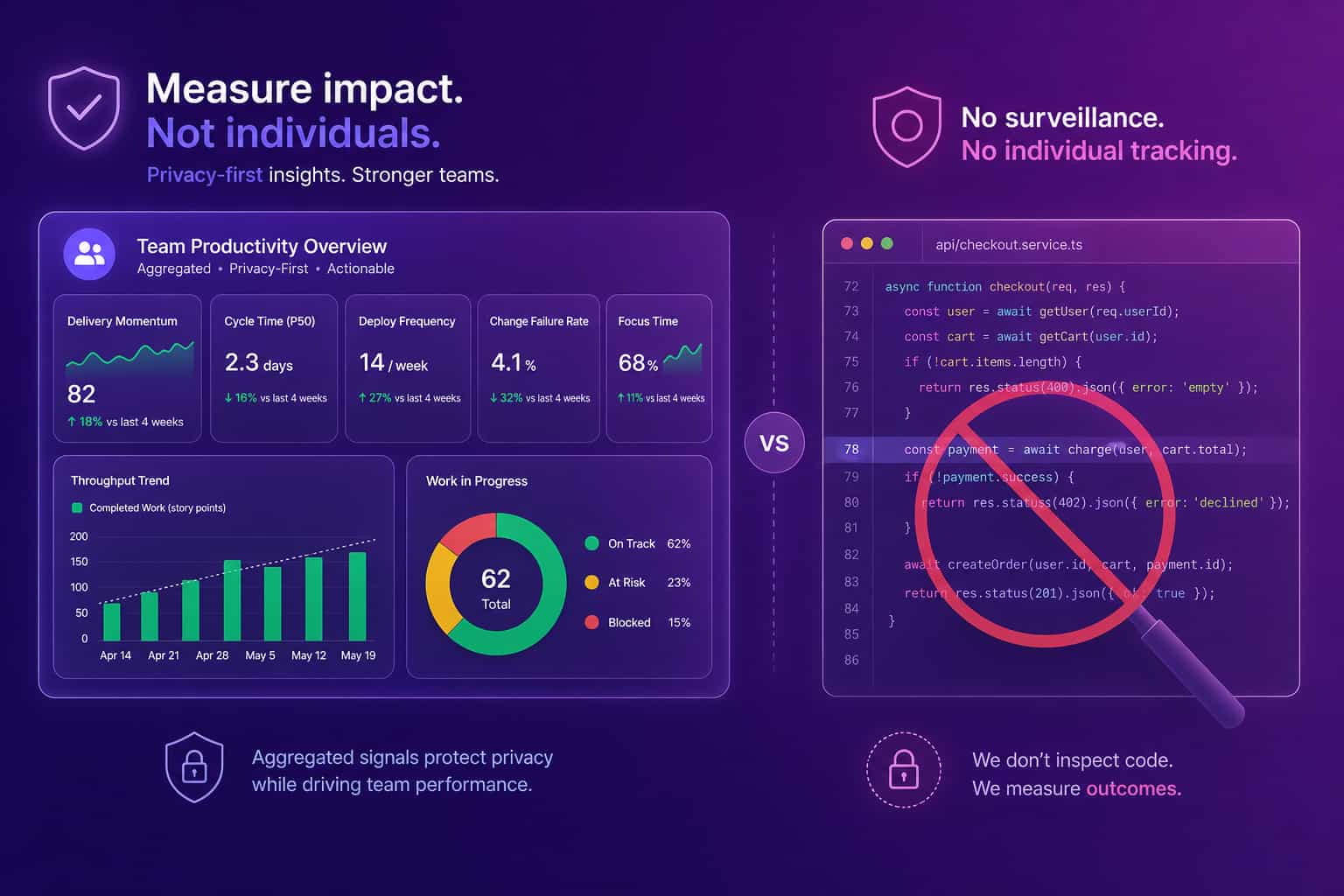
Privacy-first measurement is not just an ethical stance, it produces better data. When engineers trust that metrics are aggregated at the team level and cannot be turned into an individual leaderboard, they stop gaming the numbers. Abloomify is PII-free by architecture and reports SPACE signals at the team and cohort level by default. For more on this approach, see how to measure productivity without screenshots.
Engineering-only analytics (Jellyfish, LinearB)
Abloomify
Measuring SPACE when AI writes some of the code
By 2026 the hardest part of SPACE is the Activity dimension, because a large share of "activity" is no longer human. When Cursor, Copilot, or Claude Code generate code, raw commit counts and lines-changed climb without telling you whether Performance improved or whether you just created more code to review. We learned this inside Abloomify: after adopting AI coding tools, our output volume jumped, and the only honest way to know if it helped was to measure delivered outcomes rather than trust the tooling's own dashboards. That is exactly the trap SPACE was built to prevent, now amplified by AI.
Abloomify separates human, AI agent, and bot contributions across code and reviews, so the Activity dimension reflects who actually did the work. It also measures AI coding tool adoption and correlates usage with output, turning "we bought Cursor for everyone" into a real answer about whether heavy adopters ship and review faster. AI Leverage becomes a tunable input to the Engineering Velocity Score rather than a vanity metric. If you are rolling out AI assistants, pair this with our guide to developer productivity metrics so Activity never gets read alone.
How to roll out SPACE metrics on your team
Start narrow and let the data earn trust before you widen the program. A SPACE rollout fails when leaders present a wall of unfamiliar numbers and engineers assume the worst about how they will be used, so the sequence matters more than the tooling. Pick two or three dimensions first, connect the systems that already hold those signals, report everything at the team level, and make the first conversation about removing friction rather than judging people. Once the team sees that Efficiency data gets used to kill review bottlenecks instead of ranking committers, expanding to the full framework becomes easy.
- Pick three dimensions to start. A common set is Efficiency (PR cycle time), Performance (change failure rate), and Satisfaction (a short pulse survey). Three dimensions satisfies the SPACE rule against single-metric measurement.
- Connect the sources, not the screens. Wire up GitHub, Jira or Linear, and your CI system through API. Skip anything that captures screenshots or keystrokes.
- Report at the team level. Aggregate by team and cohort. Individual leaderboards break trust and corrupt the data.
- Fix friction first. Use the first month of Efficiency data to remove a real bottleneck, like slow first-review times, so the program's opening move is helpful.
- Add the AI layer. Once human contribution is measured cleanly, separate AI agent contribution and tie AI tool spend to output.
When a 50-person Canadian SaaS customer first connected their engineering data, their COO checked it against a spreadsheet they had built by hand. The numbers matched. As the COO put it, "what I did manually this week in a spreadsheet is exactly what I think Abloomify should be doing automatically." That is the goal of a SPACE program. Not a scoreboard. A shared, trusted picture of how the work actually flows.
FAQ
What are the SPACE metrics?
SPACE measures developer productivity across five dimensions: Satisfaction and well-being, Performance, Activity, Communication and collaboration, and Efficiency and flow. It was introduced in 2021 by Nicole Forsgren and co-authors to replace single-number measures like lines of code, which are easy to game and poor predictors of value.
What is the difference between DORA and SPACE metrics?
DORA measures delivery with four metrics: deployment frequency, lead time for changes, change failure rate, and time to restore service. SPACE is broader and adds the human dimensions DORA skips, such as satisfaction and collaboration. Abloomify computes both, so you get DORA's delivery rigor and SPACE's wider context in one place.
Can you measure SPACE metrics without monitoring developers?
Yes. Abloomify derives SPACE signals from GitHub, Jira, Linear, and AI coding tools through API integrations, plus optional pulse surveys. It is PII-free by architecture, with no screenshots, keyloggers, or code content ingestion, and reports at the team level rather than ranking individuals.
How do AI coding tools affect SPACE metrics?
AI coding tools inflate the Activity dimension without proving Performance, because generated code raises commit and line counts regardless of value. Abloomify separates human, AI agent, and bot contributions and ties AI tool usage to measurable output, so Activity reflects real work and AI spend maps to real results.
Is SPACE better than DORA?
Neither is better; they answer different questions. DORA is the sharper tool for delivery and reliability, while SPACE gives a fuller picture that includes developer satisfaction and collaboration. Most engineering teams get the strongest signal by tracking DORA for delivery health and SPACE for the human system behind it.

Reza Vatani
Co-Founder & CAIO
AI-driven entrepreneur with a strong background in robotics and advanced analytics. PhD from Old Dominion University and former Product Development leader at Nasdaq Verafin.