Productivity Can Be Improved By These 7 Levers (Not More Hustle)
May 26, 2026
Amir Tavafi
11 min read

Productivity can be improved by a short list of operational moves, not by another app or more hustle. Most advice points at personal habits. At a company of 100 to 500 people, the real gains come from removing low-value work, balancing capacity, and measuring outcomes instead of activity. That is the gap where $500K to $2M a year quietly leaks. At Abloomify we measure that gap PII-free.
Key Takeaways
Q: What can productivity be improved by?
A: Productivity can be improved by cutting low-value work, balancing capacity, protecting deep work, measuring outcomes instead of activity, getting real ROI from AI tools, removing SaaS waste, and shortening feedback loops. Those are operational levers leadership controls, not habit hacks.
Q: What is the fastest way to improve team productivity?
A: Cut the work that should not exist first. Killing a recurring status meeting or a report nobody reads returns time immediately and costs nothing. It beats any productivity app because it removes the drain at the source instead of helping people move faster through busywork.
Q: Can productivity be improved without monitoring employees?
A: Yes. Abloomify reads outcomes from the tools where work happens, PR cycle time in GitHub, completed work in Jira, focus time in Google Workspace, PII-free across 100+ integrations with no screenshots or keyloggers. A Personnel Psychology meta-analysis found no evidence that monitoring improves performance.
Q: Why do most productivity tips fail?
A: They optimize one person and ignore the system, where output actually leaks. A faster typist in a three-day review queue still waits three days. Personal hacks have a low ceiling. Operational levers change the conditions everyone works inside at once, so they move the whole team.
Q: How much does hidden capacity waste cost?
A: At a 100 to 500 person tech company, unseen capacity gaps and uneven workload run $500K to $2M a year. Activity metrics make everyone look busy, so capable people stay loaded on the wrong work and the leak never shows up on a dashboard.
What does "productivity can be improved by" really mean?
When people search how productivity can be improved, most of the answers point inward: build better habits, try a new app, time-box your day. Those help one person at the margin. They do almost nothing for a team of 100 to 500, because team productivity is a property of the system people work inside, not the discipline of any single person. At a company level, productivity can be improved by changing what work exists, how capacity is distributed, how focus is protected, and what you actually measure. Those are operational levers, and leadership owns every one of them. The reason this matters is money. When the levers stay unpulled, capable people stay busy on the wrong work, and a tech company quietly burns $500K to $2M a year in capacity nobody can see. The fix starts with naming the levers.
I learned this on my own calendar. When we started Abloomify, I assumed the job was strategy. The more we shipped, the clearer it got that most of a leader's week is admin in disguise: chasing people for updates, copy-pasting metrics into decks, turning meeting notes into action items, and digging across five tools to answer one basic question like who is overloaded right now. I was efficient at all of it. Almost none of it improved anything.
The 7 levers that actually improve productivity
Productivity can be improved by seven operational levers that move output at the team level, ordered roughly by how much they return for the effort. None of them is a habit hack or a motivational push. Each one changes the system: it removes work that should not exist, redistributes capacity, protects the conditions for focus, or fixes what gets measured. You do not need all seven at once. Most teams find that one or two of these account for the bulk of their lost output, which is why the order matters more than the count. Read the list against your own week and mark where the leak feels largest. The signals to confirm each lever already live in the tools your team uses every day, so you can measure the gap before you touch it.
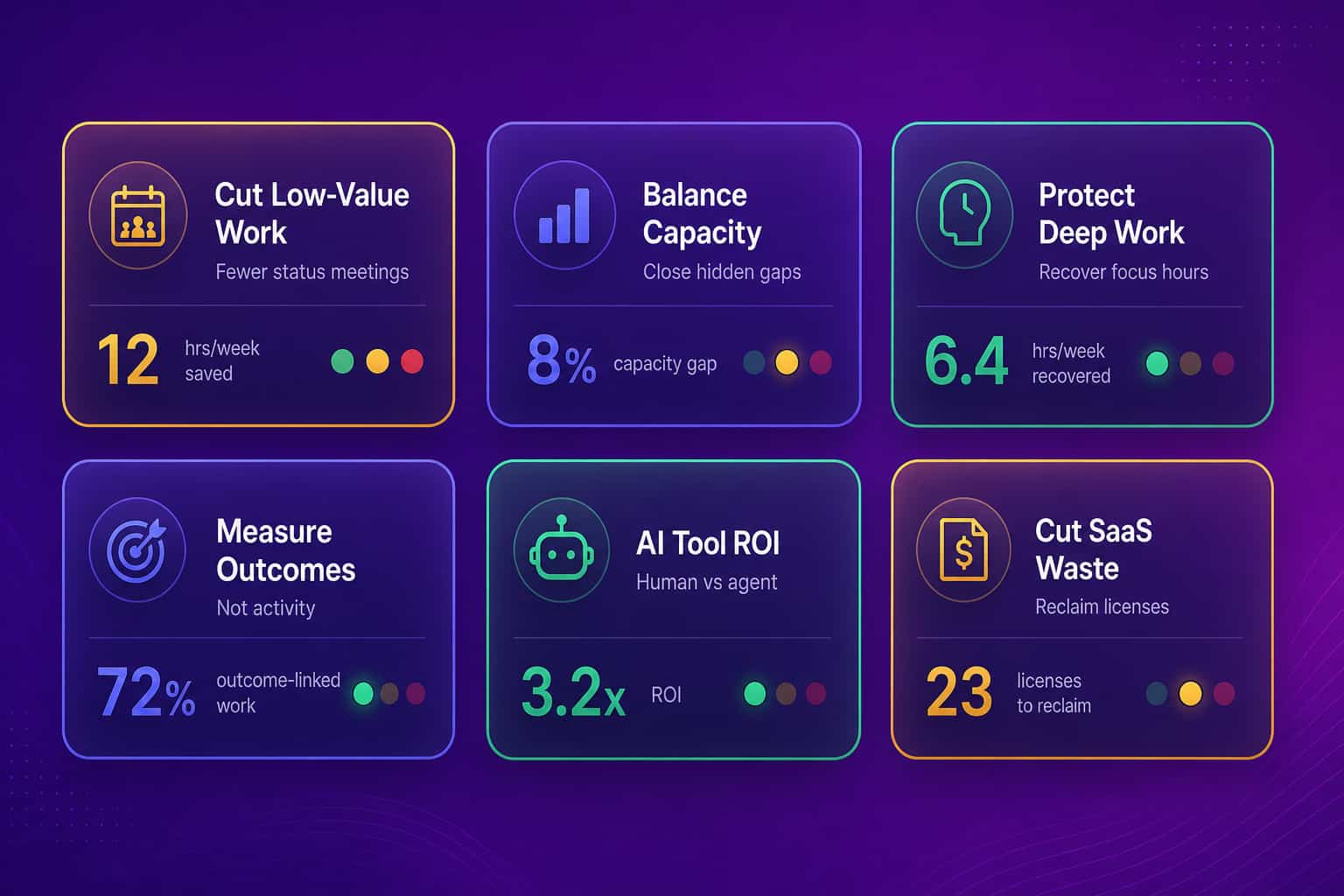
- Cut the low-value work first. The biggest drain is work that should not exist: status meetings that could be a message, reports nobody reads, metrics copied by hand into decks. Remove those before optimizing anything else, because every hour saved here is pure output recovered.
- Balance capacity, not headcount. Most teams are not understaffed, they are unevenly loaded. One engineer is buried while another coasts and nobody can see it. Closing capacity gaps recovers output you already pay for, which is where most of that $500K to $2M a year hides. This is what privacy-first workforce analytics is built to surface.
- Protect deep work. Knowledge work runs on uninterrupted focus, and meeting overload is the thing that destroys it. Blanket meeting-free days alone rarely fix it, for reasons we cover in why meeting-free days fail. Cut the meetings that carry no decision and the focus hours come back.
- Measure outcomes, not activity. You cannot improve what you track wrong. Hours, messages, and screen time measure motion. Delivered PRs, resolved tickets, and shipped features measure productivity, and the difference is the whole game (more on that in efficiency vs productivity).
- Get real ROI from your AI tools. Cursor, GitHub Copilot, and Claude Code make engineers faster at generating code, but more code is not more shipped value. Separate human from AI agent contribution and tie both to delivery, or you are paying for activity in a new costume.
- Cut tool sprawl and SaaS waste. Every unused license and overlapping tool is a tax on budget and focus. Finding the waste typically frees $50K to $100K a year and removes the context-switching that quietly slows everyone down. Here is how much SaaS waste costs.
- Shorten feedback loops. People do their best work with clear metrics and fast feedback, not annual reviews built on memory. Reviews tied to real work signals cut review time by 75% and strip out the recency bias that makes most feedback useless.
Why most productivity tips fail at the team level
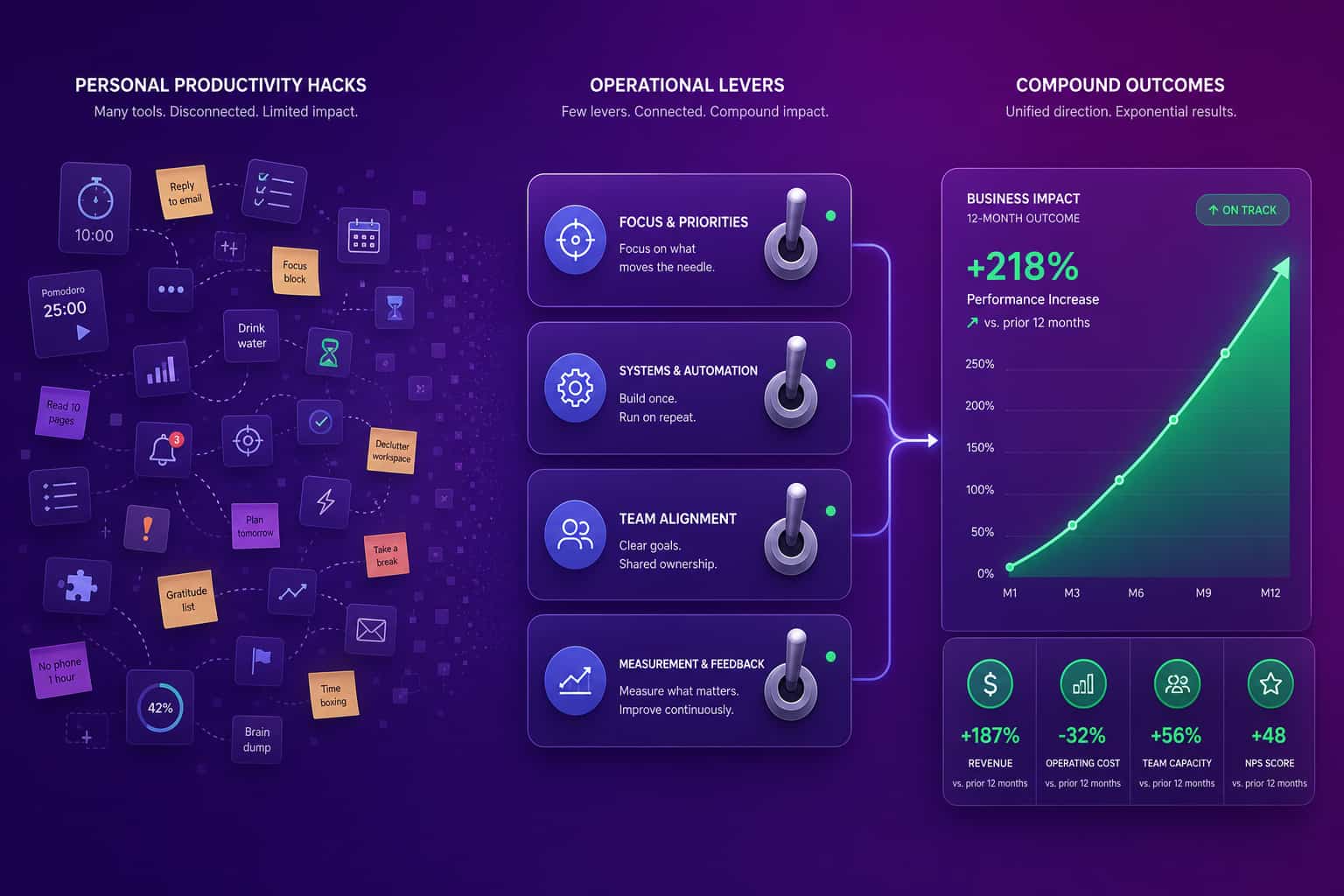
Most productivity tips fail at the team level because they optimize the individual while ignoring the system, and the system is where output actually leaks. A faster typist inside a three-day review queue still waits three days. An engineer with perfect inbox discipline still loses the afternoon to a meeting that should have been a message. Personal hacks have a low ceiling, usually a few percent per person, and they evaporate the moment someone gets busy or stressed. Operational levers have a much higher ceiling because they change the conditions everyone works inside at once. This is also why buying every team member a new productivity app rarely shows up in delivered work: the constraint was never personal discipline. It was the meetings, the uneven load, and the metrics that rewarded motion over outcomes.
| Personal productivity hacks | Operational levers | |
|---|---|---|
| Scope | One person's habits | The whole team's system |
| Examples | Pomodoro, inbox zero, new to-do app | Capacity balance, deep work, outcome metrics |
| Who owns it | The individual | Leadership |
| Realistic ceiling | A few percent per person | Recovering $500K to $2M in hidden waste |
| Holds up under growth | Rarely | Yes |
Productivity improves when you measure outcomes, not activity
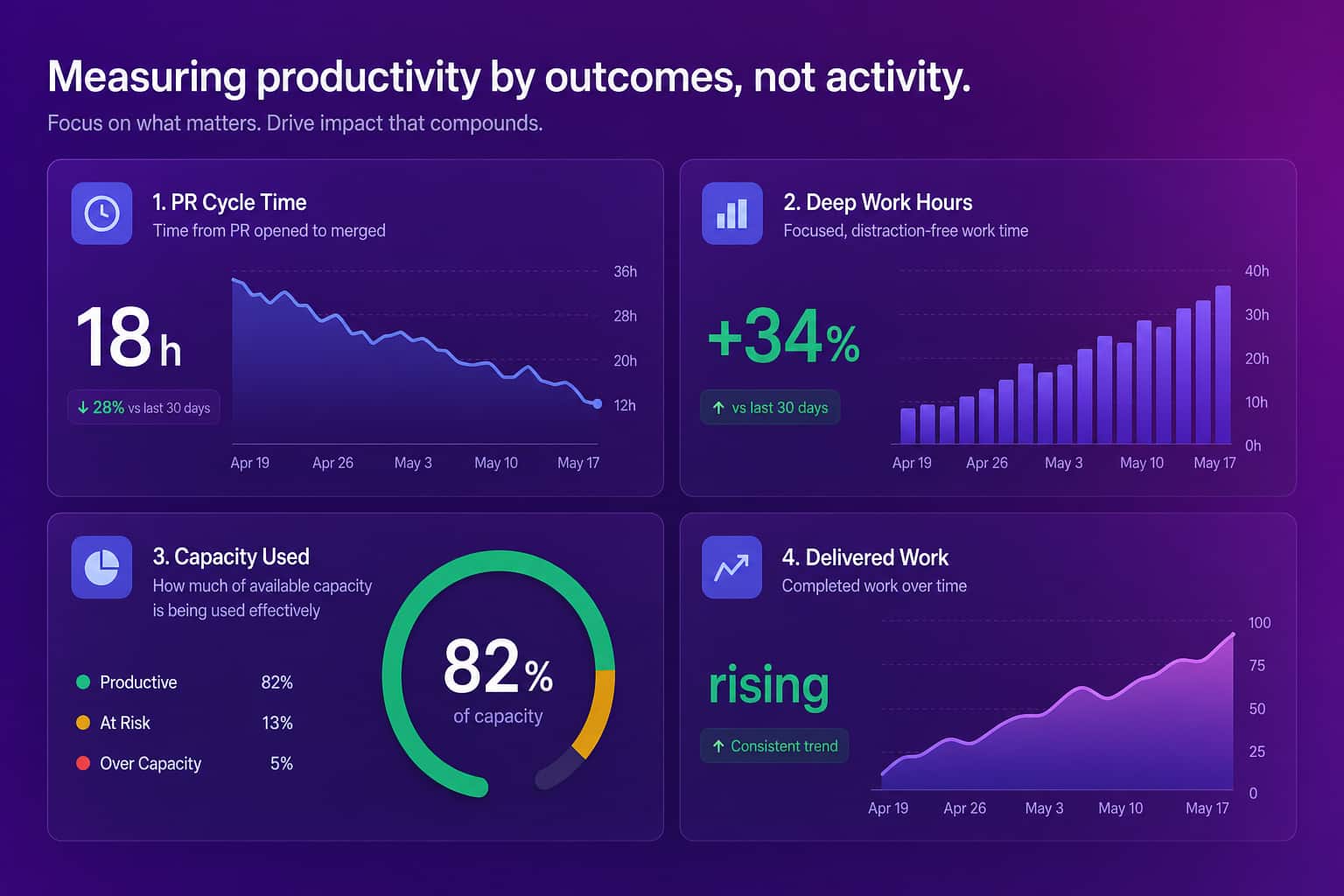
Productivity improves the moment you stop measuring activity and start measuring outcomes, because activity is easy to fake and outcomes are not. Hours logged, messages sent, and screen time all look like productivity and tell you almost nothing about delivered value. The signals that actually predict output already sit in your stack: pull request cycle time and review health in GitHub, completed work in Jira or Linear, and focus time in Google Workspace or M365. Reading those PII-free, with no screenshots and no keyloggers, gives you an honest read on whether the levers are working. This is also why surveillance is the wrong tool for the job. A Personnel Psychology meta-analysis found no evidence that monitoring improves performance, and 2026 survey research puts one in six workers as willing to quit over it. You would pay in trust to measure the wrong variable.
This is the shift one of our customers, a 50-person SaaS COO, noticed first. Their verdict on the data: "What I did manually this week in a spreadsheet is exactly what I think Abloomify should be doing automatically." The work patterns matched their own manual analysis, which is what made the number trustworthy. The same approach is laid out in how to measure productivity without screenshots, and the employee productivity software page is the entry point for measuring outcomes instead of busy-ness.
How to pick which lever to pull first
Pick the lever with the largest gap between effort and output, because that is where recovered productivity is cheapest. For most teams that means starting with the work that should not exist, since cutting a recurring status meeting or a hand-built report returns time immediately and costs nothing. A quick way to size that leak is the meeting cost calculator. From there, follow the money: uneven capacity and SaaS waste are usually the next biggest leaks, and both are measurable in days rather than quarters. The mistake is trying to pull all seven levers at once, which spreads attention thin and makes it impossible to tell what worked. Name the single outcome your team exists to produce, find the lever standing most directly in its way, and fix that one first.
The reason this works is that productivity at a company is not a willpower problem. It is a visibility problem. Once you can see where the work leaks, the levers are obvious and the order picks itself. Hustle moves activity. The right lever moves output. Pull the lever.
FAQ
What can productivity be improved by?
Productivity can be improved by removing low-value work, balancing capacity across the team, protecting deep work, measuring outcomes instead of activity, getting real ROI from AI tools, cutting SaaS waste, and giving people short data-backed feedback loops. Those are operational levers leadership owns, not personal habits.
What is the fastest way to improve team productivity?
Cut the work that should not exist first. Killing a recurring status meeting or a hand-built report returns time immediately and costs nothing. It beats any app or habit change because it removes the drain at the source rather than helping people move faster through busywork that should not be there.
Can productivity be improved without monitoring employees?
Yes. Abloomify reads outcomes from the tools where work happens, PR cycle time in GitHub, completed work in Jira, focus time in Google Workspace, PII-free across 100+ integrations with no screenshots or keyloggers. A Personnel Psychology meta-analysis found no evidence that monitoring improves performance anyway.
Why do most productivity tips fail at the team level?
Most tips optimize one person while ignoring the system, and the system is where output leaks. A faster typist in a three-day review queue still waits three days. Personal hacks have a low ceiling. Operational levers change the conditions everyone works inside at once, so they move the whole team rather than one calendar.
How much does hidden capacity waste cost a company?
At a 100 to 500 person tech company, unseen capacity gaps and uneven workload run $500K to $2M a year. The cost is invisible because activity metrics make everyone look busy, so capable people stay loaded on the wrong work while the real leak never shows up on a dashboard.

Amir Tavafi
Co-Founder & CEO
Product leader and innovator with over 15 years of experience in the tech sector, grounded in AI and robotics. Previously led product development in fraud detection and AI solutions at Nasdaq Verafin.