Efficiency vs Productivity: The Difference Most Teams Miss (2026)
May 22, 2026
Amir Tavafi
11 min read

Efficiency and productivity get treated as the same thing in most operating reviews, and the confusion is expensive. Efficiency is doing work faster and cheaper. Productivity is producing more of the work that actually matters. A team can be highly efficient and barely productive, which is how a tech company hides $500K to $2M a year in capacity waste while everyone looks busy. At Abloomify we measure the second thing, not the first.
Key Takeaways
Q: What is the difference between efficiency and productivity?
A: Efficiency measures how fast and cheaply you do work. Productivity measures how much valuable output you produce. A developer can write code efficiently all week and ship nothing that matters. Abloomify tracks output and outcomes, not just activity, so the two stop getting confused.
Q: Can a team be efficient but not productive?
A: Yes, and it is common. A team that answers every message in minutes, attends every meeting, and closes tickets fast looks efficient. If none of that work moves a customer outcome, productivity is flat. Efficiency at the wrong work is just expensive motion.
Q: Why does the efficiency vs productivity gap cost money?
A: Payroll is the largest line item at most tech companies, and unseen capacity gaps run $500K to $2M a year. When leaders optimize for efficiency, like speed and utilization, instead of productivity, like delivered outcomes, they pay for motion that never reaches a customer.
Q: How do AI coding tools change the equation?
A: Tools like Cursor and Copilot make engineers more efficient at generating code, but more code is not more shipped value. Without separating human from AI agent contribution and tying it to delivery, you book an efficiency gain while productivity stays flat.
Q: How do you measure productivity, not just efficiency?
A: Measure outcomes from the tools where work happens: PR cycle time in GitHub, delivered tickets in Jira, focus time in Google Workspace. Abloomify reads these PII-free across 100+ integrations, with no screenshots or keyloggers, so the number reflects output rather than busy-ness.
What is the difference between efficiency and productivity?
Efficiency and productivity describe two different things that leaders routinely merge into one number. Efficiency is a ratio of output to input: how much work you get done per hour, per dollar, or per person, with as little waste as possible. Productivity is about the volume and value of useful output you create, regardless of how frantic the process looks. The cleanest way to hold the distinction is this: efficiency is doing things right, and productivity is doing the right things and getting them shipped. You can max one while starving the other. A support team that closes tickets in record time is efficient, but if half those tickets trace to a bug nobody fixed, the real outcome is getting worse. Almost every workplace metric, from utilization to response time, quietly measures efficiency and then gets reported as productivity.
That swap is the root of a lot of bad operating decisions. When efficiency stands in for productivity, you reward the team that looks busiest, not the team that delivers most. You staff against activity instead of outcomes. And you miss the most common failure mode in knowledge work, which is a group of capable people being extremely efficient at work that should not exist.
| Efficiency | Productivity | |
|---|---|---|
| Question it answers | How fast and cheap is the work? | How much valuable output got produced? |
| Optimizes for | Speed, cost, utilization | Delivered outcomes |
| Looks like | A busy, fast-moving team | Shipped features, resolved customer problems |
| Easy to fake | Yes, activity metrics inflate it | Harder, it is tied to outcomes |
| Right question | Are we doing this work well? | Is this the work worth doing? |
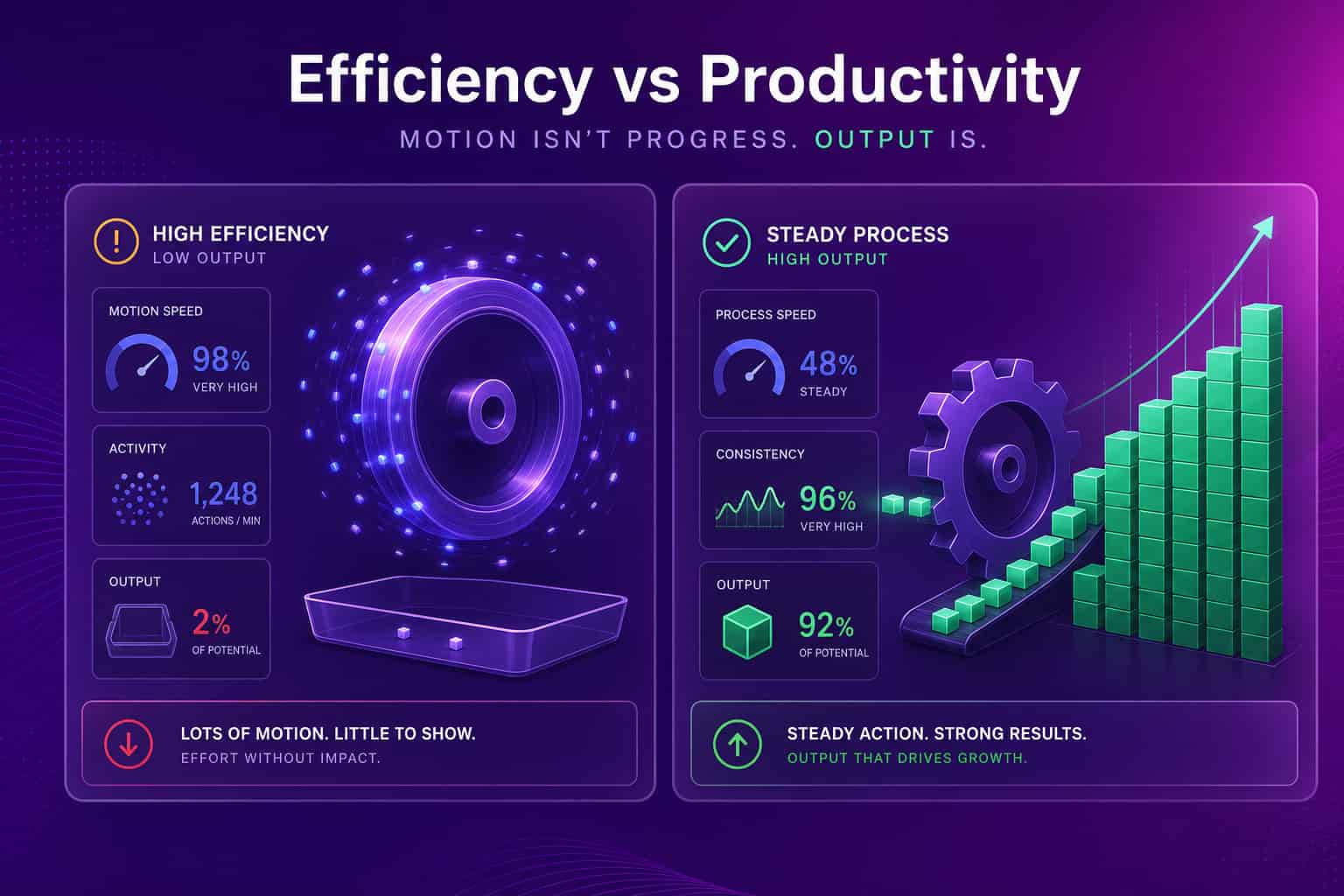
Why tech leaders confuse efficiency and productivity
Tech leaders confuse efficiency and productivity because efficiency is easy to see and productivity is hard to measure, so the visible thing wins. Activity throws off a constant stream of signals: messages sent, tickets touched, hours logged, meetings attended. All of it feels like progress, and all of it is efficiency data wearing a productivity costume. Output is quieter. A shipped feature, a resolved customer problem, or a decision that unblocks ten people does not announce itself on a dashboard the way a packed calendar does. So leaders manage what they can see, reward the people who look busy, and slowly train the whole org to optimize motion over outcomes. The fix is not more activity tracking. It is measuring the output that activity was supposed to produce in the first place.
I have watched this happen to my own week. When we started Abloomify, I assumed the job was strategy. The more we shipped, the clearer it got that most of a leader's week is admin in disguise: chasing people for updates, copy-pasting metrics into decks, turning meeting notes into action items, and digging across five tools to answer one basic question like who is overloaded right now. I was efficient at all of it. Almost none of it was productive. The hours that moved the company were the quiet ones nobody could see on a status report.
Efficiency vs productivity in engineering, and what AI tools changed
In engineering the efficiency-versus-productivity gap is wider than anywhere else, and AI coding tools just widened it. For years the proxy metrics were commits, lines of code, and story points, all of which measure how much activity a team generates, not how much working software reaches users. A team can post huge commit counts and a fast keyboard while its pull requests sit in review for three days and features ship late. That is high efficiency at typing and low productivity at delivery. Then Cursor, GitHub Copilot, and Claude Code arrived and made the typing part faster still. More code gets generated per hour, which reads as a clear efficiency win. Whether it turns into more shipped value depends entirely on review capacity, defect rates, and whether the generated code solved the right problem. If you cannot separate human contribution from AI agent contribution and tie both to delivery, you are measuring an efficiency gain and hoping it is productivity.
This is why PR cycle time, review health, and delivery flow tell you more than raw output counts. A rising volume of AI-generated code with a rising cycle time is a warning, not a win, because you are pushing more work into a review system that already cannot keep up. The honest read separates what humans built from what agents generated, then checks whether either reached production. We go deep on the delivery side in the engineering velocity metrics guide, and on the tooling side in how to measure AI adoption impact. Both come back to the same point: count outcomes, not keystrokes.
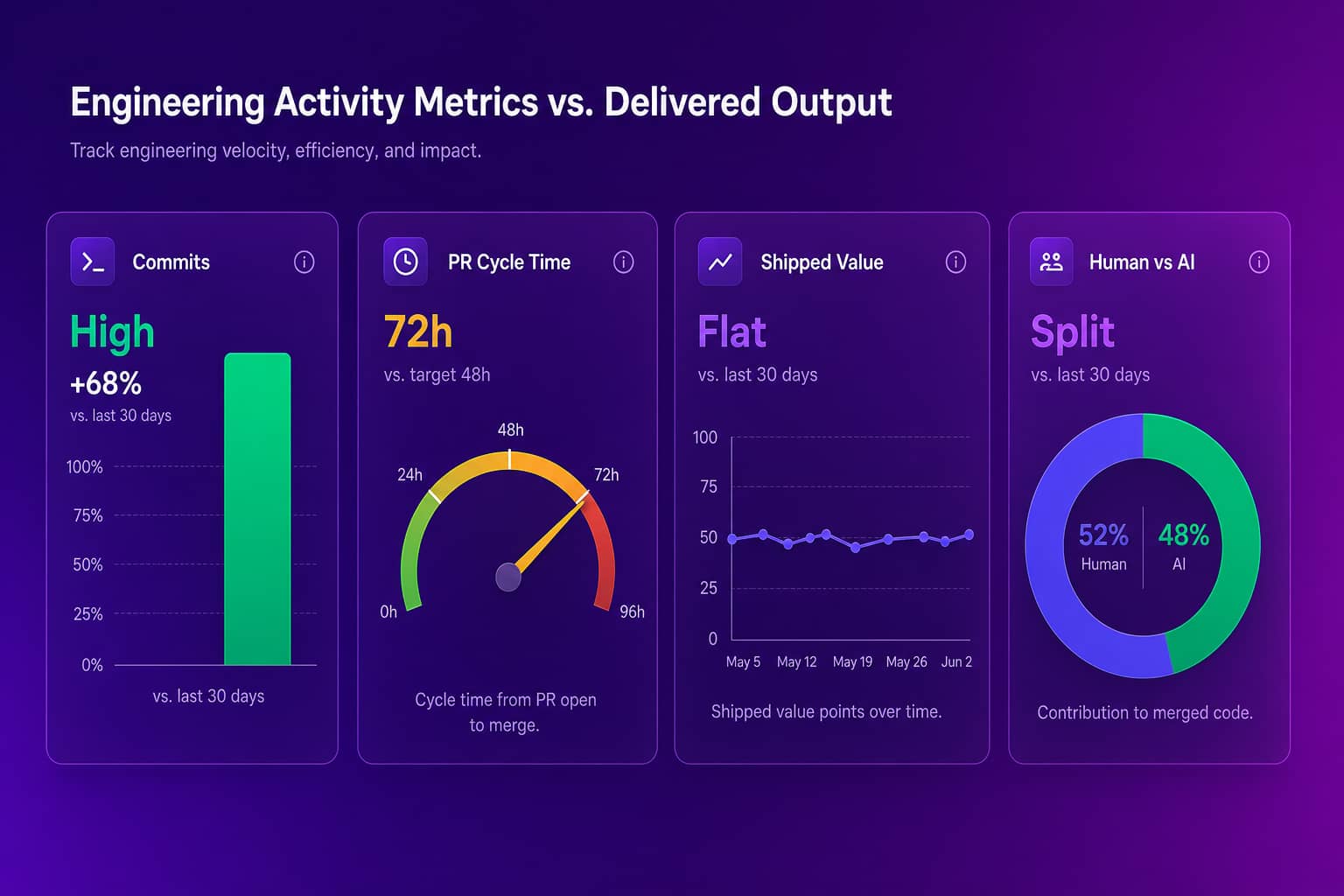
How to measure productivity without measuring activity or surveillance
Measuring productivity instead of efficiency means reading outcomes from the systems where work actually lands, not counting keystrokes or screen time. The signals that predict delivered value already live in your stack: pull request cycle time and review health in GitHub or GitLab, committed and completed work in Jira or Linear, and meeting load and focus time in Google Workspace and M365. Pulling PII-free metrics from those tools by API gives you an output-based read on productivity without capturing email content, message content, file content, or a single screenshot. This is also why surveillance fails as a productivity tool: it measures presence and activity, which is efficiency theater, not outcomes. A Personnel Psychology meta-analysis found no evidence that monitoring improves performance, and 2026 survey research puts one in six workers as willing to quit over surveillance. You would be paying in trust to measure the wrong variable.
The architecture that makes this work is two data layers. The first is 100+ API integrations across project management, code repos, communication, CRM, HRIS, and AI coding tools, all PII-free. The second is an optional privacy-first device agent on Mac and Windows that captures aggregated metrics like focus time and app categories, with no screenshots, no keyloggers, and no screen recording. The combination is SOC 2 Type 2 certified and GDPR compliant by design. For the full argument against screen monitoring, the measure productivity without screenshots guide makes the case, and the employee productivity software page is the right entry point for measuring outcomes instead of activity.
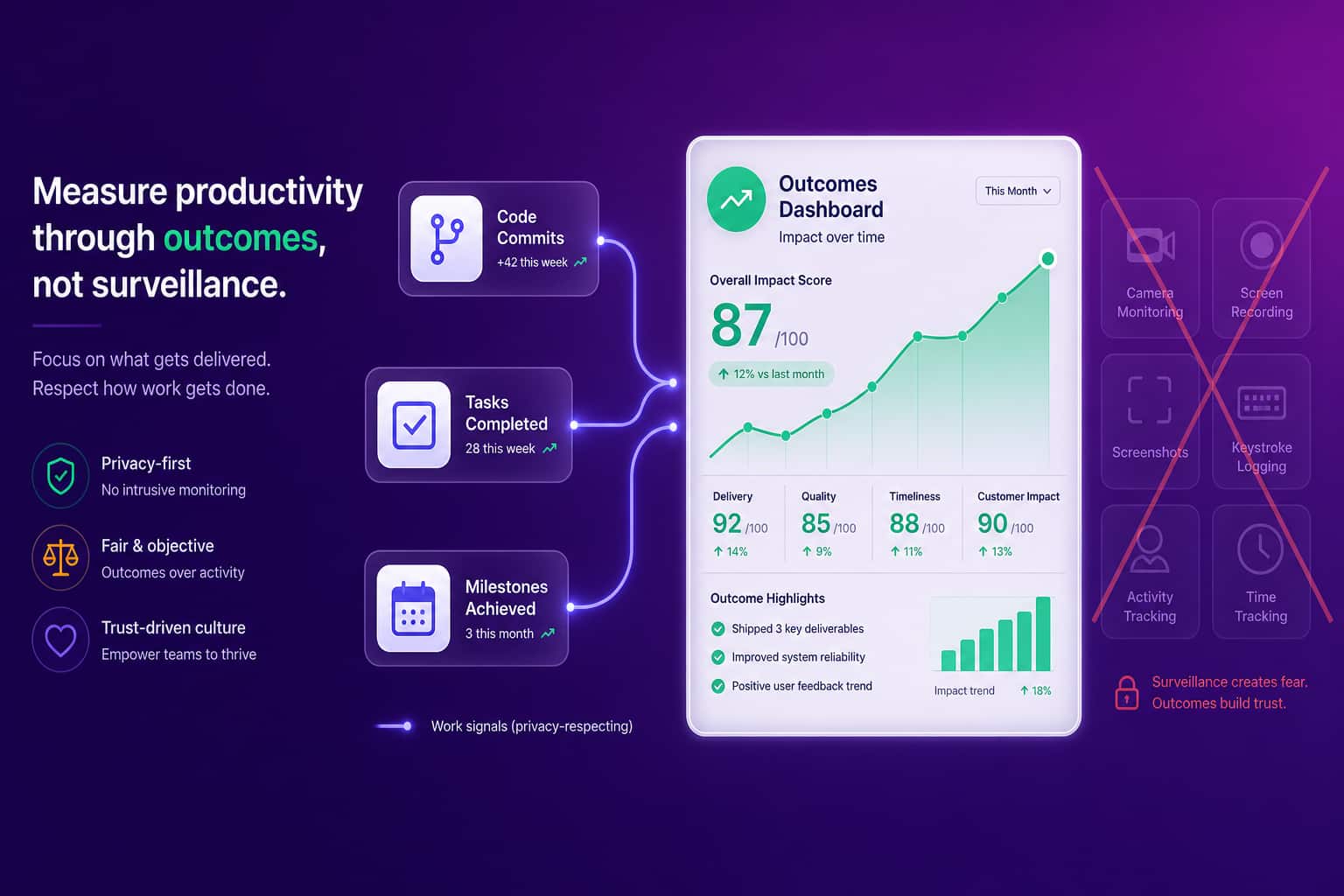
How to balance efficiency and productivity
Balancing efficiency and productivity starts with deciding which one a given metric is actually telling you, then refusing to let efficiency stand in for output. Efficiency still matters, because a productive team that wastes half its capacity on rework or status meetings is leaving money on the table. The discipline is to pair every efficiency metric with the outcome it is supposed to serve. Utilization sits next to delivered work. Response time sits next to resolved problems. AI tool adoption sits next to shipped value and defect rates. When the two move together, you have real leverage. When efficiency climbs and output stays flat, you have found waste, and that gap is usually worth $500K to $2M a year at a company of 100 to 500 people.
In practice this is a short list. Name the outcome each team exists to produce, then find the one or two efficiency metrics that should track with it. Watch for the divergence, where activity rises but the outcome does not, because that divergence is where capacity leaks. Start with the worst offender rather than boiling the ocean: the operational efficiency playbook covers how to find the hidden waste first, and how to identify process bottlenecks shows how to read effort against outcome so you fix the constraint, not the symptom.
Efficiency makes you feel fast. Productivity is whether anything shipped. Measure the second one.
FAQ
Is efficiency the same as productivity?
No. Efficiency measures how fast and cheaply you do work; productivity measures how much valuable output you produce. A team can be highly efficient at the wrong work and barely productive. Abloomify tracks output and outcomes across 100+ connected tools, not just activity, so the two stop getting confused.
What is an example of being efficient but not productive?
A support team that closes tickets in record time looks efficient. If half those tickets come from a bug nobody fixed, productivity is dropping because the real outcome, fewer customer problems, is getting worse. Fast motion at the wrong work is expensive, not productive.
Should companies prioritize efficiency or productivity?
Productivity, then efficiency in service of it. Delivered outcomes are what customers and boards pay for. Efficiency matters once the work is the right work, because a productive team that wastes capacity on rework or status meetings still leaves money on the table. Pair every efficiency metric with the outcome it serves.
How do you measure productivity without monitoring employees?
Read outcomes from the tools where work happens: PR cycle time in GitHub, completed work in Jira, focus time in Google Workspace. Abloomify pulls these PII-free across 100+ integrations with no screenshots or keyloggers. A Personnel Psychology meta-analysis found no evidence that monitoring improves performance anyway.
Do AI coding tools improve productivity or just efficiency?
On their own, mostly efficiency. Cursor, Copilot, and Claude Code make engineers faster at generating code, but more code is not more shipped value. Productivity only rises if review capacity, quality, and delivery keep up, which is why you have to separate human from AI agent contribution and tie it to outcomes.

Amir Tavafi
Co-Founder & CEO
Product leader and innovator with over 15 years of experience in the tech sector, grounded in AI and robotics. Previously led product development in fraud detection and AI solutions at Nasdaq Verafin.