Why Meeting-Free Days Fail (and What Actually Recovers Deep Work)
April 8, 2026
Walter Write
3 min read

Meeting-free days fail for 3 reasons
1. No enforcement mechanism
A policy that says "No meetings on Wednesdays" is a suggestion, not a rule. Within 3 weeks, exceptions erode the practice. Without data showing violation rates and their impact, there is no accountability.
2. No measurement of impact
If you cannot prove that meeting-free days increased output, the policy loses executive support. "It feels better" is not a business case. "PR merge rate increased 83% on meeting-free days" is.
3. They treat the symptom, not the cause
Meeting-free days reduce meeting time by one day. But they do not address why meetings proliferate: status syncs that should be async, meetings with no agenda, meetings with too many attendees, and meetings that happen because of habit, not need.
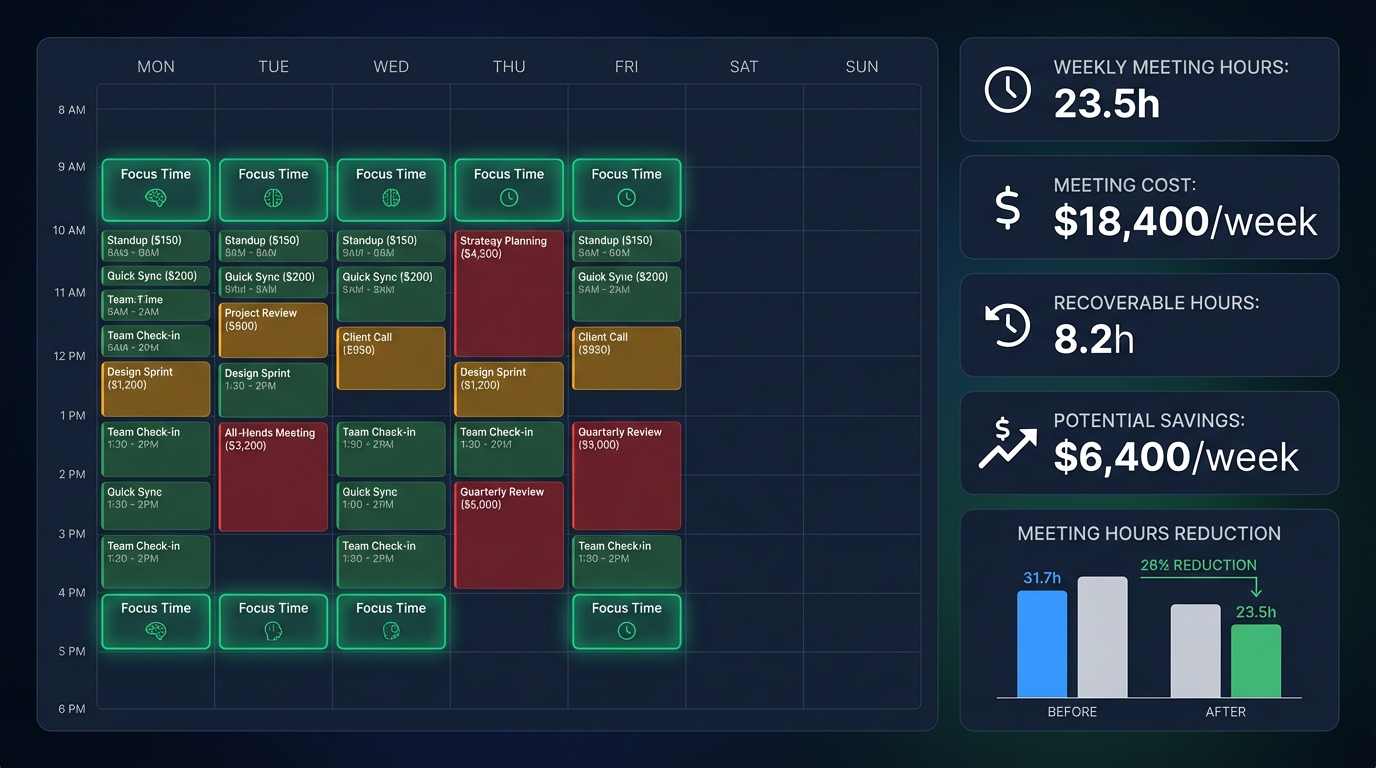
What the data shows
When measured properly, meeting-free days show significant impact:
- 83% more PRs merged on meeting-free days vs regular days.
- 2x deep work hours per person.
- 50% fewer Slack messages (people are actually working, not narrating).
- 75% more documents completed.
The problem is not that meeting-free days do not work. The problem is that most companies implement them without measurement and enforcement, so the practice erodes.
What actually recovers deep work
Step 1: Make the cost visible
Calculate the dollar cost of every meeting using attendee comp data. When leaders see that a weekly status sync costs $800/hour in loaded salary and produces zero decisions, they cancel it themselves.
Step 2: Score meeting quality
Rate every recurring meeting on agenda presence, engagement, decisions made, and participant necessity. Kill everything scoring below 40/100. Convert borderline meetings to async.
Step 3: Enforce and measure
Track meeting-free day compliance and measure output differences. Share the data weekly. When teams see that their meeting-free Wednesdays produce 83% more output, they protect the time.
Step 4: Address root causes
For every meeting that should be async, create the alternative (Slack update, Loom video, written brief). For every meeting that needs fewer people, reduce the invite list. For every meeting that needs a shorter window, timebox it.
When you use a platform like Abloomify, deep-work and meeting analytics connect to the same Goals & OKRs, review, and feedback workflows teams already run—so calendar hygiene reinforces performance management instead of living in a separate "productivity only" tool.
FAQ
How many meeting-free days per week?
Start with one. Wednesday works best (avoids Monday kickoffs and Friday wraps). If the data supports it, expand to two.
What about urgent meetings?
Urgent meetings still happen. The policy covers recurring rituals, not incident response. Data shows "urgent" exceptions represent less than 5% of total meeting time.
How long before we see results?
Output differences are measurable in the first week. Behavioral change (managers respecting the policy) takes 3-4 weeks.
What to read next

Walter Write
Staff Writer
Tech industry analyst and content strategist specializing in AI, productivity management, and workplace innovation. Passionate about helping organizations leverage technology for better team performance.