Platform Engineering: What It Is and Why It Keeps Getting Cut
September 16, 2026
Amir Tavafi
12 min read

Platform engineering is the internal team that builds the golden path so product engineers stop reinventing CI pipelines, secrets management, and deploy scripts from scratch. It is also one of the hardest functions to defend in a budget review, because most platform teams have no data showing the golden path actually shortened anything. That gap between building an internal developer platform and proving what it moved is where Abloomify's engineering intelligence lives.
Key Takeaways
Q: What is platform engineering?
A: Platform engineering is the discipline of building an internal developer platform (IDP): shared tools, templates, and self-service infrastructure that let product teams ship without rebuilding CI/CD, secrets management, and deploy pipelines themselves. The CNCF and Red Hat both define its goal as reducing cognitive load, not adding another layer of process.
Q: How is platform engineering different from DevOps?
A: DevOps is a culture and set of practices for shipping software; platform engineering is the team and product that makes those practices usable at scale through a self-service IDP. DevOps says "you build it, you run it." Platform engineering hands every team a paved road to actually do that without reinventing tooling.
Q: Why do platform engineering teams get cut first in a downturn?
A: Most platform teams can point to a golden path they built but not to the PR cycle time, deployment frequency, or onboarding speed it moved. Without delivery data tied to the platform's rollout, the team looks like overhead the moment a CFO asks what it shipped this quarter.
Q: What metrics prove platform engineering is working?
A: DORA metrics (deployment frequency, lead time for changes, change failure rate, mean time to restore), measured before and after IDP adoption, plus PR cycle time and onboarding speed. Abloomify computes all four DORA metrics directly from GitHub and Jira and layers in IDP adoption trends by team.
Q: Does platform engineering replace DevOps or SRE teams?
A: No. Platform engineering usually absorbs the tooling half of what DevOps engineers did ad hoc and works alongside site reliability engineering, which stays focused on uptime and incident response. Most orgs run all three at once: DevOps culture, an SRE function, and a platform team building the shared IDP underneath both.
What Is Platform Engineering, Actually?
Platform engineering is the internal-facing discipline of building and running an internal developer platform (IDP), the shared layer of self-service tools, templates, and infrastructure APIs that lets product engineering teams provision environments, ship code, and manage deployments without hand-building CI/CD pipelines, secrets management, or observability stacks themselves, a definition the Cloud Native Computing Foundation and Red Hat both converge on: reduce cognitive load for developers, give the organization a "golden path" (a paved, opinionated route from commit to production that is fast by default and hard to get wrong), and treat the platform itself as a product, with product engineers as its paying customers rather than a policy handed down from IT.
The role exists because of a trade that went wrong. Post-2015, "you build it, you run it" pushed operational ownership onto every squad. Each team ended up hand-rolling its own Terraform modules, its own CI config, its own way of requesting a database. Platform engineering is the professionalized fix: one team builds the golden path once, treats product engineers as its customers, and gets measured on whether people actually use the path instead of quietly maintaining their own.
That last part is where most platform teams lose the thread. They ship the portal. They write the docs. Nobody instruments whether teams onboard onto it, whether it shortens anything, or whether half the org still keeps a shadow set of scripts because the golden path was slower than what they already had.
Platform Engineering vs DevOps vs SRE: What's Actually Different
Platform engineering, DevOps, and site reliability engineering (SRE) solve overlapping problems at different altitudes, and the distinction matters because conflating them is exactly how a CFO decides the newest-sounding function is the one to cut: DevOps is a set of cultural practices, most famously "you build it, you run it," that pushes deployment and operational ownership onto the engineers who write the code; SRE, a discipline Google formalized, treats operations problems as software problems, with error budgets and blameless postmortems aimed at reliability; and platform engineering is the team that builds the internal developer platform so DevOps practices and SRE guardrails are available to every product team through self-service, instead of being reinvented, or skipped, squad by squad.
| Function | Primary job | Customer | How you'd measure it |
|---|---|---|---|
| DevOps (practice) | Ship and own what you build | The engineering org as a whole | Deployment frequency, lead time |
| SRE | Keep production reliable | Whoever's on call | Uptime, error budget burn, MTTR |
| Platform engineering | Build the self-service golden path | Product engineering teams | IDP adoption, PR cycle time, onboarding speed |
Three different jobs, three different owners, and in most orgs I talk to, three different budget lines that get evaluated by people who cannot tell them apart. That confusion is a platform team's actual enemy, more than any tooling decision.
What Platform Engineering Actually Removes From a Developer's Day
What platform engineering actually removes from a developer's day has nothing to do with Kubernetes or Backstage as products and everything to do with which hours go toward building the thing customers pay for versus provisioning a database by hand, writing a CI config from scratch, waiting three days for an IAM ticket to close, or debugging a deploy script that only one person on the team half understands, all of which a good internal developer platform collapses into a self-service action that takes minutes instead of days, while a bad one just moves the same busywork behind a shinier portal without shortening any of it.
I've made this argument about leadership before: killing the low-value chores that quietly eat someone's day matters more than adding another layer of process. Chasing people for status updates. Copy-pasting metrics into a deck. Digging across five tools to answer "who's blocked." Platform engineering runs the same play for developer experience instead of managers: kill the toil of environment setup, secrets rotation, and deploy scripts, and hand that time back to the work that actually ships product.
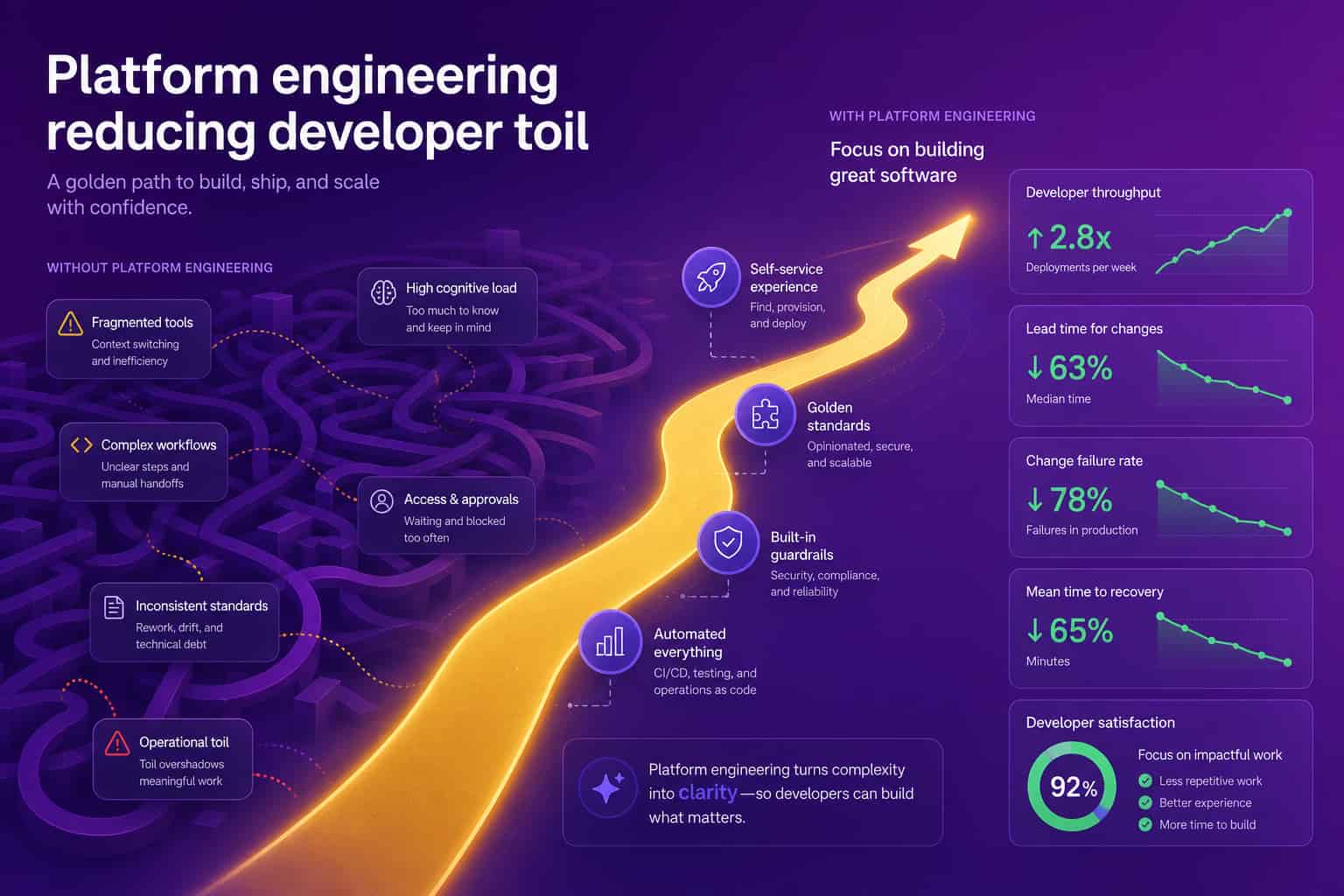
The failure mode is a platform team that measures itself by what it built (a portal, a template library, a Kubernetes abstraction) instead of what it removed. Toil eliminated only counts if someone can see the removal in the numbers: fewer support tickets, faster time to first PR for a new hire, shorter gaps between "I need an environment" and "I have one."
The Metrics That Prove (or Kill) a Platform Team's Budget
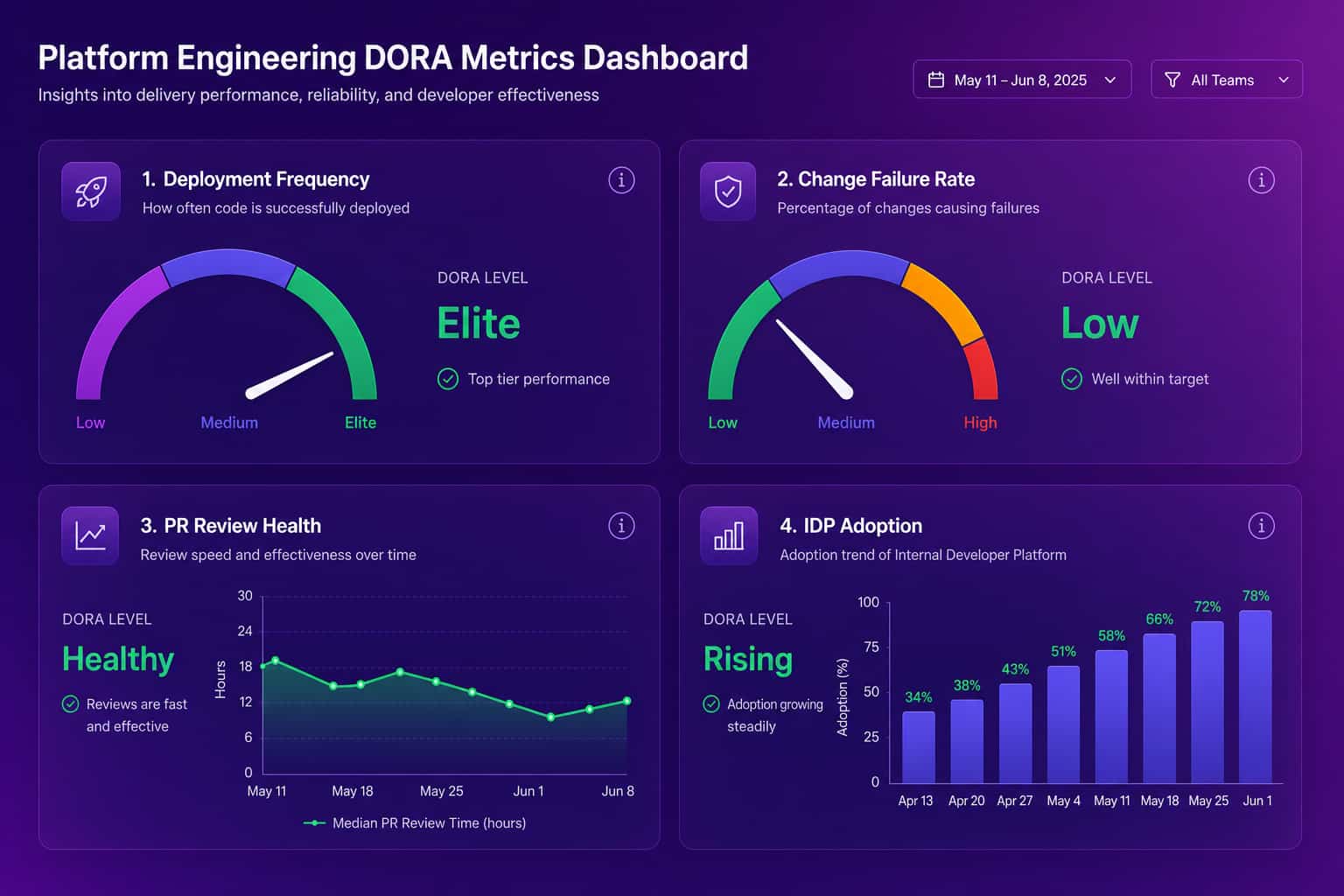
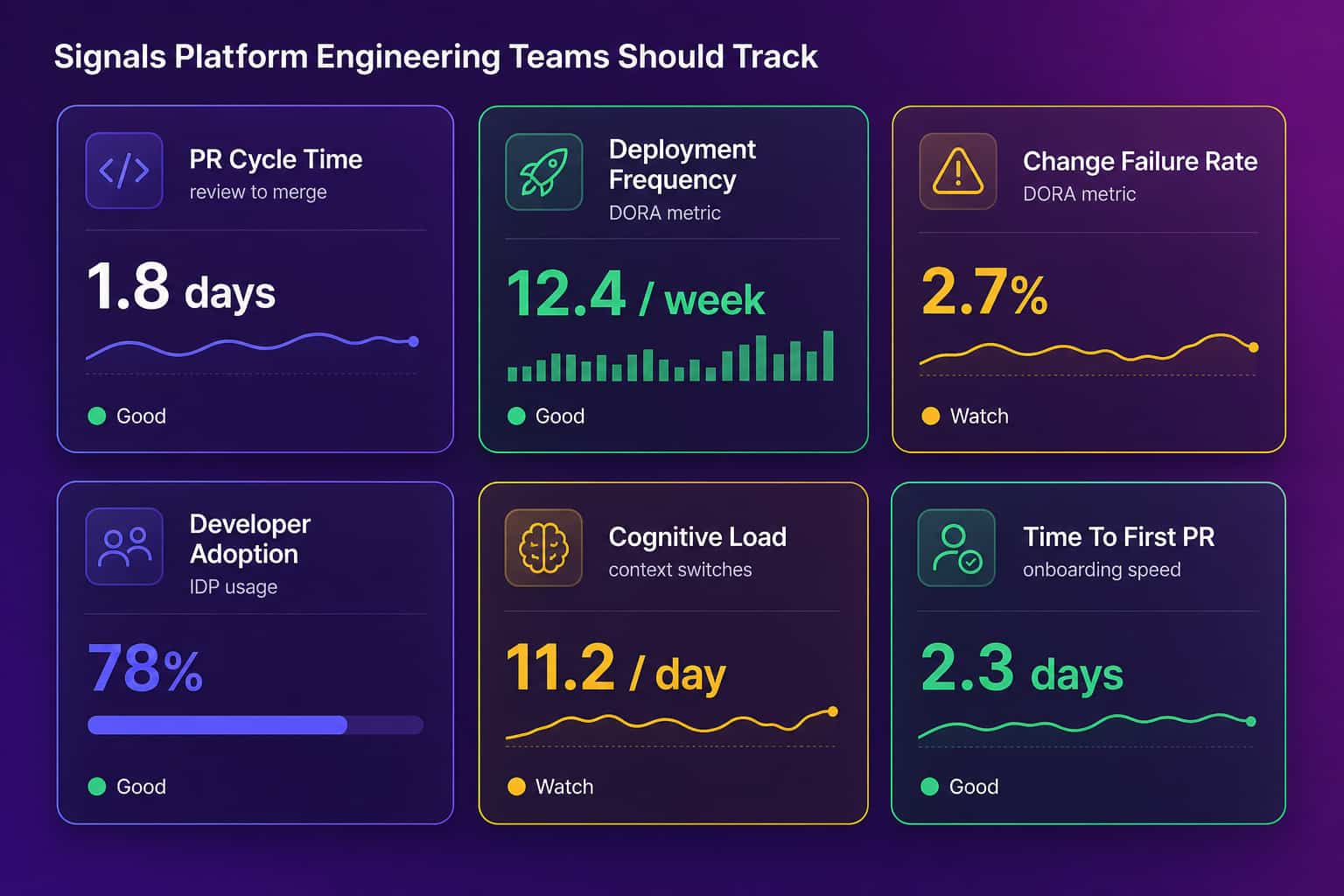
The metrics that prove platform engineering is working are the same four DORA metrics engineering leaders already track for delivery performance, read specifically as a before-and-after around your internal developer platform's rollout: deployment frequency, lead time for changes, change failure rate, and mean time to restore, each banded Elite through Low, layered with PR cycle time, time to first PR for new hires, and IDP adoption by team, which together give you an actual business case instead of an assertion that "developer experience improved." Abloomify computes all four DORA metrics directly from GitHub and Jira, tracks adoption of your internal platform by team, and separates human vs AI-agent contribution across code and reviews, a split neither Jellyfish nor LinearB offers. That split matters here specifically: if a third of a team's velocity gain this quarter came from Cursor or Copilot rather than the platform rollout, that is a different, more honest conversation with the board than crediting it all to the golden path.
Internal Developer Platforms Fail Quietly Without Adoption Data
An internal developer platform can fail without anyone noticing for two quarters, because the failure mode is silence rather than an incident: teams quietly keep their own scripts, their own pipelines, their own way of standing up a service, nobody on the platform team is tracking who actually adopted the golden path versus who is routing around it, the team keeps shipping new capabilities into a portal that fewer people open every sprint, and the gap is functionally the same shadow-IT problem operations leaders already fight with unsanctioned SaaS tools, just relocated inside the engineering org instead of outside it. The fix is the same too: instrument usage instead of assuming it, then act on the teams that never crossed the adoption line.
Watching adoption by team also tells you where to invest next. A platform with 90 percent adoption in one org and 20 percent in another is not a rollout problem, it's a signal that the second org's workflow doesn't fit the golden path yet, and building more features nobody in that org will use is wasted engineering time. This is the same discipline behind detecting unused SaaS licenses: usage data beats assuming everyone is on board.
- Track IDP adoption by team, not company-wide. A 70 percent average can hide a team at 15 percent.
- Watch time-to-first-PR for new hires. It is the fastest proxy for whether onboarding onto the platform actually works.
- Correlate adoption with PR cycle time and deployment frequency, by team, not in aggregate.
- Flag teams that never migrated. That is where the platform's next fix (or its next honest conversation) belongs.
How to Build the Business Case for Platform Engineering
Building the business case for platform engineering means treating the rollout like an experiment with a before and after, not a launch you announce once and hope people notice: baseline your DORA metrics and PR cycle time before the internal developer platform ships, track IDP adoption and the same delivery metrics by team as rollout progresses, separate AI-assisted velocity gains from platform-driven ones so you are not crediting the golden path for what Cursor or Claude Code actually did, report the delta quarterly instead of once a year when someone finally asks, and bring the same four numbers to every headcount conversation whether the news that quarter is good or not. Engineering leaders who do this walk into a budget review with a chart. Engineering leaders who don't walk in with an opinion.
- Pull a 90-day DORA baseline (deployment frequency, lead time, change failure rate, MTTR) before your next platform investment.
- Instrument IDP adoption by team, not org-wide, from day one of rollout.
- Separate human vs AI-agent contribution so platform gains and AI tool gains aren't credited to the wrong line item.
- Report the same four numbers every quarter, tied explicitly to what the platform team shipped that period.
Platform teams that measure survive budget season. Platform teams that vibe do not.
FAQ
What is platform engineering in simple terms?
Platform engineering is the internal team that builds a self-service internal developer platform (IDP): shared tools, templates, and infrastructure APIs so product engineers can provision environments and ship code without hand-building CI/CD, secrets management, or observability stacks themselves. The goal is less cognitive load per developer, not another approval layer.
Is platform engineering the same as DevOps?
No. DevOps is a set of cultural practices, most famously "you build it, you run it." Platform engineering is the team and product that makes those practices usable at scale by building the self-service golden path everyone else uses. DevOps is the philosophy; platform engineering is the plumbing that lets teams actually live it.
What is an internal developer platform (IDP)?
An internal developer platform is the paved, opinionated path from commit to production: templates, pipelines, provisioning APIs, and guardrails that a platform engineering team builds and a product engineer consumes through self-service, usually a portal or CLI, instead of filing a ticket to an ops team.
How do you measure platform engineering ROI?
Baseline your four DORA metrics (deployment frequency, lead time for changes, change failure rate, mean time to restore) and PR cycle time before an internal developer platform rollout, then track the same numbers by team as adoption grows. Abloomify computes all four directly from GitHub and Jira, alongside IDP adoption trends, so the before-and-after is a query, not a quarterly all-hands slide someone built by hand.
Does Abloomify replace tools like Backstage or Humanitec?
No. Backstage, Humanitec, and similar tools are the platform itself, the portal and provisioning layer developers touch. Abloomify sits on top and measures whether that platform is working: DORA metrics, PR cycle time, adoption by team, and a human vs AI-agent contribution split, computed from GitHub, Jira, and your AI coding tools.
Why do platform engineering teams get cut first in a downturn?
Because most of them can describe what they built but not what it moved. A CFO reviewing headcount sees a team with no delivery numbers attached to its name, and a team with no numbers reads as overhead. The platform teams that survive budget season are the ones with a before-and-after DORA scorecard, not the ones with the best internal Notion page.

Amir Tavafi
Co-Founder & CEO
Product leader and innovator with over 15 years of experience in the tech sector, grounded in AI and robotics. Previously led product development in fraud detection and AI solutions at Nasdaq Verafin.