Market Data Cost Management: A 2026 Playbook to Cut Terminal Spend
July 21, 2026
Amir Tavafi
12 min read

Market data is one of the largest line items in finance that almost nobody audits. A single Bloomberg Terminal lists at $31,980 a year, firms run hundreds to more than a thousand seats, and the renewal gets signed on habit. Market data cost management is the discipline that turns that reflex into a decision, and it starts with one number most leaders cannot produce: how many of your seats actually get used.
Key Takeaways
Q: What is market data cost management?
A: Market data cost management is the practice of tracking and reducing spend on terminals and feeds like Bloomberg, LSEG Workspace, and FactSet. It spans inventory, entitlements, real seat usage, downgrade decisions, and renewal timing, so every seat maps to actual use rather than habit.
Q: Why does market data spend keep climbing?
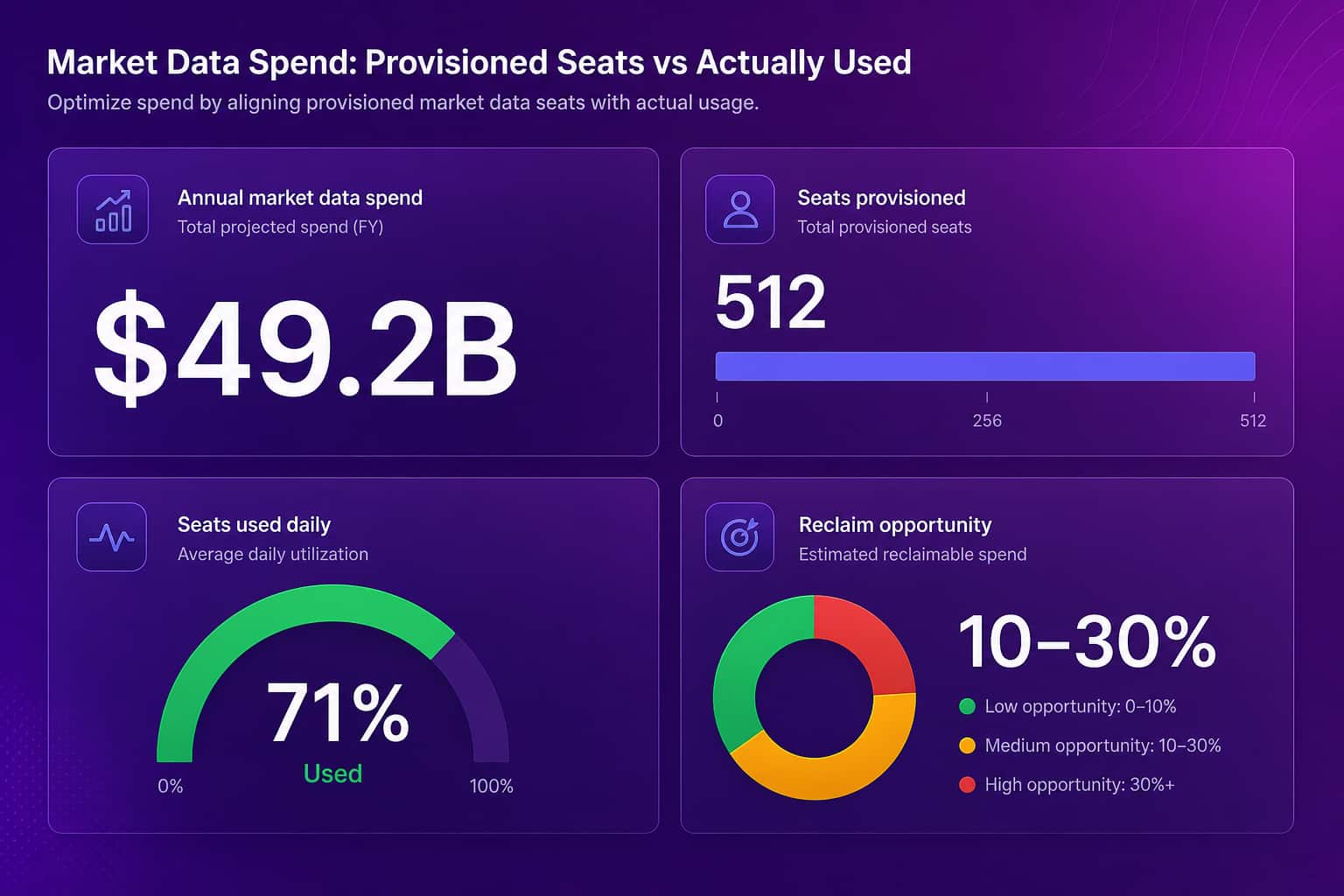
A: Global market data spend hit $49.2B in 2025, up 6.5% (Burton-Taylor), and Bloomberg applies a 6.5% increase on renewing contracts. Contracts run in two-year cycles, so every renewal signed without usage evidence locks the waste in for another two years.
Q: What is the fastest way to cut market data costs?
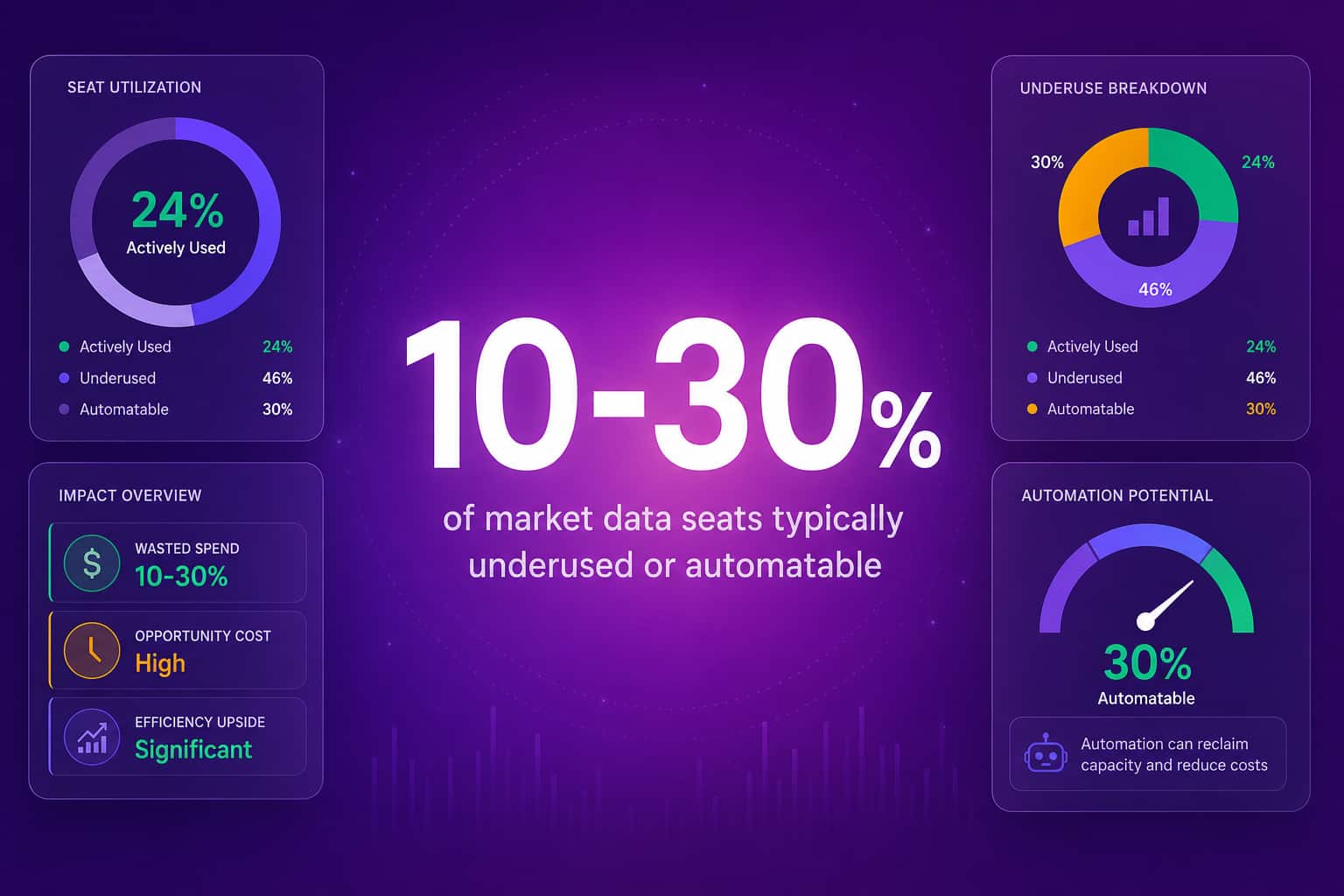
A: Find the idle and lookup-only seats before the renewal window. Entitlement reports show who is provisioned, not who works in the product. Seat-by-seat usage evidence turns a renewal into a downgrade decision, and firms typically flag 10 to 30 percent of seats as reducible.
Q: Can you measure terminal usage without surveilling analysts?
A: Yes. Abloomify uses a capture-time allowlist that only measures the market-data apps you approve, reads window titles instead of content, and never takes a screenshot or logs a keystroke. That architecture is what gets works-council and DPO sign-off in the EU.
What is market data cost management?
Market data cost management is the discipline of controlling what a firm spends on financial market data services, terminals like Bloomberg and LSEG Workspace, exchange feeds, and specialist data sets, so the spend tracks real use instead of accumulating by inertia. It sits at the intersection of procurement, IT, and the trading desk, and it covers five moving parts: an inventory of every subscription and seat, the entitlements that govern who can access what, the actual usage of each seat, the downgrade or reallocation decisions that follow, and the renewal calendar that either captures those decisions or misses them. Most firms do the first two well and the last three badly, because the vendors supply entitlement data and nobody supplies usage data. That gap is where a market data budget quietly inflates, and closing it is the entire job.
Why market data cost management is a 2026 priority
Market data has become a cost-program target in 2026 because it is one of the largest un-audited line items left on the finance stack, and the price only moves one direction. Global market data spend reached $49.2B in 2025, up 6.5% year over year (Burton-Taylor). Bloomberg holds firm on uniform pricing and applies a 6.5% increase on renewing contracts, and the single-seat list price has climbed roughly 60% since 2010, from around $20,000 to today's $31,980. Because contracts run in two-year cycles, a renewal signed without evidence does not just waste this year's budget. It commits the waste for two more years before anyone can revisit it. Boards that have already squeezed headcount, SaaS, and cloud are now landing on market data precisely because it is big, recurring, and rarely questioned.
I spent seven years building fraud products at Verafin, and the pattern held there too: the biggest, least-questioned line items were always the data subscriptions. Everyone assumed they were load-bearing. Some were. Plenty were not.
The gap that inflates every market data budget
The core problem in market data cost management is that entitlement data and usage data are two different things, and firms only have the first one. An entitlement report from your vendor answers "who is provisioned to log in." It never answers "who actually works in the product, and what kind of work do they do there." So a seat that gets opened twice a quarter looks identical, on paper, to a seat a portfolio manager lives in all day. Both bill the same $31,980. Global market data spend reached $49.2B in 2025 (Burton-Taylor), and around two-thirds of firms report insufficient transparency into how their market-data services are actually used (A-Team Group survey via TRG Screen). When a seat costs as much as a junior analyst's quarterly salary, a fleet with even 10% idle terminals is burning real money on assets that produce nothing. The fix is not a better spreadsheet. It is usage evidence at the seat level.
Entitlement suites and usage evidence answer different questions, and mature market data cost management uses both. Here is how the two layers divide the work.
| Question | Entitlement and inventory tools | Usage evidence |
|---|---|---|
| Who is provisioned to log in? | Yes | Not the focus |
| Which contracts renew when, at what price? | Yes | No |
| Who actually works in each seat, daily vs monthly? | No | Yes |
| What kind of work happens inside the seat? | No | Yes, at window-title level |
| Which seats could move to a cheaper tier or a feed? | Inferred at best | Yes, with evidence |
Tools like TRG Screen and Calero are strong on subscriptions, invoices, and contracts, and most institutions should keep them for exactly that. The Abloomify vs TRG Screen comparison walks through where each layer fits and why many firms run both. The point is not to replace entitlement management. It is to add the usage layer it was never built to provide.
A four-part operating model for market data cost management
A working market data cost management program runs on four levers, applied in order: inventory, usage evidence, demand and downgrade, and renewal strategy. Inventory means one authoritative list of every seat, feed, and contract, with cost and renewal date attached, which entitlement suites handle well. Usage evidence means seat-by-seat data on who actually works in each product and how, which is the layer most firms are missing. Demand and downgrade means matching each seat to its real usage and moving or cutting the ones that do not earn their price. Renewal strategy means timing all of that to land before the two-year contract locks, not after. Skip any one lever and the program leaks: inventory without usage is a list you cannot act on, and usage without a renewal calendar is insight that arrives too late to save money.
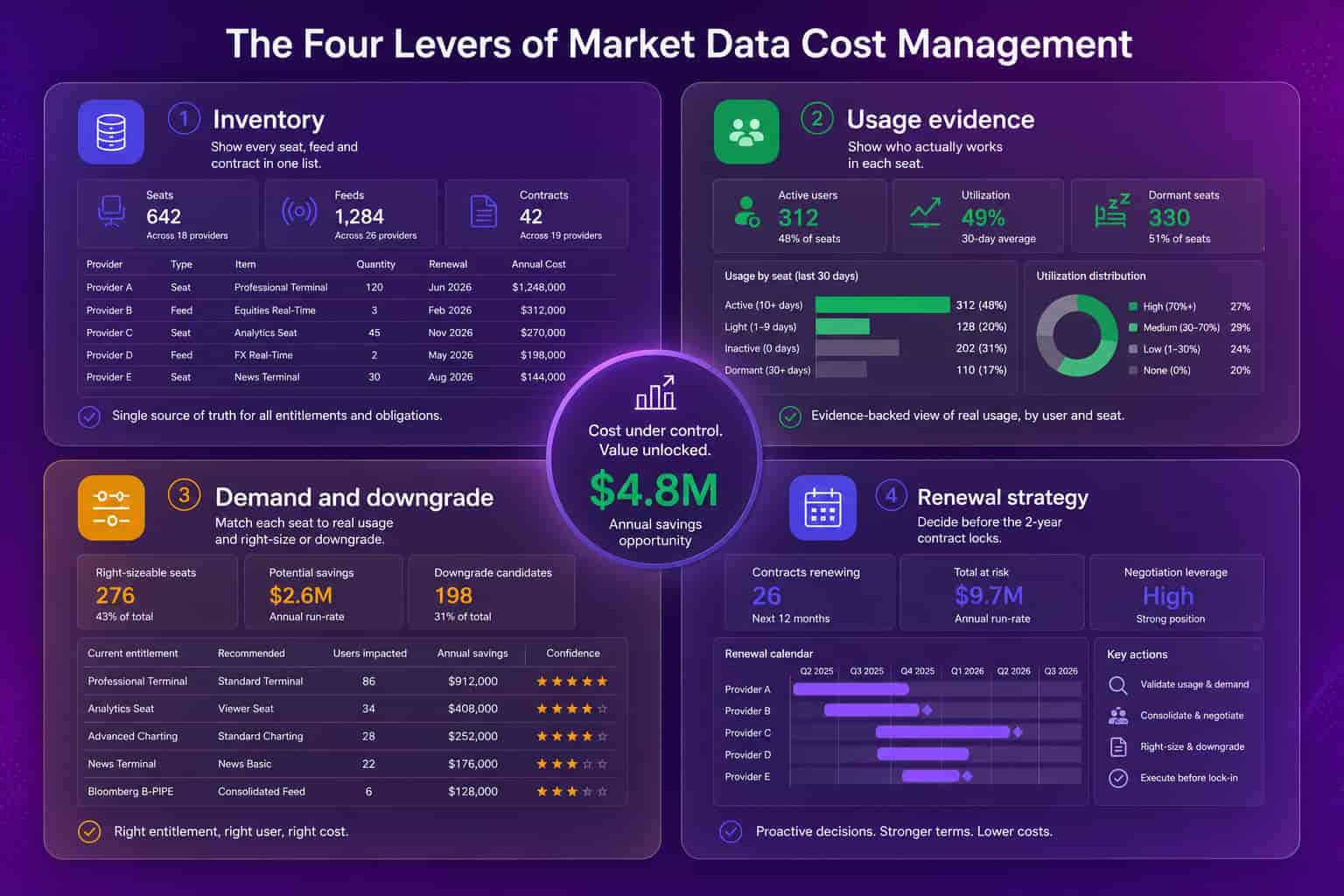
The lever that changes the economics is usage evidence, because it is the one that turns opinion into a decision. Ask a desk head whether they need every Bloomberg seat and you get politics. Show them that eight of their forty seats logged fewer than two active hours a month last quarter and you get a downgrade list. This is the job Abloomify's terminal usage analytics do: a privacy-first device agent measures only the market-data applications on an admin allowlist, reads window titles rather than content, and Bloomy, the AI analyst, clusters those patterns into usage bands and a downgrade shortlist you can take to a vendor conversation.
How to cut market data costs without losing coverage
You cut market data costs by matching each seat to how it is actually used, not by pulling terminals out from under the people who depend on them. Once you have usage evidence, most seats sort into a short decision tree. Daily power users keep the full terminal, because for them it earns its price many times over. Occasional users who need the product a few times a month often move to a lighter access tier. And the group where the real money hides is the desks whose sessions are mostly lookup-style work, the same reference-data pulls every day, which an API or data-feed subscription can serve for a fraction of an interactive seat. That last move is invisible without window-level usage detail, which is exactly why entitlement reports never surface it.
- Full terminal for daily power users who work across pricing, analytics, and execution.
- Lighter or remote tiers for occasional users who log in a handful of times a month.
- API or data feed for desks running repetitive lookup-style workflows a feed can serve.
- Cut or reallocate the seats that show rare-to-never usage across a full quarter.
The specifics differ by vendor, but the method does not. The Bloomberg Terminal cost breakdown covers the seat economics for the most expensive terminal, and LSEG Workspace pricing does the same for the main alternative at roughly $22,000 per user. You can model your own fleet with the terminal cost calculator before you talk to anyone, and see what one reclaimed seat is worth.
Doing it without tripping privacy rules
The reason most firms never gather usage evidence is fear of the compliance fight, and that fear is well founded for the wrong tools. General monitoring software collects activity broadly and then restricts it afterward with report-level settings. Works councils and DPOs in the EU block exactly that architecture, and enforcement backs them: H&M paid €35.3M, Amazon France €15M (upheld on appeal), and Italy's Garante now fines browsing-log over-retention. Abloomify was built for the opposite deployment. The device agent enforces an application allowlist at capture time, so only the approved market-data apps are ever measured, and everything outside that list is never written to the log and never transmitted. There is nothing to delete later because it never existed, which is GDPR data minimization implemented in architecture rather than policy. EU institutions run on a Frankfurt instance where telemetry, analytics, and AI processing stay in the EU, and Abloomify is SOC 2 Type II certified.
None of this requires screenshots, keyloggers, or screen recording, on any configuration, and analysts are not being watched. What gets measured is whether an expensive tool is used, the same way you would meter any other asset. Most people keep their seats. The evidence usually retires the seats nobody was defending anyway. Entitlement tools tell you what you own. Usage evidence tells you what you need.
FAQ
What is market data cost management?
Market data cost management is the discipline of tracking, controlling, and reducing what a firm spends on terminals and data feeds like Bloomberg, LSEG Workspace, and FactSet. It covers inventory, entitlements, actual seat usage, downgrade decisions, and renewal timing, so spend maps to real use instead of habit. The layer most programs miss is seat-level usage evidence.
How do you reduce market data costs without losing coverage?
Match each seat to how it is actually used. Daily power users keep full terminals, occasional users move to lighter tiers, and desks running repetitive lookups shift to an API or data feed. Abloomify measures which is which through privacy-first usage analytics, then Bloomy flags the seats you can safely cut before the renewal window closes.
Why is market data spend so hard to control?
Vendor entitlement reports show who can log in, not who actually works in the product. Global market data spend hit $49.2B in 2025 (Burton-Taylor), and about two-thirds of firms report they lack clear visibility into how seats get used. Without usage evidence at the seat level, renewals get signed on autopilot and the waste compounds every cycle.
How much can usage-based market data cost management save?
In a typical 100-seat deployment, usage analysis commonly flags 10 to 30 percent of seats as underused or automatable, an estimated $300K to $1M a year at current Bloomberg pricing. At 500 seats that models to $1.5M to $5M annually. These are modeled estimates, and your own usage evidence sets the real number before any renewal decision.
Is measuring terminal usage legal under GDPR?
It can be, when the tool minimizes data at collection. Abloomify enforces a capture-time allowlist, so activity outside your approved market-data apps is never collected or transmitted, with no screenshots or keyloggers on any configuration. EU institutions run on a Frankfurt-hosted instance where telemetry, database, analytics, and AI processing all stay in the EU, supported by a DPIA-ready compliance pack.

Amir Tavafi
Co-Founder & CEO
Product leader and innovator with over 15 years of experience in the tech sector, grounded in AI and robotics. Previously led product development in fraud detection and AI solutions at Nasdaq Verafin.