Bloomberg Terminal Cost in 2026: The Price and the Waste
July 15, 2026
Amir Tavafi
10 min read

A Bloomberg Terminal costs $31,980 per seat per year in 2026, and most finance leaders can quote that number from memory. Fewer can tell you how many of their seats get used every day. The sticker price is the easy part. The expensive part is paying full freight for terminals that sit idle, which is exactly the gap Abloomify's usage analytics were built to close.
Key Takeaways
Q: How much does a Bloomberg Terminal cost in 2026?
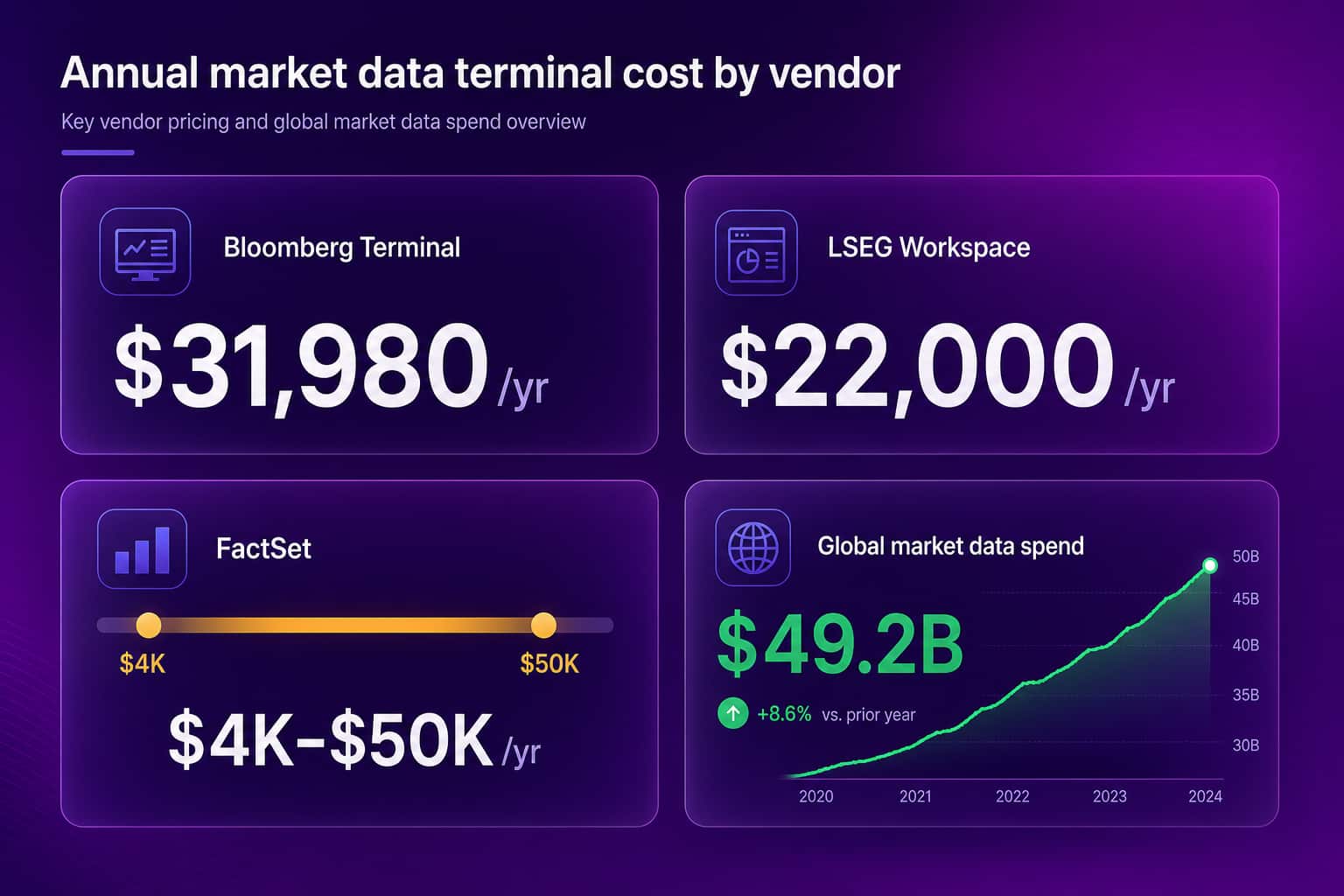
A: A single Bloomberg Terminal lists at $31,980 per year. On multi-terminal contracts the price drops to $28,320 per seat, and renewing contracts carry a 6.5% increase (NeuGroup, corroborated by 2026 pricing coverage). That works out to roughly $2,665 a month for one seat.
Q: Why is a Bloomberg Terminal so expensive?
A: You are paying for a bundle: real-time data across every asset class, the Bloomberg messaging network where the industry talks, analytics, and execution tools. Bloomberg holds firm on uniform pricing and rarely discounts, so the single-seat price has climbed roughly 60% since 2010.
Q: What is the real cost most firms miss?
A: Idle seats. Global market data spend hit $49.2B in 2025 (Burton-Taylor), and about two-thirds of firms report they lack clear visibility into how those seats actually get used. A terminal nobody logs into still bills $31,980 a year.
Q: How do you cut Bloomberg Terminal cost without losing capability?
A: Match each seat to how it is actually used. Power users keep full terminals, occasional users move to lighter tiers, and desks running repetitive lookups shift to an API or feed. Abloomify measures which is which through privacy-first usage analytics, no screenshots involved.
Q: Is there a cheaper alternative to Bloomberg?
A: LSEG Workspace is commonly reported around $22,000 per user a year, and FactSet ranges from roughly $4,000 to $50,000 depending on package. The bigger lever is usually cutting seats you do not need, verified with usage evidence before the renewal locks in.
How much does a Bloomberg Terminal cost in 2026?
A single Bloomberg Terminal lists at $31,980 per year, and on multi-terminal contracts the rate falls to $28,320 per seat, with a 6.5% increase applied to renewing contracts (NeuGroup, corroborated by 2026 pricing coverage). Bloomberg prices uniformly, so that figure is the same for a junior analyst who opens two functions and a portfolio manager who lives in the terminal all day. The two main competitors sit lower on paper. LSEG Workspace, the platform formerly known as Refinitiv Eikon, is commonly reported around $22,000 per user per year, though data entitlements push the real number higher. FactSet publishes no list pricing and is commonly reported anywhere from about $4,000 for a basic package to $50,000 or more for premium tiers. Here is how the three compare at a glance.
| Terminal | Commonly reported annual cost | Billing |
|---|---|---|
| Bloomberg Terminal (single seat) | $31,980 per seat, +6.5% at renewal | Annual, uniform pricing |
| Bloomberg Terminal (multi-terminal) | $28,320 per seat | Annual contract |
| LSEG Workspace | ~$22,000 per user (plus data entitlements) | Annual, tiered |
| FactSet | ~$4,000 to $50,000+ by package | Annual, negotiated |
Bloomberg is the only line here with a hard, citable seat price. Treat the LSEG and FactSet figures as commonly reported ranges, not quotes, since neither vendor publishes list pricing.
Why is a Bloomberg Terminal so expensive?
A Bloomberg Terminal is expensive because the price buys a bundle almost nobody uses in full, and because the network effect around it gives Bloomberg the pricing power to hold firm. One seat includes real-time and historical data across equities, fixed income, currencies, commodities and derivatives, the Bloomberg messaging system that a large slice of the buy side and sell side use to talk and trade, news, analytics, screening, and execution tools. The messaging network is the moat. Traders stay because their counterparties are on it, which lets Bloomberg apply uniform pricing and rarely discount. The single-seat list price has risen roughly 60% since 2010, from around $20,000 to today's $31,980. That is the mechanism worth understanding before any cost conversation: you are not buying a data feed, you are buying access to a market that happens to run on Bloomberg's rails, and that access is priced the same whether a given seat leans on it hard or barely touches it.
What does a Bloomberg Terminal cost per month and per seat?
Split the annual price across twelve months and a single Bloomberg Terminal costs roughly $2,665 per seat per month, while a seat on a multi-terminal contract runs about $2,360 per month. Bloomberg bills annually, not monthly, so those monthly numbers are the yearly list price divided out rather than a plan you can actually subscribe to month by month. The per-seat framing matters more than the monthly one when you manage a fleet. At 100 terminals you are committing north of $3M a year, and at the scale where single institutions run hundreds to more than a thousand seats, market data becomes a nine-figure line item. The question that decides the real cost is not the rate card. It is how many of those seats are daily working tools versus expensive status symbols that renew on habit.
The cost nobody audits: seats that never get used
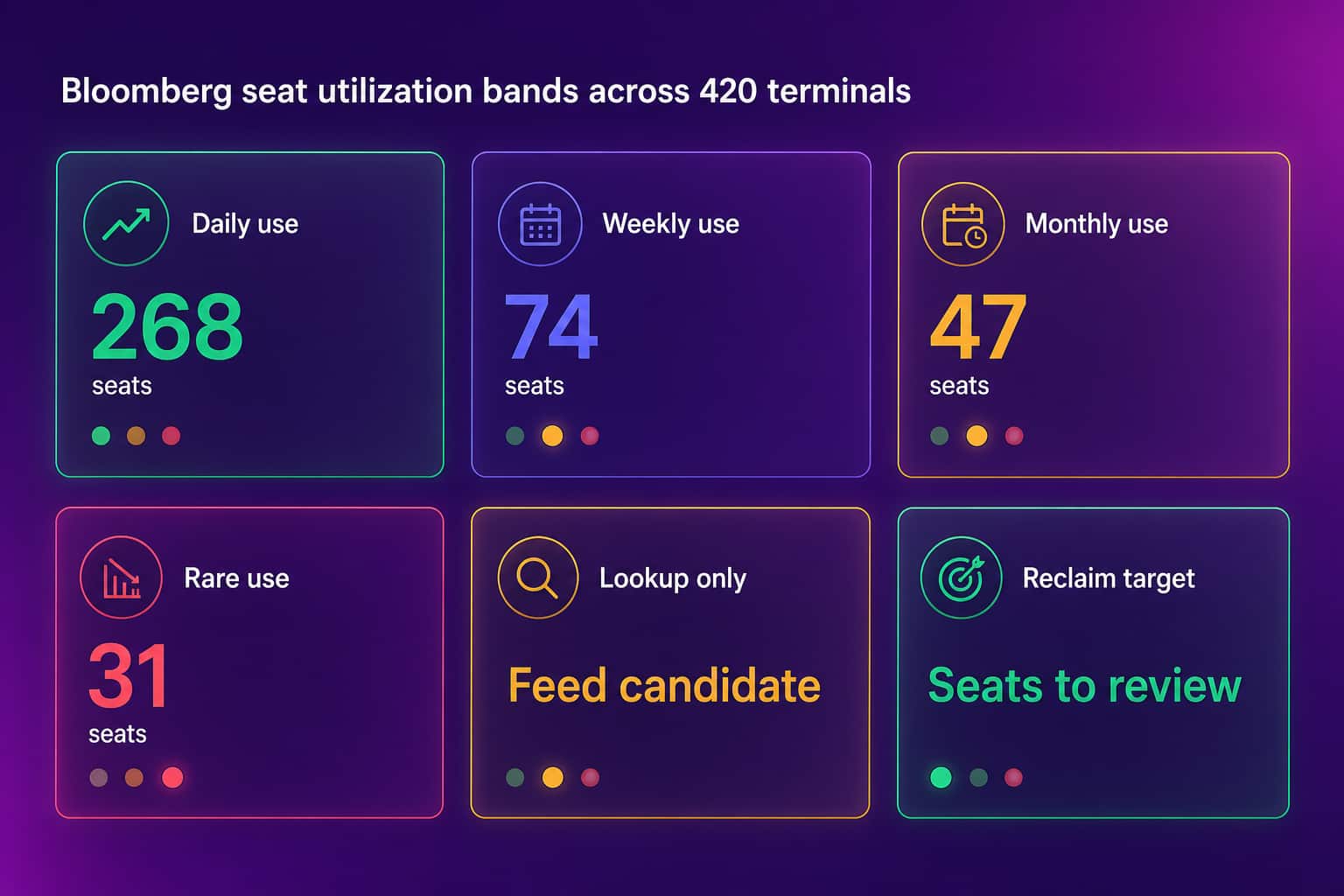
The largest hidden cost in a Bloomberg contract is the seat that renews every year and gets opened twice a quarter. Entitlement reports tell you who is provisioned to log in. They say nothing about who actually works in the product, which means the renewal gets signed at full price whether a desk lives in the terminal or treats it as a badge. That blind spot is not rare. Global market data spend reached $49.2B in 2025 (Burton-Taylor), and around two-thirds of firms report insufficient transparency into how their market-data services are actually used (A-Team Group survey via TRG Screen). When a seat costs $31,980 a year, a fleet with even 10% idle terminals is burning real money on assets that produce nothing. The fix is evidence: seat-by-seat usage data that shows daily use, weekly use, monthly use, and rare use, so the renewal becomes a decision instead of a reflex.
How to cut Bloomberg Terminal cost without losing capability
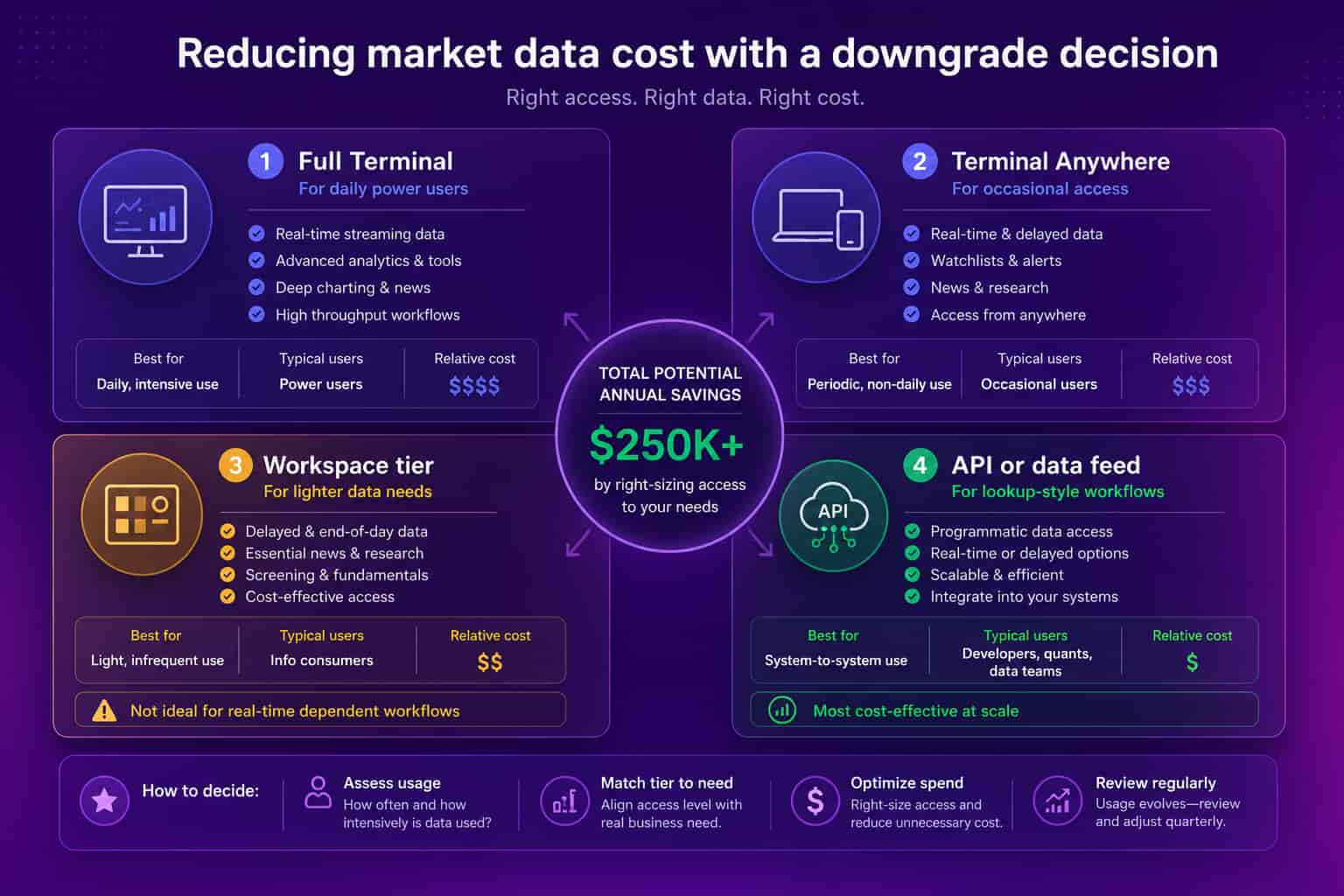
You cut Bloomberg Terminal cost by matching each seat to how it is actually used, not by ripping the terminal out from under people who depend on it. Once you have usage evidence, most seats sort into a short decision tree. Daily power users keep the full terminal, because for them it earns its price many times over. Occasional users who need the terminal a few times a month often move to a lighter access tier. And the interesting group is the desks whose sessions are mostly lookup-style work, the same reference-data pulls every day, which an API or data-feed subscription can serve for a fraction of an interactive seat. That last move is where the money is, and it is invisible without window-level usage detail.
- Full Terminal for daily power users who work across pricing, analytics, and execution.
- Lighter or remote tiers for occasional users who log in a handful of times a month.
- API or data feed for desks running repetitive lookup-style workflows a feed can serve.
- Cut or reallocate the seats that show rare-to-never usage across a full quarter.
This is the job Abloomify's terminal usage analytics do. A privacy-first device agent measures only the market-data applications on an admin allowlist, reads window titles rather than content, and never takes a screenshot or logs a keystroke on any configuration. Bloomy, the AI analyst, clusters those window-title patterns, flags the lookup-heavy seats, and suggests the feed replacement with estimated savings per desk. One reclaimed Bloomberg seat covers roughly 200 device-months of Abloomify at $9 per seat a month. You can model your own fleet with the terminal cost calculator before you talk to anyone.
How do you know if you need every seat?
You know by measuring usage before the renewal window, not by guessing after it. A 30-day terminal usage assessment connects a lightweight agent to your fleet, scopes it to your market-data apps through a capture-time allowlist, and returns seat-by-seat evidence: usage bands, a downgrade shortlist, and the lookup-style workflows a feed could absorb. Because the allowlist is enforced at capture on the device, activity outside your approved applications is never collected, which is what lets the project pass a works-council or DPO review instead of dying in it. For EU institutions, all of it runs on a Frankfurt instance where telemetry, analytics, and AI processing stay in the EU, and Abloomify is SOC 2 Type II certified. Most firms find the first reclaimed seat pays for the whole deployment. The sticker price of a Bloomberg Terminal is fixed. The waste around it is not. Measure the seats before you sign the renewal.
FAQ
How much does a Bloomberg Terminal cost per month?
A single Bloomberg Terminal seat lists at $31,980 per year, which works out to roughly $2,665 a month. Bloomberg bills annually rather than monthly, and multi-terminal contracts lower the per-seat rate to about $28,320 a year, or roughly $2,360 a month. There is no true month-to-month plan, so the monthly figure is the annual price divided out.
What is included in a Bloomberg Terminal subscription?
One subscription bundles real-time and historical data across asset classes, the Bloomberg messaging network, news, analytics, charting, screening, and trade execution into a single seat. Pricing is uniform, so the bundle is identical whether a user relies on two functions or two hundred. That uniform pricing is a big part of why usage varies so widely across seats that cost the same.
Why is a Bloomberg Terminal so expensive?
The messaging network is the reason. A large share of the buy side and sell side communicate and trade over Bloomberg, so seats hold their value through the network rather than the raw data alone. That pricing power lets Bloomberg avoid discounting and raise renewals 6.5% a year, pushing the single-seat list price up roughly 60% since 2010.
How much can usage analytics save on market data spend?
In a typical 100-seat deployment, usage analysis commonly flags 10 to 30 percent of seats as underused or running lookup-style work a data feed could serve, an estimated $300K to $1M a year at current Bloomberg pricing. These are modeled estimates, and your own usage evidence sets the real number before any renewal decision.
Is measuring Bloomberg Terminal usage legal under GDPR?
It can be, when the tool minimizes data at collection. Abloomify enforces an allowlist at capture, so activity outside your approved market-data apps is never collected or transmitted, with no screenshots or keyloggers on any configuration. EU customers run on a Frankfurt-hosted instance where telemetry, database, analytics, and AI processing all stay in the EU, supported by a DPIA-ready compliance pack.

Amir Tavafi
Co-Founder & CEO
Product leader and innovator with over 15 years of experience in the tech sector, grounded in AI and robotics. Previously led product development in fraud detection and AI solutions at Nasdaq Verafin.