LSEG Workspace Pricing in 2026: What a Seat Really Costs
July 16, 2026
Amir Tavafi
10 min read

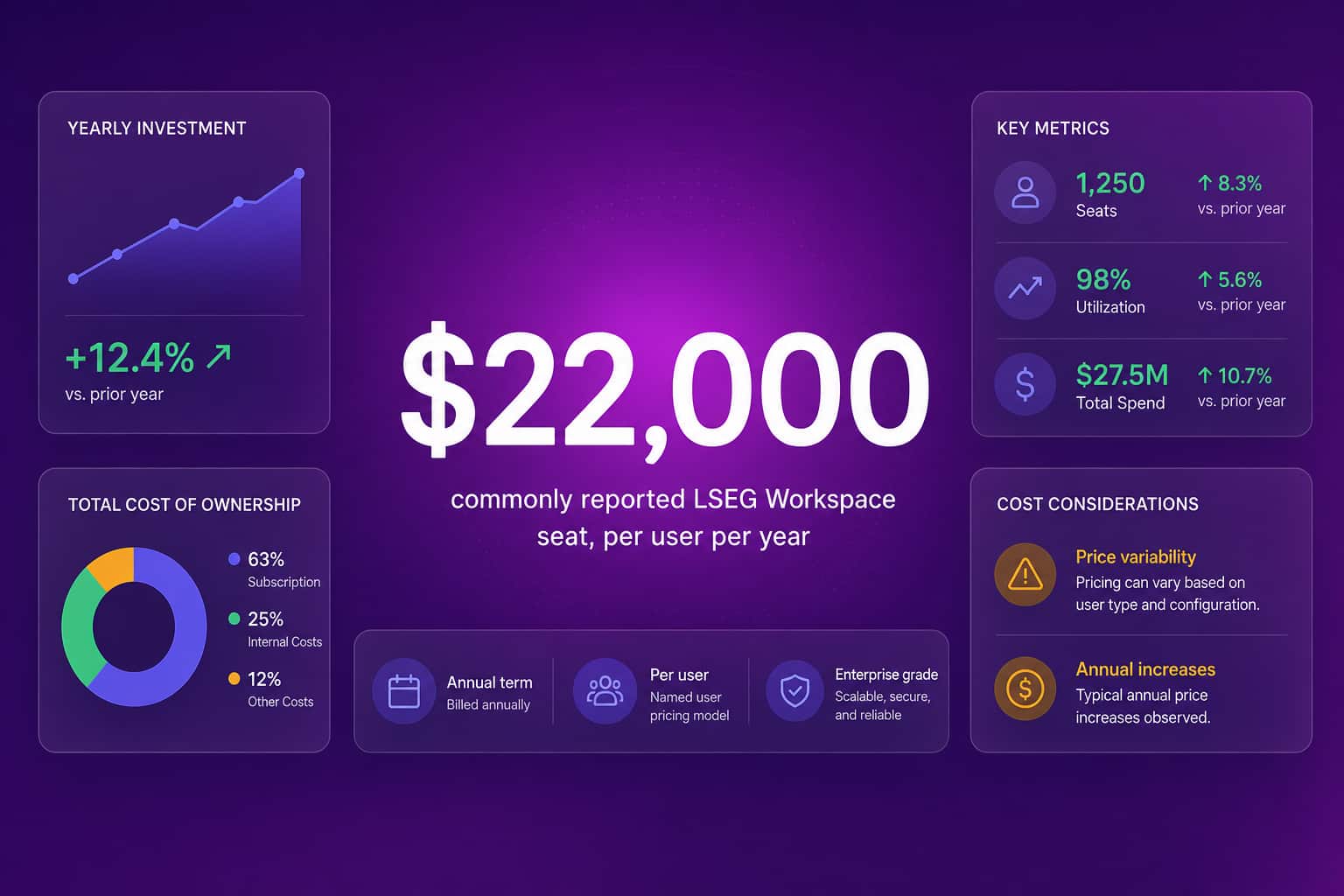
LSEG Workspace pricing is commonly reported around $22,000 per user a year in 2026, though LSEG does not publish an official list price. That number buys a lot of data and, on most desks, a lot of idle seats. The sticker cost is the part everyone quotes. The part that actually moves your budget is how many of those seats get used, which is exactly what Abloomify measures.
Key Takeaways
Q: How much does LSEG Workspace cost in 2026?
A: LSEG Workspace is commonly reported around $22,000 per user a year, though LSEG does not publish a public list price and negotiates per contract. That sits below Bloomberg Terminal at $31,980 a seat, and inside FactSet's roughly $4,000 to $50,000 range depending on package.
Q: What is LSEG Workspace?
A: LSEG Workspace is the successor to Refinitiv Eikon, rebuilt after LSEG acquired Refinitiv in 2021. One seat bundles real-time cross-asset data, Datastream history, Reuters news, charting and analytics, and the Messenger network into a single desktop. Access tiers vary by role, which is where cost control starts.
Q: Is LSEG Workspace cheaper than Bloomberg?
A: On sticker price, usually yes. LSEG Workspace near $22,000 a year runs below Bloomberg's $31,980 single-seat list price (NeuGroup). The bigger savings comes from cutting seats nobody uses, not from switching vendors. A seat that sits idle costs the same whether it says LSEG or Bloomberg on it.
Q: Does LSEG Workspace have different pricing tiers?
A: Yes. LSEG sells Workspace in role-based tiers, so a trader, a research analyst, and a compliance reviewer do not all need the full package. Matching each person to the lightest tier that covers their real workflow is the first lever most firms pull before they touch headcount.
Q: How do you cut LSEG Workspace cost without losing capability?
A: Measure how each seat is actually used, then right-size. Abloomify's privacy-first usage analytics show which seats are active, which sit idle, and which run lookup-style work a data feed could serve, an estimated $300K to $1M a year per 100 seats. No screenshots, no keyloggers.
How much does LSEG Workspace cost in 2026?
LSEG Workspace pricing is commonly reported around $22,000 per user a year in 2026, but the honest answer is that LSEG does not publish an official list price, and every real number comes out of a negotiated contract that varies by tier, volume, and region. Treat the $22,000 figure as a market-reported midpoint, not a quote you can hold LSEG to. For comparison, Bloomberg Terminal lists at $31,980 for a single seat and $28,320 on multi-terminal contracts (NeuGroup, corroborated by 2026 pricing coverage), and FactSet is commonly reported anywhere from roughly $4,000 to $50,000 a seat depending on the modules a desk turns on. So Workspace tends to land in the middle: cheaper than a full Bloomberg seat, richer and pricier than an entry FactSet package.
I say "commonly reported" on purpose. Market data vendors negotiate under NDA, discounts move with volume and region, and the public figures floating around are averages people have shared, not a rate card. If a number matters to your renewal, get it in writing from LSEG. If you want a working estimate before that call, the terminal cost calculator lets you model Workspace, Bloomberg, and FactSet seats side by side.
What is included in an LSEG Workspace subscription?
An LSEG Workspace subscription bundles real-time market data across asset classes, Datastream's historical time series, Reuters news, charting and analytics, screening tools, and the Messenger network that connects the buy side and sell side, all into a single desktop seat. Workspace is the platform LSEG built to replace Refinitiv Eikon after it acquired Refinitiv in 2021, and it folds in capabilities that used to be sold as separate Eikon and Datastream products. The important part for pricing is that not everyone needs the whole bundle. LSEG sells Workspace in role-based tiers, so a fixed-income trader, an equity research analyst, and a risk reviewer can sit on different packages at different prices. The full data-and-analytics seat is the expensive one. Lighter role tiers exist precisely so you do not pay trader pricing for a reviewer who reads three screens a day.
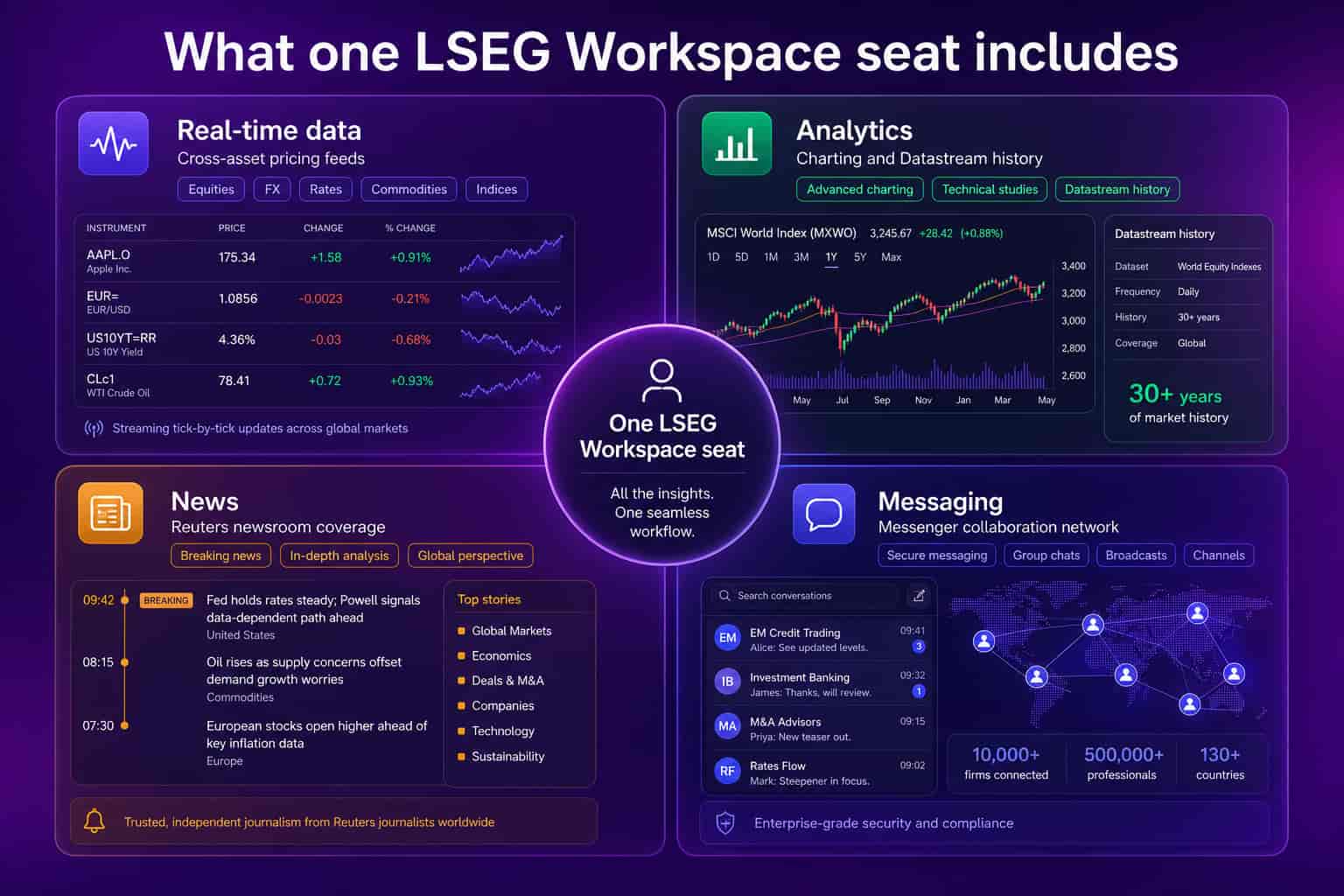
That bundle is why the seat is worth real money, and also why it hides waste. When one price covers a dozen capabilities, nobody notices that a given analyst touches two of them. The invoice looks the same for a power user and for someone who opens Workspace to glance at one screen before a morning call.
LSEG Workspace vs Bloomberg and FactSet: how the pricing compares
On published and commonly-reported numbers, LSEG Workspace at roughly $22,000 per user a year sits between FactSet and Bloomberg on price, but the three products are not priced the same way, so a straight seat-to-seat comparison hides as much as it shows. Bloomberg Terminal uses uniform, rarely-discounted pricing at $31,980 for a single seat and $28,320 on multi-terminal contracts (NeuGroup), with a 6.5% renewal increase baked in. FactSet is modular and commonly reported from about $4,000 for a light package up to $50,000 for a fully loaded quant seat, so its range overlaps both competitors. LSEG Workspace, negotiated by tier and volume, tends to undercut a full Bloomberg seat while carrying deeper data than an entry FactSet package. The table below lays out the commonly-reported ranges so you can see where each one lands.
| Terminal | Commonly reported cost per seat / year | Pricing model | Notes |
|---|---|---|---|
| LSEG Workspace | ~$22,000 (no public list price) | Role-based tiers, negotiated | Successor to Refinitiv Eikon |
| Bloomberg Terminal | $31,980 single, $28,320 multi | Uniform, rarely discounted | 6.5% annual renewal increase (NeuGroup) |
| FactSet | ~$4,000 to $50,000 | Modular by package | Range depends on modules enabled |
Price is the wrong place to end the comparison, though. For a fuller breakdown of the most expensive of the three, see our guide to Bloomberg Terminal cost. The lever that beats any vendor switch is the same across all of them: stop paying for seats that do not earn their keep.
Your real LSEG cost is the seats you do not use
Every finance leader can quote the seat price. Far fewer can tell you how many of those seats get opened on a normal Tuesday, and that gap is where LSEG Workspace money leaks. Global market data spend reached $49.2 billion in 2025 (Burton-Taylor), most of it committed a year at a time against seat counts set at the last renewal rather than against real usage. A Workspace seat that a departed analyst never handed back, or that a reviewer opens once a week for one screen, still bills at full tier price. On a 100-seat deployment, the space between seats you pay for and seats doing daily work is usually where the savings sit, and an entitlement report will not show it, because entitlement data tells you who can log in, not who does.
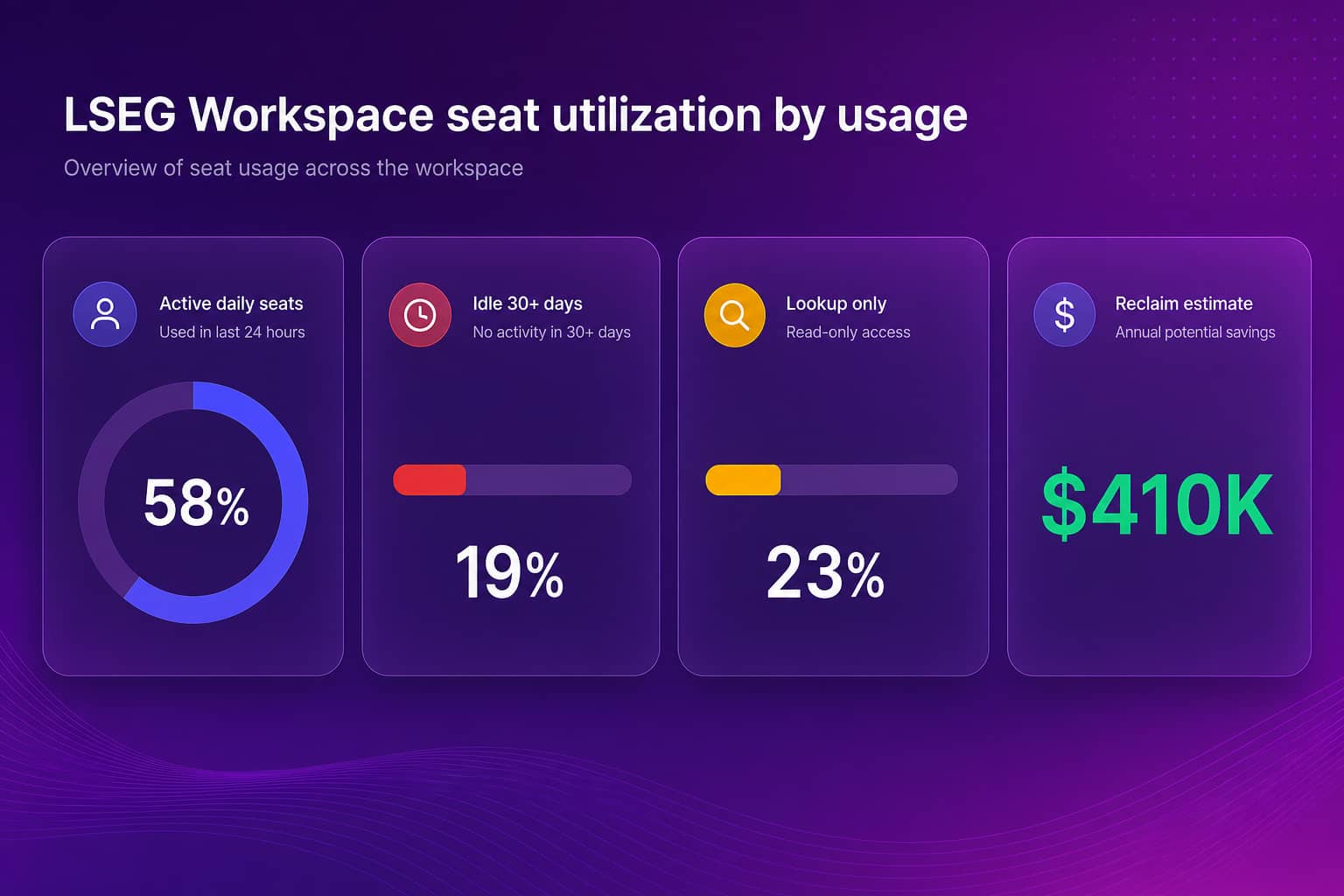
Entitlement management tools are good at telling you what you bought. They are not built to tell you what gets used, which is a different question and the one that actually cuts spend. That distinction is why many institutions run usage analytics alongside inventory tooling, a split we cover in Abloomify vs TRG Screen.
How to cut LSEG Workspace cost without losing capability
You cut LSEG Workspace cost by matching every seat to how it is actually used, then moving each person to the lightest option that still covers their real workflow. Power users who live in the data keep a full Workspace seat. Occasional users drop to a lighter role tier. Desks running the same handful of repetitive lookups often do not need an interactive terminal at all and can move to an API or data feed at a fraction of the cost. The hard part has never been the decision tree, it is having defensible evidence for each seat before a renewal locks the number in for another year. That is the job Abloomify's market data terminal usage analytics were built to do, and it does it without the surveillance that finance compliance teams rightly reject.
The architecture matters here because this is regulated data and regulated people. Abloomify uses a capture-time application allowlist, so activity outside your approved market-data apps is never collected. There are no screenshots and no keyloggers on any configuration. Window-title workflow analytics separate a seat that is doing live analysis from one that is idle or running lookups, and Bloomy flags the lookup-style seats a feed could replace. EU firms run on a Frankfurt instance where processing stays in the EU, which keeps the compliance and works-council conversation short.
Most firms start with a 30-day Terminal Usage Assessment: an allowlist scoped to your market-data apps, seat-by-seat usage evidence, a downgrade shortlist, and a DPIA-ready compliance pack. You walk into the renewal with numbers instead of a hunch. The seat price is fixed. The number of seats you can defend is not.
FAQ
How much does LSEG Workspace cost per user?
LSEG Workspace is commonly reported around $22,000 per user a year in 2026. LSEG does not publish an official list price, so the real figure comes out of a negotiated contract that moves with tier, volume, and region. For context, that runs below Bloomberg Terminal at $31,980 a single seat and inside FactSet's roughly $4,000 to $50,000 range.
What is the difference between LSEG Workspace and Refinitiv Eikon?
Workspace is the platform LSEG built to replace Refinitiv Eikon after it acquired Refinitiv in 2021. It folds Eikon and Datastream capabilities into one faster desktop and is the seat LSEG now sells and supports. Eikon is being retired in favor of Workspace, so most pricing conversations today are Workspace conversations.
Is LSEG Workspace cheaper than a Bloomberg Terminal?
On sticker price, usually yes. LSEG Workspace near $22,000 a year sits below Bloomberg's $31,980 single-seat list price (NeuGroup). The larger savings for most firms, though, comes from cutting seats nobody uses rather than switching vendors. An idle seat bills at full price whichever logo is on it, so usage evidence beats a logo swap.
Can you measure LSEG Workspace usage without surveilling analysts?
Yes. Abloomify uses a capture-time application allowlist, so activity outside your approved market-data apps is never collected, with no screenshots or keyloggers on any configuration. It reports which Workspace seats are active, idle, or running lookup-style work. EU customers run on a Frankfurt instance where all processing stays inside the EU.
How much can usage analytics save on LSEG Workspace seats?
On a 100-seat deployment, usage analysis commonly flags 10 to 30 percent of seats as underused or running lookup-style work a data feed could serve. At a commonly-reported $22,000 seat, that models to roughly $220K to $660K a year. These are modeled estimates. Your own usage evidence, gathered before renewal, sets the real number.

Amir Tavafi
Co-Founder & CEO
Product leader and innovator with over 15 years of experience in the tech sector, grounded in AI and robotics. Previously led product development in fraud detection and AI solutions at Nasdaq Verafin.