FactSet Cost in 2026: The Price Tiers and the Waste
August 4, 2026
Amir Tavafi
11 min read

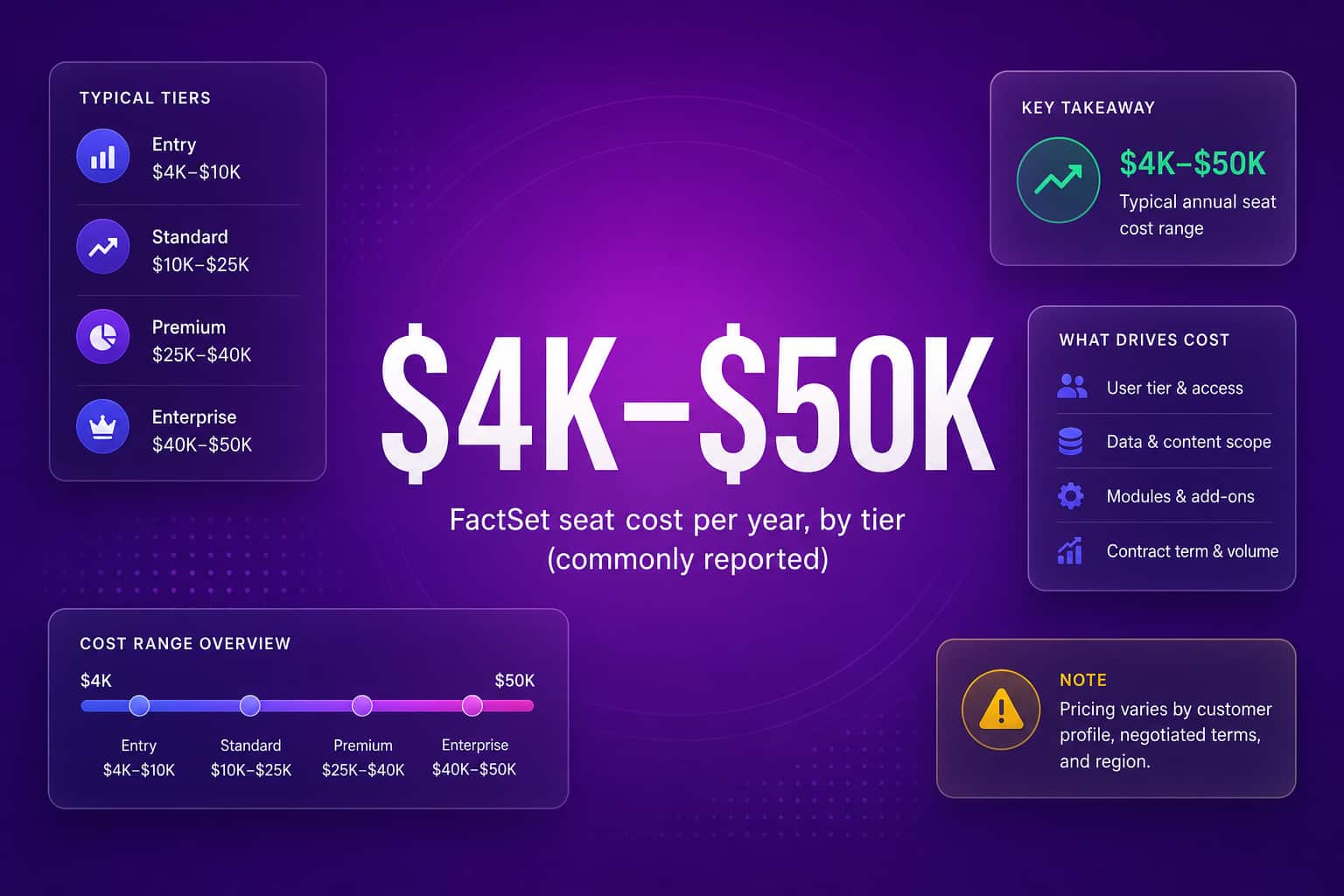
FactSet cost is commonly reported in three tiers: about $4,000 a year for a basic package, $12,000 for a standard seat, and $24,000 to $50,000-plus for a premium quant seat. FactSet publishes no list price, so those numbers come from market reporting, not a rate card. That tiering is also why FactSet spend goes wrong: a firm can pay premium prices for a seat that only touches basic features, and nobody notices until someone measures usage.
Key Takeaways
Q: How much does FactSet cost in 2026?
A: FactSet is commonly reported in three tiers: about $4,000 a year for a basic package, $12,000 for a standard research seat, and $24,000 to $50,000-plus for a premium or quant-loaded seat. FactSet publishes no list price, so every real number comes from a negotiated contract.
Q: Why is FactSet cheaper than Bloomberg on paper?
A: Because FactSet sells in modules instead of one bundle. Bloomberg Terminal is a uniform $31,980-a-year seat (NeuGroup) whether you use two functions or two hundred. FactSet lets a desk buy only the research, quant, or banking modules it needs, so a light seat can cost a fraction of a full Bloomberg terminal.
Q: Is FactSet cheaper than LSEG Workspace?
A: It depends on the tier. FactSet's basic package (~$4,000) undercuts LSEG Workspace's commonly reported ~$22,000 a year by a wide margin, but a premium FactSet quant seat ($24,000 to $50,000+) can cost more than Workspace. Modular pricing means "cheaper" only applies to specific tiers, not the whole product.
Q: What's the real cost most firms miss on FactSet?
A: Over-tiered and idle seats. Global market data spend hit $49.2B in 2025 (Burton-Taylor), and entitlement reports show who can log into FactSet, not who actually works in it. A premium seat billed for basic-tier usage is the waste nobody catches until someone measures it.
Q: How do you cut FactSet cost without losing research capability?
A: Match each seat to its actual tier of use, then downgrade or reclaim the rest. Abloomify's privacy-first usage analytics show which FactSet seats are active, idle, or running lookup-style work a data feed could replace, no screenshots or keyloggers involved.
How much does FactSet cost in 2026?
FactSet cost is commonly reported in three broad tiers in 2026: roughly $4,000 a year for a basic package with fundamentals data and light research tools, about $12,000 for a standard seat with real-time pricing and broader analytics, and $24,000 to $50,000 or more for a premium or quant-loaded seat with full data access, portfolio analytics, and advanced modeling modules. FactSet does not publish an official list price, so every real figure comes out of a negotiated contract that moves with the modules a desk turns on, the size of the firm, and how hard procurement pushes, which means the numbers above are commonly reported aggregator estimates, not a quote you can hold FactSet to. That puts FactSet in the same boat as LSEG Workspace, which also negotiates by tier with no public rate card, and unlike Bloomberg Terminal, which prices every seat the same regardless of how many modules a person actually uses.
I say "commonly reported" for a reason. Nobody outside FactSet's sales team sees the real number until a term sheet lands, and public figures floating around finance forums and pricing aggregators are averages other buyers have shared, not a rate card you can quote back at renewal. If you want a working estimate before that call, the terminal cost calculator lets you model FactSet, Bloomberg, and LSEG seats side by side against your own seat counts.
What's included in each FactSet tier?
The width of FactSet's price range comes from how differently a basic and a premium seat are actually used, not from a single product sold at different discounts. A basic package typically covers company fundamentals, consensus estimates, filings, and enough screening to support light research, the kind of access a generalist or a junior analyst touches a few times a day. The standard tier adds real-time pricing, charting, deeper company and industry analytics, and export tools that a working research or coverage analyst leans on constantly. The premium and quant tiers stack on portfolio analytics, factor and risk models, alpha-testing workspaces, and banking-grade comps and valuation templates, the toolkit a quant researcher or a banker building live models needs and a generalist never opens. FactSet built the tiers this way on purpose, so a firm can staff a research desk without buying quant licenses for everyone. The problem shows up later, at renewal, when procurement can see the seat count and the tier mix but not which seats are actually doing tier-appropriate work.
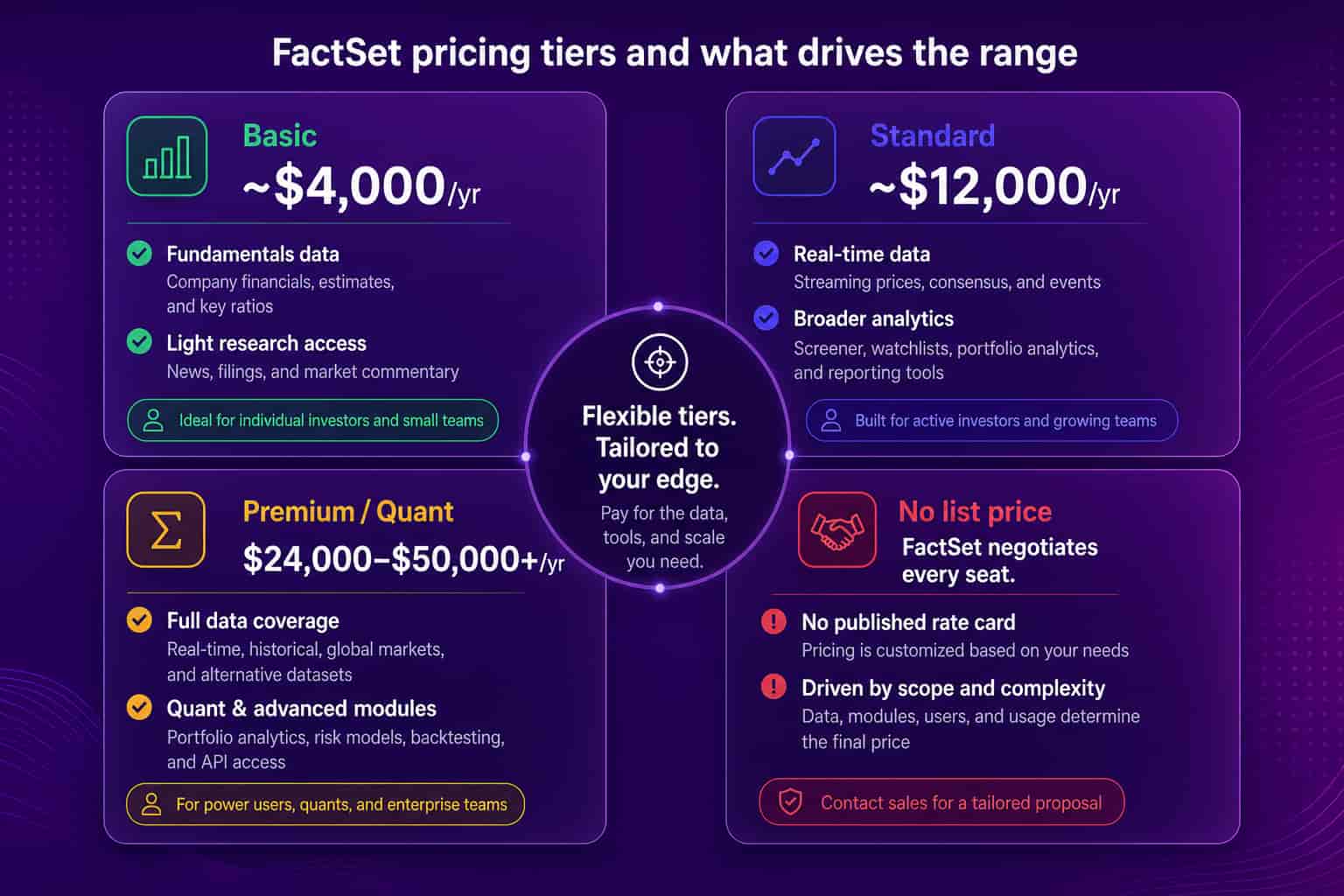
That gap between what a seat is licensed for and what it is used for is where FactSet spend quietly drifts upward. A generalist parked on a premium seat because "that's what the team standardized on" pays quant-tier money for basic-tier work, every year, until someone actually looks.
FactSet vs Bloomberg vs LSEG Workspace: how the pricing compares
On commonly reported numbers, FactSet's $4,000-to-$50,000 range spans both Bloomberg and LSEG Workspace, undercutting each at the low end and matching or exceeding them at the high end, so the honest comparison has to be tier by tier rather than product by product. Bloomberg Terminal is the outlier on structure: a uniform $31,980 for a single seat and $28,320 on multi-terminal contracts (NeuGroup), the same price whether the user runs two functions or two hundred, with a 6.5% renewal increase built in. LSEG Workspace, the platform that replaced Refinitiv Eikon, is commonly reported around $22,000 a year, negotiated by role-based tier. FactSet is the most modular of the three, which is why its range is the widest. A firm mixing all three vendors across desks is really running three different pricing philosophies at once, which is exactly the setup that hides seat waste until someone puts usage evidence next to the invoice.
| Terminal | Commonly reported cost per seat / year | Pricing model |
|---|---|---|
| FactSet | ~$4,000 to $50,000+ | Modular by tier, negotiated |
| LSEG Workspace | ~$22,000 (no public list price) | Role-based tiers, negotiated |
| Bloomberg Terminal | $31,980 single, $28,320 multi | Uniform, rarely discounted |
For the full breakdown on the other two, see our guides to Bloomberg Terminal cost and LSEG Workspace pricing. The comparison that actually moves your budget is not which vendor's logo is cheaper. It's which seats, on any of the three, are earning their tier.
The FactSet cost nobody audits: seats billed above their real use
The FactSet cost that never shows up on a vendor comparison is the seat billed at premium or standard price for work that a basic package would cover just as well. Global market data spend reached $49.2 billion in 2025, up 6.5% year over year (Burton-Taylor), most of it committed annually against tier assignments made once and rarely revisited. Entitlement data tells you who is provisioned on which FactSet tier. It says nothing about whether the analyst on a $40,000 quant seat actually opens the alpha-testing module or just pulls the same fundamentals screen a $4,000 seat would serve. That gap compounds across a fleet: a firm running 150 FactSet seats with even a fifth of them over-tiered is carrying real, avoidable spend that no renewal negotiation touches, because the negotiation is about price per tier, not which tier each person needs.
Entitlement and inventory tools are built to answer "what did we buy," which is a different question from "what gets used," and the second one is the question that actually cuts spend. That is the same distinction we cover in Abloomify vs TRG Screen: inventory tooling and usage analytics answer different questions, and most institutions that get serious about market-data cost end up running both.
How to cut FactSet cost without losing capability
You cut FactSet cost by matching every seat to the tier its actual work requires, not by pulling licenses away from people who depend on them. Once usage evidence exists, most seats sort quickly. Analysts who live in quant models and portfolio analytics keep the premium tier, because for them it earns its price. Generalists who mostly pull fundamentals and screening data belong on basic or standard, whatever the team happened to standardize on originally. And desks running the same handful of repetitive lookups every day are often candidates to move off an interactive seat entirely and onto a data feed, the move that saves the most per seat and the one that is invisible without window-level usage detail. This is the job Abloomify's market data terminal usage analytics were built to do.
The architecture matters as much as the analysis here, because this is regulated data touched by regulated people. Abloomify enforces a capture-time application allowlist, so activity outside your approved market-data apps is never collected or transmitted, with no screenshots and no keyloggers on any configuration. Window-title workflow analytics separate a seat doing live quant work from one running the same lookup every morning, and Bloomy, the AI analyst, flags the lookup-style seats a feed could replace along with an estimated savings per desk. EU firms run on a Frankfurt-hosted instance where telemetry, database, analytics, and AI processing all stay in the EU, and Abloomify is SOC 2 Type II certified. On the high end of the premium tier, one reclaimed $50,000 FactSet seat covers roughly 460 device-months of Abloomify at $9 per seat a month; even a reclaimed basic seat at $4,000 still covers most of a year across a small team.
How do you know if you need every seat?
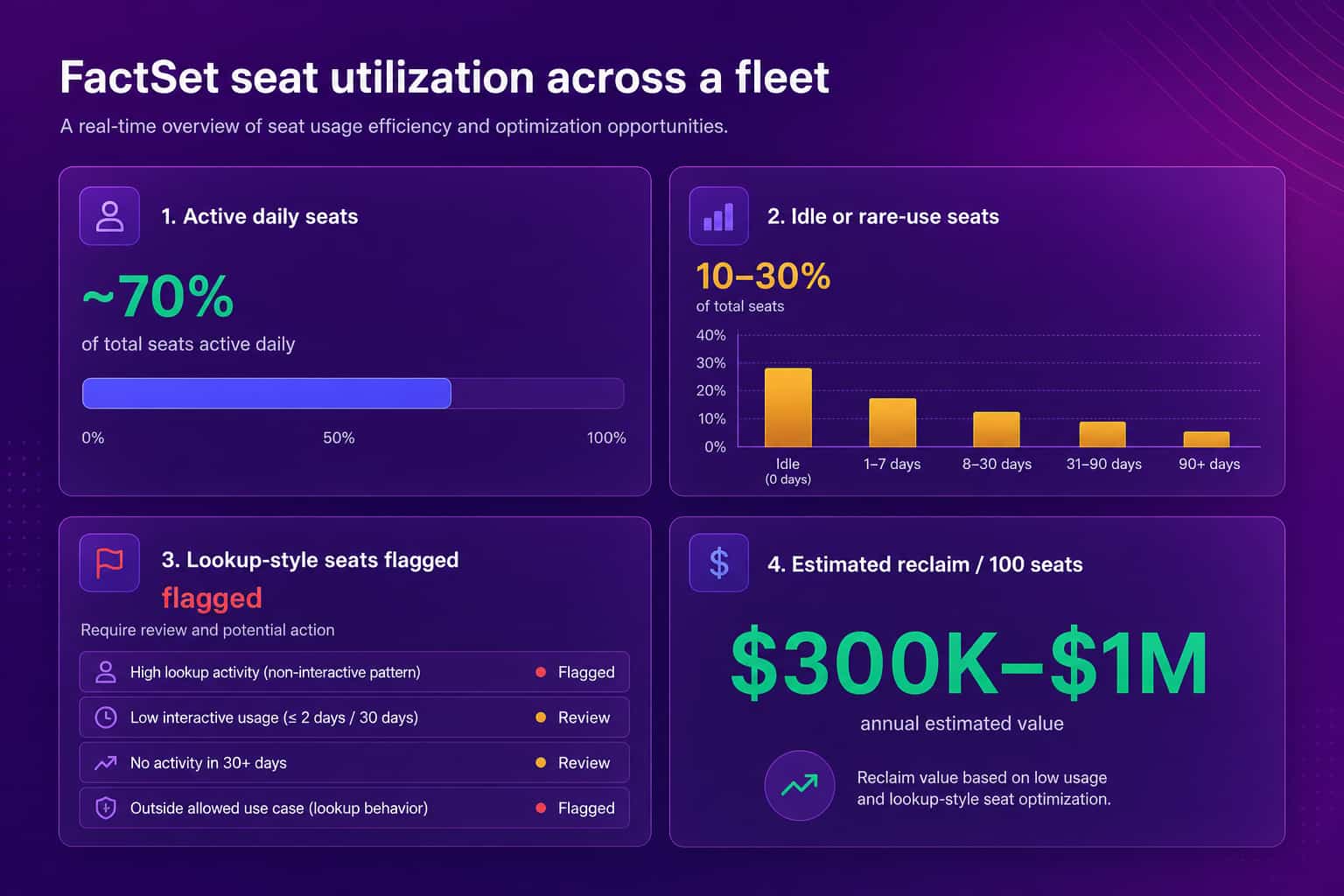
You know by measuring usage before the renewal locks the tier mix in for another year, not by asking desk heads to defend their own licenses. A 30-day Terminal Usage Assessment connects a lightweight agent to your fleet, scopes it to your market-data applications through a capture-time allowlist, and returns seat-by-seat evidence: which seats are active daily, which sit idle, which run lookup-style work a feed could absorb, and which are simply over-tiered for what the person actually does. Because the allowlist is enforced at capture, on the device, activity outside your approved apps never exists to review, which is what lets a usage project pass a works-council or DPO review instead of stalling in one. Most firms find the first reclaimed or downgraded seat pays for the whole deployment. FactSet's tiers are negotiable at renewal. Whether a seat needs the tier it is on is not a negotiation. It is a measurement.
FAQ
How much does a FactSet seat cost per year?
FactSet is commonly reported in three tiers: roughly $4,000 a year for a basic package, about $12,000 for a standard research seat, and $24,000 to $50,000 or more for a premium or quant-loaded seat. FactSet does not publish an official list price, so every real number comes from a negotiated contract.
Why doesn't FactSet publish list pricing?
FactSet sells in modules rather than one fixed bundle, so price depends on which data sets, analytics, and workflows a desk turns on. That makes a public rate card impractical and gives FactSet room to negotiate by firm size, module mix, and contract term instead of quoting a flat number like Bloomberg does.
Is FactSet cheaper than Bloomberg Terminal?
Usually, at the entry tier. FactSet basic (~$4,000) undercuts Bloomberg Terminal's $31,980 single-seat list price (NeuGroup) by a wide margin. A premium FactSet quant seat ($24,000 to $50,000+) can close that gap or exceed Bloomberg, so the honest answer depends on which tier a given desk actually needs.
Can you measure FactSet usage without surveilling analysts?
Yes. Abloomify uses a capture-time application allowlist, so activity outside your approved market-data apps is never collected, with no screenshots or keyloggers on any configuration. It reports which FactSet seats are active, idle, or running lookup-style work, and EU customers run on a Frankfurt instance where processing stays in the EU.
How much can usage analytics save on FactSet seats?
In a typical 100-seat deployment, usage analysis commonly flags 10 to 30 percent of seats as underused, over-tiered, or running lookup-style work a data feed could serve, an estimated $300K to $1M a year depending on the tier mix. These are modeled estimates. Your own usage evidence, gathered before renewal, sets the real number.

Amir Tavafi
Co-Founder & CEO
Product leader and innovator with over 15 years of experience in the tech sector, grounded in AI and robotics. Previously led product development in fraud detection and AI solutions at Nasdaq Verafin.