AI Adoption Strategy: How to Roll Out AI Tools and Prove They Work
November 2, 2026
Reza Vatani
10 min read

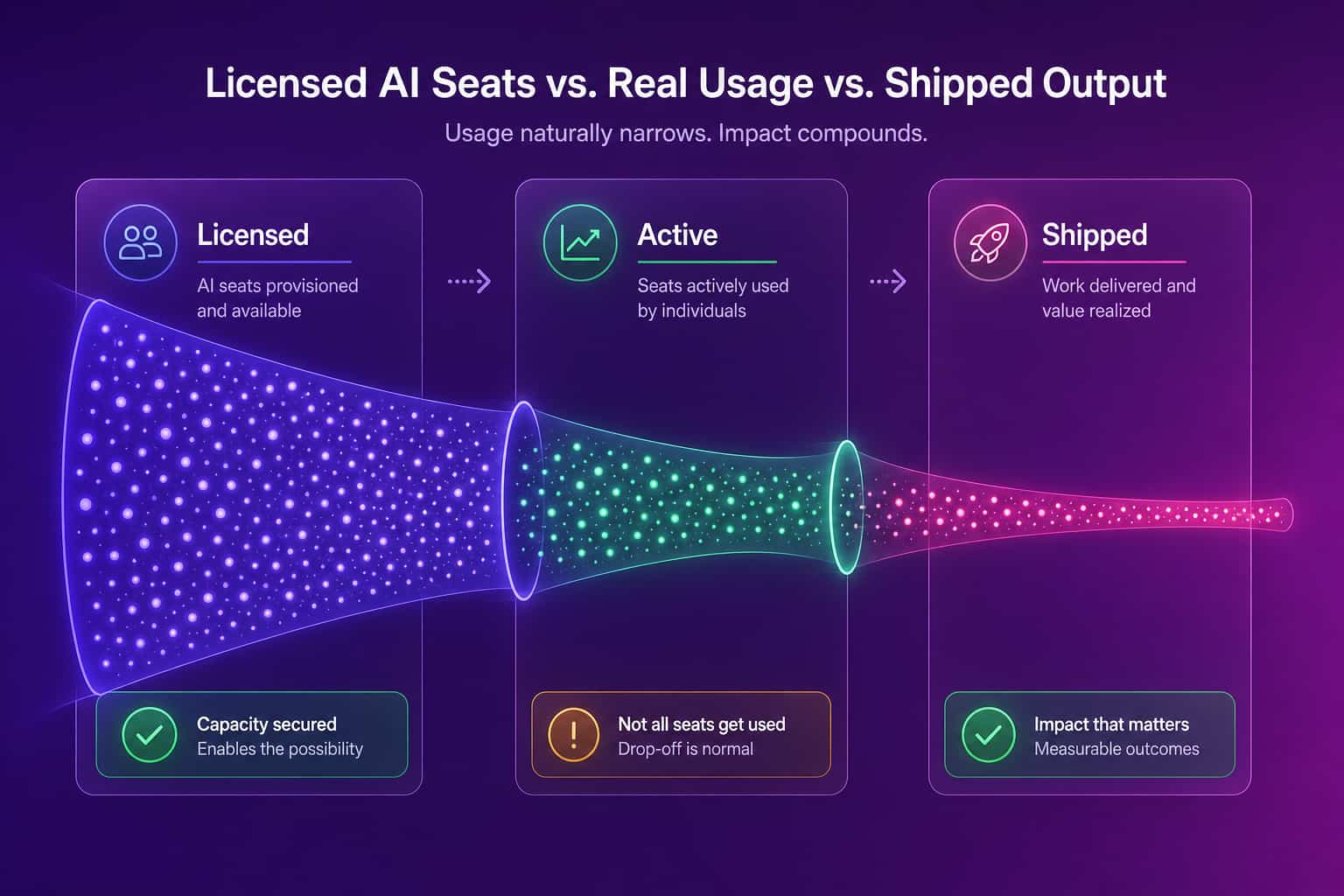
Most AI adoption strategy documents are really license plans. Buy seats, run a kickoff, send a Slack message with tips. Then someone on the board asks whether any of it changed output, and the honest answer is a login count.
A better AI adoption strategy has four moves: baseline the work, pilot one workflow, measure output instead of seats, then scale or cut. This guide walks through each, with the checks we use at Abloomify when we help engineering and ops leaders at 50 to 3,500 person companies figure out what their AI spend is actually doing.
Key Takeaways
Q: What is an AI adoption strategy?
A: It is the plan for who gets which AI tools, which workflow they are meant to change, and how you will prove the change. A plan with no baseline and no output metric is a procurement plan. Abloomify connects usage from Cursor, Claude Code, and Copilot to delivery data so the proof exists by default.
Q: Where should we start?
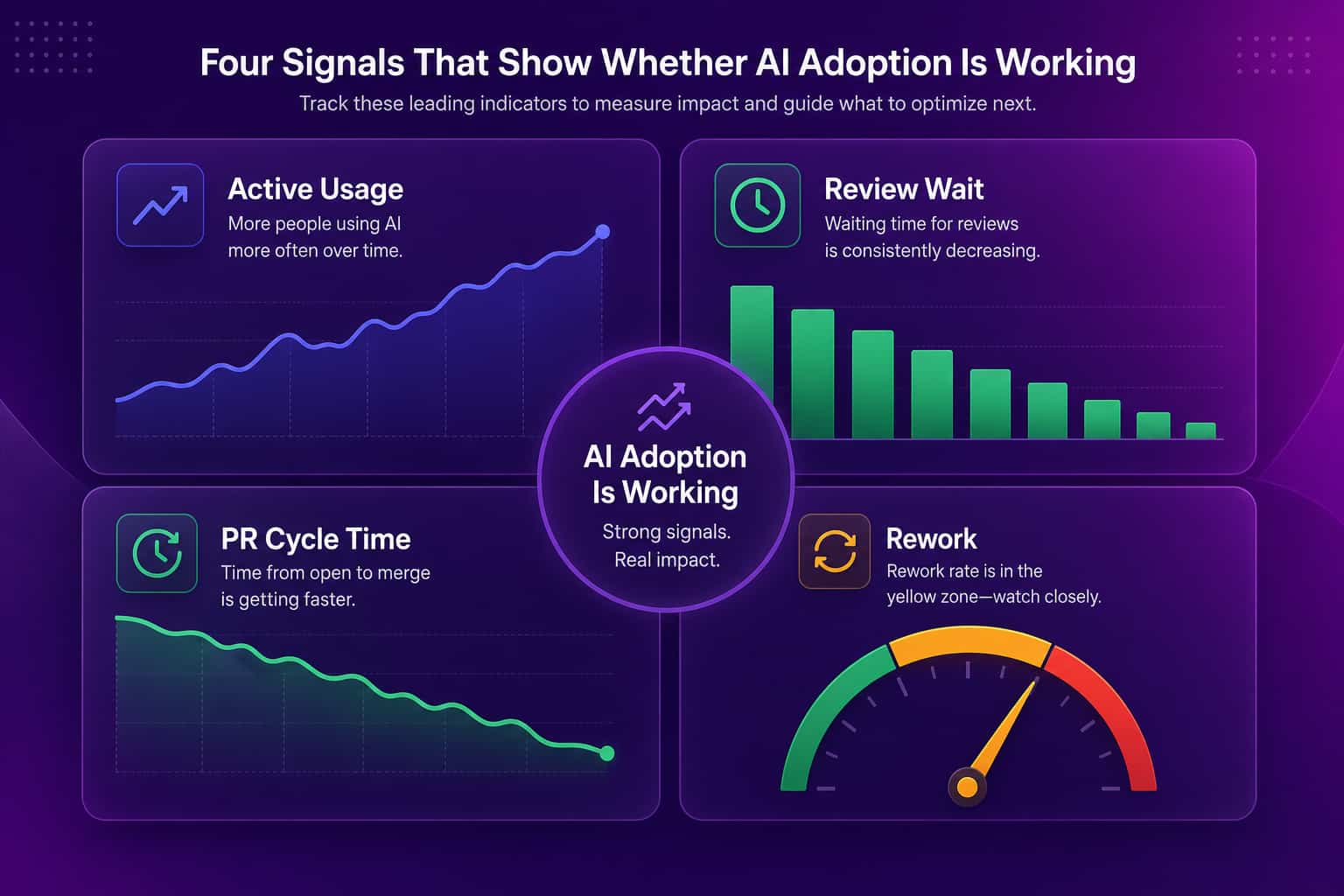
A: Start with a baseline of how the work runs today, not with the tool. For engineering that means PR cycle time, time to first review, and rework before anyone gets a seat. Without that, every later number is a story instead of a comparison.
Q: Why do rollouts stall?
A: Seats get handed out to everyone and a few enthusiasts use them. Nobody owns a workflow, so nothing is expected to change. A pilot with one team, one workflow, and one named owner fixes most of this.
Q: Do we need to monitor employees to measure adoption?
A: No. Abloomify is privacy-first and PII-free by architecture, with no screenshots, keyloggers, or screen recording. Team-level usage and delivery trends from your existing tools answer the adoption question without watching individuals.
Q: How do we know when to scale?
A: Scale when the pilot cohort shows a trend in the output metric you picked at the start, held across the whole measurement window. Cut or rework when usage is high and output is flat. High usage with flat delivery is a spend problem, not a success.
What does an AI adoption strategy need to include?
An AI adoption strategy needs five things written down before the first seat is assigned: the workflow you want to change, the baseline for that workflow, the cohort that gets the tool first, the output metric that decides success, and the date you will review it. Everything else (training sessions, champions programs, prompt libraries) supports those five. If one is missing, the rollout turns into a usage contest. The AI adoption curve most leaders describe, early enthusiasts then a long middle then laggards, is real, but a curve of logins tells you nothing about whether the work got better. Tie each stage of the curve to a delivery number, or the curve is decoration.
I'd also write down what would make you stop. That sentence is the one people skip and the one that keeps the budget honest.
Why does baselining come before the pilot?
You baseline first because AI tools change the shape of the work, and you can only see that change against a record of how it looked before. For an engineering team, the baseline is a few weeks of PR cycle time, time to first review, review load per engineer, and rework rate, pulled from GitHub or GitLab and your task tracker. For ops or sales teams it is whatever the workflow's output metric is, from Jira, Salesforce, or HubSpot. Pull it before rollout and freeze it. Teams that skip this step end up comparing the tool against a memory, and memories round in favor of whatever the team just paid for.
Abloomify has 100+ API integrations that read these signals PII-free, so the baseline exists the day you connect the tools. No spreadsheet export needed.
How do you pick the first pilot?
Pick one team, one workflow, and one tool, and keep all three fixed for the whole measurement window. Choose a team that ships often enough to produce a trend in a few weeks, with a manager who will look at the data, and a workflow where AI plausibly helps: code review turnaround, test writing, ticket triage, meeting prep. Do not pilot "AI" in general. A pilot of "give everyone Copilot and Cursor and Claude Code" produces a mess you cannot read, because three variables moved at once. If a team already runs several tools, that is fine as a starting point, but standardize on one primary tool per team during the window so the signal stays readable.
Name an owner. A pilot with a named owner gets a Tuesday review. A pilot without one gets forgotten by week three.
What should you measure besides seats and logins?
Measure active usage per team, then the delivery metrics the tool is supposed to move, and compare heavy users against light users inside the same team. Seats and logins tell you what you bought. Active usage tells you what people do. Delivery metrics tell you whether it mattered. For engineering, that is PR cycle time, time to first review, review wait, PR size, and rework. If heavy AI users ship faster and get reviewed sooner than light users on the same team, you have a real signal. If usage is high and the output metrics are flat, you have a spend problem.
One caveat matters here. AI changes the contribution mix, so separate what humans did from what AI agents did across code, PRs, and reviews. Otherwise a velocity gain gets credited to the team when part of it is the tool, or the other way around. Abloomify separates human and AI agent contribution for exactly this reason. For more on the measurement side, see how to measure AI adoption impact across your organization and our guide to AI ROI.
How do you handle resistance without surveillance?
Handle resistance by being specific about what you measure and by measuring teams instead of people. Engineers push back on AI rollouts for two reasons that often get mixed up: they doubt the tool, or they suspect the rollout is a way to rank them. You can answer the first with a pilot. You cannot answer the second with a memo. The answer is architecture. Abloomify collects PII-free signals only, with no email content, no message content, no screenshots, no keyloggers, and no screen recording, and it reports at team level. Say that in the kickoff, and show people the dashboard they will be measured on.
Research on surveillance points the same way. A 2026 survey found 1 in 6 workers would quit over it, and a Personnel Psychology meta-analysis found no evidence that monitoring improves performance. An AI rollout that feels like monitoring will cost you the very adoption you are trying to create. Our write-up on privacy-first workforce analytics goes deeper on the trust side.
Where does governance fit in an AI adoption strategy?
Governance fits in from week one, because the tools people adopt on their own will outrun the ones you approve. Shadow AI shows up as personal accounts, unapproved browser extensions, and pasted company data in tools nobody reviewed. A rollout strategy that ignores it ends up measuring the sanctioned tools while the real usage happens elsewhere. Write a short usage policy, pick the approved tools per workflow, and make the approved path the easy one. Then watch for the unapproved path so you can fix the gap instead of discovering it in an audit. We cover this in Shadow AI: enterprise risk, detection, and governance and in the AI usage policy guide.
If your team needs model controls, audit logs, and private deployment, Abloomify's AI governance software page lays out what that looks like.
When do you scale, rework, or cut?
Scale when the pilot cohort's output metric moved in the direction you predicted and stayed there across the full measurement window, and when usage held up after the novelty faded. Rework when usage is healthy but the metric is flat: the tool may be pointed at the wrong workflow, or the team may need different training. Cut when both usage and output are flat after a fair window. Cutting is a legitimate outcome and often the most valuable one, because it frees budget for the tool that does work.
I think most companies are too slow to cut. Seats are cheap per head, nobody wants to be the person who took the AI away, and the contract renews quietly. The baseline from step one is what lets you have that conversation with numbers instead of feelings.
Then repeat the cycle with the next team. A second pilot goes faster because the baseline pipeline already exists.
FAQ
What is an AI adoption strategy?
An AI adoption strategy is the plan for how a company introduces AI tools, who gets them first, what work they are meant to change, and how you will know whether they did. The measurement half is the part most plans skip. Without a baseline and an output metric, you end up with a license count and no answer.
How long should an AI tool pilot run?
Long enough to see a trend after the novelty wears off, which for most teams means a full measurement window of several weeks rather than a few days. Keep the tool and the team fixed during that window so the comparison against your baseline stays clean.
Why do AI rollouts stall after the first month?
Usually because nobody owns a specific workflow the tool is meant to improve, so usage drifts to a few enthusiasts and everyone else goes back to old habits. A narrow pilot with a named owner, a baseline, and a weekly look at usage and output catches the drift early.
Can you measure AI adoption without monitoring employees?
Yes. Abloomify is privacy-first and PII-free by architecture, with no screenshots, no keyloggers, and no screen recording. It reads usage and output signals from connected tools such as GitHub, Cursor, Claude Code, and Copilot, so you see team-level adoption and delivery trends without watching individuals work.
What should we measure besides seats and logins?
Active usage per team, and the delivery metrics the tool should move. For engineering that means PR cycle time, time to first review, and rework, compared before and after rollout and between heavy and light AI users. Abloomify correlates these across tools so the comparison is not a spreadsheet exercise.

Reza Vatani
Co-Founder & CAIO
AI-driven entrepreneur with a strong background in robotics and advanced analytics. PhD from Old Dominion University and former Product Development leader at Nasdaq Verafin.