AI Usage Policy: What to Include and How to Enforce It (2026)
June 4, 2026
Reza Vatani
11 min read

An AI usage policy is the document that tells your team which AI tools are allowed, what data they can put into them, and who is accountable when something goes wrong. Most guides stop at the template. The harder question is whether anyone actually follows it. At Abloomify, we treat the policy as the easy half and the visibility as the real work.
Key Takeaways
Q: What is an AI usage policy?
A: An AI usage policy is a written set of rules for how employees use AI tools like ChatGPT, Claude, Cursor, and GitHub Copilot at work. It defines approved and banned tools, what data is allowed, who can access which models, and how usage is monitored and audited.
Q: What should an AI usage policy include?
A: Seven parts: scope and approved tools, acceptable data, role-based access, a disclosure rule, security and vendor review, monitoring and audit, plus an owner and review cadence. Abloomify pairs each rule with an enforcement signal so the policy is checkable, not just published.
Q: How do you enforce an AI usage policy?
A: With visibility. Detect which AI tools are in use, control which models people can reach, log usage, and review it on a schedule. Abloomify provides shadow AI detection, role-aware access controls, and audit logs across 100+ integrations, all PII-free.
Q: AI usage policy or AI governance framework?
A: The policy is the employee-facing rulebook. The framework is the broader operating model around it (risk assessment, model approval, accountability). You write the policy as one artifact inside a wider AI governance framework.
What is an AI usage policy?
An AI usage policy is a written set of rules that defines how employees can use artificial intelligence tools, especially generative AI like ChatGPT, Claude, Cursor, and GitHub Copilot, for company work. It names which tools are approved, restricted, or banned, spells out what data can and cannot be entered into them, sets role-based permissions, and explains how usage is monitored and audited. A good policy covers both the consumer AI tools employees reach for on their own and the sanctioned platforms the company pays for. It works best as a living standard that you revisit as new models ship and new risks appear, rather than a document you file once and forget. The goal is practical: let people get the productivity benefit of AI while keeping company data, customers, and compliance obligations protected.
The policy sits inside a bigger picture. If you want the broader operating model around risk, model approval, and accountability, that is an AI governance framework, and the usage policy is one artifact inside it.
Why your company needs an AI usage policy now
You need an AI usage policy because adoption is already happening, with or without your sign-off. Employees paste code, customer records, and strategy docs into personal AI accounts to move faster, and most of that activity is invisible to IT. This is shadow AI, the 2026 version of shadow IT, and it carries real exposure: data leaving your control, customer information processed by tools you never reviewed, and compliance gaps under regimes like GDPR and the EU AI Act. The pressure runs both ways. Lock everything down and your best people route around you. Do nothing and you carry unmanaged risk on your biggest new productivity lever. A clear policy is how you give teams permission to use AI confidently while drawing the lines that protect the business. It also gives you a baseline to measure against, which matters when the board asks what AI is actually doing for output.
For the deeper version of this risk and how to find unapproved tools, see our guide on shadow AI detection and governance.
What to include in an AI usage policy
A complete AI usage policy has seven sections, and each one should be paired with a way to verify it is followed. Most templates online give you the wording for the first six and stay silent on the seventh, which is monitoring. That gap is why so many policies read well and change nothing. The table below maps each section to what it covers and how you actually check it in practice. Use it as the skeleton for your own document, then adjust the specifics to your industry, your regulatory exposure, and the AI tools your teams already depend on. Keep the language plain enough that a new hire can read it once and know what is allowed.
| Policy section | What it covers | How you verify it |
|---|---|---|
| Scope and approved tools | Which AI tools are approved, restricted, or banned, and for which teams | Detect tools actually in use vs the approved list |
| Acceptable data | What data can and cannot be entered into AI tools (no customer PII, no secrets) | Role-aware access controls and usage review |
| Roles and access | Who can use which models and at what permission tier | RBAC tied to the model gateway |
| Disclosure and labeling | When AI-generated work must be flagged in code, content, or decisions | Review patterns and team norms |
| Security and vendor review | Approval bar a new AI vendor must clear before use | Audit log of approved vendors and access |
| Monitoring and audit | How usage is logged and how often it is reviewed | Continuous AI usage analytics, PII-free |
| Owner and review cadence | Who owns the policy and when it gets updated | Scheduled review, not a one-time sign-off |
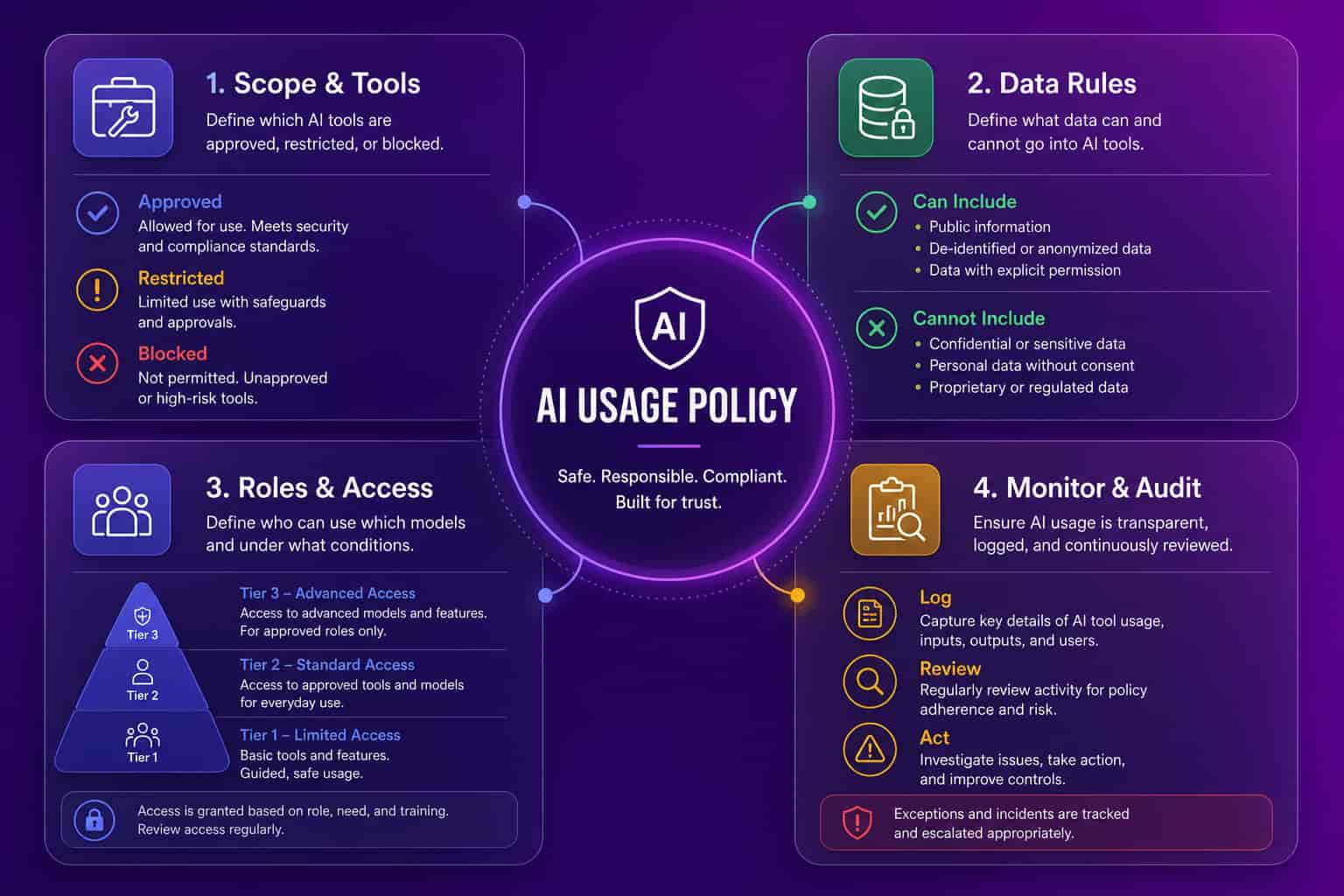
Write each section as a short rule plus one example. A rule like "do not paste customer PII into any external AI tool" lands harder when it is followed by a concrete case your team will recognize. Avoid legalese where a plain sentence works. The policy people actually read is worth more than the airtight one nobody finishes.
The part most AI usage policies miss: enforcement
Enforcement is where almost every AI usage policy falls apart, because a policy you cannot see is just a PDF. You can write the cleanest rules in the world about approved tools and acceptable data, but if you have no way to know which AI tools your team is actually using or what they are feeding into them, you are governing on the honor system. That is the whole game. The signed acknowledgment in the HR system tells you people read the document. It tells you nothing about Tuesday afternoon, when an engineer pastes a production config into a personal chatbot to debug it faster. Real enforcement means closing the loop between the rule and the behavior: detect the tools in use, control which models people can reach, and keep an audit trail you can review.
This is the layer Abloomify is built for. Our secure AI platform detects shadow AI across the tools your company already runs, applies role-aware access controls so people only reach the models they are cleared for, and keeps audit logs that make usage reviewable instead of invisible. It connects through 100+ API integrations and stays PII-free by architecture, so you get governance without surveilling individual keystrokes or reading content. SOC 2 Type 2 certified, with private cloud and BYOC deployment for regulated teams.
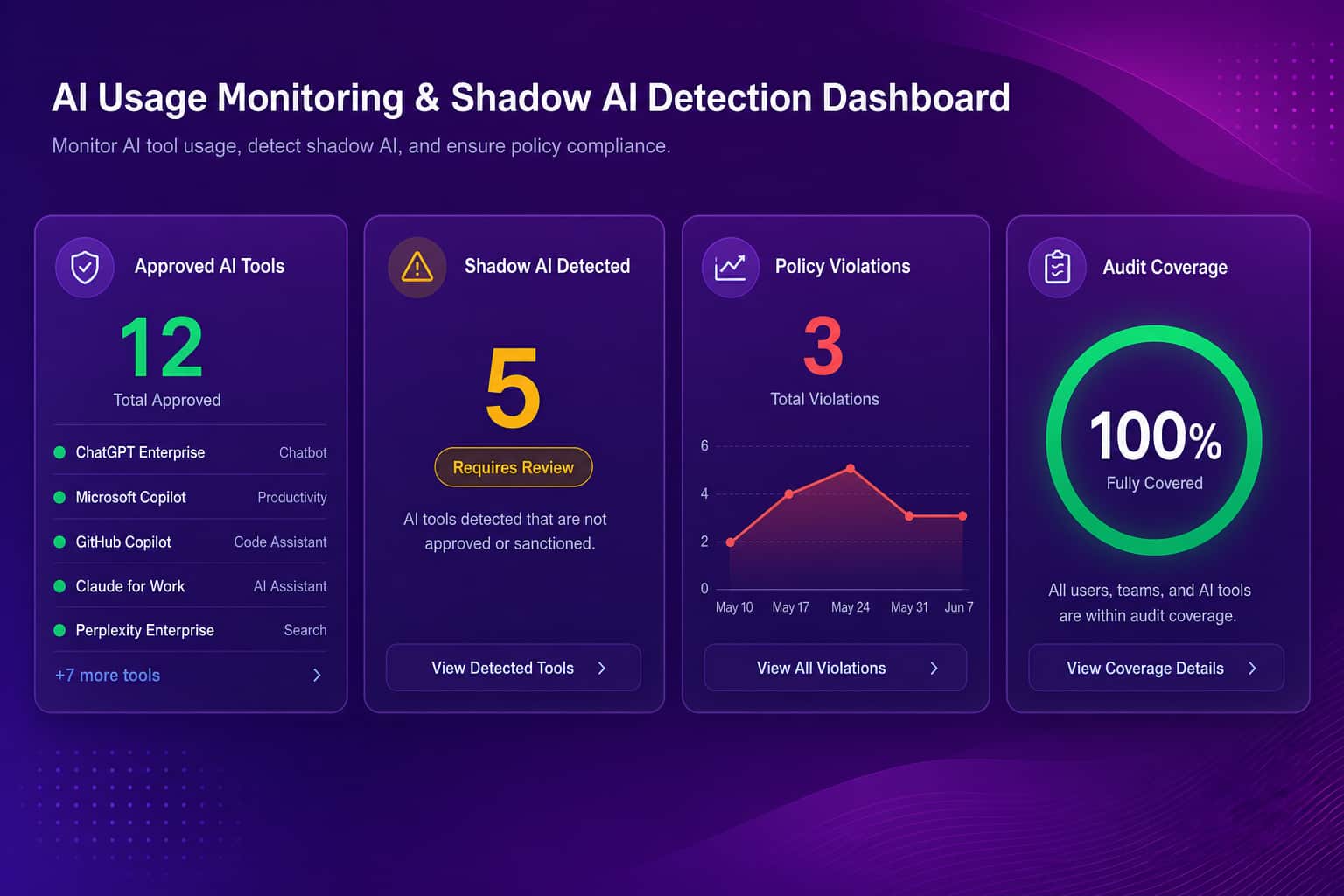
Enforcement also pays for itself in a way leaders forget. Once you can see real AI tool usage, you can see redundant and unused licenses too. Abloomify's SaaS license optimization typically surfaces $50K to $100K per year in tools nobody effectively uses, and AI subscriptions are now a fast-growing slice of that waste.
How to roll out an AI usage policy without slowing teams down
Rolling out an AI usage policy works best when you lead with enablement, not restriction, because the fastest way to grow shadow AI is to make the sanctioned path feel slower than the back channel. Start by naming the AI tools people can use with confidence, so the default answer is yes rather than ask permission. Then layer in the limits where they matter most, which is usually data handling and customer information. Pair the launch with monitoring from day one, so you learn what real usage looks like instead of guessing. The companies that get this right treat the policy as a product they iterate, not a memo they broadcast once.
A simple sequence that works:
- Inventory first. Use shadow AI detection to see which tools are already in play before you write a single rule. You cannot govern what you cannot see.
- Approve a short list. Name the sanctioned tools and models per team. Keep it small enough to support well.
- Set the data lines clearly. One page on what data is allowed beats ten pages of legalese nobody reads.
- Wire up access and audit. Tie model access to roles and turn on usage logging so the policy is checkable.
- Communicate the why. Explain the risk in plain terms. People follow rules they understand.
- Review on a schedule. Revisit quarterly and whenever a major model ships. AI moves faster than annual cycles.
Most leaders write the policy and call it done. The work is in the loop that comes after. Write the rules. Then watch whether they hold.
FAQ
What is an AI usage policy?
An AI usage policy is a written set of rules defining how employees use AI tools like ChatGPT, Claude, Cursor, and GitHub Copilot for work. It covers approved and banned tools, what data is allowed, who can access which models, and how usage is monitored and audited. It protects company data while letting teams capture the productivity benefit of AI.
What should an AI usage policy include?
Seven sections: scope and approved tools, acceptable and prohibited data, role-based access, a disclosure rule for AI-generated work, security and vendor review, monitoring and audit, plus a named owner and review cadence. The difference between a policy that works and one that gathers dust is whether each rule is paired with a way to verify it is followed.
Do small companies need an AI usage policy?
Yes. A 50-person startup carries the same data-leak and compliance exposure as a large enterprise, often with less oversight to catch problems. The policy can be one page, but it should still name approved tools, set data rules, and define how usage is checked. Starting early is far easier than retrofitting governance after a leak.
How do you enforce an AI usage policy?
Enforcement requires visibility, not just a signature. You detect which AI tools are actually in use, control which models people can reach, log usage, and review it on a schedule. Abloomify provides shadow AI detection, role-aware access controls, and audit logs across 100+ integrations, PII-free, so the policy is something you can verify rather than hope for.
Is an AI usage policy the same as an AI governance framework?
No. The AI usage policy is the employee-facing rulebook for day-to-day AI use. An AI governance framework is the broader operating model around it, including risk assessment, model approval, and accountability structures. The policy is one artifact that lives inside the framework, and the two should stay consistent with each other.

Reza Vatani
Co-Founder & CAIO
AI-driven entrepreneur with a strong background in robotics and advanced analytics. PhD from Old Dominion University and former Product Development leader at Nasdaq Verafin.