Will AI Replace Software Engineers? What the Data Shows (2026)
July 14, 2026
Reza Vatani
9 min read

Will AI replace software engineers? Not the way the headlines want you to believe. AI coding tools are changing how engineering work happens, and Abloomify measures that shift directly by separating human from AI-agent contribution across code, pull requests, and reviews. The interesting question is no longer "human or machine." It is how much of the work each one is really doing, and whether your team can see it.
Key Takeaways
Q: Will AI replace software engineers?
A: Not wholesale. AI coding tools absorb the typing and boilerplate, not the judgment. The job shifts toward directing, reviewing, and validating machine output. Teams that track human vs AI contribution with a tool like Abloomify see where that line moves instead of guessing.
Q: Is AI writing most of the code?
A: On some teams AI generates a large share of raw lines. But raw lines are a weak measure. What counts is merged, reviewed code that survives production, and there humans still do the deciding.
Q: What happens to the engineering job?
A: It moves up the stack. Generation gets cheap, so review, architecture, debugging, and taste become the scarce skills. The bottleneck shifts from writing code to verifying that generated code is correct and safe.
Q: How do I measure this on my own team?
A: Abloomify imports usage from Cursor, Claude Code, and GitHub Copilot, correlates it with engineering output, and compares AI-heavy against AI-light cohorts. You get the real human vs AI split, not a self-reported guess.
Will AI replace software engineers, or just change the job?
Will AI replace software engineers is the wrong framing, and the SERP full of hot takes proves it. AI is replacing tasks, not the role. The tasks going first are the ones engineers already disliked: scaffolding, boilerplate, test stubs, translating a known pattern into a new file. In 2025 one AI lab CEO predicted machines would write ninety percent of code within months, and that prediction did what predictions do, it collapsed "code" into a single number and skipped the part where someone has to decide what to build, review what came back, and own it in production. The share of raw lines a model can emit says almost nothing about who is responsible for the system. On the teams we work with at Abloomify, AI-generated code shows up everywhere, and human engineers are busier than ever, because every generated block still needs a person to point it, read it, and merge it.
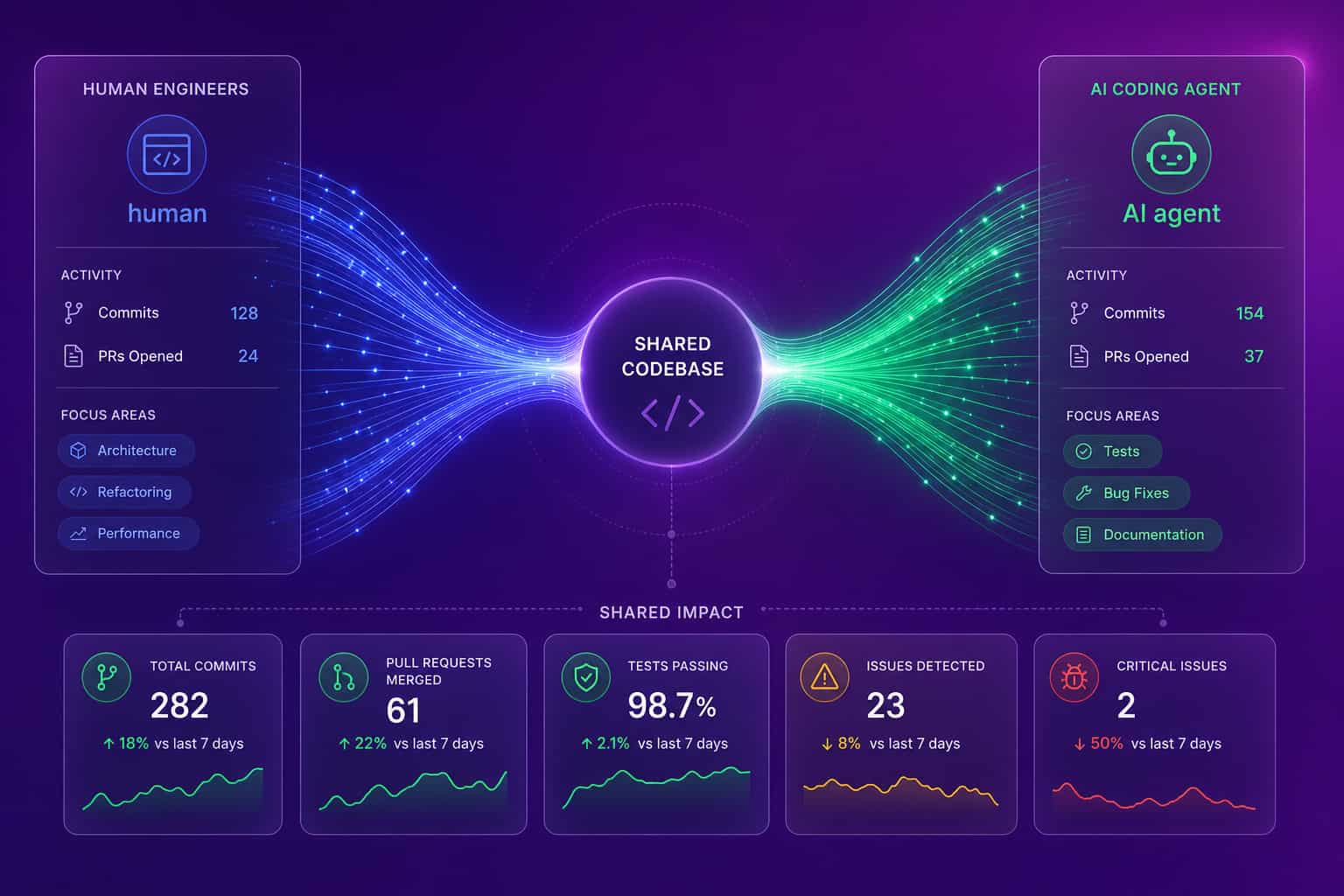
The honest read is that the demand for judgment goes up when the cost of generation goes down. You can produce a pull request in ninety seconds now. Someone still has to know whether it belongs in the codebase.
What AI actually changes about the engineering job
AI changes the shape of the engineering job by moving effort from production to direction and verification. Writing a function used to be the work. Now the work is describing the function well enough for a model to draft it, then reading the draft closely enough to trust it. That sounds like a small shift. It is not. Review load climbs because there is more code to look at, and more of it is plausible-looking code written by something that has no stake in whether it is correct. Architecture matters more because a model will happily generate a locally reasonable solution that is globally wrong. Debugging matters more because generated code fails in less familiar ways. The engineers who compound in value are the ones who are strong at reading, judging, and integrating, not just producing. Vibe coding is fun until the third incident, and then taste is the whole job.
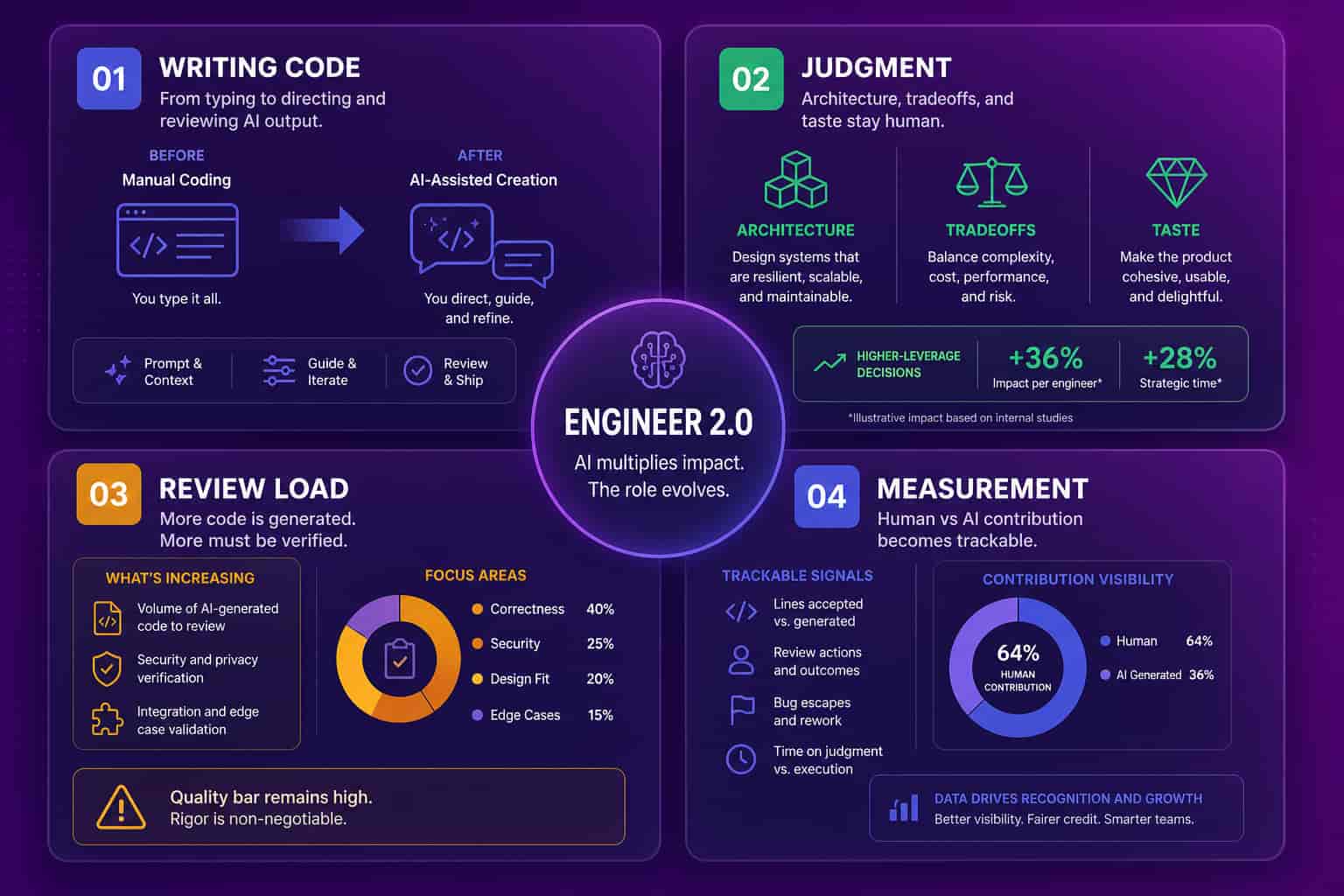
This is why "how many engineers do we still need" is the wrong first question. The better one is "what is each engineer now spending their time on, and is the AI actually buying us leverage or just more code to review." That is a measurement question, and most teams cannot answer it. For a deeper breakdown of what to track, see our guide to developer productivity metrics.
The failure mode nobody puts in the demo
The real risk with AI coding tools is subtler than replacement. They make weak decisions feel finished. Large language models are very good at making you feel confident about a shaky choice. They return fluent, well-formatted, authoritative code for a bad approach just as fast as they return it for a good one, and the fluency is the trap. A junior engineer who would have hesitated now ships. A senior engineer who is moving fast now skims. The code compiles, the tests you thought to write pass, and the flawed assumption rides straight into production. This is where change failure rate and mean time to recovery quietly get worse even as raw output climbs, and it is exactly the pattern a lines-of-code dashboard will never show you.
The teams that get this right treat AI output the way a good editor treats a first draft: useful, fast, and not to be trusted until read. The ones that get it wrong measure success by how much the model produced. We built AI ROI measurement precisely because "we shipped more" and "we shipped better" are different claims, and only one of them survives a board meeting.
How to see human vs AI contribution on your own team
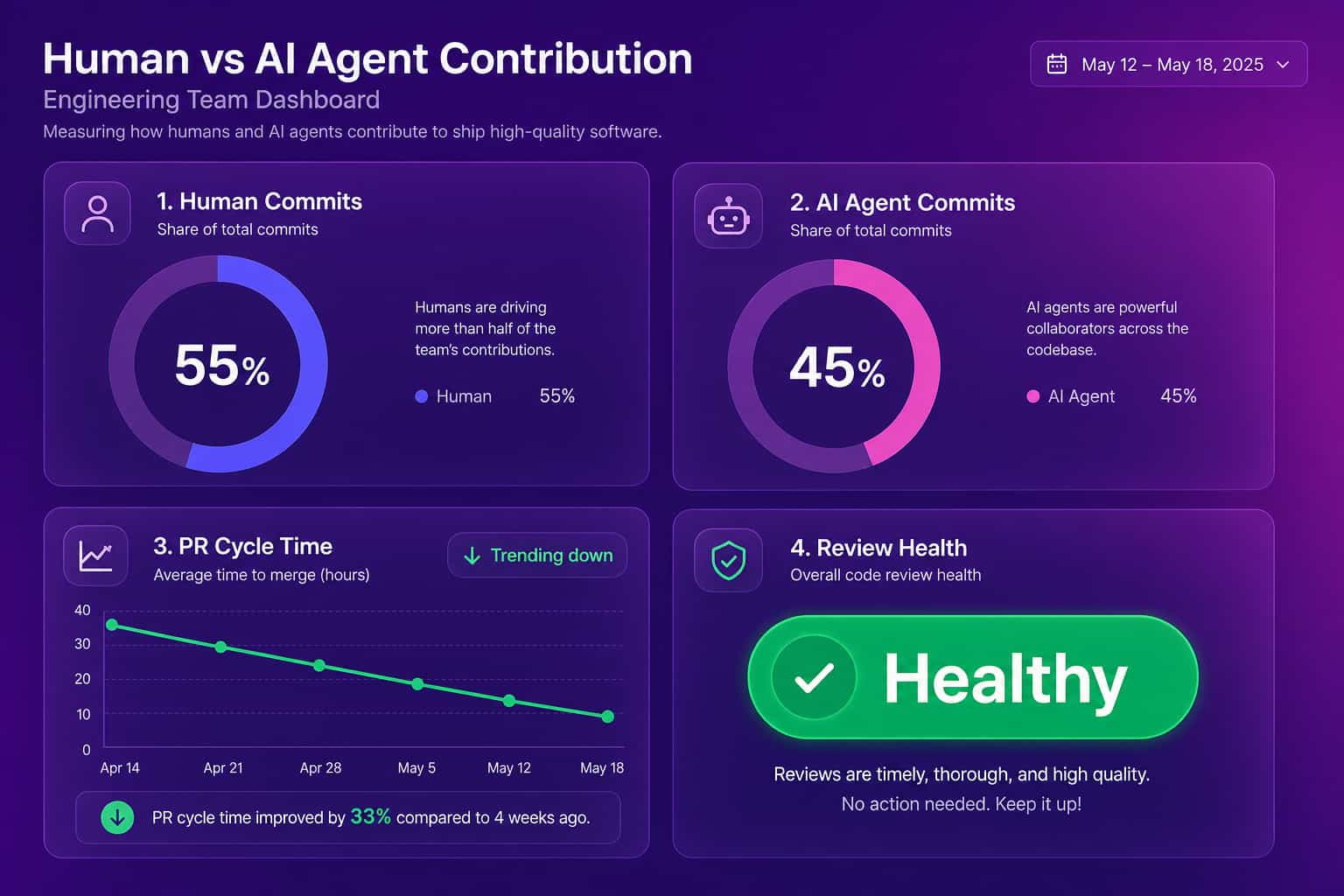
You measure whether AI is replacing or amplifying your engineers by separating human from AI-agent contribution and tying both to delivery outcomes. Abloomify connects to GitHub, GitLab, Bitbucket, Jira, and Linear, then imports usage metrics directly from Cursor, Claude Code, and GitHub Copilot and correlates them with engineering output. Instead of a lines-of-code vanity number, you see contribution split across code, pull requests, and reviews, plus an AI-vs-human cohort comparison that answers the question leaders actually care about: do the engineers leaning hardest on AI ship more and review faster, or just generate more work for everyone else? AI Leverage becomes a tunable pillar of the Engineering Velocity Score, sitting next to all four DORA metrics, PR cycle time, review health, and security posture. It is privacy-first by architecture, so this runs on work signals, never on the content of your code.
One 50-person SaaS company we work with validated Abloomify's engineering data against the manual analysis their COO had been building by hand. Their words: "What I did manually this week in a spreadsheet is exactly what I think Abloomify should be doing automatically." When the numbers matched their own, they trusted them, and the weekly spreadsheet went away.
Here is the practical difference between the headline view and the measured view:
| Question | Lines-of-code view | Abloomify contribution view |
|---|---|---|
| Who wrote it? | "AI wrote 60 percent" | Human vs AI-agent split across code, PRs, reviews |
| Did it help? | Volume went up | Usage correlated with PR cycle time and delivery |
| Is it safe? | Not measured | Change failure rate, review health, security posture |
| Who is at risk? | Guesswork | AI-heavy vs AI-light cohort comparison |
What this means for hiring and team design
The move is to hire and organize for judgment, because that is the work AI leaves on the table. Stop scoring engineers on how much code they emit, a metric AI just made meaningless, and start valuing the ability to review well, design systems that hold up, and catch the plausible-but-wrong answer before it ships. That changes interviews, it changes what you promote, and it changes span of control, because a smaller group of strong reviewers directing AI can now cover ground that used to need a bigger team. It also means giving engineers the tools their AI assistants can actually learn from. Through Abloomify's MCP server, the same engineering context is available inside Cursor and Claude Code, scoped to what each person is already allowed to see, so the AI answers from your company's real work data instead of generic training data.
AI will not replace your software engineers. It will replace the parts of their job that never needed a human, and it will expose which teams were coasting on volume. The engineers who read, judge, and own the outcome get more valuable, not less. Machines write code. People decide what is worth building.
FAQ
Will AI replace software engineers?
Not as a wholesale replacement. AI coding tools like Cursor, GitHub Copilot, and Claude Code are absorbing the typing and boilerplate, not the judgment. The job shifts toward directing, reviewing, and validating machine output. Teams that measure human vs AI contribution can see exactly where that line is moving instead of guessing.
Is AI writing most of the code now?
On some teams AI generates a large share of raw lines, but raw lines are a weak measure. What matters is merged, reviewed, shipped code that survives production. Abloomify separates human from AI-agent contribution across code, pull requests, and reviews so leaders see the real split, not a lines-of-code headline.
Which engineering skills matter more because of AI?
Review, architecture, debugging, and taste. When generation is cheap, the bottleneck moves to verifying that generated code is correct, secure, and maintainable. Engineers who are strong at reading and judging code, not just producing it, become more valuable.
How do I know if AI tools are actually helping my engineers?
Tie usage to output. Abloomify imports metrics from Cursor, Claude Code, and GitHub Copilot and correlates them with PR cycle time, review health, and delivery, then compares AI-heavy and AI-light cohorts. That tells you whether adoption changed what shipped, not whether people opened the tool.

Reza Vatani
Co-Founder & CAIO
AI-driven entrepreneur with a strong background in robotics and advanced analytics. PhD from Old Dominion University and former Product Development leader at Nasdaq Verafin.