Stack Ranking: Why Forced Curves Fail and What to Use Instead
November 24, 2026
Amir Tavafi
13 min read

Stack ranking is the review system where managers have to put a fixed share of their people at the bottom, whether or not anyone there is underperforming. GE made it famous, Microsoft dropped it in 2013, and it keeps coming back every time a board asks for efficiency. At Abloomify we build privacy-first workforce intelligence, and I get why COOs reach for it. The question behind it is fair. The method is the problem.
Key Takeaways
Q: What is stack ranking?
A: Stack ranking, also called forced ranking or a forced distribution, is a performance review system that ranks employees against each other and forces a fixed share into each band, including a bottom band that usually gets a performance plan or an exit. The quota is set before anyone looks at the work.
Q: Where did stack ranking come from?
A: Jack Welch made it famous at GE as the "vitality curve": the top 20% rewarded, the middle 70% developed, and the bottom 10% managed out. Microsoft ran its own version for years and ended it in November 2013 after it became known for internal politics.
Q: Why does stack ranking fail?
A: It assumes every team has the same spread of talent, so a strong team has to label a good engineer as a low performer. People respond rationally: they avoid strong teams, hoard credit, sandbag goals, and stop helping each other. The ranking measures politics as much as output.
Q: What should you use instead of stack ranking?
A: Compare people to the job instead of to each other, and back every rating with work data. Abloomify connects tools like Jira, GitHub, calendars, and OKRs through 100+ PII-free API integrations, so reviews start from what actually shipped, and drafting them takes 75% less time.
What is stack ranking?
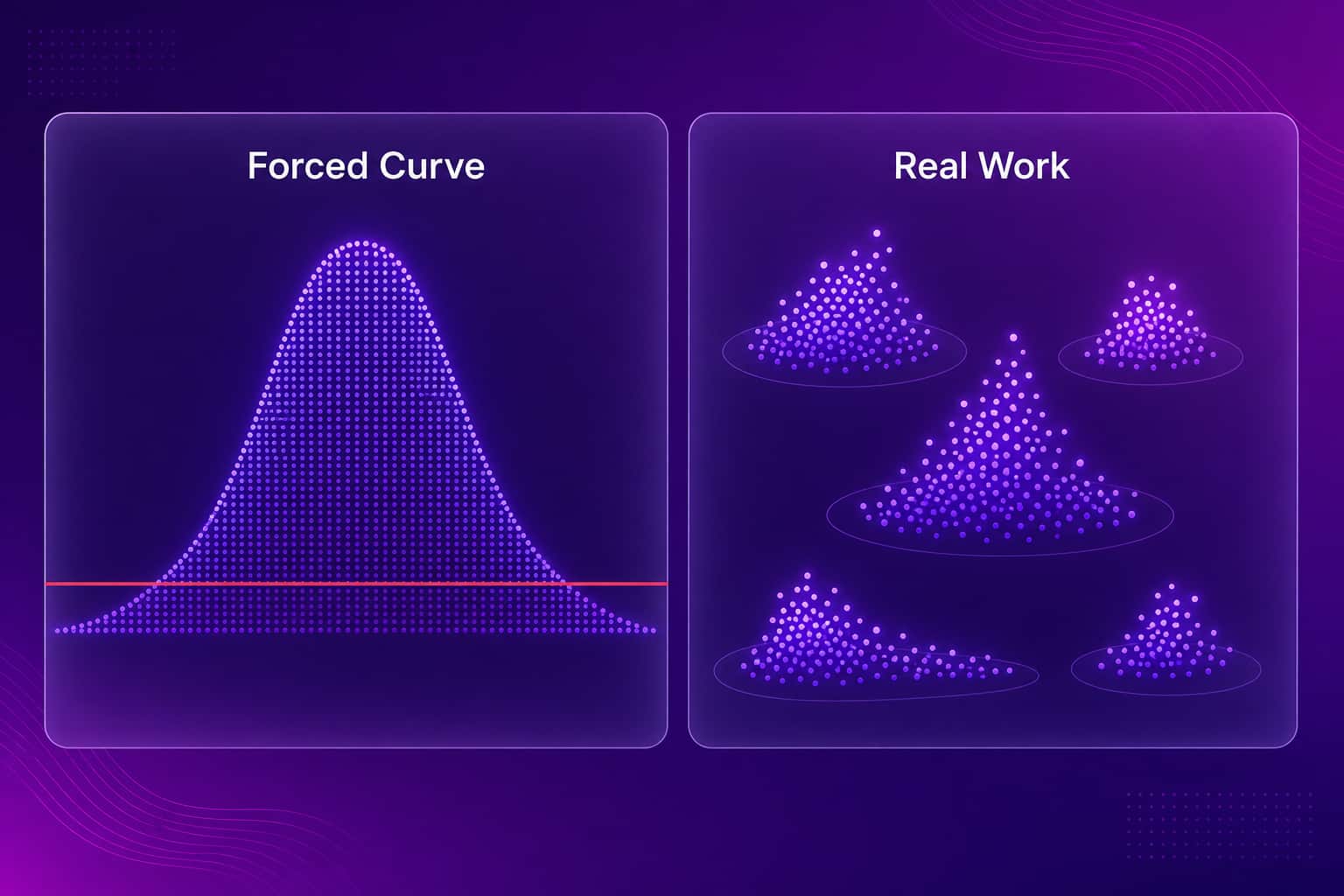
Stack ranking is a performance management method where a manager, or a calibration group of managers, orders every employee in a unit from best to worst and then assigns them to rating bands with fixed sizes, so that a set percentage must land in the top band, a set percentage in the middle, and a set percentage at the bottom regardless of how well the team actually performed that year, with the bottom band typically receiving no raise, a performance improvement plan, or a managed exit. The defining feature is the quota. A normal review system can rate everyone on a strong team as strong. Stack ranking can't.
You'll see it under a few names:
- Forced ranking or forced distribution, the HR textbook terms.
- The vitality curve, or "rank and yank", from the GE era.
- Calibration to a curve, which is how a lot of companies describe it today without using the words stack ranking at all.
That last one matters. Plenty of companies say they dropped stack ranking and still hand managers a target distribution before calibration starts. If the curve comes before the evidence, it's stack ranking with better branding.
There's also a second meaning of stack ranking that has nothing to do with people. In product and agile teams, stack ranking a backlog means ordering items from first to last with no ties. That habit is genuinely useful, and I'll come back to it near the end.
Where stack ranking came from: GE, Microsoft, and Amazon
Stack ranking became mainstream through General Electric in the 1980s and 1990s, when Jack Welch described a vitality curve that split employees into a top 20% to reward, a vital middle 70% to develop, and a bottom 10% to move out every year, and the apparent success of GE in that period convinced a generation of executives that a forced curve was how high performance companies kept the bar high, which is why so many large tech and finance firms copied some version of it over the next two decades. The idea spread fast because it felt rigorous. It gave leaders a number.
Microsoft is the case everyone quotes. Its system forced managers to grade people on a curve within each team, and a widely read 2012 Vanity Fair story blamed it for years of infighting. The complaint from engineers was simple and very rational: if you join a team full of stars, someone on that team will get a bad rating, so the smart career move is to avoid the best teams. Microsoft ended the system in November 2013.
Amazon comes up in almost every search about stack ranking. Amazon doesn't describe its own review process that way. Press reports over the years have described forced-distribution style targets, often called unregretted attrition goals. I'd treat any specific percentage you read online as unconfirmed unless it comes from Amazon.
| Stack ranking | Rating against the job | |
|---|---|---|
| Who you are compared to | Your teammates | The expectations for your role and level |
| Size of the bottom band | Fixed before reviews start | Whatever the evidence says, including zero |
| What a strong team gets | Some people labeled low performers anyway | Everyone rated on what they did |
| What people optimize for | Relative position | The work |
| Main input | Manager judgment in a calibration room | Manager judgment plus work data |
Why stack ranking fails in practice
Stack ranking fails because it bakes in an assumption that is almost never true at the team level, namely that every group of eight or twelve people contains the same spread of strong, average, and weak performers, and once you force that shape onto teams that don't have it, the system starts producing wrong answers, and people quickly learn that their rating depends as much on who sits next to them and how well their manager argues in calibration as on what they actually delivered. Smart people adapt to incentives. That's where the damage comes from.
What I see when companies run a forced curve:
- Sandbagging. People set goals they know they can beat, because a missed stretch goal is ammunition in calibration.
- Team avoidance. Strong people move away from strong teams, the Microsoft pattern, and weak teams become the safest place to be.
- Credit hoarding. Helping a teammate ship their project can push them above you in the stack, so fewer people do it.
- Manager politics. The rating often reflects the manager's negotiating skill in the calibration room more than the employee's work.
- Talent flight. The people with the most options are the first to leave a system that can label them a low performer by quota.
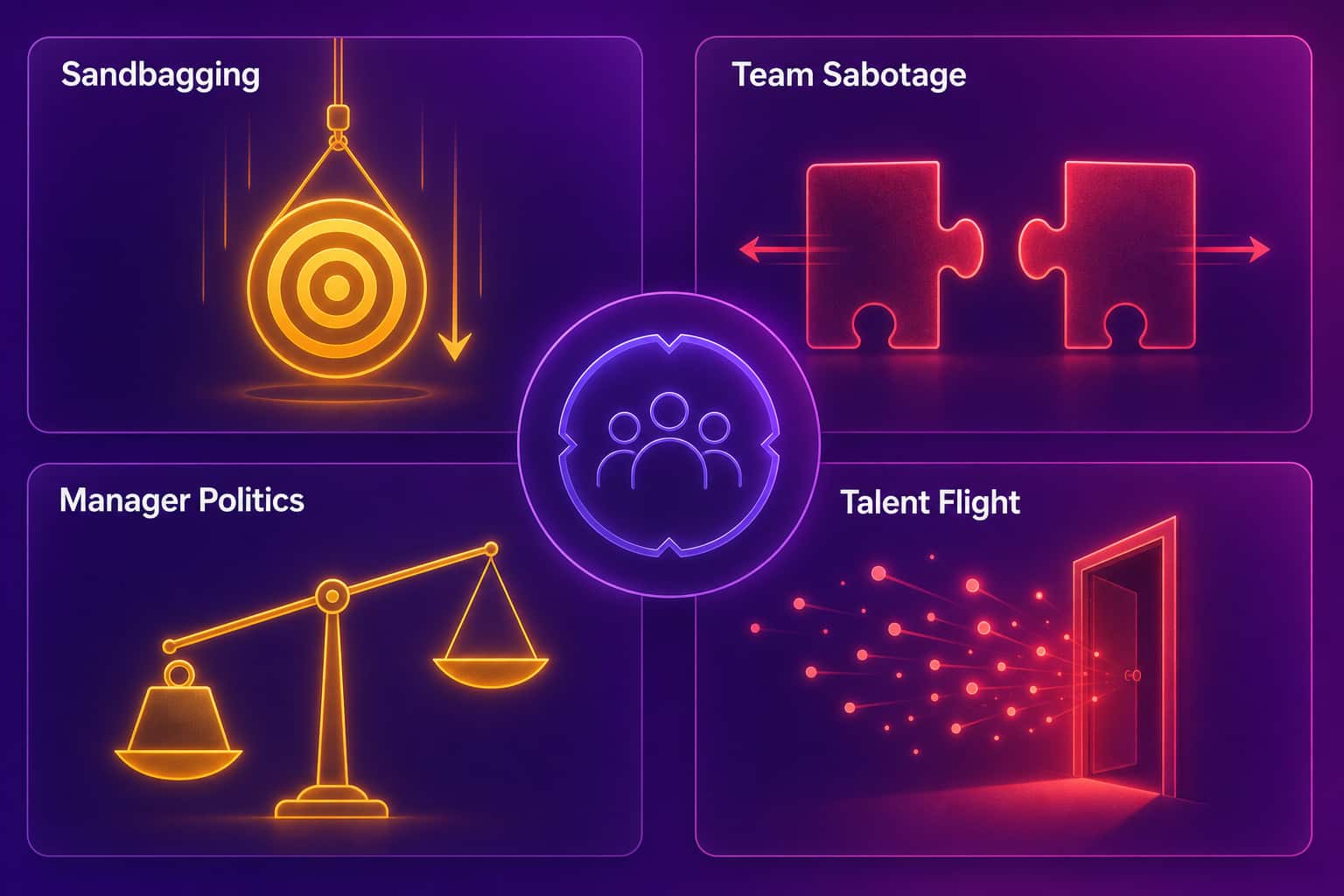
The worst part is that stack ranking makes your data worse. Once people know they're being ranked against each other, everything visible gets optimized for the ranking. You end up with a cleaner looking curve and a blurrier picture of who is actually carrying the work.
The question behind stack ranking is still fair
The question that drives leaders toward stack ranking is legitimate, because in most companies of 100 to 500 people there really are a few people who are coasting, a few who are carrying far more than their share, and a large middle that does solid work, and leadership usually cannot see which is which with any confidence, since self-reviews are inflated, manager ratings cluster around "meets expectations", and nobody has the time to reconstruct a year of work from Jira, GitHub, and calendars before a review cycle. Stack ranking is a crude answer to a real visibility problem.
My own view here is messy. I've written before that in most teams, roughly 1% are epic, 5% are great, 15% get stuff done, 50% do OK to solid work, and 30% add little real value. That's a rough personal estimate, not research. I think some version of it has always been true, and in a tight market it gets exposed fast.
So I'm not against the idea that performance varies a lot. I'm against forcing that shape onto every team before anyone looks at the evidence. Your platform team might be all strong. Your support tooling team might have three people quietly coasting. A curve applied to both gets both of them wrong.
The cold email that closed our only cold-outbound customer, a 3,500-person enterprise, had the subject line "Quiet quitters at [Company]?". Leaders want this answered. They just don't want to destroy trust or run surveillance to get there, and they're right not to. If you suspect disengagement specifically, we wrote a separate guide on how to spot quiet quitting without monitoring.
What to use instead of stack ranking
The better alternative to stack ranking is to rate each person against clear expectations for their role and level, and then back that rating with evidence from the systems where work already happens, such as Jira or Linear for delivery, GitHub for code and review load, calendars for focus time and meeting load, and OKRs for goal progress, so that calibration becomes a discussion about what the data shows and where it's missing context, rather than a negotiation over who has to fill the bottom slots. Underperformance should show up as a pattern over months, not as a quota.
A practical version for a 100 to 500 person company:
- Write down what "meets expectations" means for each role and level. Two or three observable outcomes each, not a page of values.
- Pull the work signals before the review cycle, not during it. Delivery against plan, review load, focus time, meeting load, after-hours trend, and goal progress.
- Look at trends per team first. A whole team with flat delivery and rising meeting load usually has a planning or staffing problem, not six individual performance problems.
- Then look at individuals, with the manager adding the context the data can't see: the person who unblocked three teams, the person who was on parental leave, the person who carried the incident.
- Calibrate on evidence. If the evidence says nobody on a team is underperforming, nobody gets that label.
- For the few real performance issues, use a clear and fair performance improvement plan with specific goals, not a surprise at year end.
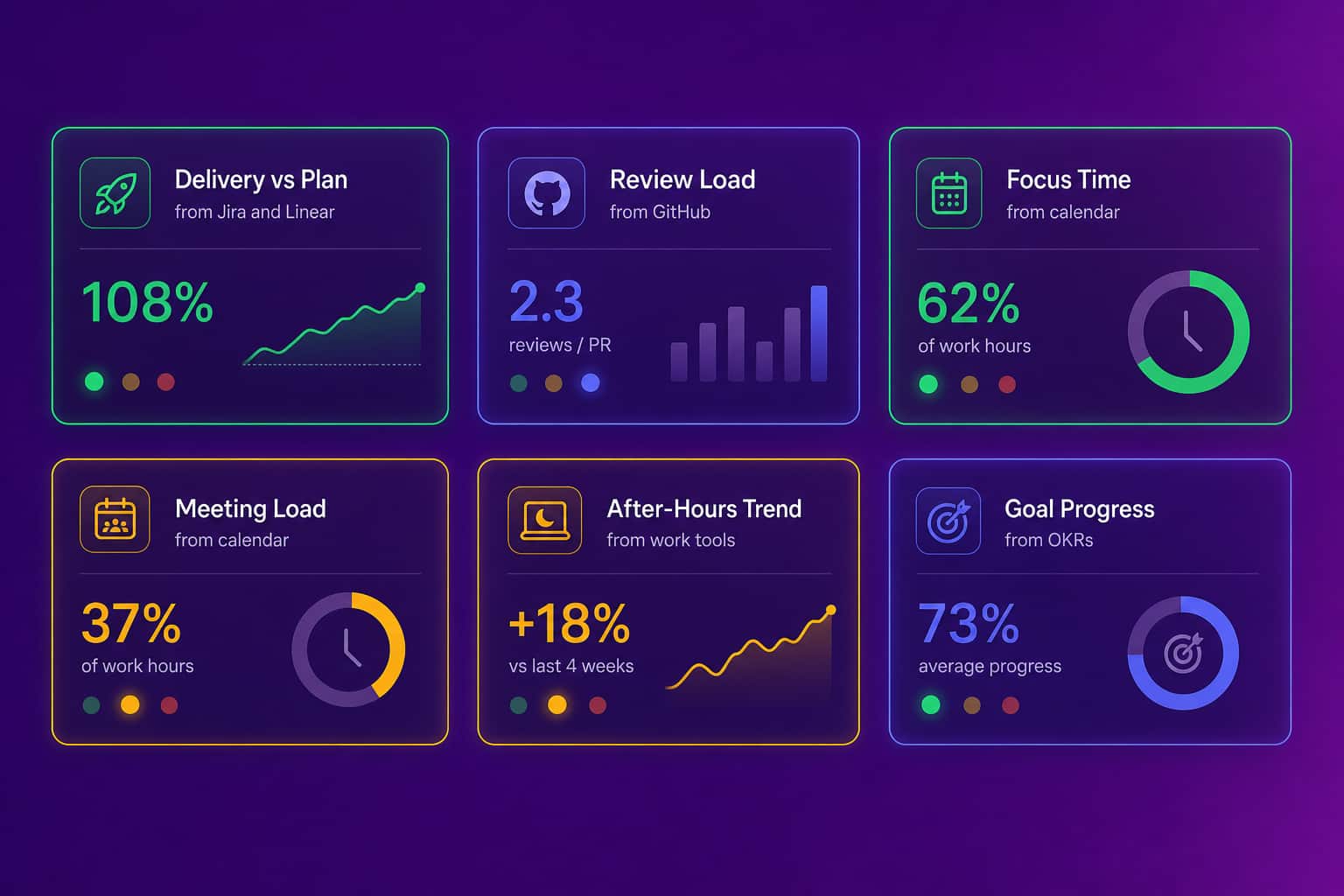
This is where Abloomify fits. Our performance management module handles goals and OKRs, self, peer, upward, and downward reviews, and feedback, and it's included alongside workforce analytics rather than bolted on. The difference from survey-based tools like Lattice or 15Five is the input: reviews draw on actual work signals from 100+ integrations, PII-free, with no email content, message content, or file content. Optional device agents report aggregated usage by application category, with no screenshots, keyloggers, or screen recording. If you're comparing options, our Abloomify vs Lattice page goes deeper.
One honest caveat from our own customers. That 3,500-person enterprise started with Google Workspace data alone, and their COO told us they were seeing low correlation with their internal performance metrics. Single-source data under-proves performance. Collaboration patterns by themselves won't tell you who is strong. You need delivery data next to them, and a manager who knows the context. For the review mechanics, our guide on how to build fair performance reviews walks through it step by step.
Stack ranking in prioritization and in Excel
Stack ranking in prioritization means ordering a list of work items, such as a product backlog, a roadmap, or a set of bugs, from first to last with no two items allowed to share the same rank, which forces a team to make the real trade-off between options instead of labeling ten things "high priority" and leaving engineers to guess, and it's one of the most useful planning habits a product or engineering team can have. Agile teams use it all the time. It's a completely different thing from ranking people, and you should keep doing it.
If you've landed here trying to stack rank something in Excel, the mechanics are simple. Put your items in one column and a score in the next, then use
RANK.EQ on the score column, or just sort descending. For a backlog, the hard part is the score, not the formula. For people, my advice is don't build the spreadsheet at all.Our Customer 1, a 50-person SaaS company, had a COO who built exactly this kind of spreadsheet by hand before a review cycle. Their words after seeing the same numbers come out of Abloomify automatically: "What I did manually this week in a spreadsheet is exactly what I think Abloomify should be doing automatically." That's the job. Get the evidence together without the manual work and without the curve, and let managers spend their time on the conversations.
A curve tells you where people have to land. Work data tells you where they actually are.
FAQ
What is stack ranking in simple terms?
Stack ranking is a performance review system where managers rank employees against each other and must place a fixed share of them in each band, including a bottom band. Someone has to be last, even on a strong team. The bottom group usually gets a performance plan, no raise, or an exit.
Does Amazon use stack ranking?
Amazon does not publicly describe its review system as stack ranking. Press reports over the years have described forced-distribution style practices and targets for unregretted attrition. Treat any specific percentage you see quoted online as unconfirmed unless it comes from Amazon itself.
Why did Microsoft stop stack ranking?
Microsoft ended its stack ranking system in November 2013, after years of internal criticism and a widely read 2012 Vanity Fair story that blamed it for infighting. The common complaint was that engineers avoided strong teams, because joining a team of stars made a bottom rating more likely.
What does stack ranking mean in prioritization?
In product and agile teams, stack ranking means ordering a backlog from first to last with no ties, so two items can never share the same priority. It is a useful planning habit. It has nothing to do with rating people, and most of the criticism of stack ranking is about the HR version.
What is a better alternative to stack ranking?
Calibrated reviews against clear expectations, backed by work data. Compare people to the job, not to each other, and bring evidence from tools like Jira, GitHub, calendars, and OKRs into the review. Abloomify connects those sources PII-free and drafts data-backed reviews, so underperformance shows up as a pattern, not a quota.

Amir Tavafi
Co-Founder & CEO
Product leader and innovator with over 15 years of experience in the tech sector, grounded in AI and robotics. Previously led product development in fraud detection and AI solutions at Nasdaq Verafin.