Span of Control: What It Is and How to Set It With Real Data
June 5, 2026
Amir Tavafi
11 min read

Span of control is the number of people who report directly to one manager, and it is one of the most consequential numbers in your org chart. Set it too low and you pay for management layers that slow everything down. Set it too high and managers stop leading and start firefighting. Most companies pick the number from a spreadsheet ratio. Abloomify connects your HRIS and work tools so spans reflect the capacity managers actually have.
Key Takeaways
Q: What is span of control?
A: Span of control is the number of employees who report directly to a single manager. A narrow span means few reports and more layers. A wide span means many reports and a flatter org. Most modern tech teams land between 5 and 9 direct reports per manager.
Q: What is a good span of control?
A: There is no universal number, but 5 to 9 direct reports is a common healthy range for knowledge work, and the old rule of seven still anchors many org charts. The right span depends on task complexity, team maturity, and how much real capacity each manager has.
Q: How do you calculate span of control?
A: Divide the number of employees by the number of managers to get your average span. For a single manager, count their direct reports. Abloomify pulls org structure from your HRIS so the ratio updates automatically as teams change.
Q: Why do flat org charts still fail?
A: Because a clean ratio on paper ignores a manager's real workload. A manager with 8 reports and 25 hours of weekly meetings has no capacity left to lead. Abloomify measures meeting load, coaching time, and team capacity so spans reflect reality.
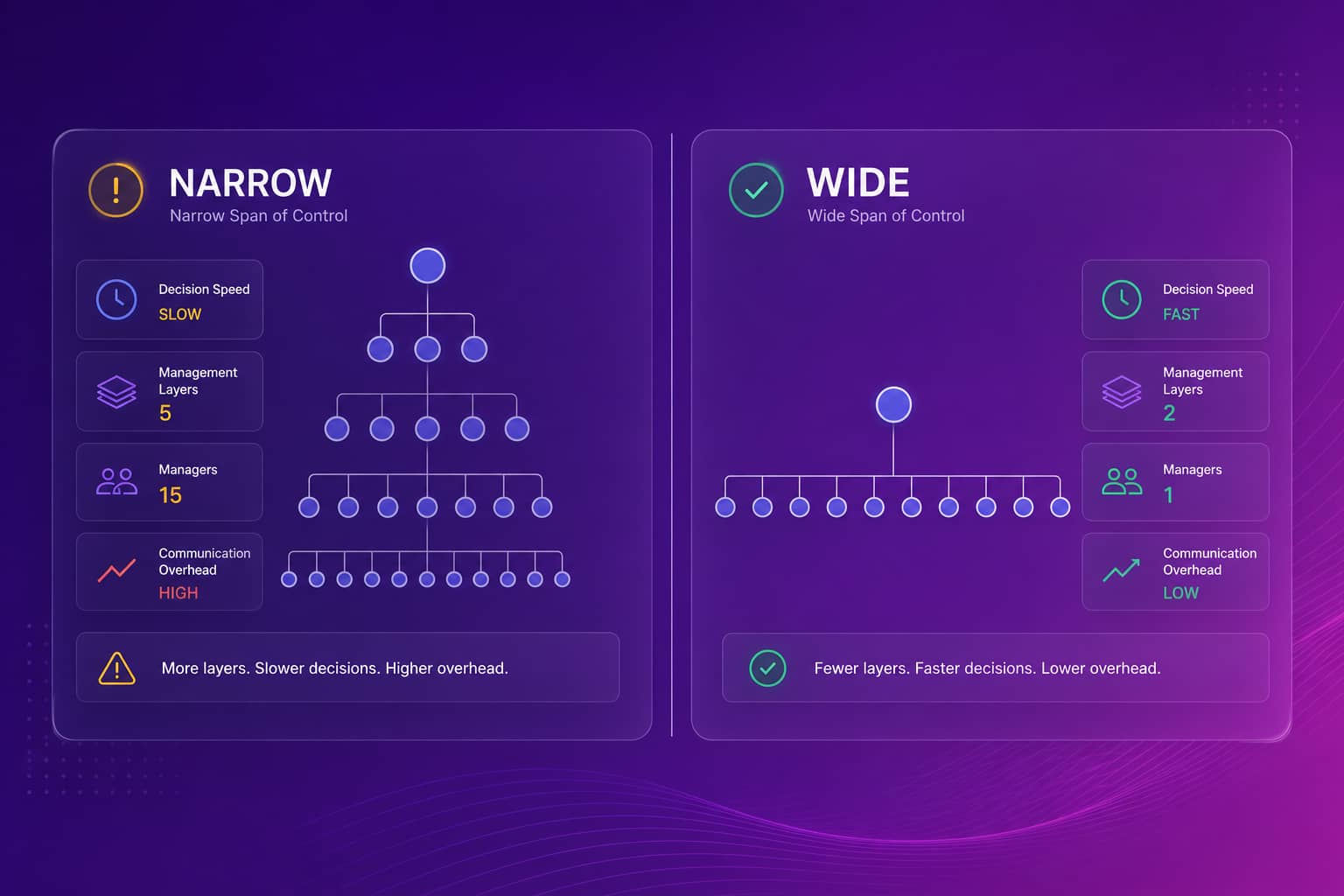
What is span of control in management?
Span of control is the number of employees who report directly to a single manager or supervisor. It is a structural choice that decides how tall or flat your organization is. A narrow span, say three or four reports per manager, produces a tall org with many layers and tight oversight. A wide span, ten or more reports, produces a flat org with fewer managers and faster decisions. The term traces back to early management theory and the military, where commanders needed a workable limit on how many units one person could direct. The same logic applies to a 200-person SaaS company. Every report you add to a manager divides their attention, and at some point the math stops working.
The concept matters because span of control quietly sets three things at once: how much you spend on management, how fast decisions move, and how much coaching each person receives. A COO who wants to cut cost reaches for wider spans. A VP of Engineering who wants tighter quality control reaches for narrower ones. Both are right in their context, and both are wrong if they pick the number without looking at what managers can actually handle.
How do you calculate span of control?
To calculate span of control, divide the total number of employees by the number of managers. If you have 120 employees and 20 managers, your average span of control is 6. For a single manager, you just count their direct reports. That gives you the ratio every org-design deck shows. The problem is that an average hides the outliers, so a healthy 6 can mask one manager carrying 14 reports while another carries 2.
A worked example makes it concrete. A 300-person company with 50 managers has an average span of 6, which looks fine. Break it down by team and you find the platform group runs spans of 11 while a newer product pod runs spans of 3. The first manager is drowning and the second is barely managing anyone. The average told you nothing useful.
This is why the raw ratio is a starting point, not an answer. You need to see the spread across teams, and then you need to weight each span by how much capacity that specific manager has left. A span of 8 is comfortable for a senior manager running a mature team and brutal for a new manager running a team mid-reorg.
What is a good span of control? Narrow vs wide
A good span of control for knowledge work usually falls between 5 and 9 direct reports, and the classic rule of seven still anchors a lot of org charts. That range is a guideline, not a target to force everyone into. The right number sits where a manager can still do the actual work of management: one-on-ones, coaching, unblocking, and reviewing output, on top of their own deliverables. Push past that and the title stays but the leadership stops.
Narrow and wide spans each buy you something and cost you something. The choice is a trade, and naming the trade out loud beats defaulting to whatever the last reorg left behind.
Narrow span (3-5 reports)
Wide span (8-12 reports)
The reason teams chase wider spans in 2026 is cost and speed. Flattening removes layers, and every layer you remove is a salary saved and a decision that moves faster. That instinct is sound, which is exactly why it is dangerous. Flattening without checking manager capacity is how you turn a clean org chart into a slow, burned-out team. The work on reducing middle management without losing performance covers how to expand spans deliberately instead of by blunt cut.
The factors that decide the right span of control
The right span of control depends on four factors more than any rule of thumb: task complexity, team maturity, manager workload, and how interdependent the work is. Complex, ambiguous work needs narrower spans because each report needs more of the manager's judgment. Routine, well-documented work supports wider spans because people can run without constant input. A senior team that has shipped together for years can sit under one manager at a 10 or 12. A team of new hires mid-migration cannot.
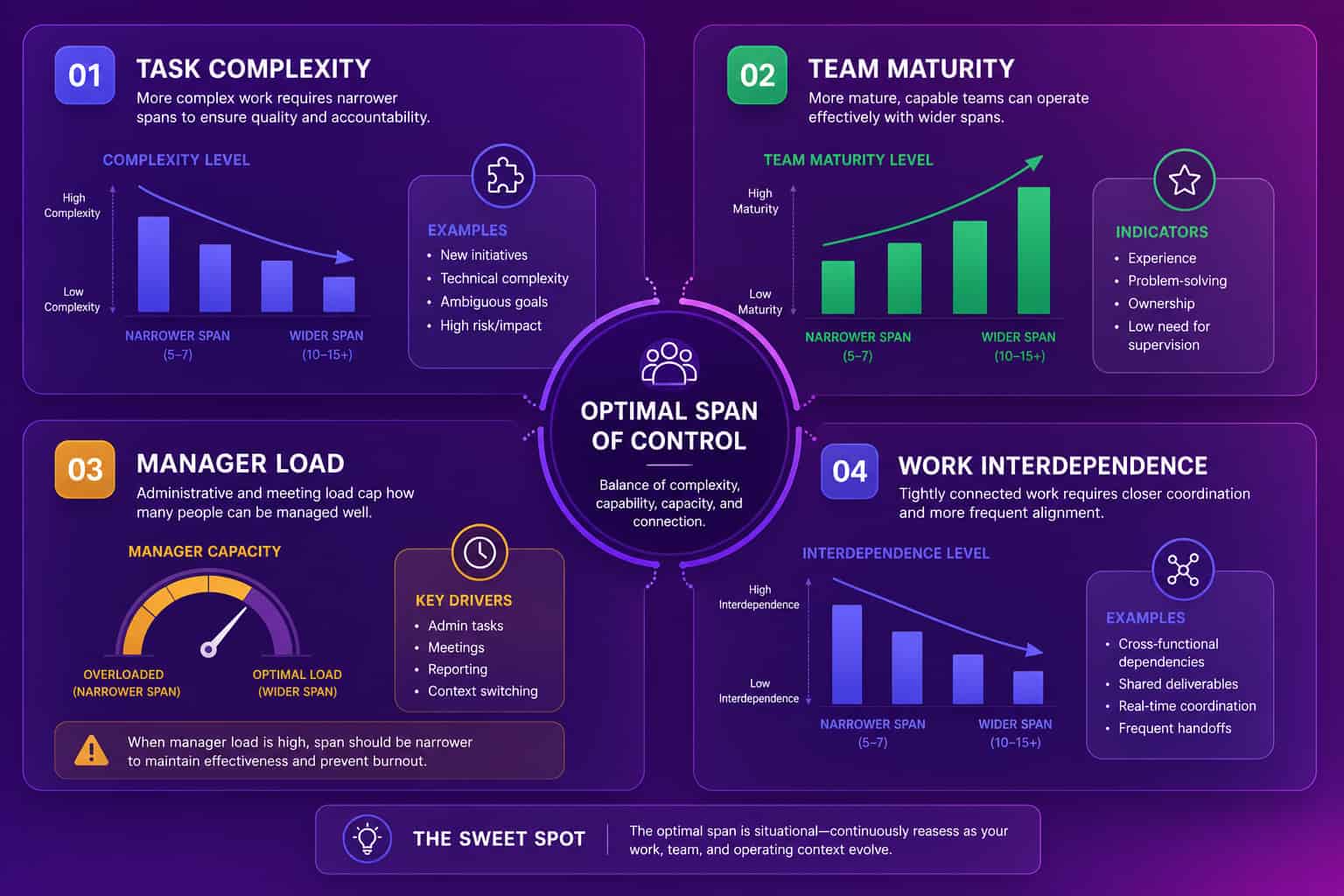
Manager workload is the factor everyone forgets. A manager is not a fixed container that holds N reports. Their real capacity changes with meeting load, the number of cross-functional projects they carry, and how much of their week is admin versus leadership. A manager buried in status meetings and reporting has far less room than the org chart assumes. Work interdependence is the fourth lever: tightly coupled work where one person's output blocks another needs closer coordination and a narrower span, while loosely coupled work scales wider. Get these four right and the ratio mostly takes care of itself. The capacity planning guide goes deeper on measuring the workload side.
Why the org chart gives you the wrong number
The org chart gives you the wrong span of control because it counts boxes and ignores load. A clean 1-to-7 ratio assumes every manager has the same capacity to lead seven people, and they do not. When we started Abloomify, I thought we were building software for managers. The longer we ship, the clearer it gets that most of a manager's week is admin in disguise: chasing updates, copy-pasting metrics into decks, turning meeting notes into action items, and digging across five tools to answer who is overloaded right now. A manager spending 25 hours a week on that has no real room for an eighth report, no matter what the ratio says.
This is where the cost of guessing shows up, and it is rarely on the management line you were trying to cut. It surfaces as capacity waste: teams that look fully staffed but ship slowly, managers too busy to catch disengagement, and quiet quitting that nobody sees until the resignation lands. For operations leaders, that hidden waste runs into the hundreds of thousands.
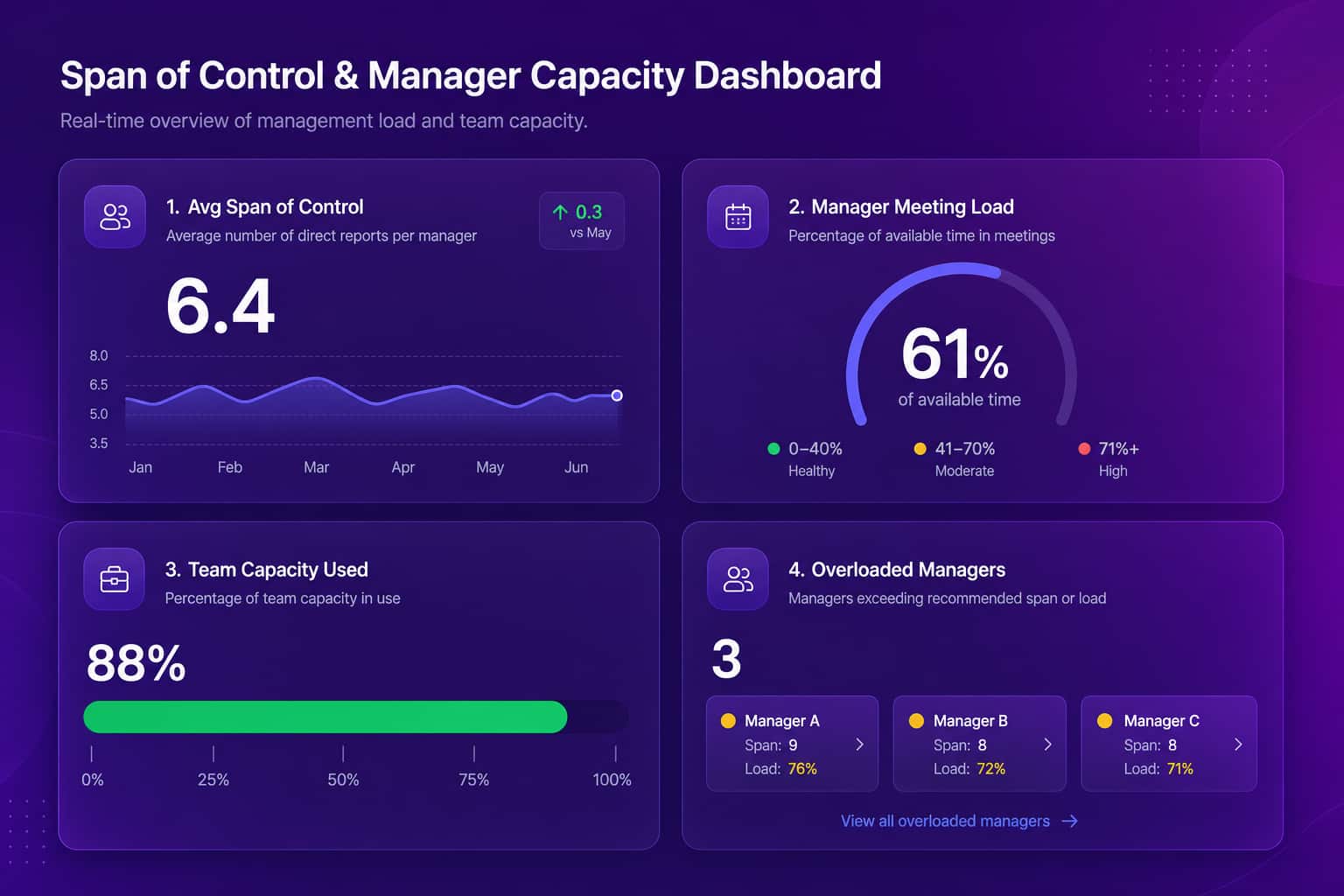
A better ratio will not fix this. What fixes it is pairing the ratio with evidence of what each manager actually has room for. That is a measurement problem, and it is solvable without surveillance.
How to set span of control with real work data
To set span of control with real data, start from the org structure and overlay each manager's actual capacity. Abloomify connects to your HRIS for the reporting lines and to your calendar, Jira, GitHub, and collaboration tools for the workload signals. You see the average span, the distribution across teams, and the part the org chart hides: meeting load per manager, coaching time, and whether each team's workload is balanced or lopsided. The data is PII-free by architecture, with no screenshots, no keyloggers, and no content capture, so you get the picture without the trust damage that monitoring tools cause.
From there, span decisions stop being guesses. You can see which managers have headroom to take on another report and which are already underwater, then move people accordingly instead of applying a flat ratio across the company. You can model a flattening before you commit to it, checking whether the managers who inherit wider spans actually have the capacity, or whether you are about to manufacture three new bottlenecks. The same signals feed workforce utilization and revenue per employee, so span of control connects to the metrics your board already tracks.
Span of control looks like an org-chart decision. It is really a capacity decision wearing an org-chart costume. Measure the capacity, and the right number stops being a debate.
FAQ
What is meant by span of control?
Span of control is the number of employees who report directly to a single manager. A narrow span means few direct reports and more management layers. A wide span means many direct reports and a flatter organization. It is one of the core levers in org design because it shapes cost, decision speed, and how much coaching each person gets.
What is the rule of 7 in span of control?
The rule of seven is a long-standing guideline that one manager can effectively oversee about seven direct reports. It comes from classic management theory and still anchors many org charts. Treat it as a starting point, not a law. The right number depends on task complexity, team experience, and how much real capacity the manager has after meetings and admin.
How do I calculate span of control?
Divide the total number of employees by the number of managers to get your average span of control. For one manager, count their direct reports. To get the real picture, pair that ratio with each manager's actual workload. Abloomify pulls org structure from your HRIS and updates the ratio automatically as teams change.
What is the ideal span of control for managers?
For knowledge work, 5 to 9 direct reports is a common healthy range. Experienced teams doing routine work support the higher end, while complex or junior teams need the lower end. There is no universal ideal. The best span is the one where the manager still has capacity to lead, not just to keep the lights on.
Does a wider span of control save money?
A wider span reduces management headcount and can speed decisions by removing layers. It only saves money if managers can still support their teams. Stretch spans too far and you trade visible management salary for invisible costs: slower delivery, burnout, and quiet quitting that nobody catches until people leave.

Amir Tavafi
Co-Founder & CEO
Product leader and innovator with over 15 years of experience in the tech sector, grounded in AI and robotics. Previously led product development in fraud detection and AI solutions at Nasdaq Verafin.