Revenue Per Employee: The Board Metric Your CEO Needs
April 6, 2026
Walter Write
3 min read

What is revenue per employee?
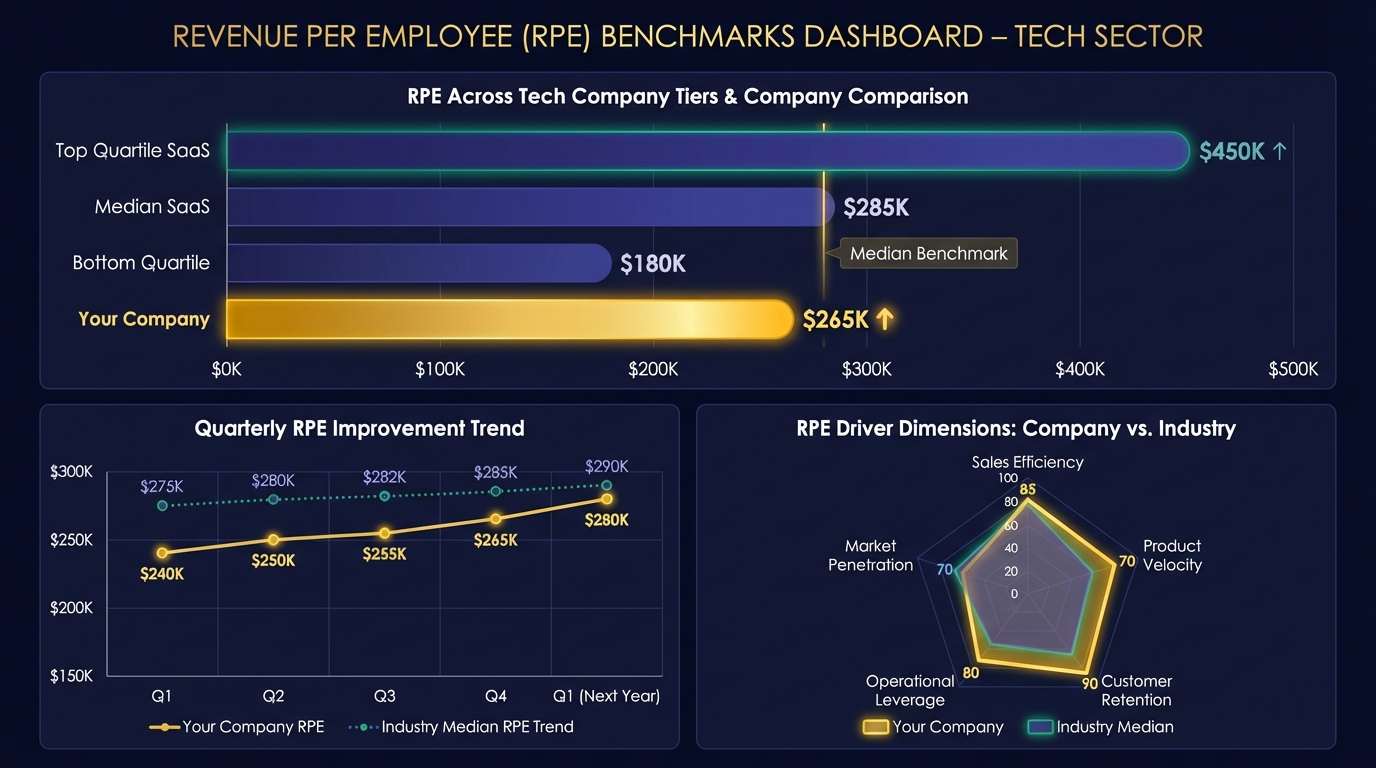
Revenue per employee (RPE) divides annual revenue by total headcount. It is the simplest measure of organizational productivity that boards and investors care about. A company doing $50M with 200 employees has an RPE of $250K. A company doing $50M with 500 employees has an RPE of $100K.
The second company has the same revenue but 2.5x the payroll cost. Boards notice.
Why RPE matters to your board
RPE tells investors whether you are scaling efficiently or just adding headcount. SaaS companies with best-in-class RPE ($350K+) are valued at 2-3x higher multiples than companies with $150K RPE, controlling for growth rate.
- Investors use RPE to benchmark you against peers in your vertical and stage.
- Declining RPE signals bloated operations and triggers restructuring conversations.
- Improving RPE shows the board that revenue is scaling faster than headcount.
RPE benchmarks by company stage
| Stage | Typical RPE | Best-in-Class RPE |
|---|---|---|
| Seed/Series A | $80K-$120K | $150K+ |
| Series B/C | $150K-$250K | $300K+ |
| Growth/Pre-IPO | $250K-$350K | $400K+ |
| Public SaaS | $300K-$500K | $600K+ |
How to improve RPE without cutting headcount
The fastest path to higher RPE is eliminating operational waste, not reducing staff.
Cut meeting waste ($250K+ per year for mid-market companies)
The average employee spends 40% of their week in meetings. Cutting 20% of meetings recovers a full day of deep work per person per week. That is capacity you are already paying for but not using.
Eliminate unused SaaS ($50K-$100K per year)
24% of SaaS licenses in a typical tech company are unused. Reclaiming them does not affect anyone's work because nobody is using them.
Improve delivery velocity
Faster cycle times mean more output from the same team. Reducing PR review bottlenecks and meeting overload typically improves throughput 20-30% without adding headcount.
Detect and fix capacity leaks
Context-switching, redundant workflows, and misallocated effort are invisible capacity drains. Workforce analytics makes them visible so you can fix them.
How Abloomify tracks RPE
Abloomify connects financial data with headcount and operational metrics to give CEOs a real-time RPE dashboard:
- RPE trend by quarter with department breakdown
- Headcount growth vs revenue growth correlation
- Capacity waste identification (meetings, unused tools, overhead)
- Scenario modeling: impact of hiring vs efficiency on RPE trajectory
- Same platform as performance management: Goals & OKRs, reviews, feedback, and surveys—so board efficiency metrics and people programs stay in one system
FAQ
How often should we track RPE?
Quarterly at minimum for board reporting. Abloomify provides real-time RPE tracking so you can see the impact of operational changes as they happen.
Should RPE always go up?
Not necessarily. RPE naturally dips after hiring surges (new employees take time to ramp). The key is the trend: is RPE recovering and improving after investment periods?
Can RPE be gamed?
Yes, by cutting headcount. That is why sophisticated boards look at RPE alongside retention, customer satisfaction, and delivery metrics. Abloomify provides the full picture.
What to read next

Walter Write
Staff Writer
Tech industry analyst and content strategist specializing in AI, productivity management, and workplace innovation. Passionate about helping organizations leverage technology for better team performance.