Software Asset Management in the SaaS Era (2026)
September 15, 2026
Amir Tavafi
11 min read

Software asset management (SAM) is the practice of tracking every piece of software a company pays for, who has access to it, and whether that access is actually earning its renewal. It's a 20-year-old IT discipline built for a world of shrink-wrapped licenses and compliance audits. Most of what a tech company wastes money on in 2026 isn't a compliance problem. It's 140 SaaS subscriptions and nobody who can say with a straight face which ones people still open.
Key Takeaways
Q: What is software asset management?
A: Software asset management is the discipline of knowing what software you own, who's using it, and whether the spend matches the value. Abloomify's version of it runs on 100+ API integrations reading usage signals directly from the tools themselves, no agent install required for the SaaS layer.
Q: Why do legacy SAM tools miss so much SaaS waste?
A: Tools like Flexera and ServiceNow SAM were built for on-prem license compliance, tracking entitlements against contracts. They're strong at that. They were never designed to answer "did anyone log into this tool in the last 30 days," which is the question that actually finds SaaS waste.
Q: How much can a company typically save?
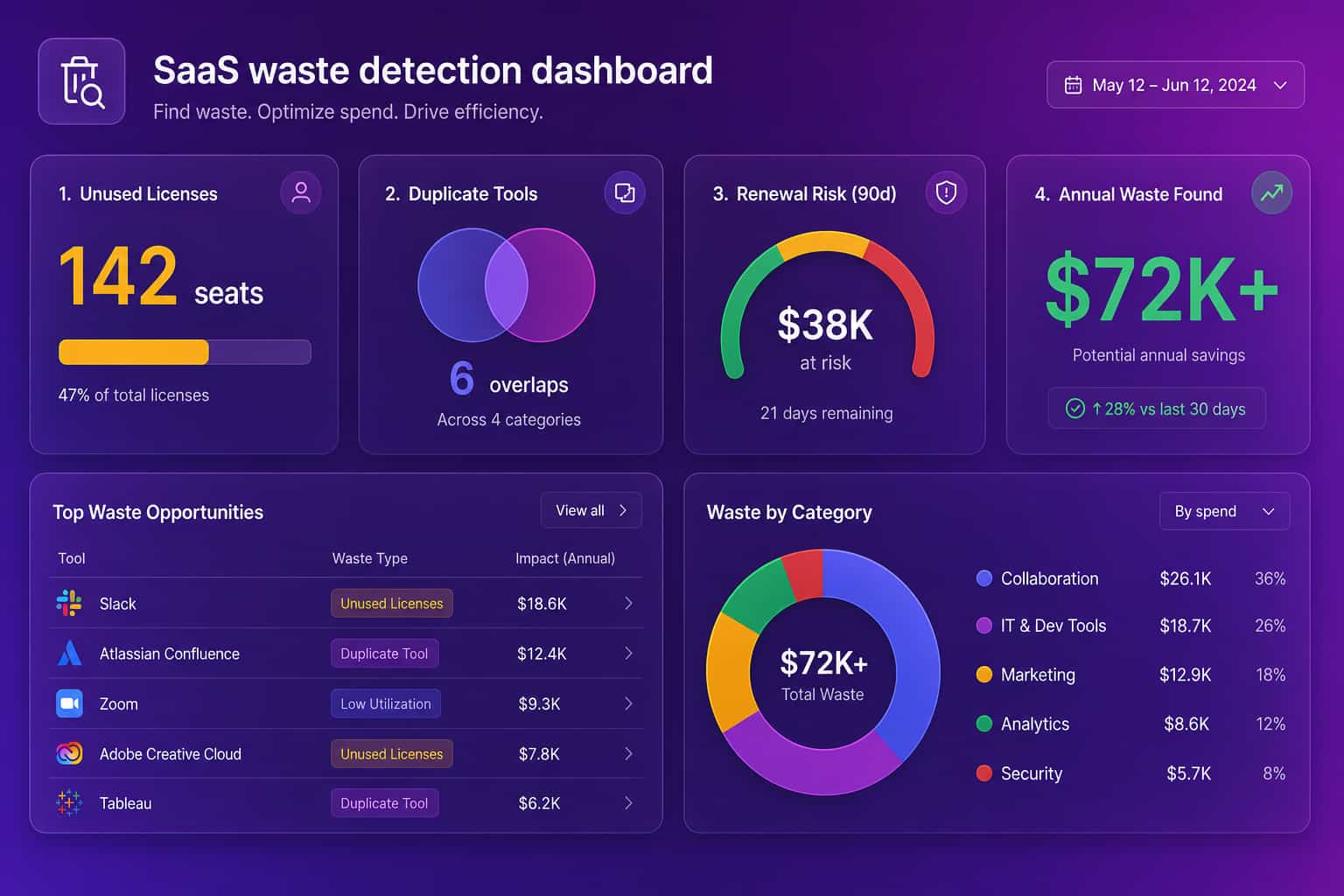
A: Abloomify has identified $50K to $100K a year in unused SaaS licenses at mid-size tech companies, and $72K+ in SaaS cost optimization for one customer through Bloomy, its AI Chief of Staff. The range depends on headcount and how stale the license list already is.
Q: Who should own software asset management at a tech company?
A: Usually IT or Operations, with the COO as the budget owner who actually cares about the renewal line. At Abloomify's own customers, the COO has been the champion on every SaaS-waste engagement, because it's their line item.
Q: Is this the same thing as employee monitoring?
A: No. Usage signals here come from API-level login and activity data inside the SaaS tools themselves, not screen recording, keyloggers, or content capture. It answers "is this seat active," not "what did this person type."
What Software Asset Management Actually Means
Software asset management is the process of maintaining an accurate inventory of every software asset a company has purchased or licensed, matching that inventory against actual usage, and using the gap to cut costs, reduce risk, and inform renewal decisions. The formal definition, the one you'll find on Gartner, IBM, and Flexera's glossary pages, ties it to compliance: making sure a company isn't under-licensed (legal exposure) or over-licensed (wasted spend) relative to its contracts. That's still true and still matters for large enterprise agreements with Microsoft, Oracle, or Adobe, where an audit can turn into a seven-figure true-up. But for a 50 to 500 person tech company running mostly SaaS, the compliance risk is small and the waste risk is enormous, because nobody signs a formal license agreement for a $12/seat/month tool a team picked up in a Slack thread eight months ago and forgot to cancel.
The practical version of SAM at a SaaS-native company looks less like an audit and more like a standing question: for every tool we pay for, is someone actually using it, and does the size of the contract match the size of the usage. That's a usage-data problem, not a contracts problem, and it's the specific gap Abloomify's SaaS license optimization capability is built to close.
Why Legacy SAM Tools Were Built for a World That's Gone
Big companies bring ceremony. Startups bring outcomes. That's not a knock on Flexera or ServiceNow, they're genuinely good at what they were built for: normalizing license entitlements across thousands of on-prem software titles and proving compliance to an auditor when a vendor comes asking. That world still exists at large enterprises running SAP, Oracle, and perpetual license agreements negotiated years in advance, with a legal team that reads the fine print before renewal season. It is not the world most 50 to 500 person tech companies live in anymore. Their software spend is 100+ SaaS subscriptions, most under $50/seat/month, purchased with a credit card by whichever team needed them, with no central contract to reconcile against and no audit clause anyone's ever invoked. Pointing a compliance-first SAM tool at that stack answers a question nobody's asking while missing the one that's actually costing money.
Running a traditional SAM tool against that stack is like hiring an auditor to count inventory in a store that restocks itself every week. The tool isn't wrong, it's aimed at the wrong problem. What a SaaS-era company actually needs is usage evidence: who logged in, how often, and whether that pattern justifies the renewal, pulled straight from the tools themselves through API integrations rather than reconstructed from a spreadsheet someone updates twice a year.
Where the Real Waste Hides in a Modern SaaS Stack
The first sentence of every SaaS waste conversation should be the same: the waste isn't in the tools you know about, it's in the ones nobody remembers signing up for. Duplicate tools in the same category (two project management apps, three meeting-recording tools) are the easiest to catch and the most common. Seats that were provisioned for a contractor or a hire who left and were never deprovisioned come next, quietly renewing on autopilot. Underused tiers, where a company pays for an enterprise plan's feature set but only ever touches the basics, are harder to see because the tool itself looks "in use," just not at the price being paid for it.
None of this shows up in a license compliance report, because compliance isn't the question. Usage is. That's the gap between what a legacy SAM platform tracks and what actually costs a growing tech company money every renewal cycle.
How to Actually Run Software Asset Management in 2026
A SaaS-era approach to software asset management starts from usage data, not a license spreadsheet, and works through four steps that don't require a formal audit cycle or a dedicated compliance team to run. The first is connecting to the tools themselves rather than trying to reconstruct a contract inventory from memory or a shared spreadsheet nobody's updated since the last renewal. The second is deciding in advance which usage patterns actually predict waste, so the review doesn't turn into scrolling a spreadsheet looking for something that feels wrong. The third ties the review to the calendar that matters, the renewal date, instead of a once-a-year audit that finds the waste months after the money's already gone. The fourth, and the one teams skip most often, is making sure the finding reaches whoever actually owns the budget line, not just an IT ticket queue where it sits until someone remembers to look:
- Connect the tools, not just the contracts. API integrations into Google Workspace, Microsoft 365, and the SaaS apps themselves surface real login and activity data. No agent install required for this layer.
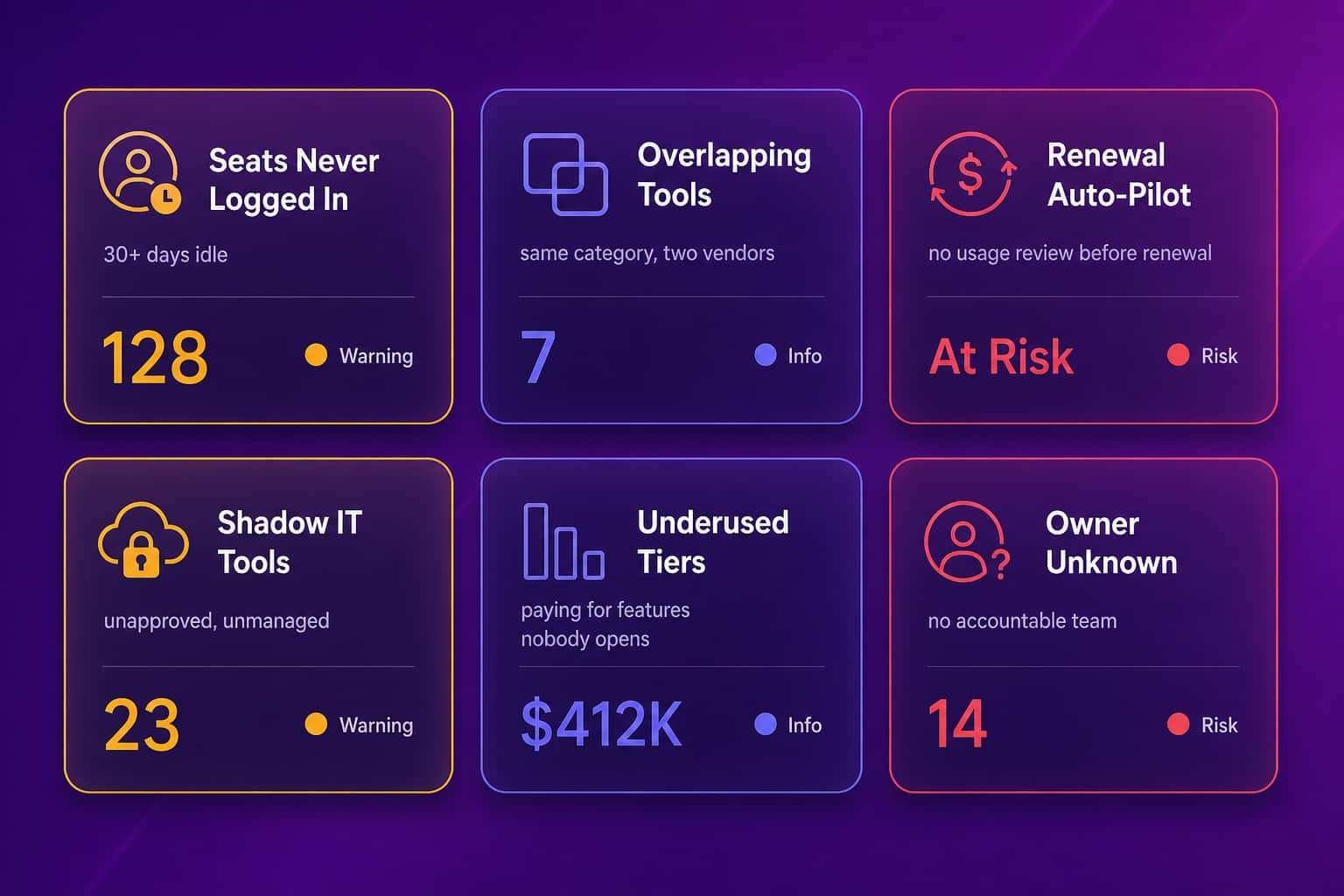
- Flag the signals that predict waste. Seats idle for 30+ days, overlapping tools in the same category, and licenses with no accountable owner are the three patterns worth automating an alert on.
- Tie the review to the renewal calendar, not a once-a-year audit. Waste compounds between audits. Reviewing usage in the weeks before a renewal, instead of after it auto-renews, is where the savings actually get captured.
- Give the finding to whoever owns the budget. At every Abloomify customer running this use case, the COO has been the one who acts on it, because it's their line item, not IT's project.
Legacy SAM (Flexera, ServiceNow SAM)
Abloomify
Software Asset Management vs SaaS Management Platforms vs Abloomify
Software asset management, SaaS management platforms (SMPs), and workforce intelligence platforms overlap in ways that make procurement conversations confusing. Traditional SAM tools focus on license compliance and entitlement tracking, usually for large, contract-heavy software estates. Pure-play SaaS management platforms focus narrowly on discovering and de-duplicating SaaS subscriptions, often through finance and SSO data. Abloomify sits in a different spot: SaaS license waste is one signal inside a broader privacy-first workforce intelligence platform, alongside capacity utilization, engineering velocity, and AI tool ROI, all pulled from the same 100+ API integrations. That combination matters because SaaS waste rarely shows up in isolation. A team paying for three overlapping project management tools is usually also the team with a capacity problem nobody's measured yet.
We are not trying to out-compliance Flexera or out-discover a pure SaaS management platform. The pitch is narrower and, we think, more useful for a 50 to 500 person tech company: connect once, see the SaaS waste alongside the capacity and engineering signals that explain why it happened, and skip the separate tool for each question. Bloomy, Abloomify's AI Chief of Staff, is the layer that turns the finding into a decision, surfacing the waste in a report instead of a dashboard someone has to remember to check.
How to Evaluate a Software Asset Management Approach for Your Company
Start by asking what problem you're actually solving, because the two problems software asset management gets asked to solve need genuinely different tools. A company with large enterprise on-prem agreements and a compliance audit on the calendar needs a tool built for entitlement tracking against contract terms, which is what Flexera, ServiceNow SAM, and similar platforms were designed to do well. A company whose software spend is 100+ SaaS subscriptions bought a la carte over three years, by different teams, with no master agreement to reconcile against, needs usage evidence instead: who's logging in, how often, and whether the seat count matches the contract. Most 50 to 500 person tech companies are the second kind and still default to shopping for tools built for the first, because that's what "software asset management" has meant for twenty years.
Ask any vendor two questions before signing: does this tell you who's actually logging in, not just who's licensed, and does it require installing something on every employee's device to get there. If the answer to the first is no, it won't find the waste. If the answer to the second is yes for basic SaaS usage, it's asking for more trust than the problem requires. This is usually a call for IT leaders or Operations, and the tool should fit the buyer, not the other way around. Fix the actual question, not the version of it that fit the tool you already had.
FAQ
What is software asset management?
Software asset management (SAM) is the practice of tracking what software a company owns, who has access to it, and whether that access is actually being used. It started as a compliance discipline for on-prem license audits. In a SaaS company, the harder problem is usage: knowing which of the 100+ tools you pay for are worth the renewal.
Is software asset management the same as IT asset management?
No. IT asset management (ITAM) covers everything the IT department tracks, hardware, devices, network equipment, and software. Software asset management is the software-specific slice of that: licenses, seats, subscriptions, and usage. Most tech companies today have more SAM problems than hardware problems.
How much does poor software asset management cost?
Abloomify has found $50K to $100K a year in unused SaaS licenses at mid-size tech companies, and identified $72K+ in SaaS cost optimization for one customer through its AI Chief of Staff. The number scales with headcount and how long it has been since anyone actually audited the stack.
Do I need a dedicated SAM tool, or can existing IT tools handle it?
Depends on what you're optimizing for. If you need software license compliance audits for enterprise on-prem agreements, a dedicated SAM platform like Flexera or ServiceNow SAM Pro is built for that. If your problem is "we pay for 140 SaaS tools and nobody knows which ones people still open," that's a usage question, not a compliance question, and it needs usage data from the tools themselves, not a license inventory.
Does software asset management require installing agents on every device?
No, not for the SaaS-usage half of the problem. API integrations into the tools themselves (Google Workspace, Microsoft 365, and the individual SaaS apps) surface login and usage data without touching an endpoint. Abloomify adds privacy-first device agents as an optional second layer, aggregated metrics only, no screenshots or keyloggers, for companies that also want app-usage visibility.

Amir Tavafi
Co-Founder & CEO
Product leader and innovator with over 15 years of experience in the tech sector, grounded in AI and robotics. Previously led product development in fraud detection and AI solutions at Nasdaq Verafin.