Presenteeism: What It Means and How to Spot It Without Surveillance
November 18, 2026
Amir Tavafi
12 min read

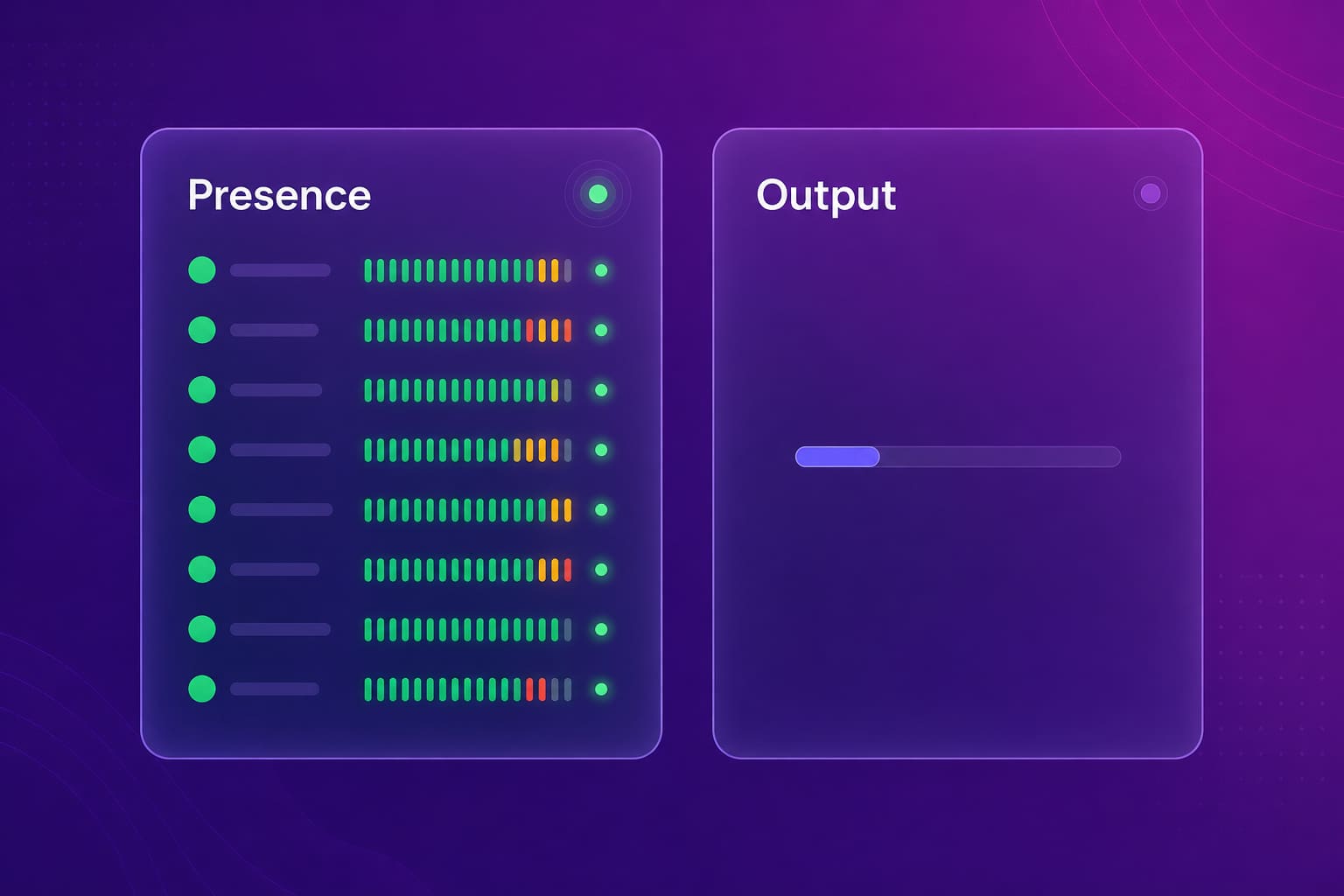
Presenteeism is the cost nobody puts on a dashboard: people who are at work, logged in, green on Slack, and running at half capacity. At Abloomify we build privacy-first workforce intelligence, and a lot of the COOs I talk to describe the same thing: everyone is online, and the work is not moving. That gap has a name. Here is what it means, why monitoring tools make it worse, and how to spot it from the work itself.
Key Takeaways
Q: What is presenteeism?
A: Presenteeism is working while you are not able to work well, because you are sick, exhausted, stressed, or stuck in a culture that rewards being seen. The person is present. Their normal output is not. It is the quiet opposite of absenteeism, and much harder to count.
Q: How is presenteeism different from absenteeism?
A: Absenteeism is missing work, so it shows up in your HRIS as sick days and unplanned leave. Presenteeism happens inside a perfect attendance record. That makes it invisible to headcount reports and to any tool that measures who is online.
Q: What causes presenteeism in the workplace?
A: The usual drivers are fear of falling behind, thin team coverage, a manager who praises long hours, unclear workload, and remote setups where being visibly online feels like proof of work. Illness and burnout supply the low capacity. Culture decides whether people stay logged in anyway.
Q: Do monitoring tools help with presenteeism?
A: They make it worse. ActivTrak-style activity scores reward visible busyness, which is the symptom. A Personnel Psychology meta-analysis found no evidence that monitoring improves performance, and 2026 survey research found 1 in 6 workers would quit over surveillance.
Q: How can you spot presenteeism without surveillance?
A: Read team-level work signals as trends: shrinking focus time, after-hours creep, rising review wait, heavier meeting load, and flat delivery next to full attendance. Abloomify pulls these PII-free from Jira, GitHub, calendars, and 100+ other tools, with no screenshots, keyloggers, or content capture.
What is presenteeism?
Presenteeism is the state of being at work, physically or digitally, while your capacity to do the job is reduced by illness, fatigue, stress, distraction, or personal strain, so you produce less, make more mistakes, or work slower than you would on a normal week, and nobody records it as lost time because you were technically there the whole day. That is the presenteeism definition most researchers use, and the measurement tools reflect it. The Stanford Presenteeism Scale, for example, asks people how much their health got in the way of finishing work, not whether they showed up.
I'd add one modern wrinkle. In a remote or hybrid company, "present" mostly means visible. A green dot, a fast Slack reply, a calendar packed with meetings. So presenteeism now comes in two flavours:
- Sick or depleted presenteeism: someone with the flu, a newborn, or six weeks of burnout grinding through the day at 50%.
- Performative presenteeism: someone whose capacity is fine but who spends a real chunk of it proving they are online, because that is what the culture rewards.
The first is a health and workload problem. The second is a management problem. Both look identical on an activity report, and both look like a perfect attendance record in your HRIS.
Presenteeism vs absenteeism: what is the difference?
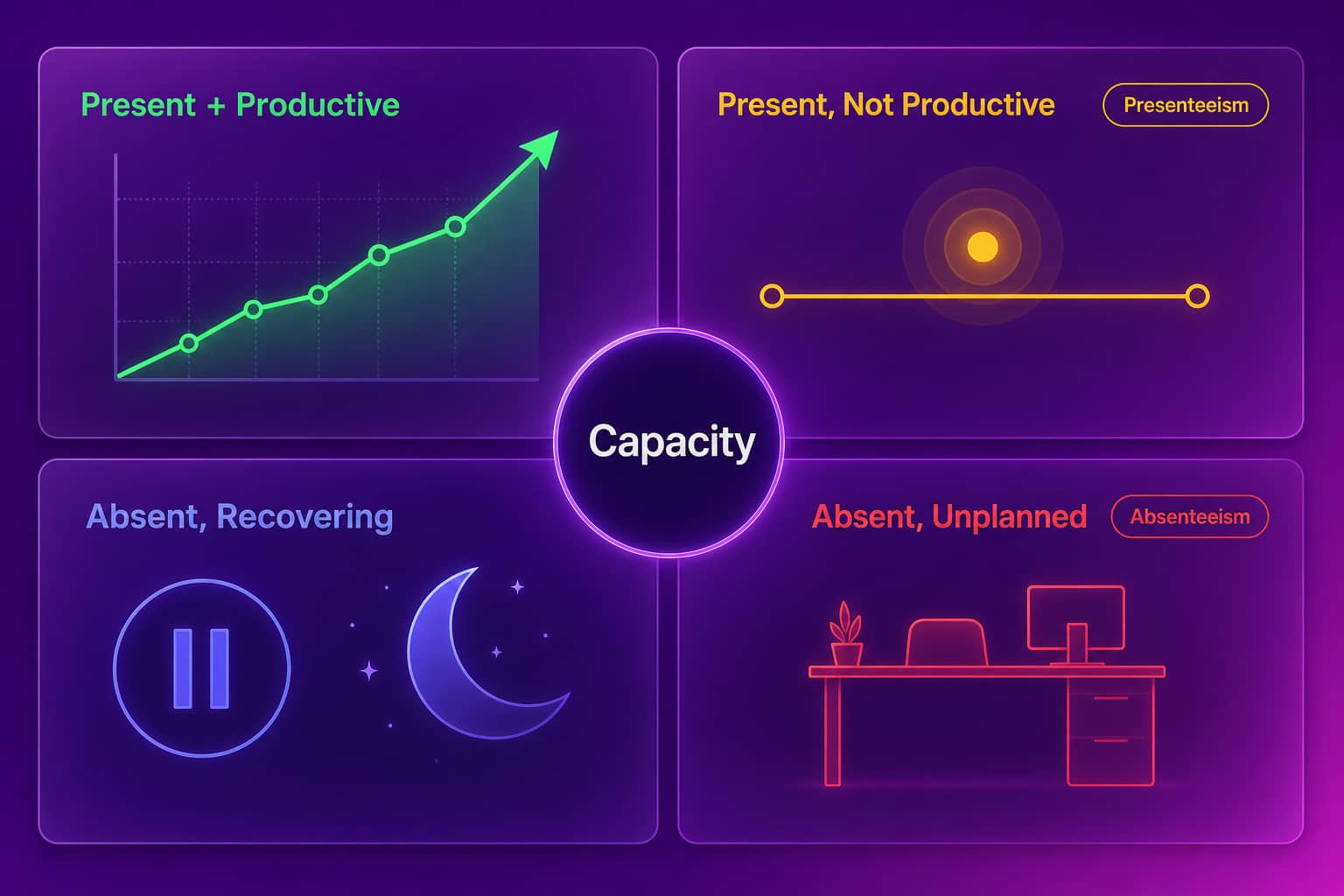
Presenteeism and absenteeism are two sides of the same lost capacity, with the difference being that absenteeism means the person is not at work and the loss is recorded as a sick day, unplanned leave, or a no-show, while presenteeism means the person is at work and the loss is not recorded anywhere, so it stays invisible to payroll, to the HRIS, and to most leadership reporting until it turns into a missed release, a resignation, or a long medical leave. Left alone long enough, presenteeism can turn into absenteeism anyway, in the form of a long leave or a resignation.
| Absenteeism | Presenteeism | |
|---|---|---|
| What happens | Employee does not come to work | Employee works with reduced capacity |
| Where it shows up | HRIS: sick days, unplanned leave | Nowhere by default |
| How leaders notice | Headcount gaps, coverage problems | Slipping delivery, quality issues, burnout |
| Typical driver | Illness, disengagement, personal events | Illness, fear, culture, overload |
| What monitoring tools see | An inactive device | A fully active device |
That bottom row is the whole problem with activity-based tools. They catch the absent person and give the depleted person a high score.
What causes presenteeism in the workplace?
Presenteeism in the workplace is almost always caused by a mix of low capacity and high pressure to look available, meaning someone is sick, burned out, or stretched across too much work, and at the same moment the team, the manager, or the company has signalled, often without saying it, that stepping away will cost them, whether through missed promotions, a pile of work waiting when they return, or a quiet reputation for not being committed. Take away either half and most presenteeism goes away. A sick person on a team with real coverage logs off. A healthy person in a culture that rewards outcomes stops performing busyness.
The causes I see most often at 100 to 500 person tech companies:
- Thin coverage. One person owns the deploy pipeline, the key customer, or the billing integration, so they cannot really take a day.
- Managers who praise hours. "Thanks for jumping on at 10pm" is meant kindly and teaches the whole team what gets noticed.
- Unclear workload. Nobody can see who is overloaded, so the people who are drowning look exactly like the people who are coasting.
- Remote visibility anxiety. When the only proof of work is being online, people stay online.
- Unused PTO that nobody tracks, so exhaustion compounds quietly for months.
Few of these are really about the employee. Most come from how the team and the work are set up.
Why monitoring tools make presenteeism worse
Employee monitoring tools make presenteeism worse because they measure presence, and presenteeism is a condition where presence is high and capacity is low, so a tool that scores keyboard activity, active screen time, and app usage will rate a depleted employee who grinds through the day as highly productive, while giving everyone a strong incentive to manufacture the very visible busyness that defines performative presenteeism in the first place. In other words, the software rewards the symptom you were trying to find.
The workarounds prove the point. We wrote about mouse jigglers separately, but the short version is that once a company scores activity, a segment of the team starts optimizing activity. Now you have a fake signal on top of the real problem.
This is also why I'm skeptical of "productivity scores" in general. Leaders under pressure want one number, and a single activity number is easy to compute. It just measures the wrong thing, and we go deeper on that in output vs outcome.
How do you measure presenteeism without surveillance?
You measure presenteeism without surveillance by reading team-level signals from the tools where work already happens, such as calendars, Jira, GitHub, and your HRIS, and watching them as trends over several weeks rather than snapshots of individuals, because presenteeism shows up as a pattern: focus time shrinking, after-hours work creeping up, review wait times rising, meeting load growing, and delivery going flat while attendance stays perfect. No screenshot or keystroke log adds anything to that picture. Surveys like the Stanford Presenteeism Scale are useful as a second lens, as long as people trust what happens to their answers.
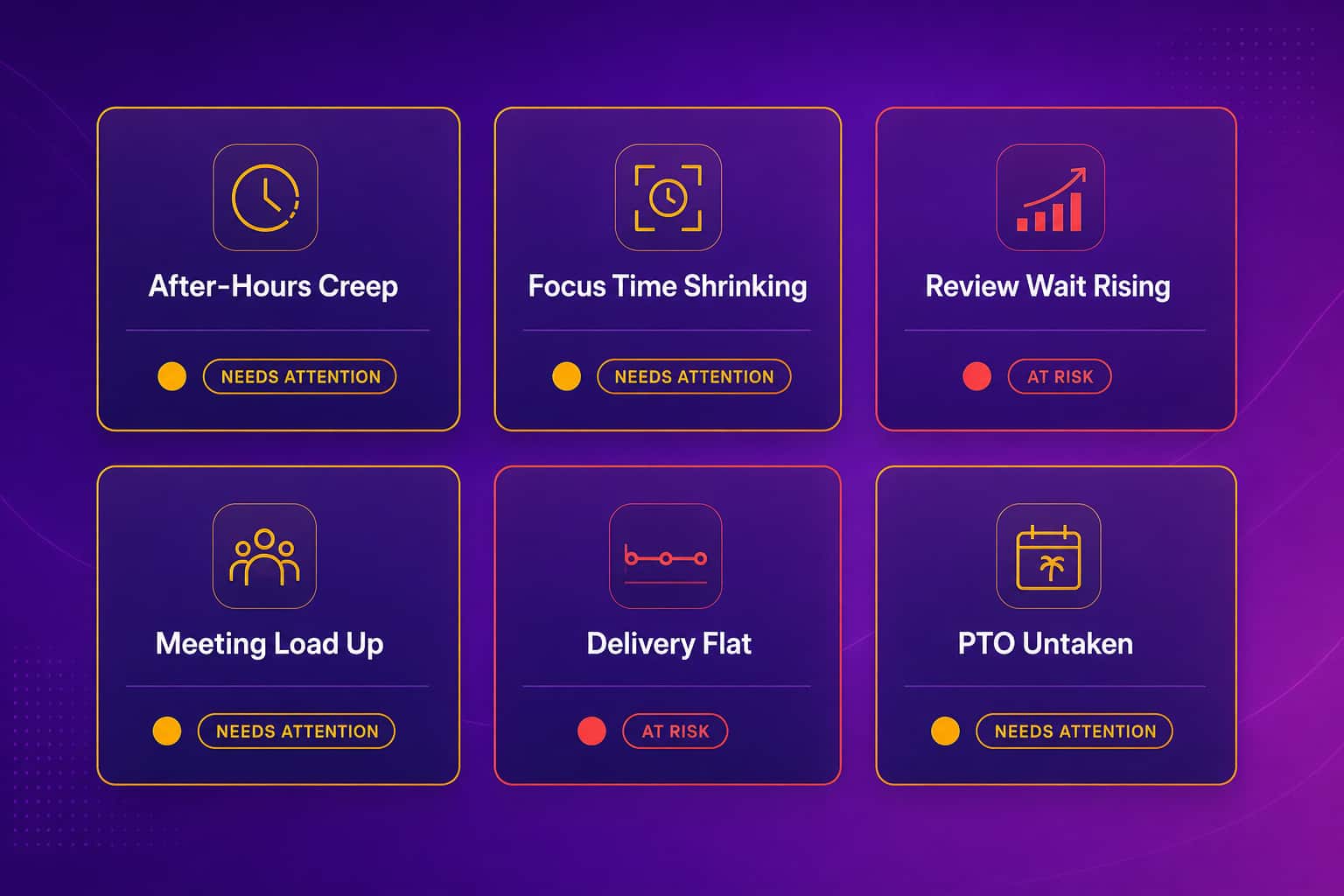
The signals worth watching, and where they come from:
| Signal | Source | What it can mean |
|---|---|---|
| After-hours work trending up | Calendar, Slack or Teams timestamps, Git commits | People catching up on a normal day's work at night |
| Focus hours shrinking | Calendar | Meetings crowding out the work itself |
| Time to first review rising | GitHub, GitLab, Bitbucket | Reviewers stretched, or quietly checked out |
| Delivery flat against plan | Jira, Linear | Capacity lower than attendance suggests |
| Meeting load climbing | Calendar | Being seen in meetings replacing doing |
| PTO not taken | HRIS, where tracked | Exhaustion building with no recovery |
One honest caveat from our own customers. A 3,500-person enterprise started with Google Workspace data alone, and the COO told us they were seeing low correlation with their internal performance metrics. Single-source data under-proves this kind of thing. Presenteeism only becomes readable when you combine collaboration patterns with delivery data, which is why Abloomify connects 100+ tools instead of leaning on one.
Abloomify reads these signals through API integrations, PII-free: no email content, no message content, no file content. Optional device agents report aggregated usage by application category and never take screenshots, log keystrokes, or record screens. Burnout and disengagement signals surface as proactive alerts, and a scheduled Bloomy brief can land in a manager's inbox every Monday with the teams whose patterns moved. If you want the burnout angle specifically, our burnout detection software page covers how those alerts work.
How to reduce presenteeism (what actually works)
Reducing presenteeism means making it safe and practical for people to work at their real capacity, which in practice comes down to fixing coverage so nobody is a single point of failure, changing what managers praise from hours to outcomes, making workload visible enough that overload gets caught before it turns into burnout, and taking away the incentive to look busy by retiring activity scores, so that a sick employee logs off and a healthy one stops spending energy on proving they are online. Wellness perks help at the margins, but they won't fix a team where resting gets you punished.
The steps I'd take, in order:
- Find the single points of failure. List the systems and customers that only one person can handle. Pair someone on each. Coverage is what lets a sick person actually stop.
- Change the praise. Have managers stop thanking people for late nights in public channels. Thank them for the shipped feature, the clean incident review, the customer save.
- Make workload visible at team level. Look at focus time, meeting load, after-hours trend, and delivery together for each team. The overloaded team and the coasting team look identical on attendance. They do not look identical here.
- Retire activity scores. If you run monitoring software, stop ranking people by active time. It is feeding the problem.
- Watch PTO. If a team has gone a quarter without anyone taking real time off, treat it as a risk signal before someone hands in a resignation.
- Review it monthly, not yearly. Presenteeism builds over weeks. An annual engagement survey finds it after the damage.
I'll admit the uncomfortable part. Some presenteeism is the company's fault and some of it is a person who has checked out and is running out the clock, which looks a lot like quiet quitting. From the outside those two can look the same for a while. Team-level data won't tell you which one you're looking at. It tells you where to have the conversation, and the manager has to do the rest.
Presence is cheap to measure. Capacity is what you actually pay for.
FAQ
What is presenteeism in simple terms?
Presenteeism is when someone is at work, logged in, and visibly online, but not able to do their job at their normal level. The usual reasons are illness, exhaustion, stress, or a culture that rewards looking busy. The person is there. The work is not getting done the way it would on a good week.
What is the difference between presenteeism and absenteeism?
Absenteeism is not showing up. Presenteeism is showing up without the capacity to perform. Absenteeism is easy to count because it lands in your HRIS as sick days and unplanned leave. Presenteeism hides inside full attendance records, which is why most companies underestimate it.
What are examples of presenteeism?
An engineer with the flu joining standup and pushing a half-tested fix. A manager answering Slack at 11pm all week while their own reviews stall. A team where nobody takes PTO because the last person who did came back to a pile of blame. Someone keeping their status green with a mouse jiggler while doing very little.
How do you measure presenteeism?
Researchers use self-report surveys like the Stanford Presenteeism Scale. Operationally, look at team-level work signals over time: focus hours shrinking, after-hours work creeping up, review wait times rising, and delivery flattening while attendance stays perfect. Abloomify reads these from tools like Jira, GitHub, and calendars through API integrations, PII-free, with no screenshots or keyloggers.
Does employee monitoring software reduce presenteeism?
No. Monitoring tools measure presence, which is the exact thing presenteeism inflates. Activity scores reward people for staying visibly busy, so they push the behaviour up. A Personnel Psychology meta-analysis found no evidence that monitoring improves performance, and 2026 survey research found 1 in 6 workers would quit over surveillance.

Amir Tavafi
Co-Founder & CEO
Product leader and innovator with over 15 years of experience in the tech sector, grounded in AI and robotics. Previously led product development in fraud detection and AI solutions at Nasdaq Verafin.