Quiet Quitting Meaning: What the Term Actually Describes
September 4, 2026
Amir Tavafi
12 min read

Quiet quitting meaning, in plain terms: doing your job as described and nothing beyond it, without announcing you've stopped going the extra mile. That definition is accurate and mostly useless. After watching companies chase the term, including one of Abloomify's own customers who used it as a cold-email hook that actually closed a deal, the real question isn't what the phrase means. It's whether you can tell the difference between a boundary and a warning sign.
Key Takeaways
Q: What does quiet quitting actually mean?
A: Quiet quitting means an employee does the job they were hired for and stops doing unpaid extra: staying late, covering gaps, chasing "above and beyond." It isn't the same as low performance. The harder problem, and the one this article focuses on, is telling boundary-setting apart from genuine disengagement before it costs a team its best people.
Q: Is quiet quitting the same as being lazy or a bad employee?
A: No. Someone quiet quitting still meets their job description; they've just stopped volunteering unpaid extra hours or emotional investment. Confusing that with poor performance is how managers misread a boundary as a problem, then damage trust by scrutinizing people who were never underperforming to begin with.
Q: How do you detect quiet quitting without spying on employees?
A: You look at patterns across the tools people already use, GitHub, Jira, calendars, Google Workspace or Microsoft 365, instead of screens or keystrokes. Abloomify does this with 100+ PII-free integrations plus optional device agents that measure aggregated activity, never content, screenshots, or keystrokes.
Q: What does quiet quitting cost a company?
A: Hidden workforce waste, including quiet quitters and over-employed staff nobody has flagged, runs $500,000 to $2 million a year at a typical 100 to 500 person tech company. That number stays invisible until someone connects work-pattern data across tools instead of relying on manager gut feel.
Q: Is quiet quitting the same as burnout?
A: No, and conflating them leads to the wrong fix. Burnout is exhaustion from doing too much; quiet quitting is often a rational response to doing exactly enough. Abloomify is built to detect burnout signals as early as 60+ days before they show up in a resignation letter, a different pattern entirely.
What Does "Quiet Quitting" Actually Mean?
Quiet quitting means an employee keeps doing their actual job, the tasks in the job description and the outcomes they were hired to deliver, while stopping the unpaid extras that used to be assumed: staying late without being asked, answering messages on weekends, volunteering for the project nobody wanted, treating the job as an identity instead of a transaction. The phrase went viral in 2022 as a pushback against hustle culture, but the underlying behavior predates the term by decades; it used to just get called "work to rule" or, less charitably, "coasting." What makes the current wave different is scale: enough people are doing it at once, in remote and hybrid teams where managers already have less visibility, that it registers as a workforce trend instead of one disengaged employee. That scale is also why the definition matters more than it used to. A manager who mislabels a boundary as a performance problem risks alienating someone who is, by every measurable output, still doing the job.
That's the dictionary version. It's accurate, and it's also the version every HR blog already has. It stops short of the part that actually matters to a company trying to do something about it: knowing which of your people are doing this, and why.
Where the Term Came From
The phrase "quiet quitting" spread from a TikTok video posted in July 2022, which reframed the old idea of doing only what you're paid for as a quiet rebellion against always-on work culture. That framing landed right as burnout, the Great Resignation, and return-to-office fights were already dominating HR conversations, so the term absorbed all of it: exhaustion, resentment, generational friction over hustle culture, and plain disengagement got folded into one catchy phrase that meant something slightly different to whoever was using it. Employers heard "employees checking out." Employees heard "finally naming the unpaid labor I was always expected to do for free." Gallup picked it up in its workplace research and turned it into an annual talking point. Neither read is wrong, which is exactly the problem: a term flexible enough to mean both things isn't precise enough to build a management response on.
That ambiguity is why so much of the coverage stops at definition. This one won't, because a definition doesn't tell you what to do on a Tuesday when a normally responsive engineer stops showing up in code review.
Quiet Quitting vs. Burnout vs. Actual Disengagement
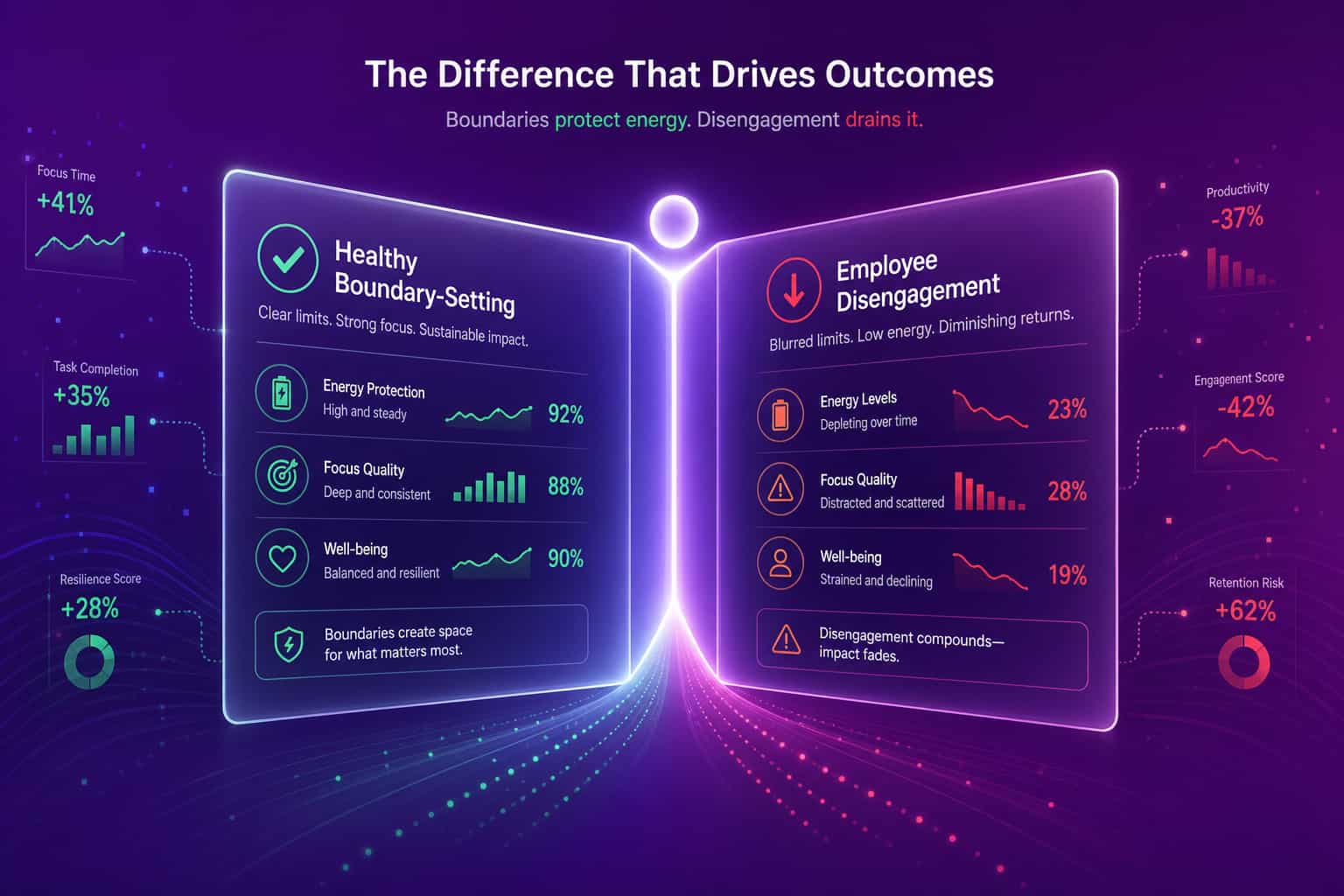
Quiet quitting, burnout, and disengagement get used interchangeably, and treating them as one problem guarantees the wrong fix. Burnout is what happens when someone has been doing too much for too long and their capacity collapses, usually visible in falling output, more mistakes, and a withdrawal that looks sudden even though it built for months. Quiet quitting is closer to a boundary: an employee deciding to do exactly what the role requires and not one task more, which can be a healthy correction after years of scope creep. Disengagement is the broader, more dangerous category: someone who has mentally checked out of caring whether the company succeeds at all, regardless of how many hours they log. A manager who sees an engineer decline three optional projects in a row could be looking at any of the three, and the intervention for each is almost opposite: burnout needs workload relief, a boundary needs respect, disengagement needs a direct conversation about whether the person still wants to be there.
Here's a rougher way to think about it, from watching this pattern across teams for a while: in any group, a small slice does exceptional work, a bigger slice does solid, dependable work, and a meaningful chunk is coasting, not because they're bad people but because coasting has rarely been visibly costly before. That distribution isn't new. What's new is that AI tools and remote work have made the gap between the top and the bottom of it measurable for the first time, which is exactly why "quiet quitting" feels like a bigger deal in 2026 than it did in past decades. It was always there. Now it shows up in the data.
What Quiet Quitting Actually Costs (When It's Real)
When quiet quitting is genuine disengagement rather than a healthy boundary, it shows up as invisible workforce waste: quiet quitters whose output has quietly shrunk, over-employed staff moonlighting on a second job, and capacity gaps nobody has mapped. At a typical 100 to 500 person tech company, that hidden waste runs $500,000 to $2 million a year, a number that stays hidden precisely because it doesn't show up as a line item, a resignation, or a complaint. It shows up as slightly slower delivery, slightly more meetings that don't need everyone in them, and a slightly longer PR cycle that nobody flags because nothing is technically broken. Companies that go looking for it with spreadsheets or manager instinct find some of it. Companies that connect actual work signals, like GitHub activity, calendar load, and collaboration patterns, tend to find the rest, which is the core of what Abloomify builds for operations leaders.
The instinct once you suspect quiet quitting is to watch more closely: screenshots, keyloggers, activity trackers. That instinct usually backfires. There's no evidence monitoring improves performance (a Personnel Psychology meta-analysis found none), and 1 in 6 workers say they'd quit a job over invasive surveillance. You can spend real money finding out that your fix cost you people who weren't quiet quitting at all.
How to Spot It Without Spying
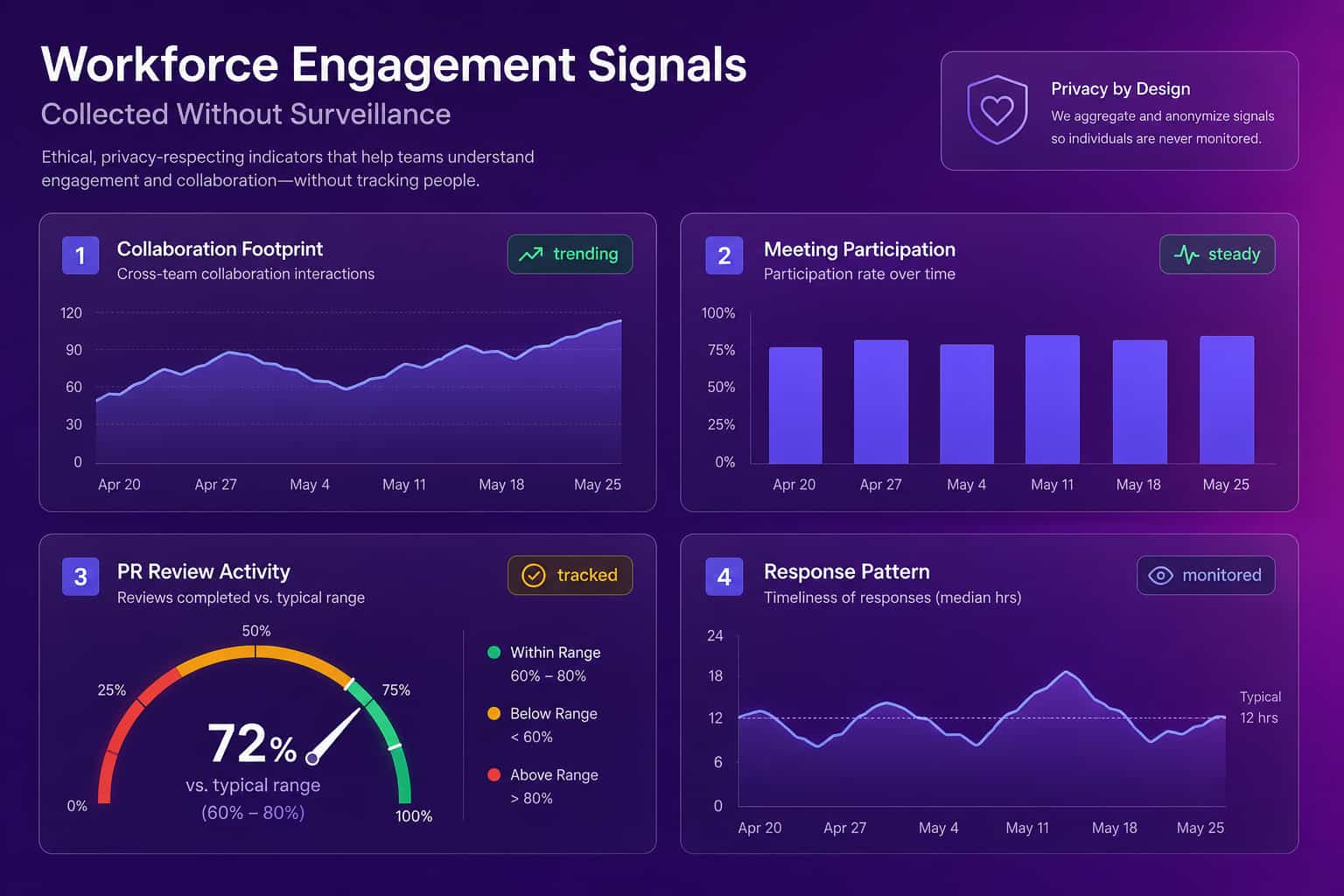
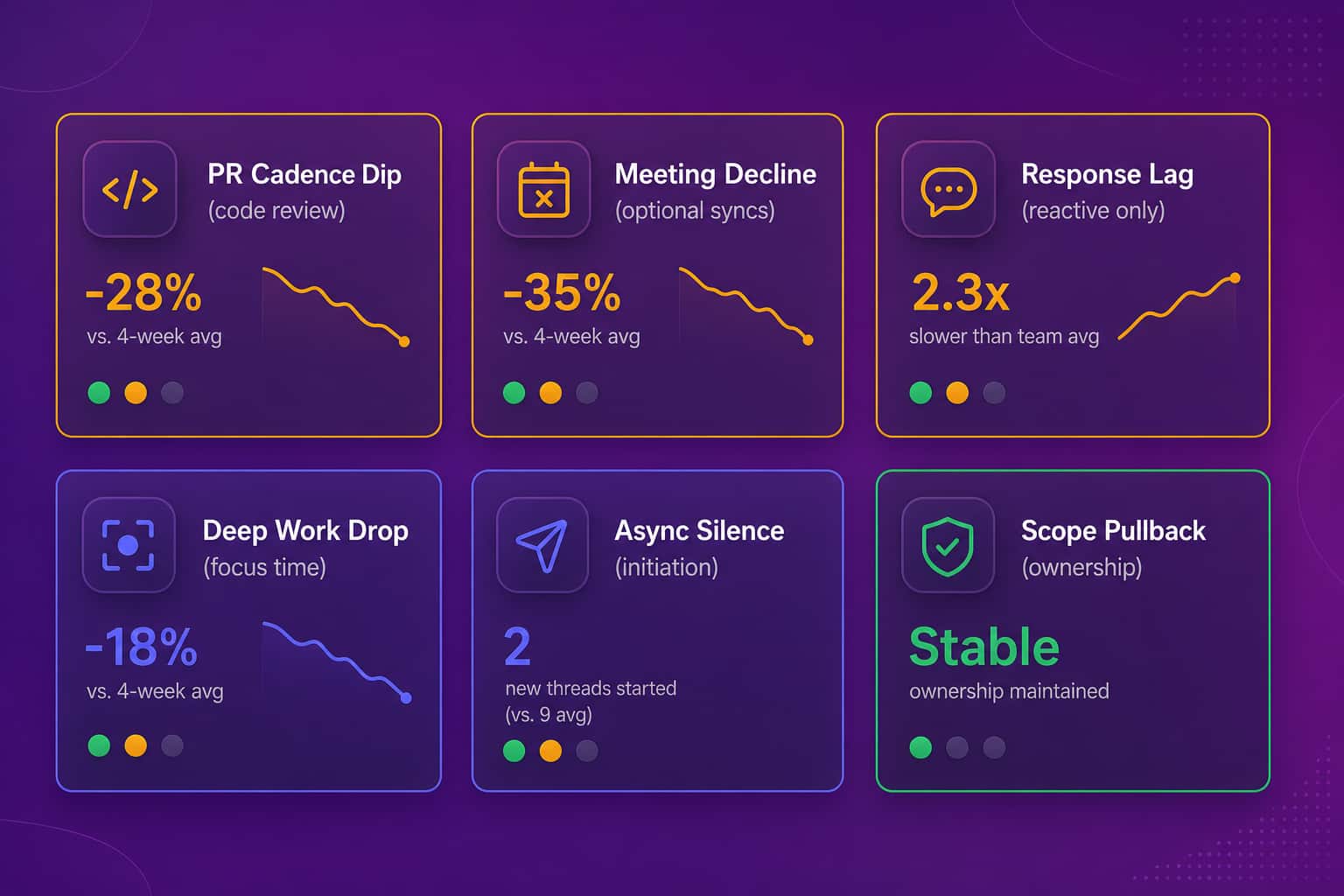
Detecting quiet quitting without surveillance means watching patterns across the tools someone already uses for work, not the screen they're looking at, which in practice means tracking change over time rather than one-time snapshots: a drop in GitHub PR activity or code review participation, a shift from proactive Slack or email initiation to purely reactive replies, declining attendance in optional meetings paired with unchanged attendance in mandatory ones, a Google Workspace or Microsoft 365 collaboration footprint that used to span five projects and now touches one, and calendar load that used to include mentoring or cross-team syncs and no longer does. None of that requires reading anyone's messages, watching their screen, or logging their keystrokes. It requires connecting signals that already exist across the tools a company runs, which is the architectural difference between workforce intelligence and monitoring: one triangulates PII-free signals from systems of record, the other watches a person.
The signals worth tracking, in practice, tend to fall into five buckets:
- Code and delivery: fewer PRs opened or reviewed, longer time to first review, more self-merges
- Meeting behavior: optional syncs skipped while mandatory ones stay attended
- Collaboration footprint: fewer tools or projects touched across Google Workspace, Microsoft 365, Jira
- Response pattern: initiation drops, replies stay reactive-only
- Ownership: no new projects volunteered for, existing scope quietly narrowing
This is the wedge Abloomify was built on. 100+ API integrations pull PII-free signals from Google Workspace, Microsoft 365, GitHub, Jira, and CRM tools: no email content, no message content, no files. Optional device agents add aggregated usage metrics, productive time by application category, without screenshots, keyloggers, or screen recording. The combination gives you the visibility a monitoring tool promises without the trust damage, which is also why burnout and engagement detection built for HR leaders leans on the same architecture. If you want to see how this plays out for the "how to spot it" side specifically, we wrote a companion piece on spotting quiet quitting without invasive monitoring.
What Leaders Should Actually Do About It
Once you've confirmed a pattern looks like quiet quitting rather than a one-off busy month, the right response depends on whether it's a boundary or a warning sign, and the fastest way to tell the difference without guessing is a direct, non-accusatory conversation grounded in the actual pattern you observed, not a vague "you seem checked out": ask about workload, ask what changed, ask whether the role still fits what the person signed up for, and treat the answer as information rather than a performance write-up waiting to happen. If it's a boundary, respect it and adjust expectations instead of quietly resenting someone for doing their job. If it's disengagement, the fix is almost never more oversight. It's usually a conversation about scope, growth, or an honest exit that saves both sides a slow, expensive drift toward resignation. You can run your own numbers on what turnover would cost before that conversation, so you're negotiating from data instead of a hunch.
Most companies choose a third option: do nothing, hope it passes, and watch the pattern spread to whoever sits next to the disengaged person. Ignoring the signal is a decision too. It's just a worse one.
FAQ
What's the difference between quiet quitting and quiet firing?
Quiet quitting is an employee choice: doing the job as defined and no more. Quiet firing is the employer mirror version, withholding raises, promotions, or interesting work until someone leaves on their own. Both get mistaken for one bad month when what is actually happening is a slow, deliberate pullback on one side of the relationship.
Is quiet quitting a real productivity problem or just a media trend?
Both, depending on the person. For some employees it's a healthy correction to unpaid overwork. For others it's early-stage disengagement that, left alone, becomes attrition. Hidden workforce waste, including both patterns, runs an estimated $500,000 to $2 million a year at a typical 100 to 500 person tech company.
Can you fix quiet quitting with more employee monitoring?
No. There's no evidence monitoring improves performance, per a Personnel Psychology meta-analysis, and 1 in 6 workers say they'd quit over invasive surveillance. Screenshots and keyloggers tend to punish engaged employees while pushing away the people you were trying to keep.
How is quiet quitting different from burnout?
Burnout is exhaustion from doing too much for too long. Quiet quitting is often the opposite: a deliberate scaling back to exactly what the job requires. Abloomify is built to flag burnout signals 60+ days before they'd otherwise surface, using a different pattern than disengagement detection.
What should a manager do if they suspect an employee is quiet quitting?
Have a direct, non-accusatory conversation about workload and fit before assuming the worst. Ground it in a real pattern, like declining participation or shifted collaboration, rather than a feeling. Abloomify surfaces those patterns from tools like GitHub, Jira, and Google Workspace, without reading anyone's messages or content.

Amir Tavafi
Co-Founder & CEO
Product leader and innovator with over 15 years of experience in the tech sector, grounded in AI and robotics. Previously led product development in fraud detection and AI solutions at Nasdaq Verafin.