Output vs Outcome: What the Difference Really Costs (2026)
July 31, 2026
Amir Tavafi
11 min read

Output vs outcome is the gap between what your team did and what it changed. Output is the commit, the closed ticket, the hour logged. Outcome is the release that cut lead time, the capacity you got back, the revenue per head that finally moved. Most workforce and engineering tools count output because it is easy to count. Abloomify was built to measure outcomes, because that is the only thing your board actually pays for.
Key Takeaways
Q: What is the difference between output and outcome?
A: Output is the activity a team produces: commits, tickets, hours, documents. Outcome is the change that activity creates: faster delivery, recovered capacity, lower turnover, real ROI. A team can post huge output and near-zero outcome. Leaders are paid for outcomes, not motion.
Q: Why does output vs outcome matter for measuring productivity?
A: Because most tools measure output and call it productivity. Screen-time monitors, story-point burndowns, and activity dashboards all count motion. Abloomify measures outcomes instead: delivery health, capacity utilization, and AI tool ROI, so the number on the dashboard matches the result on the P&L.
Q: What is an example of output vs outcome in engineering?
A: Merging 40 pull requests is output. Cutting PR cycle time in half and shipping the release a sprint early is the outcome. Abloomify computes all four DORA metrics straight from GitHub, so engineering leaders see delivery outcomes, not just commit volume.
Q: How do you measure outcomes without surveillance?
A: Use work signals, not screenshots. Abloomify is privacy-first and PII-free by architecture: 100+ API integrations plus optional device agents that collect aggregated metrics, with no keyloggers or screen recording. You get outcome visibility without the employee trust damage monitoring tools cause.
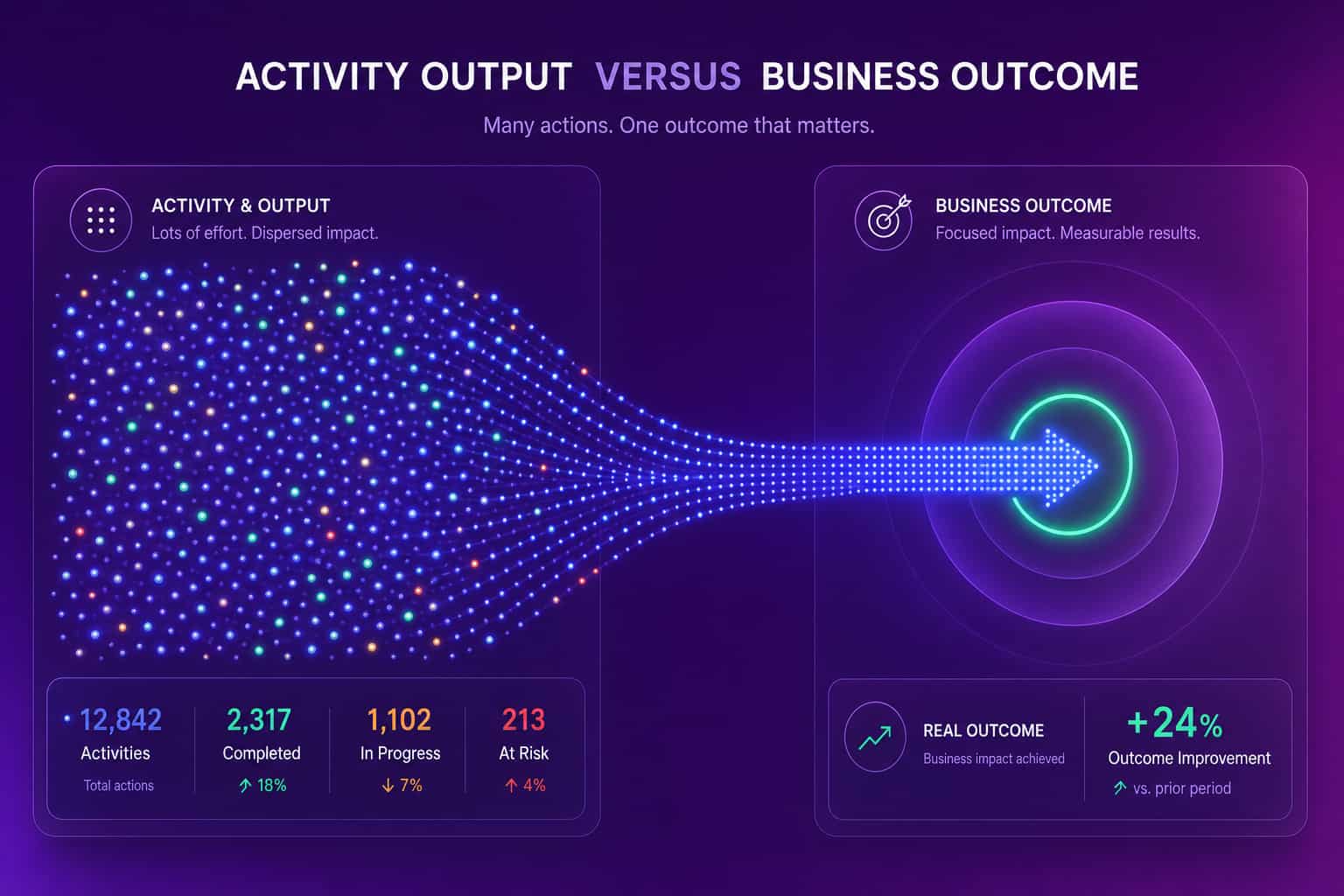
What is the difference between output and outcome?
Output is what a team produces. Outcome is the change that production causes. Output is the pull request, the support ticket you closed, the deck you built, the hour you logged. Outcome is the thing that is now different because the work happened: a release that shipped early, a churn number that dropped, capacity you can redeploy, a cost you removed. The two get confused because output is visible and countable and outcome usually is not, at least not without connecting the work to a result. So teams optimize the thing they can see. You end up with a quarter full of activity and a leadership team that still cannot answer whether any of it moved the business. Output is cheap. Outcome is what you were actually hired to deliver.
It helps to add a third rung. Output, outcome, and impact form a ladder from activity to lasting result.
| Level | Question it answers | Example | How easy to measure |
|---|---|---|---|
| Output | What did we produce? | 40 pull requests merged, 120 tickets closed | Easy, and often misleading |
| Outcome | What changed because of it? | PR cycle time halved, release shipped a sprint early | Harder, requires connecting work to results |
| Impact | What did it mean for the business? | Permanent cost advantage, higher revenue per employee | Hardest, shows up over quarters |
Most dashboards stop at the first row. The whole point of workforce intelligence is to climb to the second and third.
Why output vs outcome trips up most teams
Output is easy to fake and easy to inflate, which is exactly why it wins by default. When you started measuring your team, you probably reached for whatever was already counted: hours, tickets, commits, screen time. None of those require a definition of success. They just accumulate. The trouble is that busy and productive look identical on an activity chart. Someone can spend a week chasing updates, copy-pasting metrics into decks, and filling review forms with things everyone already knew, and their output line will look healthy. The outcome line, if you had one, would be flat. I have watched this happen inside my own company on the weeks where it felt like we were only putting out small fires. High output, and you have to stop and ask what actually changed.
The monitoring industry sells this confusion as a feature. Install an agent, watch the activity, feel in control. But there is no evidence it works.
The deeper problem is incentive. When output is the metric, people produce output. Engineers open more PRs and make them smaller to game the count. Reps log more calls that go nowhere. Managers manufacture activity for the dashboard. You get more motion and no more results, and you have quietly taught the whole team that motion is the job.
Output vs outcome in engineering: DORA, not commit counts
In engineering the output-outcome gap is measurable, which is why it is the best place to fix it first. Commit counts, lines of code, and story points burned are pure output. They tell you a team was busy. They do not tell you whether software got to customers faster or more safely. The outcome metrics are the four DORA measures: deployment frequency, lead time for changes, change failure rate, and time to restore service. Those describe delivery, not activity. Abloomify computes all four straight from GitHub, bands each one Elite to Low, and detects change failures automatically from failed deploys and reverts. On top of that it reads PR flow, cycle time, time to first review, review health, self-merge rate, and PR size, so a slow review process shows up as the bottleneck it is instead of hiding behind a healthy-looking commit graph.
There is a 2026 wrinkle that makes output metrics even more dangerous: AI. When Cursor, Claude Code, and Copilot are writing a chunk of every pull request, raw output climbs on its own. More code, more PRs, more of everything, none of it proof of a better outcome. That is why Abloomify separates human contribution from AI agent contribution across code, PRs, and reviews, and correlates AI tool usage with actual delivery. The question stops being "are we producing more?" and becomes "are the teams leaning hardest on AI actually shipping and reviewing faster?" That is an outcome you can put a number on. See engineering productivity analytics for how the delivery view is built.
Output vs outcome for operations and capacity
Outside engineering, the output-outcome gap is where the money hides. Operations leaders inherit the worst version of activity measurement: monitoring tools that count keystrokes and active windows and call it productivity. That is output at its most literal, and it is expensive. Unmeasured capacity waste (quiet quitters, over-employed staff, meeting overload, and idle licenses) costs a company of this size an estimated $500K to $2M a year, and none of it shows up on an activity dashboard because everyone looks busy. The outcome you actually want is recovered capacity: hours redeployed to real work, seats you can stop paying for, teams that are neither drowning nor coasting. Abloomify surfaces that by connecting to the tools where work already happens and reading patterns across them, PII-free, instead of watching screens. The result is an outcome number a COO can defend, not a heat map of who moved their mouse.
These are outcome metrics, not activity metrics. Nobody gets promoted for logging hours. They get promoted for capacity reclaimed, cost removed, and people who stay. That is the difference between measuring productivity through outcomes and measuring it through surveillance.
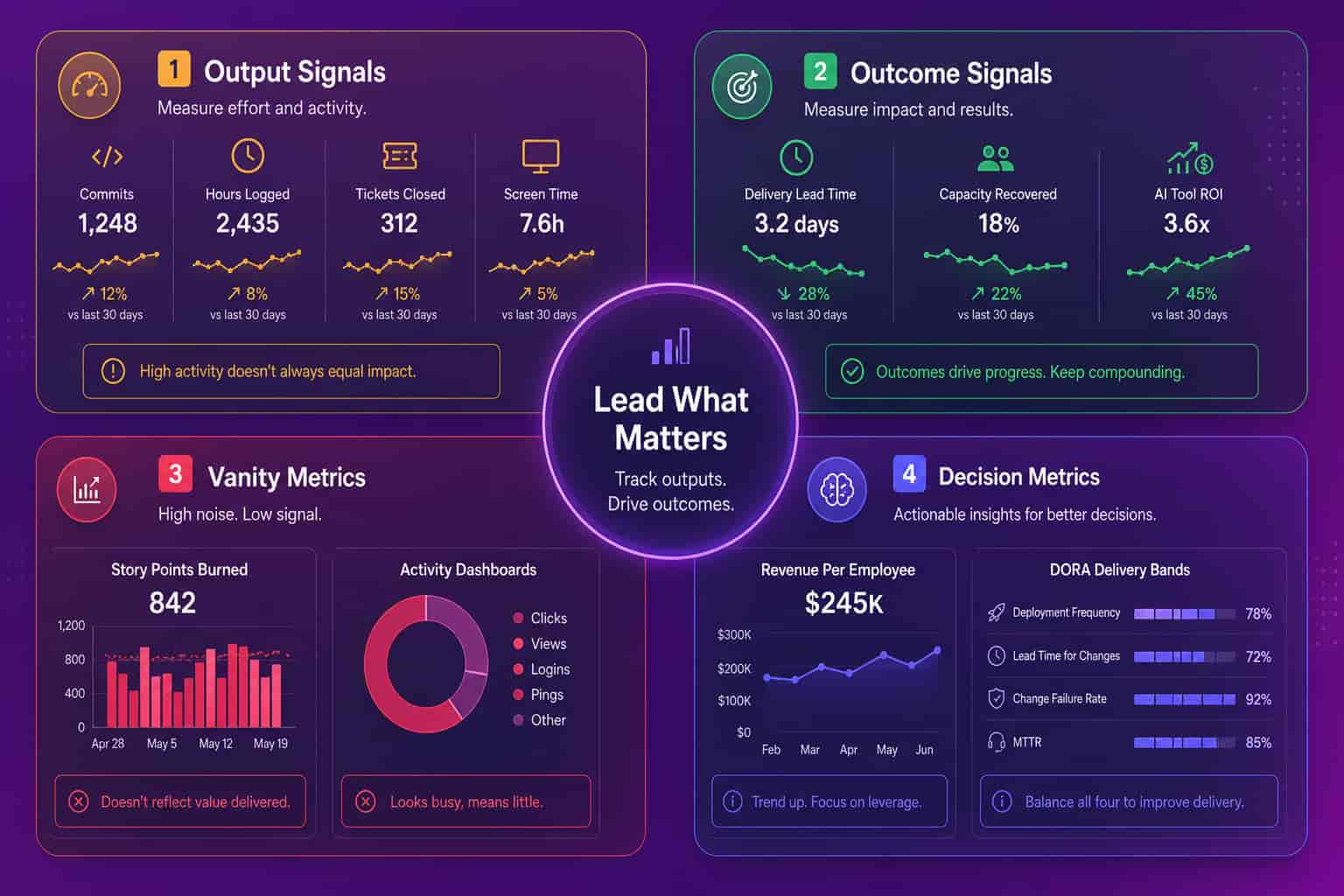
How to shift from measuring output to measuring outcomes
Shifting from output to outcome is a measurement change, not a motivation speech. The move is to name the result you want, then instrument the work so you can see whether that result arrived, instead of instrumenting activity because activity is easy. In practice it looks like five steps:
- Define the outcome per team. For engineering it might be lead time and change failure rate. For sales, pipeline that actually converts. For ops, capacity utilization. Write it down before you touch a tool.
- Connect the systems where the work lives. Outcomes live across GitHub, Jira, CRM, Google Workspace, and M365, not in a single activity agent. One source under-proves value, a lesson we learned the hard way with an early customer whose single-source data barely correlated to their own performance numbers.
- Kill the vanity output metric. If a number goes up when people get busier but nothing ships, retire it from the leadership view. Story-point velocity is the usual suspect.
- Separate human and AI contribution. In 2026 you cannot read raw output honestly without knowing how much of it an AI agent produced.
- Make the outcome recurring, not a one-time report. Schedule the analysis so the outcome brief arrives on its own. Abloomify's Bloomy runs on a cadence and emails a decision-ready summary, then leaves a chat thread you can interrogate. Dashboards you check. Bloomy checks in on you.
None of this requires watching anyone. It requires connecting the work to the result and being honest about which metrics are output dressed up as progress. If you want the fuller version of the privacy-first side, we wrote it up in how to measure productivity without screenshots, and the operations lens lives on the page for operations leaders.
Outputs are cheap. Outcomes compound.
Any team can manufacture output. Open more tickets, log more hours, generate more code, fill the dashboard with green. It costs almost nothing and proves almost nothing. Outcomes are harder because they force a definition of success and a connection between the work and the result, and that is exactly why they are worth measuring. The companies that win the next few years will be the ones that stopped grading themselves on motion. They will know their delivery outcomes, their capacity outcomes, and their real AI ROI, and they will know them without spying on anyone to get there.
Output is what your team did. Outcome is what your team is for.
FAQ
What is the difference between outcome and output?
Output is the activity a team produces: commits, closed tickets, hours logged, documents shipped. Outcome is the change that activity creates: faster delivery, recovered capacity, lower turnover, real ROI. A team can post huge output and near-zero outcome. Leaders are paid for outcomes, not motion.
What comes first, output or outcome?
Output comes first in time, outcome comes first in importance. You produce activity (output), and if the work was aimed at the right thing, that activity changes something for the business (outcome). The common mistake is stopping at output because it is easy to count, and never checking whether the outcome actually arrived.
What is output vs outcome vs impact?
Output is what you produced (40 pull requests). Outcome is the near-term change it caused (release shipped a sprint early, PR cycle time dropped). Impact is the longer-term business result (a permanent cost advantage, higher revenue per employee). Output is the cheapest to measure and the least useful on its own.
What are examples of outputs?
Commits, merged pull requests, lines of code, closed tickets, hours logged, calls made, documents shipped, and screen-active time are all outputs. They describe activity. To turn any of them into an outcome you have to connect them to a result: did the release ship faster, did capacity free up, did the deal close, did the number on the P&L move?
How does Abloomify measure outcomes instead of output?
Abloomify connects to the tools where work happens (GitHub, Jira, Google Workspace, M365, CRM, and AI coding tools) and measures results: DORA delivery bands, PR cycle time, capacity utilization, SaaS waste, and human vs AI contribution. It is privacy-first and PII-free by architecture, so you get outcome visibility without screenshots or keyloggers. SOC 2 Type II certified.

Amir Tavafi
Co-Founder & CEO
Product leader and innovator with over 15 years of experience in the tech sector, grounded in AI and robotics. Previously led product development in fraud detection and AI solutions at Nasdaq Verafin.