Performance Improvement Plan Template (Free, Editable) for 2026
August 17, 2026
Amir Tavafi
11 min read

A performance improvement plan template is only useful if the sections force evidence, not opinion, into every field. Below is a free, six-section performance improvement plan template you can copy into Google Docs, Notion, or your HRIS, a filled-in sample, and how Abloomify pre-fills the evidence sections from goal, review, and delivery data instead of a manager's memory.
Key Takeaways
Q: What should a performance improvement plan template include?
A: A header with role and review dates, the specific gap with dated evidence, a measurable target, the support the manager provides, a check-in cadence, and the consequence if goals aren't met. Six fields. Miss the evidence field and the rest of the template doesn't matter.
Q: Is there a free performance improvement plan template I can use right now?
A: Yes, copy the six sections below into any document editor. It works for a single missed-deadline pattern or a broader skills gap with minor edits to the target and cadence fields.
Q: How is a PIP template different from a performance review template?
A: A review template scores a full cycle across every competency an employee has. A PIP template narrows to one dated, specific gap with a fix-or-consequence deadline, usually triggered after that gap shows up across two or more review cycles.
Q: What makes a filled-in PIP template legally defensible?
A: Dated, specific evidence tied to job requirements, the same standard applied to every employee with the same gap, and check-ins documented as they happen. "Attitude problem" fails this test immediately. "Missed three of four sprint deadlines, dates attached" survives it.
Q: How does Abloomify fill in this template automatically?
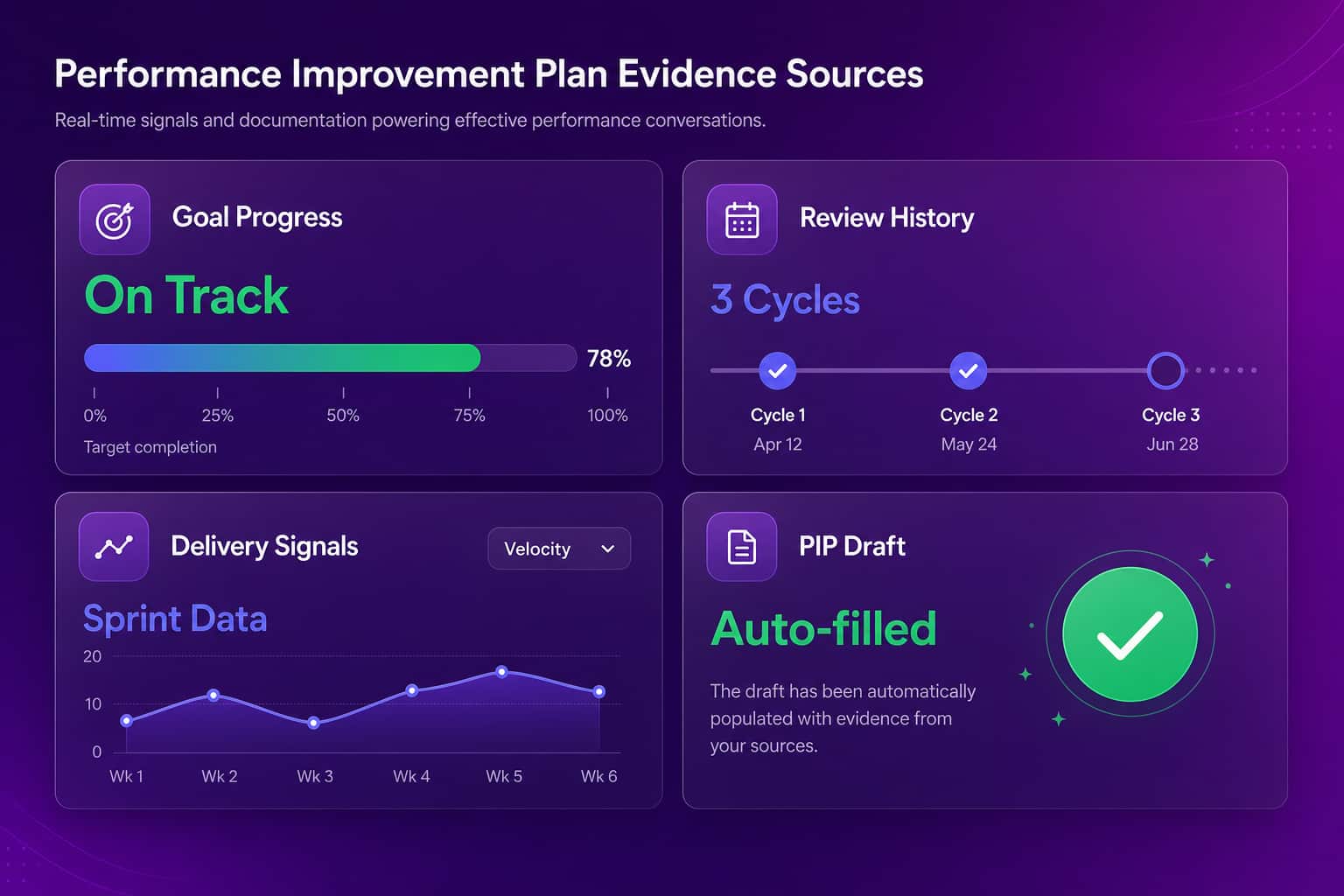
A: It pulls goal progress, review history, and delivery data (GitHub, Jira, the goals module) from a connected team into the gap and evidence fields before a manager opens the document, so the template starts as a record instead of a blank page.
What a performance improvement plan template should actually include
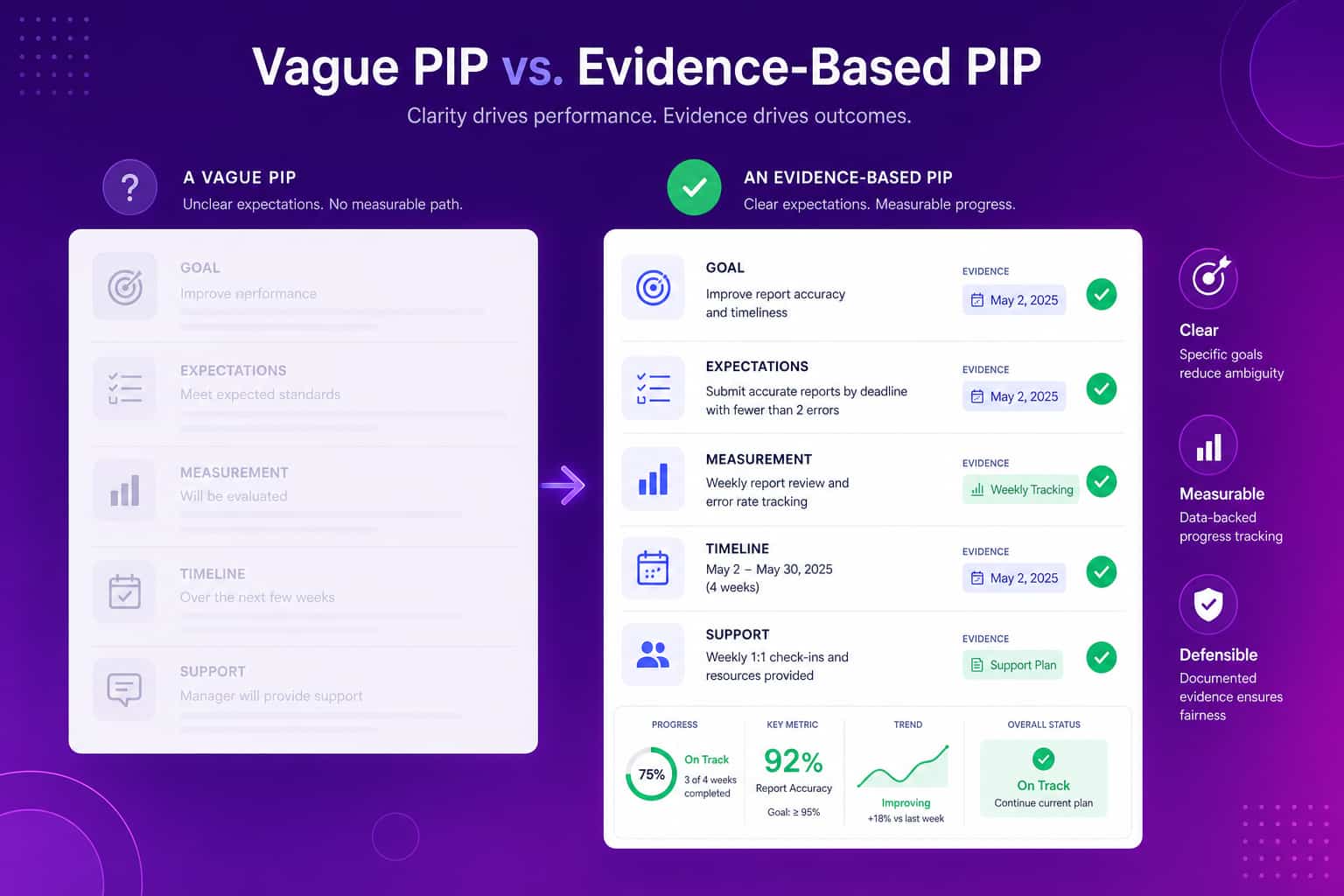
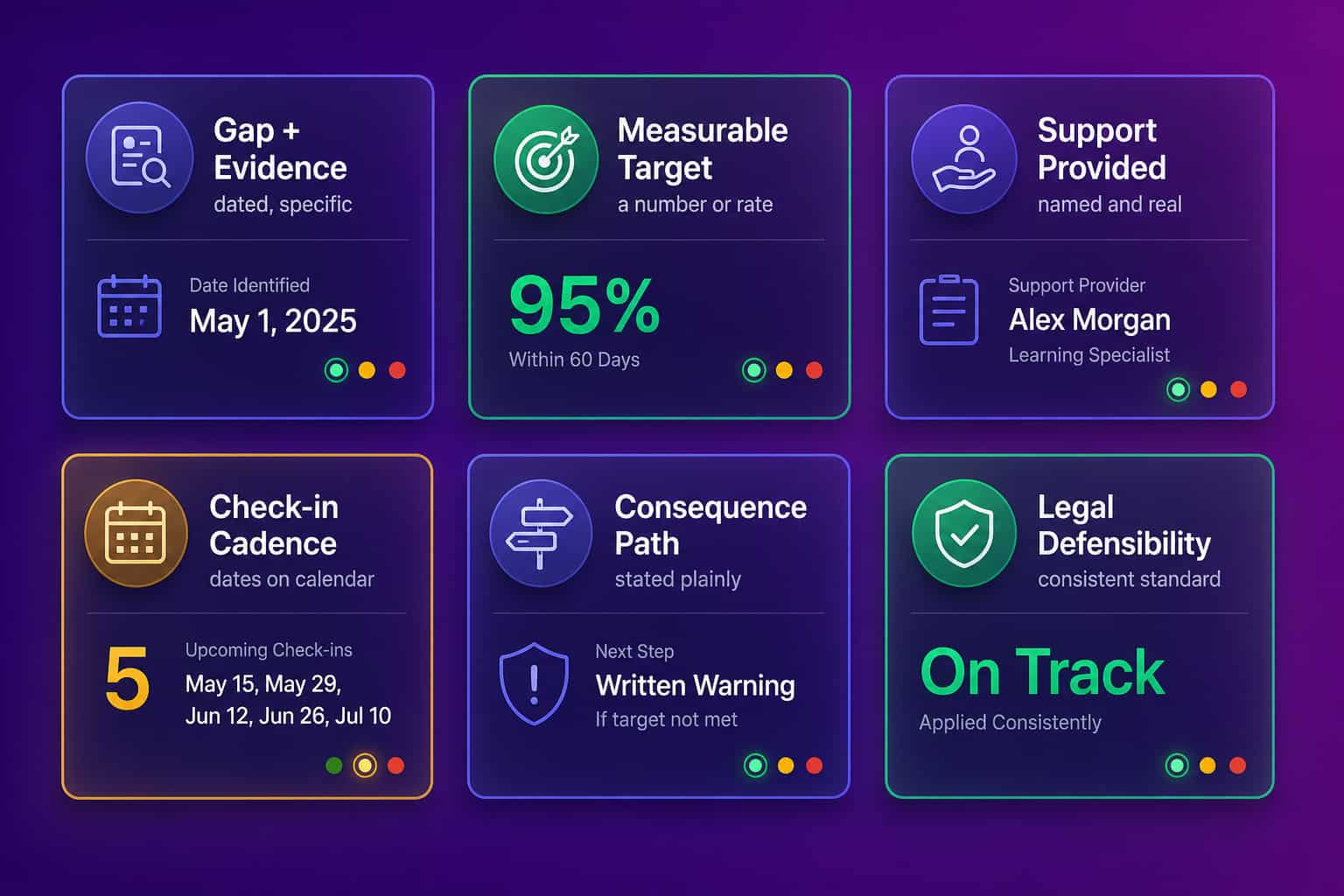
A performance improvement plan template needs six fields to survive contact with an actual HR review, a skeptical employee, or a lawyer: a header, the specific gap with dated evidence, a measurable target, the support the manager commits to, a check-in cadence with dates already on the calendar, and a plainly stated consequence path. Most free templates floating around online nail the header and the consequence line, since those are the easy parts, and skip the field that actually determines whether the plan holds up: a requirement that the gap be described with dates and specifics instead of a general impression. That gap is not cosmetic. A PIP that names "communication issues" instead of "missed the stated deadline on three of the last four sprint commitments, dates attached" is functionally an opinion with a deadline stapled to it, and it reads that way to the employee receiving it, to HR reviewing it, and to a lawyer if it ever gets that far.
Templates built by generic HR-suite vendors tend to over-invest in formatting (colored severity badges, a signature block, a progress bar) and under-invest in the one thing that changes the outcome: whether the evidence field forces a date and a source, or accepts a sentence like "performance has been below expectations lately." The template below makes the evidence field mandatory, the same discipline our performance review template applies to competency ratings.
The free performance improvement plan template (copy this)
Copy the six sections below into your document editor of choice. Fill in every bracketed prompt before the meeting where the PIP gets delivered, not during it, and don't leave the evidence field for later. A PIP without dated evidence attached at delivery time is the version that gets challenged.
1. Header
Employee name, role, manager, department, PIP start date, PIP end date (30, 60, or 90 days out), and the HR contact if one is assigned.
2. The specific gap (evidence, not adjectives)
State the gap in one sentence, then list 3-5 dated instances that demonstrate it. Each instance needs a date and a source (a sprint retro note, a missed deliverable, a specific ticket, a customer escalation). "Underperforming" is not an entry. "Missed the committed delivery date on 3 of the last 4 sprints (Jan 12, Jan 26, Feb 9), each flagged in the sprint retro" is.
3. Measurable target
The number, rate, or binary outcome that defines success, agreed by both employee and manager before the plan starts. "Ship committed sprint work on time in 4 of the next 5 sprints" is measurable. "Improve reliability" is not.
4. Support the manager is providing
Name the real thing: extra 1:1 time, pairing with a senior teammate, a training budget line, a reduced scope during the plan window. A PIP with no support line reads as a paper trail for a decision already made, because it usually is one.
5. Check-in schedule
Weekly or biweekly, with actual calendar dates, not "we'll touch base." At each check-in, note progress against the target in writing. A plan with no scheduled check-ins gets revisited only at the deadline, which defeats the point of the window.
6. Consequence path
State plainly what happens if the target is met and what happens if it isn't. No ambiguity. The manager who has to follow through on this line will thank you for writing it down now instead of improvising it later.
Sample performance improvement plan (filled in)
A filled-in example makes the template's evidence requirement concrete faster than another paragraph of instructions. Here is a sample for an engineer with a delivery pattern, adapted to show the level of specificity each field needs: Gap: "Missed the committed sprint delivery date on 3 of the last 4 sprints (Jan 12, Jan 26, Feb 9), each flagged in the sprint retro and confirmed against the sprint board." Target: "Ship committed sprint work on time in 4 of the next 5 sprints, tracked against the same sprint board." Support: "Weekly 1:1 added through the plan window; paired with a senior engineer on estimation for the first two sprints; scope reduced by one story point per sprint during the plan." Check-in: "Biweekly, Feb 16 and Mar 2, written notes in the shared doc comparing actual delivery against the target." Consequence: "Meeting the target closes the plan with no further action. Missing it triggers a follow-up conversation about role fit, documented separately."
The pattern to copy from this example is not the specific numbers, it's the specificity itself. Every field cites a date, a source, or a number. Nothing in the sample could be replaced with "seemed better" or "still a concern" without weakening it.
How to fill the evidence fields from real work data instead of memory
The fastest way to fix a PIP template's weakest point is to stop asking a manager to reconstruct a quarter from memory the night before the delivery meeting, which is exactly what most teams still do whether the template lives in a Google Doc or an HR suite. Abloomify pulls the evidence a PIP needs from the systems where the work actually happened: GitHub and Jira for delivery and review activity, the goals module for progress against targets set last cycle, and the performance review history for the pattern across cycles that justifies opening a PIP in the first place. That evidence lands in the gap field before a manager opens the document, so "missed 3 of 4 sprint deadlines" starts as a real, sourced timeline instead of a manager's best recollection typed in under deadline pressure.
When we started building Abloomify, I thought the hard part of a manager's week was leadership: coaching, tough conversations, the calls that actually need a human. The more we shipped, the clearer it got that a huge share of that week is admin wearing a leadership costume, digging across five tools to answer a question as basic as "was this really a three-month pattern, or did I just have one rough conversation with this person two weeks ago and it's coloring everything." A PIP built on that kind of recall is fragile in both directions: it collapses under scrutiny if it's too harsh, and it lets a real pattern slide if recency bias points the other way.
Our performance management module keeps goals, reviews, and feedback in one connected record, and pulls in delivery and capacity signals from the tools already connected through Abloomify's 100+ integrations, so the evidence trail exists before anyone needs it for a PIP.
PIP template vs the full performance improvement plan process
A template is the document. The process is everything that has to happen before a manager fills it in, and confusing the two is the most common reason a PIP fails even when the paperwork looks clean. Before touching the template, pull the full evidence review across the actual pattern window, not the last two weeks: goal progress, every review cycle's scores and written comments, delivery data if the role produces any, and prior documented conversations about the same gap. Only after that review should the template get filled in, because a PIP drafted before the evidence is assembled tends to fit whatever conclusion the manager already reached rather than the record. For the full walkthrough of that evidence review, when to start a PIP versus a single bad week, and how to decide between a PIP and heading straight to termination, see our guide to writing a performance improvement plan.
Big companies tend to solve the evidence problem with more process: longer forms, more approval layers, an HRBP reviewing every draft before it ships. Startups solve it by making the data show up on its own, before the template gets opened. If turnover is part of the calculation once a PIP starts, our employee turnover cost calculator estimates the real cost of a departure, replacement, and ramp time before that decision gets made.
FAQ
What should a performance improvement plan template include?
A header with role and dates, the specific performance gap with dated evidence, a measurable target, the support the manager commits to providing, a check-in schedule, and a stated consequence path. Skip the evidence field and the template just becomes a formal way to write down an opinion.
Is there a free performance improvement plan template I can copy?
Yes. The template in this guide is free to copy into Google Docs, Notion, or your HRIS. It has six sections built from the same structure Abloomify uses to generate PIP drafts from goal, review, and delivery data.
What's the difference between a PIP template and a performance review template?
A performance review template scores a full cycle across every competency. A PIP template targets one specific, dated gap with a fix-or-consequence deadline attached. A PIP usually gets triggered by a pattern that already showed up across two or more review cycles.
How do you make a performance improvement plan template legally defensible?
Require dated, specific evidence for the named gap instead of adjectives, apply the same standard to every employee with the same gap, and document every check-in as it happens, not after the fact. A PIP with vague language and no consistent application is the first thing an employment lawyer flags.
Can Abloomify fill in the evidence section of a PIP template automatically?
Yes. Abloomify pulls goal progress, review history, and delivery data (GitHub, Jira, the goals module) from a connected team, so the gap section of the template starts as a real timeline instead of a manager reconstructing a quarter from memory the night before an HR meeting.

Amir Tavafi
Co-Founder & CEO
Product leader and innovator with over 15 years of experience in the tech sector, grounded in AI and robotics. Previously led product development in fraud detection and AI solutions at Nasdaq Verafin.