Performance Review Template (Free, Editable) for 2026
August 13, 2026
Amir Tavafi
12 min read

A performance review template is only as good as what fills it in. Most free templates give you a rating scale and a blank paragraph, which just moves the bias problem into a form with nicer formatting. Below is a performance review template built from nine sections that actually hold up under scrutiny, plus how Abloomify pre-fills the evidence section from recorded work data instead of a manager's memory.
Key Takeaways
Q: What should a performance review template include?
A: A review-period header, goal progress from last cycle, dated evidence of contributions, competency ratings, growth areas, a development plan, a manager narrative, and a self-assessment section. Nine sections total. Abloomify's performance management module ships this structure by default.
Q: Is there a free performance review template I can use right now?
A: Yes, copy the full nine-section template below into Google Docs, Notion, or your HRIS. It works for annual, quarterly, or continuous review cycles with minor edits to the goal-review section.
Q: What's the difference between a self-assessment and a manager review template?
A: A self-assessment is the employee's own account, written first so it isn't anchored to the manager's framing. The manager template adds ratings, evidence review, and a development plan. Abloomify runs both in the same cycle, side by side.
Q: How do you reduce bias in a performance review template?
A: Require dated evidence for every rating instead of adjectives. "Shipped 14 of 16 sprint commitments on time" holds up; "reliable" doesn't. Sourcing that evidence from GitHub, Jira, and goal data instead of memory removes recency bias before anyone writes a word.
Q: How does Abloomify fill in the evidence section automatically?
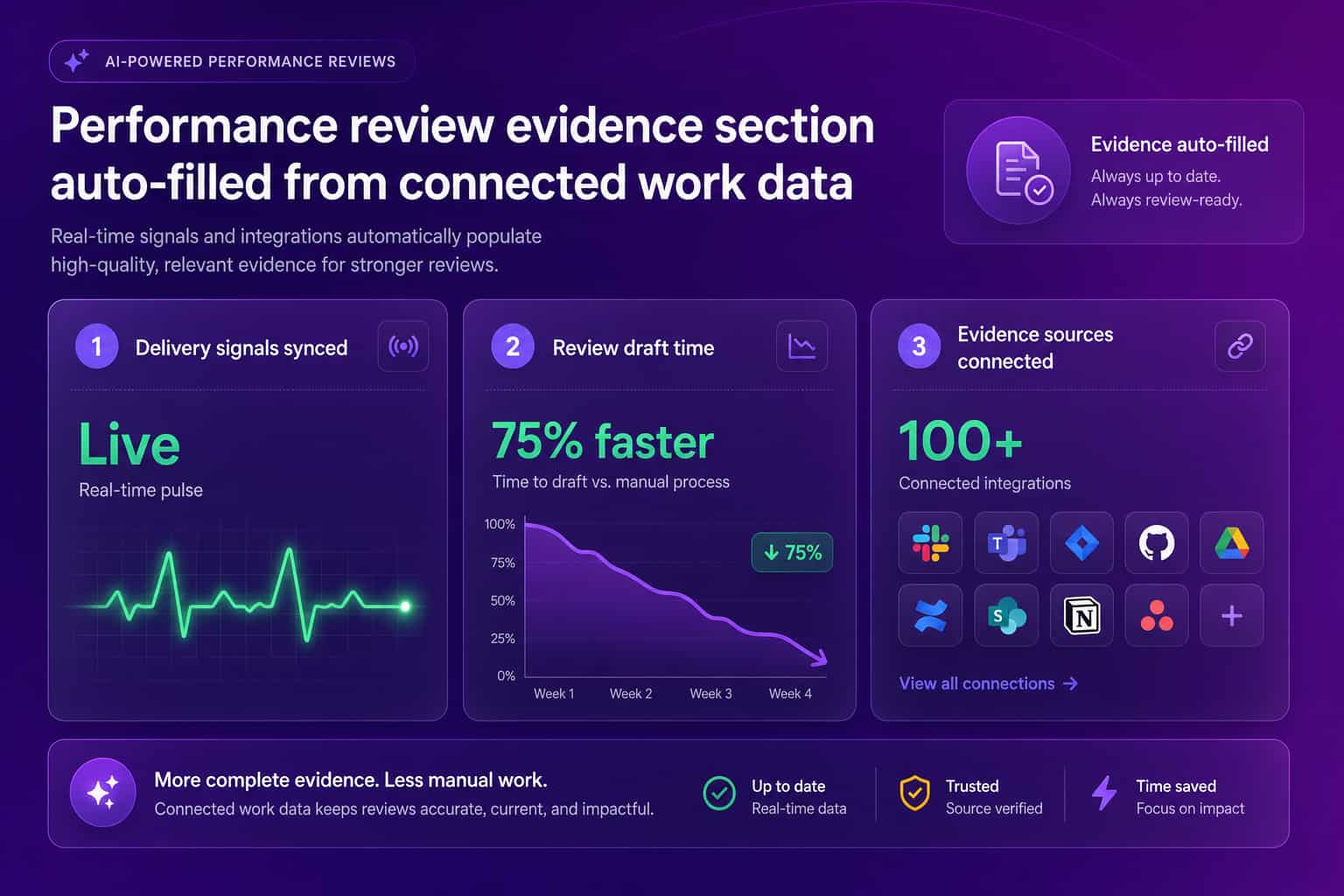
A: It connects to GitHub, Jira, Google Workspace, and the goals module, then pulls delivery, collaboration, and goal-progress signals into the review draft before a manager opens it. PII-free: signals only, no code content, no message content.
What a performance review template should actually include
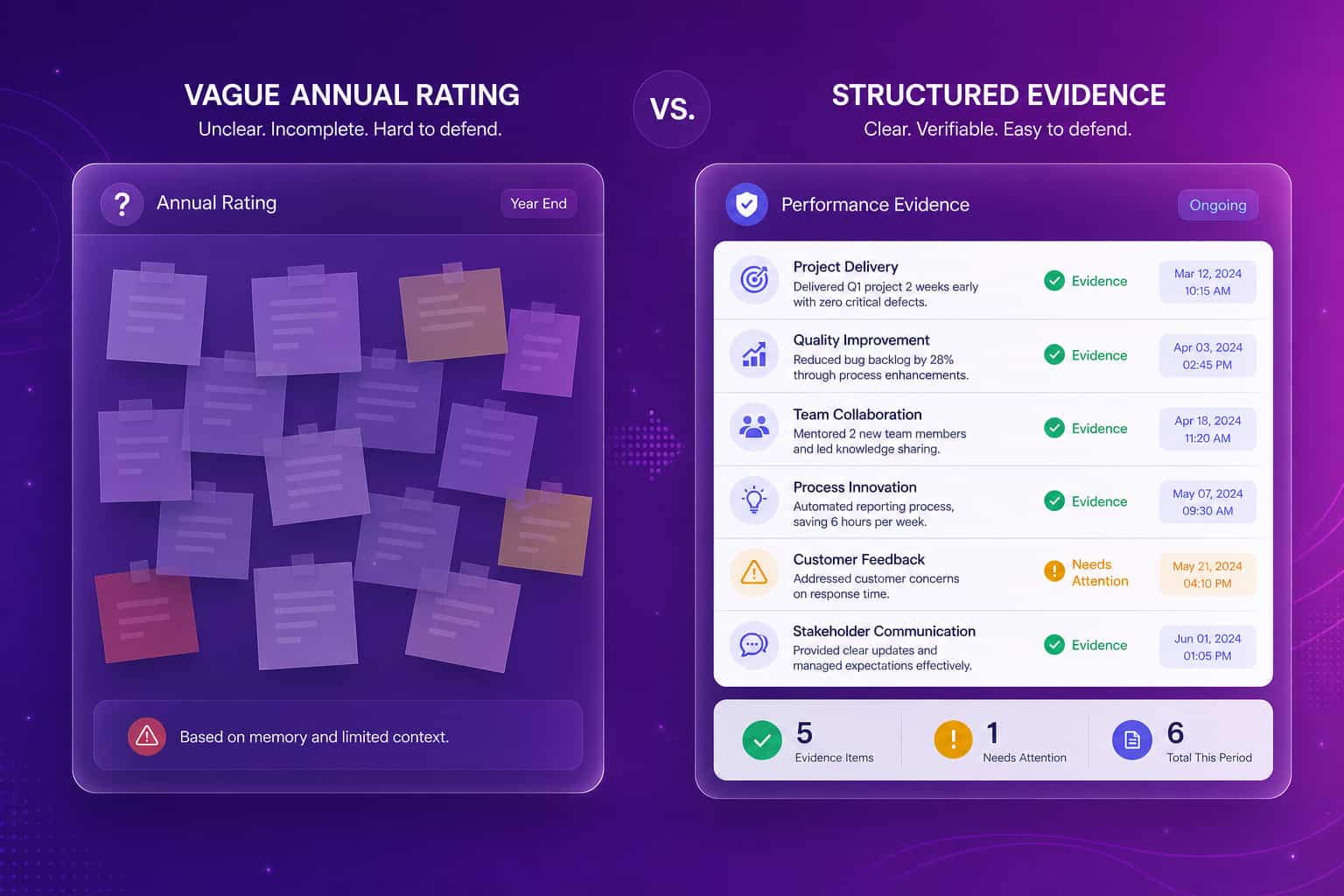
A performance review template needs nine things to survive contact with an actual review cycle: a role and period header, goal progress against last cycle's targets, dated evidence of contributions, competency ratings tied to the role, specific growth areas, a development plan for next cycle, a manager narrative, a self-assessment from the employee, and calibration notes for internal use, and if a template is missing more than one of these it will produce a document that reads fine but falls apart the moment HR or an employee asks "based on what, exactly." Most free templates online nail the first few (header, goals, a rating scale) and skip the parts that actually prevent bias: the requirement that every rating cite specific, dated evidence rather than a general impression. That gap is not cosmetic. It's the difference between a review an employee trusts and one they roll their eyes at, and it's the difference between a rating that holds up if HR or legal ever asks a manager to justify it and one that doesn't.
Templates built by monitoring or HR-suite vendors tend to over-index on the rating scale (5-point, 4-point, whatever) because that's the easiest thing to standardize across a company. What they under-build is the evidence layer underneath the rating. A 4-out-of-5 with no dated example attached is an opinion with a number stapled to it. The template below fixes that by making evidence a required field, not an optional comment box.
The free performance review template (copy this)
Copy the nine sections below into your document editor of choice. Fill in the bracketed prompts, delete anything that doesn't apply to the role, and keep the evidence fields mandatory even when it's tempting to skip them for a quick cycle, because the sections that get skipped under deadline pressure are exactly the ones that keep the review fair.
1. Header
Employee name, role, manager, review period (start and end dates), review type (annual / quarterly / continuous).
2. Goals from last cycle
For each goal set last cycle: goal statement, target, actual result, evidence source (link, ticket number, or dated note). Leave a row blank if a goal wasn't tracked, don't fill it with a guess.
3. Key contributions (evidence, not adjectives)
List 3-5 contributions. Each one needs: what happened, the date or date range, and where it's documented (a PR, a shipped feature, a closed deal, a project deliverable). "Strong quarter" is not an entry. "Led the migration that cut deploy time from 40 minutes to 9, merged March 3" is.
4. Competency ratings
List the 3-5 competencies relevant to the role (technical execution, collaboration, ownership, communication, whatever the role actually requires). Rate each Below / Meets / Exceeds, with one evidence line per rating.
5. Areas for growth
1-3 specific, actionable gaps. Not "needs to communicate better." Instead: "PR descriptions often skip the why, only the what, per feedback from three reviewers this quarter."
6. Development plan for next cycle
For each growth area: the specific target, the support the manager is providing, and the check-in cadence. No check-in date means no real plan.
7. Manager narrative
Free text, 150-300 words. Summarize the cycle in plain language, tie it back to the evidence above, and avoid introducing any new claim that isn't already documented in sections 2-4.
8. Self-assessment (employee-completed, before the manager review)
The employee's own account: top accomplishments, biggest challenges, and what support they're asking for next cycle. Written independently, not after seeing the manager's draft.
9. Calibration notes (internal use)
For the manager and HR: how does this rating compare to similar roles on the team? Note any pattern (is this manager consistently rating high or low relative to peers) so calibration catches it before the review ships.
Self-assessment template for employees
A self-assessment only does its job if it's written before the employee sees any part of the manager's draft, because a self-assessment written after the fact just mirrors whatever framing the manager already used, which defeats the point of having two independent accounts of the same cycle. Ask the employee to answer four prompts: what were your two or three biggest wins this cycle, with dates and where the work lives; what got harder than expected, and what did you do about it; where do you want to grow next cycle, specifically enough that a manager could turn it into a development plan item; and what support, resources, or context would help you close that gap. Skip the open-ended "how do you feel about your performance" prompt entirely. It invites vague answers and gives a manager nothing evidence-based to calibrate against.
The strongest self-assessments read like the evidence section of the manager template, written from the other side of the table. That's intentional. When both documents cite the same kind of dated, specific evidence, the review conversation becomes a comparison of two evidence sets instead of a negotiation over who remembers the quarter more favorably.
Why the same template produces wildly different reviews
The same performance review template can produce a fair, defensible review in one manager's hands and a biased, forgettable one in another's, and the reason is almost never the template itself, it's what gets typed into the evidence fields. Recency bias is the most common failure mode: a manager fills in "key contributions" from the last two weeks because that's what's fresh in memory, even when the review period covers a full quarter. Affinity bias shows up quietly too, in which employees get generous, specific evidence and which get vague filler like "solid work this quarter." A template with mandatory, dated evidence fields makes both of these harder to get away with, because an empty or vague evidence field is visible on the page in a way a low rating with no explanation isn't.
How to fill the evidence section from real work data instead of memory
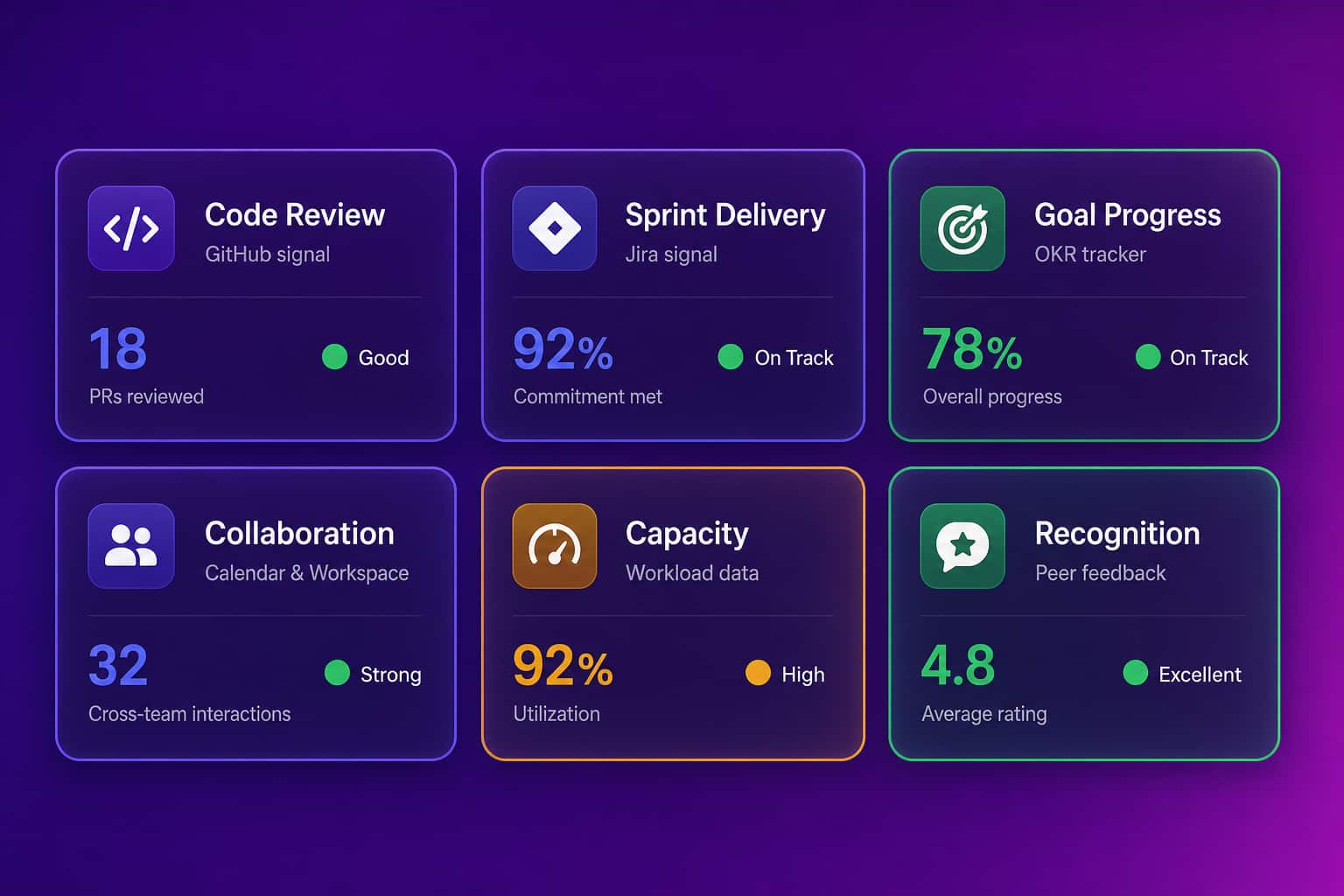
The fastest way to fix a biased performance review template is to stop asking a manager to reconstruct a full quarter from memory the week before the review is due, which is exactly what most companies are still doing, whether the template is a Google Doc or a line item inside an HR suite. Abloomify pulls the evidence a review needs from the systems where the work actually happened: GitHub and Jira for delivery and code review activity, the goals module for progress against targets set last cycle, and Google Workspace or Microsoft 365 for collaboration signals like meeting load and cross-team work. That evidence lands in the review draft before a manager opens it, so the "key contributions" section starts as a real timeline instead of a blank box, and the manager's job shifts from reconstructing the quarter to reviewing and adding judgment to what the record already shows.
When we started building Abloomify, I thought the hard part of a manager's week was leadership: coaching, tough calls, the stuff that actually needs a human. The more we shipped, the clearer it got that a huge share of that week is admin wearing a leadership costume, chasing people for updates, digging across five tools to answer "what did this person actually ship this quarter," then typing it all into a review form the night before it's due. That's the chore a review template can't fix on its own. Connecting the template to the data underneath it can.
Choosing a review cadence: annual, quarterly, or continuous
The cadence you pick changes how much of this template gets filled in at once, and most companies get the choice backwards by picking a cadence first and forcing the evidence process to match it, instead of picking a cadence their evidence process can actually support. Annual reviews put the most pressure on the evidence section, since a manager is reconstructing 12 months from memory in a single sitting, which is exactly the setup that produces recency bias and vague filler. Quarterly reviews cut that reconstruction window to three months and make the self-assessment and manager narrative sections easier to keep specific. Continuous or check-in-based models spread the evidence-gathering across the whole cycle, so the formal review becomes a summary of an already-documented record instead of the first time anyone wrote anything down. If a company is still running annual-only reviews, the single highest-leverage fix is not switching to a new cadence overnight, it's making sure the evidence behind whatever cadence exists is being captured continuously, not reconstructed once a year.
Big companies tend to solve this with more process: longer forms, more approval steps, an HRBP reviewing every draft. Startups solve it by making the data show up on its own. Our performance management module keeps goals, reviews, and feedback in one connected record so the evidence trail exists before the review cycle starts, whatever cadence a team runs on.
For the case on continuous vs annual cadence specifically, see our guide on continuous performance management vs annual reviews. If a review is heading toward a documented performance gap rather than a routine cycle, our guide to writing a performance improvement plan covers the template for that conversation, and our employee turnover cost calculator estimates what a bad outcome from either process actually costs.
FAQ
What should a performance review template include?
A role and review-period header, goal progress against last cycle, evidence-based contributions with dates, competency ratings, growth areas, a development plan for next cycle, a manager narrative, and a self-assessment section. Skip the evidence and dates and the template just moves bias into a form.
Is there a free performance review template I can copy?
Yes. The template in this guide is free to copy into Google Docs, Notion, or your HRIS. It has nine sections, from goal review through calibration notes, built from the same structure Abloomify's performance management module uses.
What is the difference between a self-assessment and a manager review template?
A self-assessment is the employee's own account of their accomplishments, challenges, and growth asks, written before the manager review so it is not anchored by the manager's framing. A manager review template adds ratings, evidence review, and a development plan the manager owns.
How do you make a performance review template less biased?
Force every rating to cite dated evidence, not adjectives. "Shipped 14 of 16 sprint commitments on time" survives scrutiny; "reliable" does not. Pulling that evidence from GitHub, Jira, and goal-tracking data instead of a manager's memory removes recency bias before the form is even filled out.
How does Abloomify fill in the evidence section automatically?
Abloomify connects to the tools work already happens in (GitHub, Jira, Google Workspace, the goals module) and pulls delivery, collaboration, and goal-progress signals into the review draft before a manager opens it. PII-free: no code content, no message content, only the signals a fair review needs.

Amir Tavafi
Co-Founder & CEO
Product leader and innovator with over 15 years of experience in the tech sector, grounded in AI and robotics. Previously led product development in fraud detection and AI solutions at Nasdaq Verafin.