Code Review Tools: 7 That Actually Speed Up Delivery (2026)
September 9, 2026
Amir Tavafi
13 min read

Most "code review tools" roundups hand you a list of AI reviewers and call it done. Code review tools speed up delivery only if review actually gets faster, and almost nothing on a typical list measures that. Abloomify tracks PR cycle time, time to first review, and review health straight from GitHub, PII-free, so you can tell whether the tool you bought is working.
Key Takeaways
Q: What's the single best code review tool for a growing engineering team in 2026?
A: There isn't one tool that wins outright. GitHub's native review covers the basics for free. CodeRabbit, Greptile, or DeepSource add AI comments on every PR. Sonar adds quality gates. The tool that matters most alongside any of them is the one that tells you if PR cycle time actually dropped, which is what Abloomify's engineering intelligence measures.
Q: Does adding an AI code review tool actually cut PR cycle time?
A: Sometimes, and the only honest way to know is to measure before and after. Abloomify imports GitHub PR data and computes cycle time and time to first review automatically, so a team can see whether CodeRabbit or Greptile changed the number instead of assuming a new tool helped because it feels busier.
Q: What's the difference between a code review tool and a code review analytics layer?
A: A code review tool (CodeRabbit, Sonar, Greptile) reads the code and leaves feedback. A code review analytics layer measures the process around that feedback: how fast PRs move, how often they self-merge, how healthy review is across the team. Abloomify is the analytics layer, built on 100+ API integrations including GitHub, and it never reads code content.
Q: Do code review tools require sending source code to a third-party AI model?
A: The AI reviewers on this list (CodeRabbit, Greptile, DeepSource) generally do send diffs to a model to generate comments, so check each vendor's data terms if that matters to you. Abloomify doesn't have that question to answer, because it reads PR timing and metadata only, never code content, by architecture.
Why Most "Code Review Tools" Lists Miss What Actually Slows PRs Down
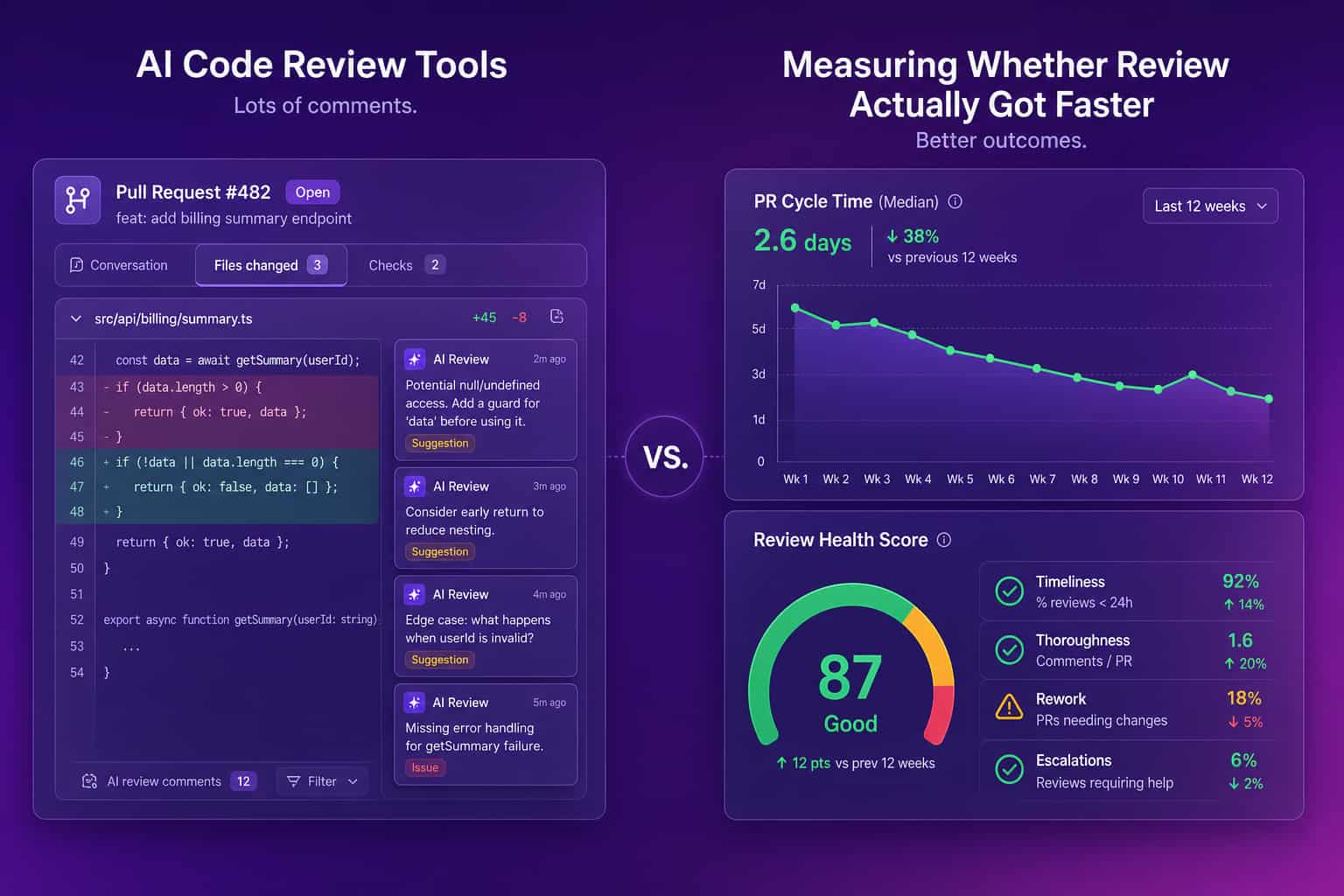
A typical code review tools list ranks seven or eight AI reviewers by feature count and calls it a buying guide, and that approach answers the wrong question for most engineering leaders. The real problem isn't a shortage of tools that can comment on a diff. GitHub, GitLab, CodeRabbit, Greptile, Sonar, and half a dozen others all do that job reasonably well today. The problem is nobody can say whether adding one of them actually made review faster, because "faster" requires a before-and-after number, and almost none of these tools report PR cycle time or time to first review as a first-class metric. A team can install an AI reviewer, watch comment volume go up, and still have no idea if PRs are merging sooner or just sitting in review longer while someone triages more feedback.
That's the gap this list is built around. The seven tools below cover what people actually mean when they search "code review tools": the native option everyone starts with, the AI reviewers built to reduce human review load, a static-analysis quality gate, a stacked-PR workflow tool, and the one entry that isn't a reviewer at all but tells you whether the other six are earning their keep.
1. Abloomify: the review-health layer, not another reviewer
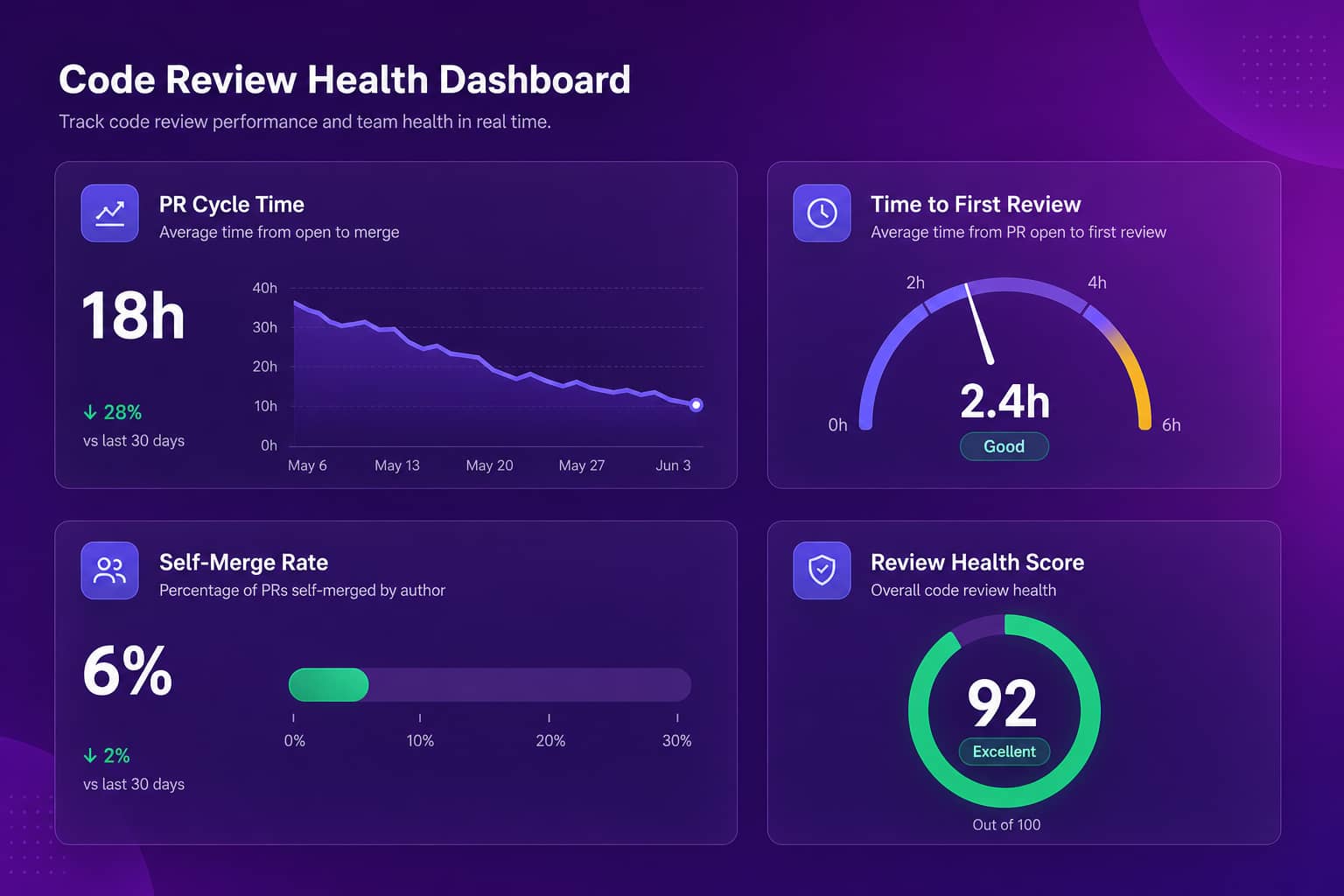
Abloomify is the one tool on this list that doesn't read your code at all. It connects to GitHub, GitLab, Bitbucket, Jira, and Linear through API integrations and computes PR flow analytics straight from GitHub: cycle time, time to first review, review health, self-merge rate, and PR size, alongside all four DORA metrics banded Elite to Low. It also separates human vs AI agent contribution across code, PRs, and reviews, so a team running CodeRabbit or Greptile alongside their human reviewers can see the split instead of guessing. None of it requires reading a line of code content: the architecture is PII-free by design, SOC 2 Type II certified, no screenshots, no keyloggers, no screen recording.
A 50-person Canadian SaaS company runs its engineering metrics through Abloomify today, connecting GitHub and Jira for exactly this kind of visibility. Their COO validated the data against a manual spreadsheet before trusting it: "What I did manually this week in a spreadsheet is exactly what I think Abloomify should be doing automatically." That's the bar for any tool on this list that claims to save time: not a busier dashboard, the same signal a careful person would produce by hand, without the hand.
Where it fits on this list: everything else here helps a team review code. Abloomify is how a VP of Engineering knows whether that review is actually getting faster and healthier, including whether the AI reviewer they just bought is paying for itself.
2. GitHub Pull Requests: the default, and its blind spot
GitHub's native pull request review is where almost every team starts, and for good reason: inline comments, requested reviewers, required status checks, and merge queues cover the basics without adding a vendor. Its first sentence deserves to be honest about the limit, though: GitHub's own PR interface shows you who reviewed and when, but it doesn't tell you whether a "3-day-old PR" is a red flag or normal for your team, because it has no baseline and no trend line built in. Insights exists, but it stays shallow past headcount-level counts. That gap is exactly why teams that outgrow the default start layering something else on top, either an AI reviewer to add feedback depth or an analytics layer like Abloomify to add the trend line GitHub doesn't compute on its own.
3. CodeRabbit: AI review comments on every PR
CodeRabbit is an AI code review tool that posts automated comments on pull requests as soon as they're opened, summarizing the diff and flagging issues like missing null checks, unhandled errors, and obvious edge cases before a human ever looks. It integrates with GitHub, GitLab, and Bitbucket, and the pitch is straightforward: catch the small stuff automatically so a human reviewer's time goes to the parts that actually need judgment. The honest caveat, shared by every AI reviewer on this list, is that "left more comments" and "review got faster" are two different claims, and only the second one is worth paying for. Abloomify's cycle-time and time-to-first-review numbers are how a team tells the difference instead of assuming a busier PR thread means a healthier one.
4. Graphite: stacked PRs built for faster review
Graphite is built around a different idea than the AI reviewers on this list: instead of adding more feedback to a big PR, it helps teams keep PRs small in the first place by supporting a stacked-diffs workflow, where a large change ships as a sequence of small, reviewable PRs instead of one sprawling one. Smaller PRs review faster almost by definition; a reviewer can hold a 40-line change in their head, and a 900-line one turns into a rubber stamp or a week of back-and-forth. Graphite also ships its own AI review layer on top of the stacking workflow. Where it earns a spot on this list is the size problem specifically: Abloomify's PR-size metric is one of the signals that shows whether a team's PRs are actually shrinking after adopting a stacking workflow, or whether the habit didn't stick.
5. Sonar: code quality and security gates
Sonar (SonarQube for self-hosted, SonarCloud for the hosted version) is a static-analysis platform that scans code for bugs, security vulnerabilities, and code smells, and enforces quality gates in CI so a PR with new issues can be blocked from merging automatically. It's less a reviewer and more a gatekeeper: the "Clean as You Code" model focuses only on new and changed code, so a legacy codebase with years of debt doesn't have to pass an unrealistic bar overnight. For a code review tools list, Sonar's role is catching the mechanical issues (a null pointer, a SQL injection risk, a duplicated block) so human review time goes to logic and design instead of bugs a linter should have caught.
6. Greptile: AI review trained on your codebase
Greptile is an AI code review tool that indexes a team's entire codebase, not just the diff in front of it, so its review comments can reference how a function is used elsewhere in the repo instead of judging a PR in isolation. That full-repo context is the differentiator from a diff-only reviewer: catching a case where a change breaks an assumption three files away is a different (and harder) job than flagging a missing null check in the lines that changed. It posts comments directly on GitHub PRs, similar to CodeRabbit. The same measurement gap applies here as everywhere else on this list: full-repo context makes for a more impressive comment, but whether it actually shortens the path from PR opened to PR merged is a number, not a feeling, and it's the number Abloomify computes.
7. DeepSource: static analysis with autofixes
DeepSource is a static-analysis platform in the same family as Sonar, scanning for bugs, security issues, performance problems, and style violations, with one feature that separates it from a pure linter: autofix suggestions a developer can accept with one click instead of manually rewriting the flagged line. That autofix layer is where DeepSource earns its place on a "tools that speed up delivery" list specifically, because it removes review cycles entirely for the class of issues it can fix on its own, rather than just flagging them for a human to handle later. Like Sonar, it's a quality gate more than a reviewer, and it pairs naturally with either GitHub's native review or an AI reviewer like CodeRabbit for the judgment calls a static analyzer can't make.
How to Actually Evaluate Code Review Tools for Your Team
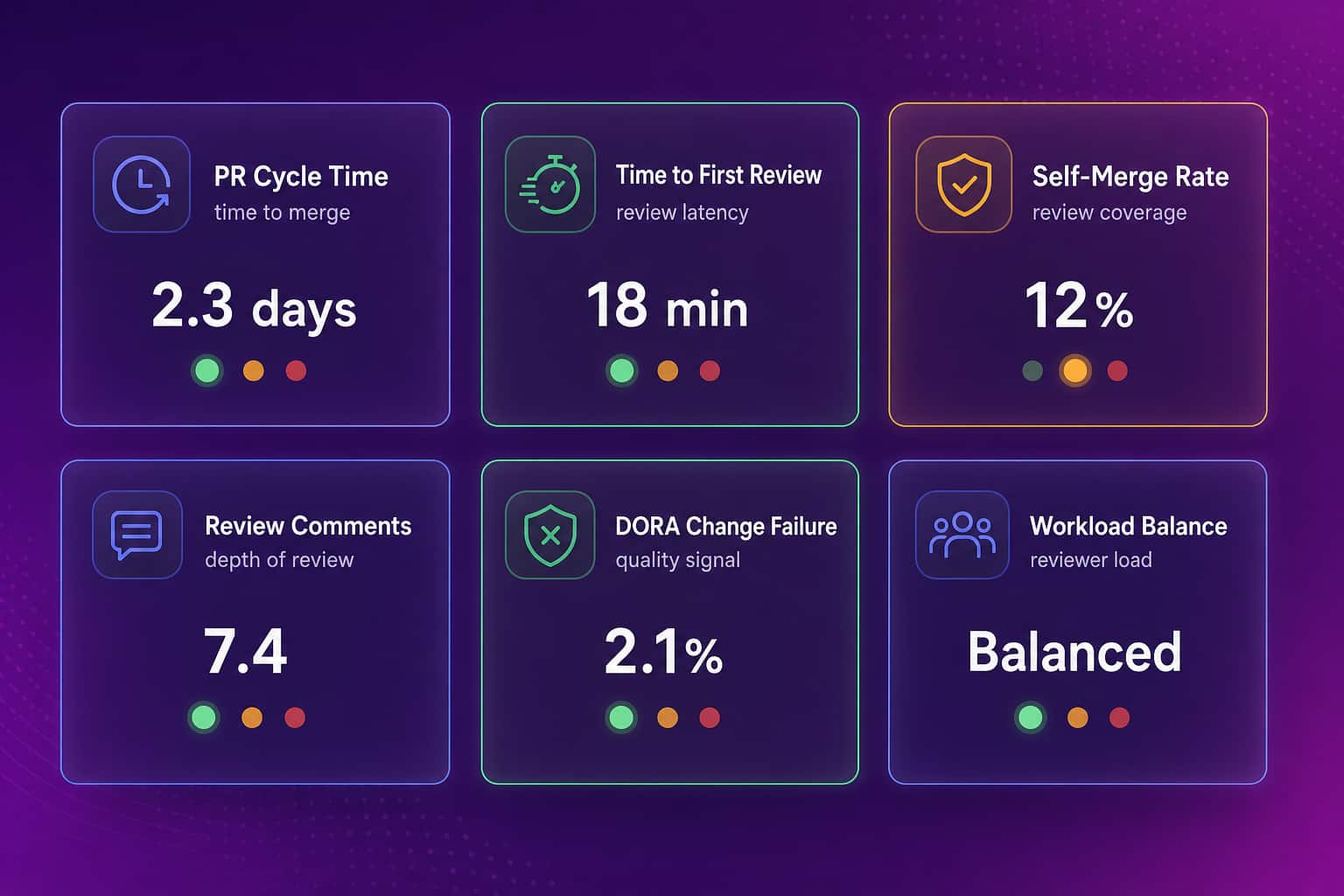
Skip the feature checklist most code review tools comparisons lean on and start with the question that actually predicts whether a tool earns its budget line: does PR cycle time go down after adopting it, or does it just feel busier because there are more comments to read? Every tool on this list has a legitimate job, GitHub for the baseline, CodeRabbit and Greptile for AI review depth, Sonar and DeepSource for quality gates, Graphite for keeping PRs small, but none of them, on their own, tells a VP of Engineering whether the combination is working. That's a measurement problem, not a tooling problem, and it's the same gap Abloomify closes for engineering velocity more broadly: PR cycle time, time to first review, and review health computed automatically from GitHub, without reading code content.
- Before adding a tool, know your current PR cycle time and time to first review. Without a baseline, "it feels faster" is the only feedback you'll ever get.
- Pick AI review depth (CodeRabbit, Greptile) if the bottleneck is human reviewer bandwidth. Pick quality gates (Sonar, DeepSource) if the bottleneck is bugs slipping through review. Pick a stacking workflow (Graphite) if the bottleneck is PR size itself.
- Re-measure 60 to 90 days after adopting anything. A tool that doesn't move cycle time in that window probably isn't the fix, whatever the demo promised.
Small engineering teams win here because they can layer in the measurement from day one instead of retrofitting it after three code review tools have quietly stopped getting used. Abloomify vs Jellyfish covers how this compares to a pure-play engineering analytics tool if DORA dashboards alone are what you're evaluating.
Big companies bolt on another dashboard. Small ones measure what already changed.
FAQ
What are the best code review tools in 2026?
It depends on what's broken. GitHub's native review UI is the default and works fine for small teams. CodeRabbit, Greptile, and DeepSource add AI review comments on every PR. None of them tell you if review actually got faster. That's the layer Abloomify adds: PR cycle time, time to first review, and review health, computed straight from GitHub.
Is AI code review actually reliable, or does it still need a human?
AI reviewers like CodeRabbit and Greptile catch real issues, null checks, missing error handling, obvious edge cases, but they miss architectural judgment and business context a senior engineer would catch. Most teams that adopt them keep a human as the final approver. The honest way to know if the combination is working is to watch whether PR cycle time actually drops, not just whether comment counts go up.
How is Abloomify different from a code review tool like CodeRabbit or Sonar?
CodeRabbit and Sonar review the code itself: leaving comments, flagging bugs, scoring quality. Abloomify does not read code content at all. It connects to GitHub through API integrations and measures the review process: cycle time, time to first review, self-merge rate, and review health, PII-free, so you know whether your code review stack is actually working.
Do code review tools slow down or speed up PR cycle time?
Both happen, depending on the team. A reviewer that adds five automated comments to every PR can extend cycle time if nobody triages which comments matter. The tools that speed things up are the ones that cut noise (Sonar's quality gates, DeepSource's autofixes) or shrink PR size (Graphite's stacked diffs). Abloomify measures which effect you're actually getting.
Can code review tooling work without exposing proprietary code to a third party?
Most AI code review tools (CodeRabbit, Greptile, DeepSource) do send diffs to a model to generate comments, so check each vendor's data-handling terms if that's a concern. Abloomify is the exception on this list: its engineering intelligence reads PR metadata and timing signals only, never code content, so it adds review-health visibility without a code-exposure question to answer.
For a deeper look at whether AI-generated review comments actually catch real bugs, see AI code review: what it is and how to know it works. And if code review is one piece of a bigger engineering-velocity question, Abloomify for development teams covers the rest of the picture.

Amir Tavafi
Co-Founder & CEO
Product leader and innovator with over 15 years of experience in the tech sector, grounded in AI and robotics. Previously led product development in fraud detection and AI solutions at Nasdaq Verafin.