Code Review Checklist: What Actually Predicts Ship Risk
September 28, 2026
Amir Tavafi
12 min read

A code review checklist is supposed to stop bad code before it ships. Most of the ones I've seen stop bad formatting instead: tabs vs spaces, import order, variable naming, the stuff a linter already owns for free. The PR that breaks production sails through because it "looked fine." Abloomify's engineering productivity analytics track PR size, self-merge rate, and time to first review, the signals that actually correlate with a bad deploy.
Key Takeaways
Q: What items should be on a code review checklist?
A: Focus on failure modes, not style: test coverage on the changed path, a rollback plan for anything touching a production system, whether the diff touches a file with a known incident history, and whether the PR is small enough for a reviewer to actually reason about. Abloomify's PR flow analytics track PR size, self-merge rate, and time to first review as the signals that correlate with these failures.
Q: Do code review checklists actually catch bugs?
A: They catch what they're designed to catch. A checklist of style items catches style problems. A checklist built from what your team's DORA change-failure data says actually correlates with bad deploys catches bad deploys. Most teams never connect the two, so their checklist and their incident history tell different stories.
Q: How is a code review checklist different from PR review metrics?
A: A checklist is a per-PR manual gate. Metrics (cycle time, time to first review, self-merge rate, change failure rate) are the aggregate signal across every PR. Abloomify computes all four DORA metrics straight from GitHub, banded Elite to Low, so you can see whether your checklist is actually moving the number that matters.
Q: Does AI-generated code need a separate checklist?
A: Not a separate one, but an added question: how much of this diff did a human write versus Cursor, Copilot, or Claude Code. Abloomify separates human vs AI agent contribution across code and reviews, because AI-assisted PRs fail differently than hand-written ones, usually at the boundary the model couldn't see.
Q: What's the single biggest checklist item most teams skip?
A: PR size. A 40-line diff and a 600-line diff get the same checklist run by the same tired reviewer in about the same amount of time. Abloomify tracks PR size as a standing PR flow metric because it's one of the few signals with a genuinely direct line to review quality.
Why Most Code Review Checklists Miss What Matters
The first sentence of most code review checklists you'll find with a search is some version of "did you check for typos, naming, and formatting." That's the wrong starting point for what a checklist is actually for. A checklist exists to catch the failure modes a human reviewer, skimming a diff at 4pm, is most likely to miss: missing test coverage on the actual changed behavior, a migration with no rollback path, a change to a file that's caused three incidents this quarter, or a PR so large that "approved" really meant "I scrolled to the bottom." Style problems get caught by a linter running in CI before a human ever opens the diff. When a checklist spends its first five items on things a machine already checks, the reviewer's attention runs out before it reaches the items that predict an actual bad deploy.
The fix is a shorter checklist built backward from what breaks, not a longer one. If your team has ever done a postmortem, go read the "how did this get merged" section of the last three. That's your checklist. Ours, after doing this exercise with customers connecting GitHub and Jira to Abloomify, keeps landing on the same short list: test coverage on the changed path, a named rollback plan for anything touching production data or infra, a flag on files with recent incident history, and a hard look at diff size before a single line gets read. If cycle time is the piece you want to fix first, our guide on reducing code review cycle time covers the process side of this same problem.
The Code Review Checklist Items Worth Keeping
A code review checklist worth keeping has five to eight items, not twenty, because a reviewer's attention degrades fast past that point and the last few items get rubber-stamped regardless of what they say. Every item on it should trace to a real failure mode your team has actually hit, not a best practice copied from a blog post about a different codebase with different risk. Test coverage on the changed behavior catches the most common gap: a diff that adds a new branch but never exercises it. A named rollback plan catches the second most common one: a migration or config change that works fine until it needs to be undone at 2am. Flagging files with recent incident history catches the pattern most teams know intuitively but never formalize, the handful of modules that cause a disproportionate share of production issues every time they're touched. And diff size catches the failure mode nobody wants to admit: PRs too large for a human to genuinely hold in their head, approved anyway because rejecting a 600-line diff feels worse than the risk of missing something in it.
Here's the short version, stripped down to what survives contact with an actual incident review:
- Does the change have a test for the behavior it changes, specifically the path it now touches differently, not only the new code added
- Is there a rollback plan for anything that touches a database migration, a feature flag default, or a third-party integration
- Does the diff touch a file with recent incident history. This is exactly the kind of pattern that's tedious to track by hand and straightforward for a tool watching GitHub activity to flag automatically.
- Is the PR small enough to actually review. A rough gate a lot of teams land on is under 400 lines; past that, approval time correlates more with reviewer fatigue than diff quality.
- Did more than one person look at it, or did it self-merge. Self-merge rate is one of the PR flow signals Abloomify surfaces because a spike in it usually means review is becoming theater.
What's not on that list: naming conventions, import ordering, comment style, whether a function is "too long" by some arbitrary line count. Put those in a linter config once and stop asking a human to hold them in their head on every single PR.
What the Checklist Can't See: The Data Behind Ship Risk
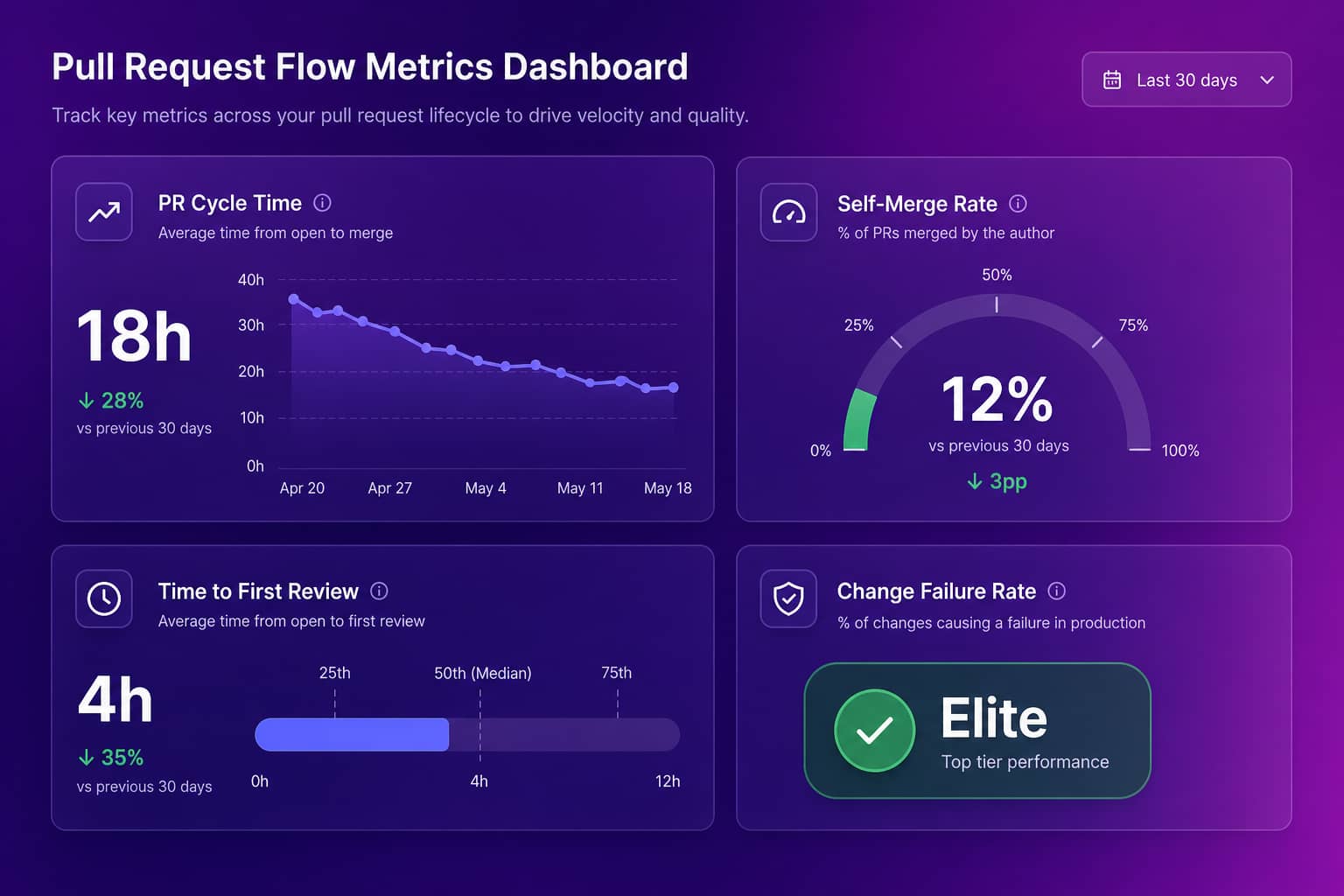
A checklist only runs on the PRs someone remembers to run it on, and only catches what a tired human notices at the end of a long list. The signals that actually predict ship risk live one level up, in the pattern across every PR your team has merged, not in any single review. Abloomify pulls this straight from GitHub: PR cycle time, time to first review, self-merge rate, and PR size, alongside all four DORA metrics (deployment frequency, lead time, change failure rate, mean time to recovery) each banded Elite to Low, with automatic change-failure detection built from failed deploys and reverts. Security posture layers in from Dependabot and code scanning, ranked by CVSS severity and EPSS exploit probability, so a checklist item like "does this touch a flagged dependency" stops being a manual lookup and becomes a fact the reviewer already has in front of them.
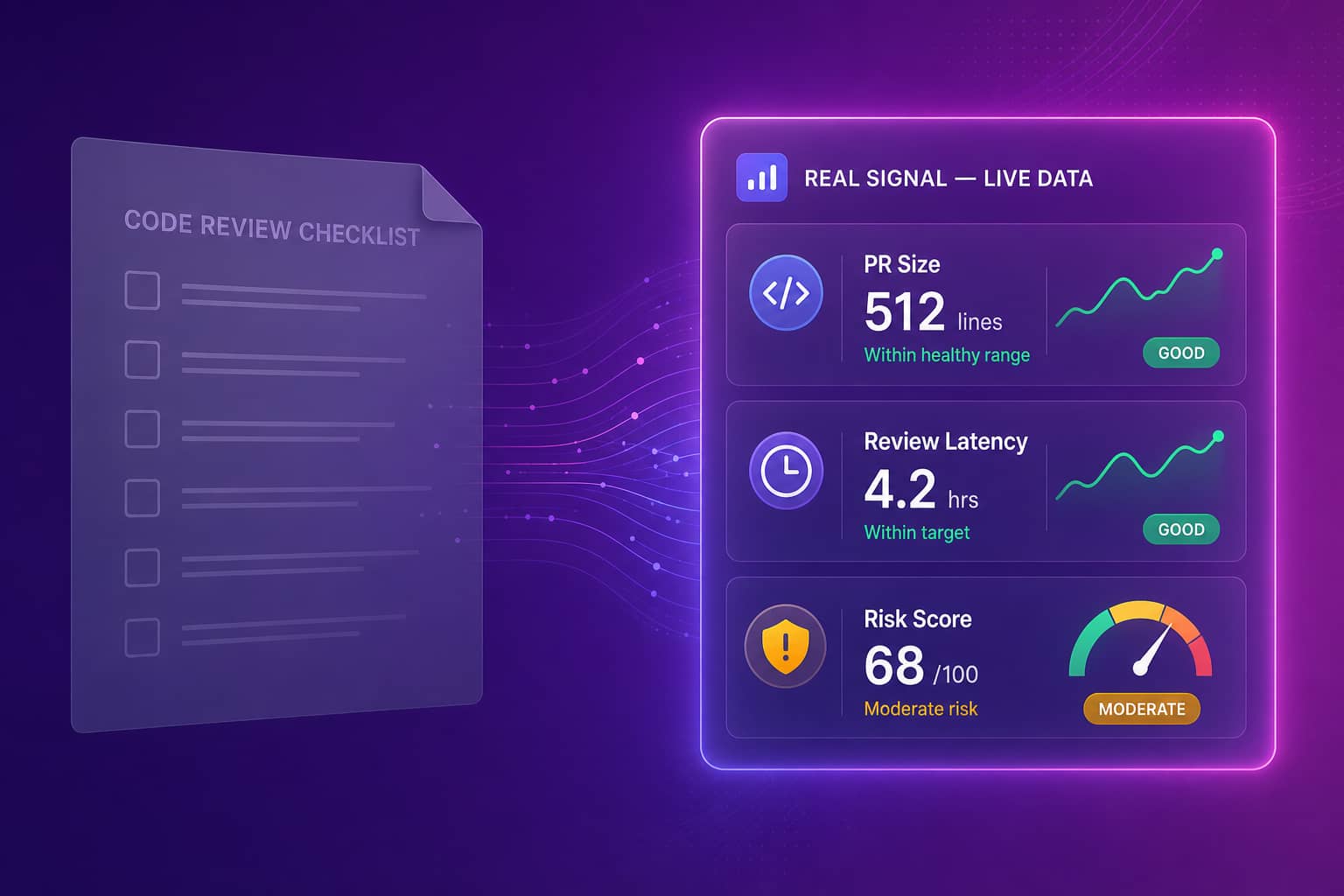
That's the shift a checklist alone can't make. A human running a checklist by hand is checking one PR in isolation. A checklist informed by cycle time, self-merge rate, and change-failure history is checking that PR against every PR your team has shipped, including the ones that went wrong.
AI-Generated Code Changes the Checklist
When I switched our stack from GitHub Copilot and ChatGPT to Cursor, the volume of code we were reviewing went up before the quality of our reviews caught up. That's the part most code review checklists written before 2025 don't account for: they assume every line in the diff came from a person who understood the surrounding file. AI-generated code is frequently locally correct and globally wrong. It solves the function directly in front of it competently, then breaks an assumption two files over that it never had visibility into. A reviewer skimming that diff the way they'd skim hand-written code will miss exactly the failure mode AI output is most prone to.
The checklist question that needs to exist now: how much of this PR is AI-assisted, and which parts. Abloomify separates human vs AI agent contribution across code, commits, and reviews, and correlates AI coding tool usage (Cursor, Claude Code, GitHub Copilot) with actual output, so "is this team's AI adoption translating into shipped, working code" stops being a guess. That answer changes what a reviewer should be looking for on a given PR. A diff that's 80% AI-generated deserves more attention at file boundaries and integration points, not more attention to whether the variable names match your style guide. If your team is also running AI on the review side, our breakdown of AI code review covers what it catches and what it still misses.
How to Build a Checklist Your Team Will Actually Use
Start from incidents, not from a template. Pull the last five "how did this get merged" postmortems your team has run, and write down what a checklist item would have needed to say to catch each one. That's your first draft. It will be short, five to eight items, because most real incidents trace back to two or three recurring patterns: missing test coverage on an edge case, a migration with no rollback, or a PR too large for anyone to have actually read it closely.
Then connect it to your PR flow data instead of leaving it as a static doc nobody opens. If self-merge rate creeps up, that's a sign the checklist is being skipped, not that it's working. If time to first review stretches past a day, PRs are sitting long enough that reviewers approach them fatigued rather than fresh, and checklist adherence drops with it right alongside review quality. A checklist reviewed once a quarter against those three signals, self-merge rate, time to first review, and PR size, tells you faster than any incident postmortem whether the process is holding or quietly eroding. Engineering leaders using Abloomify's engineering productivity analytics get PR cycle time, review health, and workload distribution in one place instead of pulling GitHub exports by hand every sprint to check whether the process is actually holding.
When to Automate the Checklist Instead of Running It by Hand
Some checklist items should never be a human's job in the first place. "Does this touch a flagged dependency" is a lookup a security-posture feed can answer before a human opens the tab. "Is this file historically incident-prone" is a pattern a tool watching commit and incident history over time can flag automatically. "Is this PR unusually large for this repo's norm" is a threshold, not a judgment call. What should stay manual is judgment: does the rollback plan actually make sense, does the test cover the real behavior change, is this the right architectural call. Automate the lookups. Keep the judgment.
That's the split we built Abloomify's engineering intelligence around: automate the DORA metrics, PR flow signals, and security posture that a human shouldn't be manually re-deriving every sprint, and leave engineers free to spend review time on the calls a dashboard can't make. Big companies bring a 40-item checklist and a review-approval workflow with three sign-offs. Startups bring a five-item list and data that tells them when it's not working.
FAQ
What should be on a code review checklist?
Keep the items that catch real failure modes: does it have a test, does it have a rollback path, does it touch a high-risk file, is the diff small enough for a reviewer to actually hold in their head. Drop the naming-convention and formatting items; a linter should own those, not a human.
How long should a pull request sit in code review?
There is no universal number, but time to first review matters more than total cycle time. A PR that waits 30 hours for someone to even look at it has a process problem, not a review-quality problem. Abloomify customers track this as one PR flow metric alongside cycle time and self-merge rate.
Should AI-generated code get a different code review checklist?
The checklist items do not change, but the volume does. When a third or more of a diff is AI-generated, reviewers need to know which parts, because AI output tends to be locally correct and globally wrong: it solves the function in front of it without knowing the file it is about to break two folders over.
What's the difference between a code review checklist and code review metrics?
A checklist is what a human checks on one PR. Metrics are what you track across every PR: cycle time, time to first review, self-merge rate, PR size, change failure rate. A good checklist is built from what the metrics say actually predicts a bad outcome, not from a template someone copied off the internet.
Does a checklist replace DORA metrics?
No. A checklist is a per-PR gate a human runs by hand. DORA metrics, specifically change failure rate, tell you after the fact whether your checklist is working. Abloomify computes all four DORA metrics directly from GitHub, banded Elite to Low, with automatic change-failure detection from failed deploys and reverts.
Amir Tavafi
Co-Founder & CEO
Product leader and innovator with over 15 years of experience in the tech sector, grounded in AI and robotics. Previously led product development in fraud detection and AI solutions at Nasdaq Verafin.