AI in the Workforce: How to Staff and Measure It in 2026
July 30, 2026
Amir Tavafi
9 min read

AI in the workforce stopped being a forecast about two years ago. Part of every pull request now comes from Cursor or Claude Code, and part of every report starts as an AI draft. Your workforce already includes AI agents. Abloomify exists because most companies are staffing that blended team blind: no split between human and AI output, no capacity plan, and no ROI on the tools they already pay for.
Key Takeaways
Q: What does AI in the workforce mean in 2026?
A: It means people and AI agents producing work together: code, reviews, drafts, summaries, and analysis. Headcount no longer describes your real capacity, because some of the output is now AI. Abloomify separates human contribution from AI agent contribution so the blended team is something you can actually see.
Q: Will AI replace the workforce?
A: AI is replacing tasks faster than jobs, mostly repetitive admin and first-draft work. The exposed roles were mostly busywork. Judgment, coaching, and accountability do not automate, and they get more valuable as AI clears the noise around them. Reshaping beats mass replacement for most teams.
Q: How do you plan capacity for a blended workforce?
A: Treat AI as a labor input with a measurable ROI, not a mystery. Tie Cursor, Copilot, and Claude Code usage to delivery, track where AI adds leverage, and map the human capacity that frees up. Hidden capacity waste runs $500K-$2M a year at many midmarket tech companies.
Q: Can you measure this without monitoring employees?
A: Yes. Abloomify uses PII-free signals from 100+ integrations plus optional aggregated device metrics, with no screenshots or keyloggers. There is no evidence that monitoring improves performance, and 1 in 6 workers would quit over surveillance. Signals beat screen capture.
What does AI in the workforce mean?
AI in the workforce means AI tools and agents doing or assisting the real work of a company, from writing and reviewing code to drafting documents, summarizing meetings, answering questions over business data, and running scheduled analysis. A few years ago the phrase meant pilots and chatbots. In 2026 it means output that ships: when an engineer merges a feature, some of that diff came from an AI coding assistant and some came from their own judgment about what to keep. When an analyst produces a report, the first pass was often generated and then edited. The practical consequence is that the old unit of planning, one person equals one unit of work, no longer holds. Your headcount and your capacity have quietly stopped being the same number, and that gap is where most workforce decisions now go wrong.
This matters because the workforce is the single largest line item most tech companies carry, and AI is the fastest-growing new input into it. Treating AI as a vague tailwind ("everyone's more productive now") wastes the shift. The companies that win treat AI as a labor input they can measure: how much work it does, where it adds leverage, and where it just adds more code to review.
Will AI replace jobs, or just reshape the workforce?
AI is automating tasks much faster than it is deleting whole jobs, and the roles most exposed are the ones that were mostly busywork to begin with. That is the honest answer to "what jobs will AI replace by 2030," and it is less dramatic than the headlines. First-draft production, status chasing, copy-pasting metrics into decks, and turning meeting notes into follow-ups are collapsing toward zero effort. The durable work is the opposite of that: deciding what to build, telling someone their work is not good enough, holding a quality line under deadline pressure, and owning an outcome when it goes wrong. AI raises the value of that judgment because it clears the noise around it. So the realistic 2026 move is reshaping roles around AI, not mass layoffs, and the risk is not that AI takes the jobs but that leaders cut the wrong ones because they cannot see who actually produces value.
Your workforce already includes AI agents. Can you see them?
Your workforce already includes AI agents, and most companies cannot see them, which means they are running a blended team with visibility into only half of it. The moment coding assistants like Cursor, GitHub Copilot, and Claude Code started touching real production code, output stopped being a clean measure of human effort. Some engineers ship more because they are strong; some ship more because they lean hard on AI; some generate a lot of code that then eats reviewer time. If you only look at raw output, you reward the wrong pattern and miss the real one. Abloomify separates human contribution from AI agent contribution across tasks, code, pull requests, and reviews, and runs an AI-vs-human cohort comparison: do heavy AI adopters actually ship more and review faster, or just create more to check? That is the difference between managing a blended workforce and guessing at it.
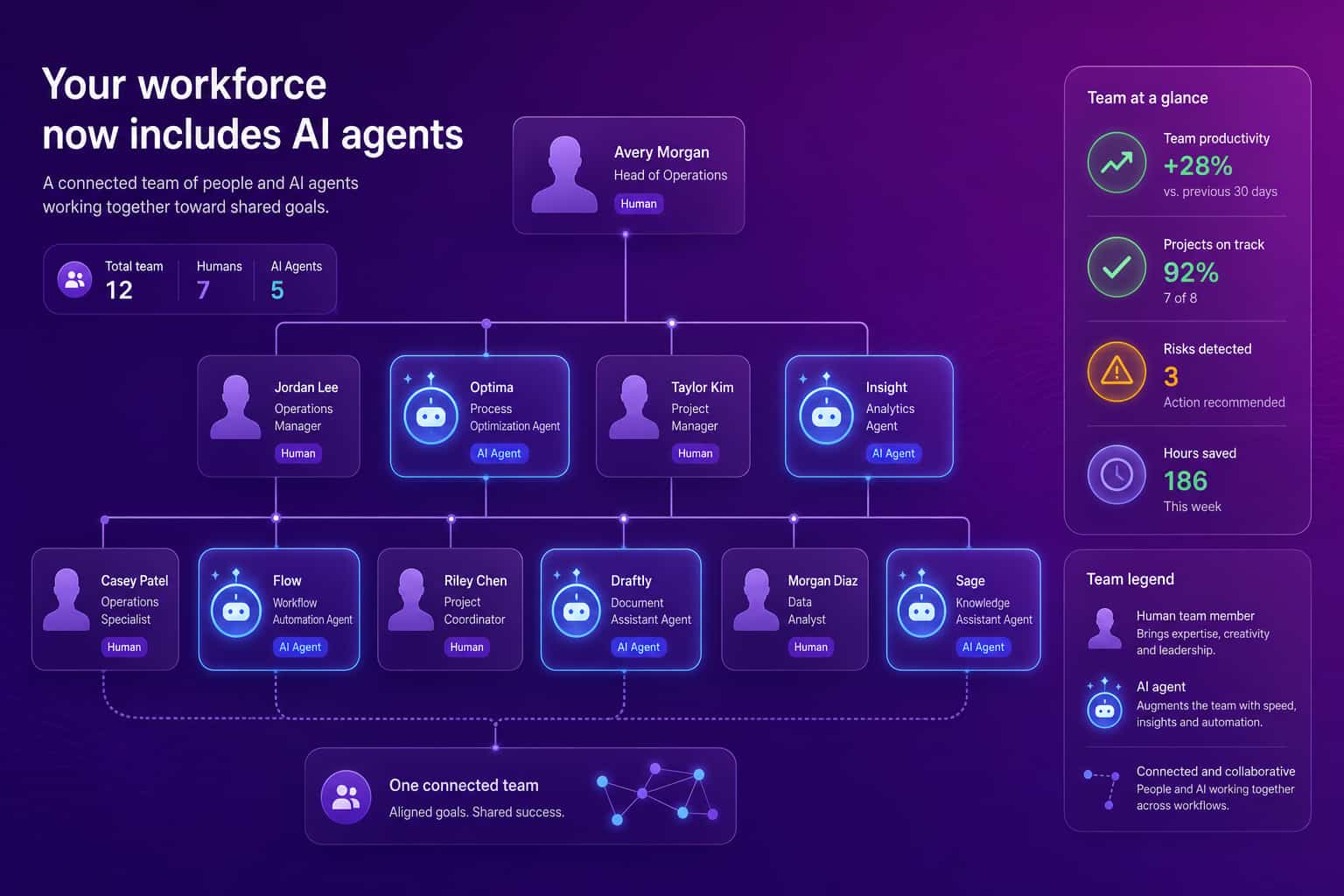
This is also where single-source data burns people. One of our own customers, a 3,500-person enterprise, started with Google Workspace engagement data alone and, candidly, saw low correlation to their internal performance metrics. The lesson we took from that is blunt: one signal under-proves value. Seeing a blended workforce takes multiple sources triangulated together, not a single dashboard read in isolation.
How to plan capacity for a human and AI workforce
Planning capacity for a human and AI workforce starts by treating AI as a measurable input with a real ROI, then reading the human capacity it frees up. Most teams deployed AI coding tools without ever answering the board's question: is this working, and for whom? Abloomify imports usage directly from Cursor, Claude Code, and GitHub Copilot, correlates it with engineering output like PR cycle time and code velocity, and even lets AI Leverage become a tunable pillar of an Engineering Velocity Score. Once you can see which teams turn AI spend into shipped work and which just hold licenses, capacity planning changes. Freed-up hours become visible and reallocatable instead of vanishing into more meetings. Hidden capacity waste, the utilization gaps and meeting overload nobody tracks, runs an estimated $500K-$2M a year at many midmarket tech companies, and a blended-workforce plan is how you claw it back.
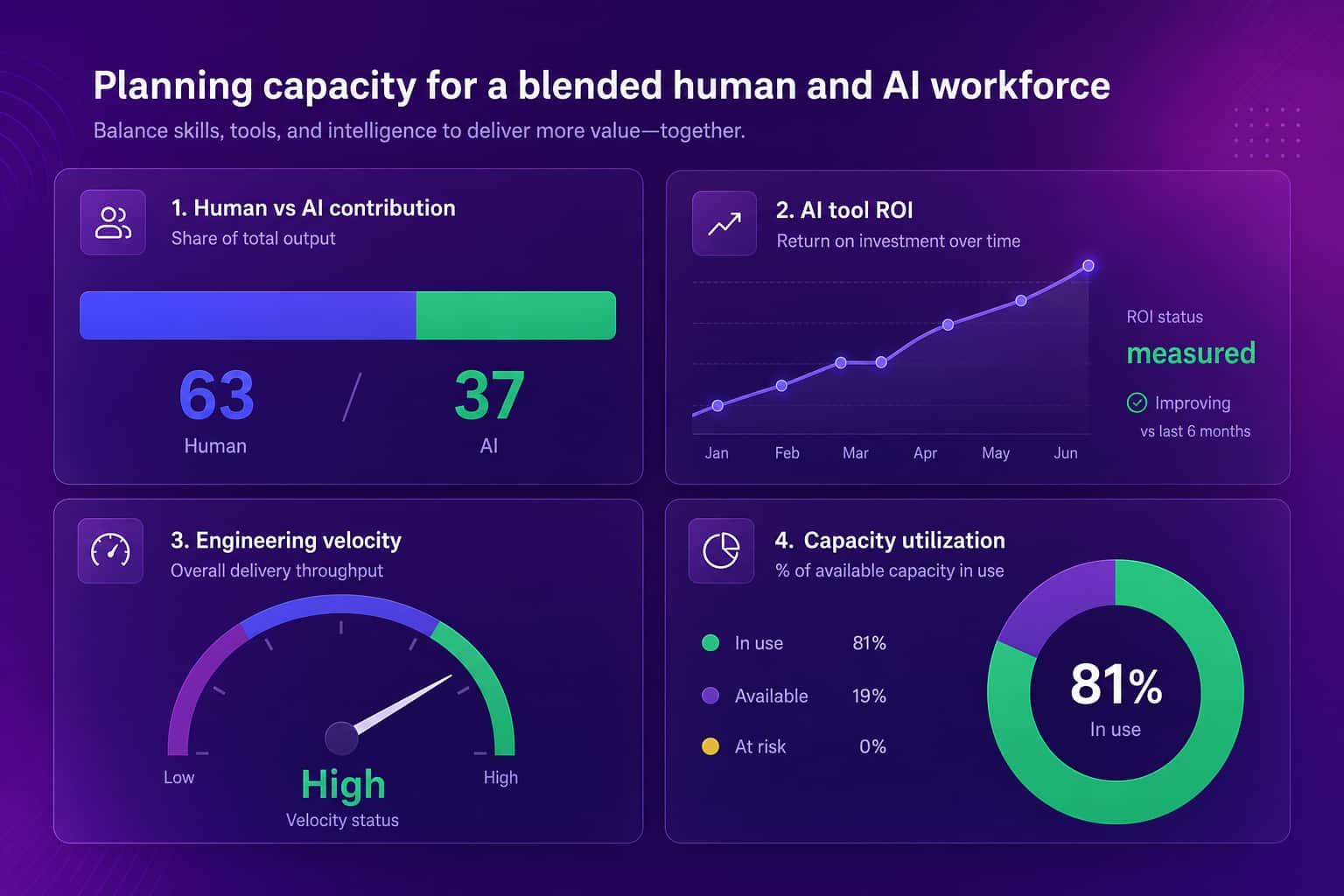
The practical workflow is boring in the best way. Connect GitHub, Jira, and your AI coding tools, measure the actual impact of AI adoption rather than trusting self-reports, and pair it with the delivery signals in a VP-of-engineering view of velocity. Leaders who do this stop debating whether AI helps and start deciding where to add people, where to redeploy them, and where an AI agent already covers the work. Engineering leaders can go deeper on this in Abloomify for engineering leaders.
Measuring an AI workforce without surveillance
You can measure an AI workforce without surveilling anyone, and you should, because the surveillance approach fails on both ethics and results. There is no evidence that monitoring improves performance (a Personnel Psychology meta-analysis found no such link), and roughly 1 in 6 workers say they would quit over intrusive monitoring. Screenshots and keyloggers buy you resentment and gamed behavior, not truth. Abloomify takes the opposite path: two data layers, 100+ API integrations that read PII-free signals only (no email content, no message content, no file content) plus optional privacy-first device agents that collect aggregated usage metrics with no screenshots, no keyloggers, and no screen recording. It is PII-free by architecture and SOC 2 Type II certified, so you get contribution, capacity, and AI ROI visibility without the trust damage. That combination is what makes measuring a blended workforce sustainable instead of a one-time audit people learn to route around.
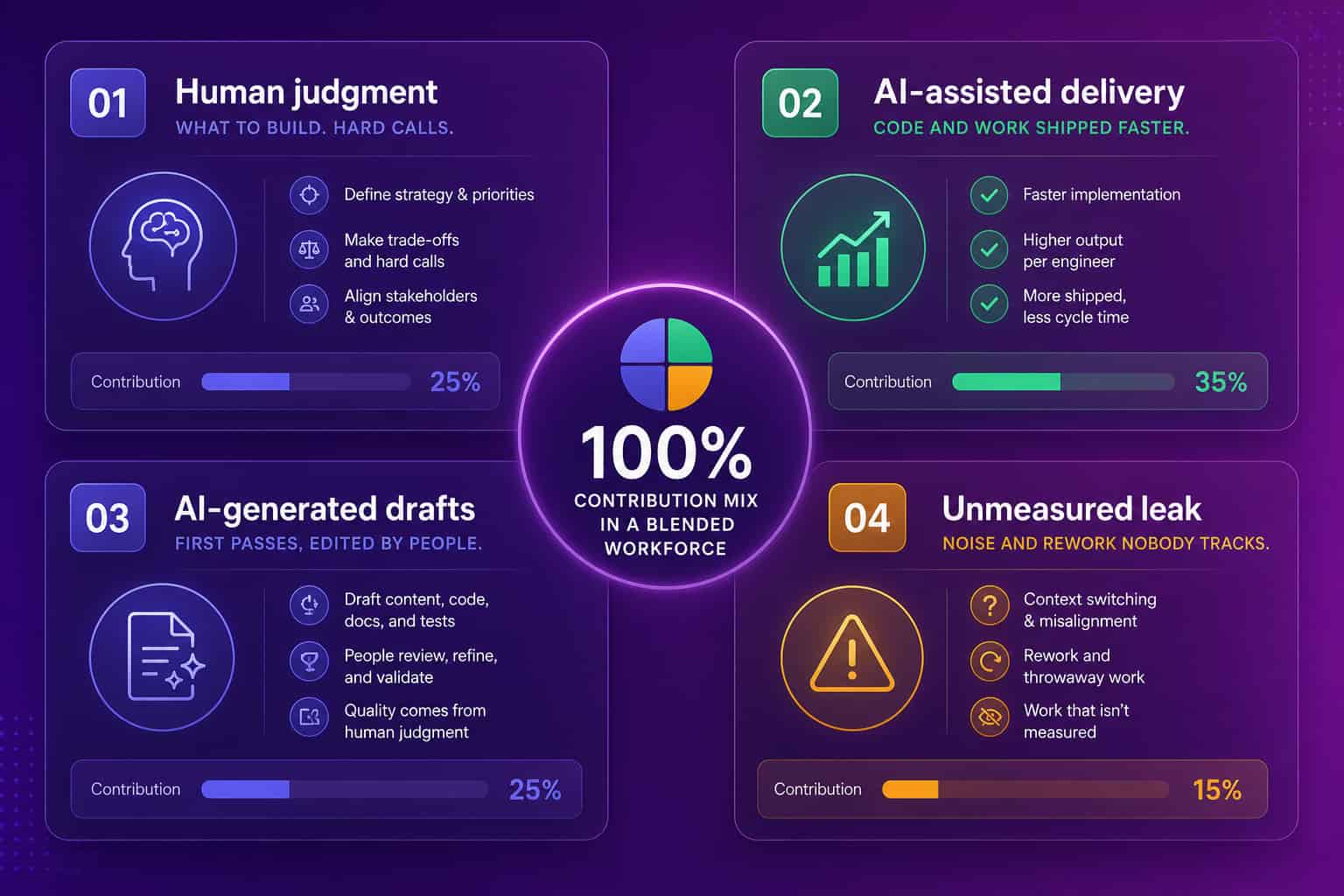
The goal is not a scoreboard. It is clarity: who is doing the judgment work, where AI is genuinely adding leverage, and where output is leaking into rework nobody tracks. Start with the workforce analytics that connect your existing tools and read the team you actually have, humans and agents together. Headcount tells you who you hired. Contribution tells you what your workforce is really producing.
FAQ
What does AI in the workforce mean?
AI in the workforce means AI tools and agents doing real work alongside people: writing and reviewing code, drafting and summarizing documents, and analyzing operations. In 2026 the important shift is that your output is now a blend of human and AI effort, so headcount alone no longer describes your capacity. Measuring the human-versus-AI split is the new baseline.
Will AI replace jobs in the workforce by 2030?
AI is automating tasks faster than whole jobs. The roles most exposed are the ones that were mostly busywork, like first-draft production and status reporting. Judgment, coaching, and accountability do not automate and grow more valuable as AI clears routine work. Most companies will reshape roles rather than replace engineers wholesale, and the real risk is cutting the wrong roles blind.
How do you measure human vs AI contribution?
Connect the tools where work happens and separate the two inputs. Abloomify imports usage from Cursor, GitHub Copilot, and Claude Code, correlates it with delivery output across GitHub and Jira, and splits human contribution from AI agent contribution across code, pull requests, and reviews. It also compares heavy AI adopters against everyone else, so ROI becomes a number you can defend.
How do you track AI in the workforce without surveillance?
Use signals instead of screen capture. Abloomify is privacy-first and PII-free by architecture: 100+ API integrations plus optional device agents that collect aggregated metrics, with no screenshots, keyloggers, or screen recording. There is no evidence monitoring improves performance, and 1 in 6 workers would quit over it. You get contribution and capacity visibility without the trust damage. SOC 2 Type II certified.

Amir Tavafi
Co-Founder & CEO
Product leader and innovator with over 15 years of experience in the tech sector, grounded in AI and robotics. Previously led product development in fraud detection and AI solutions at Nasdaq Verafin.