Workforce Intelligence: What It Is and Why Monitoring Fails (2026)
June 23, 2026
Amir Tavafi
10 min read

Workforce intelligence is how operations and engineering leaders see where work actually happens without watching anyone's screen. Abloomify connects to the 100+ tools a company already runs on, from GitHub and Jira to Google Workspace and CRM, and turns those signals into a clear operating picture. Privacy-first by architecture. No screenshots, no keyloggers, no screen recording. The goal is decisions, not surveillance.
Key Takeaways
Q: What is workforce intelligence in plain terms?
A: It connects the work signals a company already generates across GitHub, Jira, Google Workspace, and CRM, then turns them into answers about capacity, velocity, and waste. Abloomify delivers this privacy-first, using PII-free metrics instead of screenshots or keyloggers.
Q: How is it different from employee monitoring?
A: Monitoring tools install endpoint agents that can capture screens and keystrokes. Workforce intelligence reads aggregated signals from work tools via API. There is no evidence monitoring improves performance, and 1 in 6 workers would quit over surveillance.
Q: What can leaders actually find with it?
A: Hidden capacity waste that can run $500K to $2M a year, $50K to $100K in unused SaaS licenses, and burnout 60+ days before it shows up in attrition. All from work data, not surveys or gut feel.
Q: Who buys workforce intelligence?
A: COOs and CEOs who need efficiency without employee backlash, and VPs of Engineering who want PR cycle time, review health, and AI coding tool ROI in one view. Abloomify's first three customers were all COO-championed.
Q: How fast does it pay off?
A: A 30-Day Workforce Waste Assessment returns a dollar-quantified report. One 3,500-person enterprise used a 30-day pilot to surface quiet quitters, and a 400-person fintech gained capacity visibility across a distributed team.
What is workforce intelligence?
Workforce intelligence is the practice of connecting signals from the systems a company already runs on, then using analysis and AI to show where work happens, where output leaks, and which tools create or destroy leverage. It pulls from source code, project trackers, calendars, meeting tools, CRM, and AI coding assistants, and it ties those signals to outcomes rather than activity. The difference from a generic dashboard is the layer on top: instead of leaving a leader to interpret twenty charts, a workforce intelligence platform surfaces the one capacity gap or the one review bottleneck that matters this week. Abloomify is built this way, with 100+ API integrations and optional privacy-first device agents that collect aggregated metrics, never screen content. The point is to answer real questions, like who is overloaded right now, with data a leader can trust.
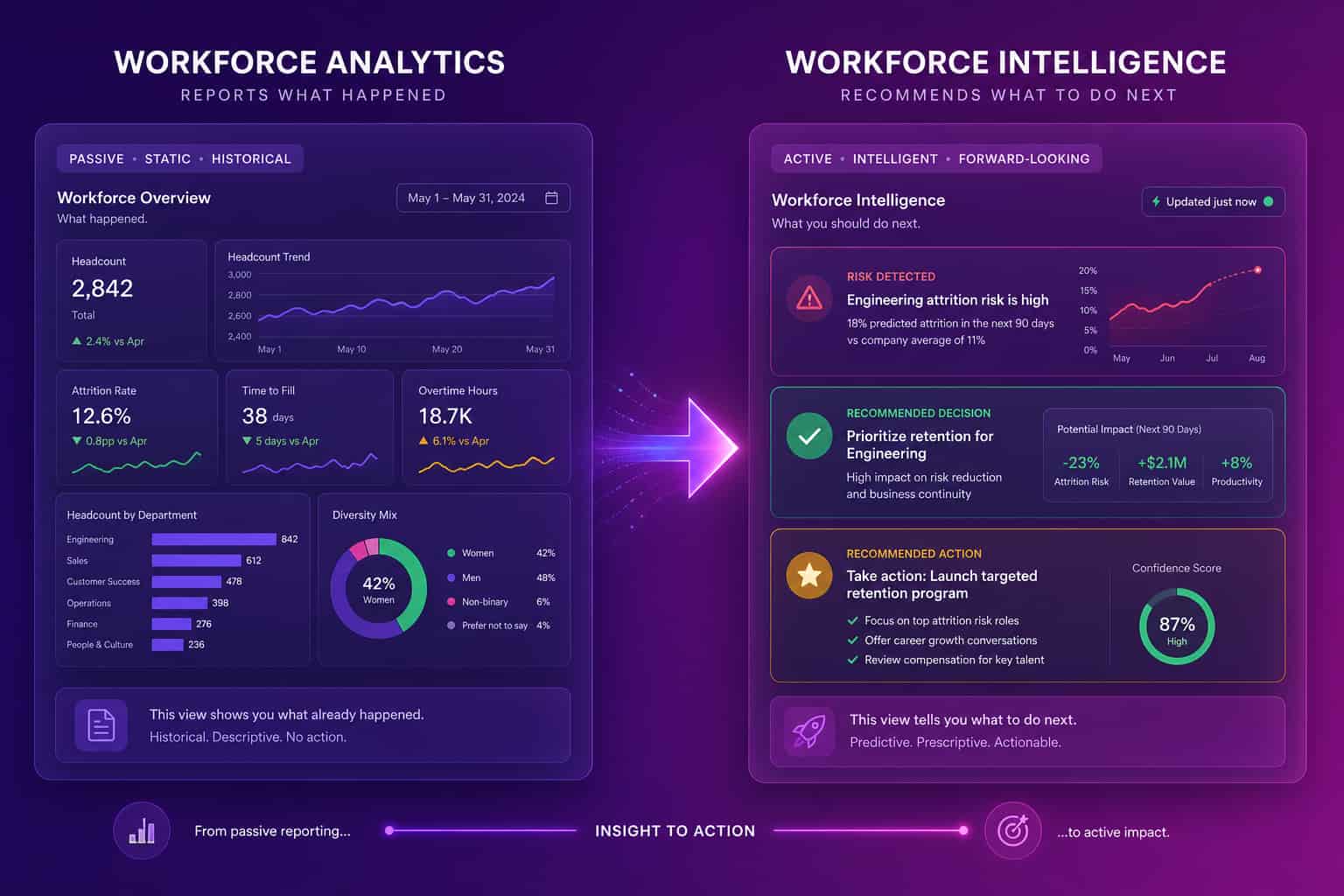
Most leaders already have fragments of this. Engineering has GitHub insights. Ops has a spreadsheet. HR has an engagement survey. The problem is that none of those fragments talk to each other, and each one is a single source. A 50-person SaaS customer put it well when their COO compared Abloomify against the manual analysis they ran by hand: "What I did manually this week in a spreadsheet is exactly what I think Abloomify should be doing automatically." That is the job. Replace the spreadsheet, connect the sources, and make the signal trustworthy enough to act on.
Workforce intelligence vs workforce analytics
Workforce analytics and workforce intelligence are often used as synonyms, but they sit at different points on the same path. Workforce analytics reports what already happened: headcount, utilization, time-to-hire, engagement scores. It is descriptive, it lives in dashboards, and it leaves interpretation to the reader. Workforce intelligence starts from the same work data but adds a decision layer. It connects more sources, weights the signals, flags the risk, and in Abloomify's case answers questions in plain language through Bloomy, the company-aware AI analyst. Analytics tells you the past. Intelligence helps you decide what to do about it. The distinction matters because a buyer drowning in dashboards does not need a twenty-first chart. They need the platform to say where the capacity gap is and what it costs.
| Capability | Workforce analytics | Workforce intelligence |
|---|---|---|
| Core output | Dashboards and reports | Answers, alerts, and recommended actions |
| Data sources | Usually HRIS or one system | 100+ work tools triangulated |
| Question it answers | What happened? | What is happening and what should I do? |
| AI layer | Optional, surface-level | Company-aware AI analyst (Bloomy) |
| Privacy posture | Varies | Privacy-first, PII-free by architecture |
If you want the deeper version of the analytics side, our guide to privacy-first workforce analytics software covers the data layer in detail. Workforce intelligence is that layer plus the judgment on top.
What workforce intelligence measures
A good workforce intelligence platform measures four things that traditional tools keep in separate silos: capacity, engineering velocity, AI tool ROI, and risk. Capacity covers utilization gaps, meeting overload, and the invisible slack that costs companies $500K to $2M a year. Engineering velocity covers PR cycle time, review health, and delivery flow, with human versus AI agent contribution separated so leaders know what people built and what the tools generated. AI tool ROI ties spend on Cursor, Copilot, and Claude Code to measurable output instead of seat counts. Risk covers burnout signals, disengagement, and SaaS license waste. Abloomify pulls all four from aggregated work data, which is why a single connection can surface findings that five disconnected tools miss. The breadth is the point. Single-source data under-proves value, a lesson we learned the hard way.
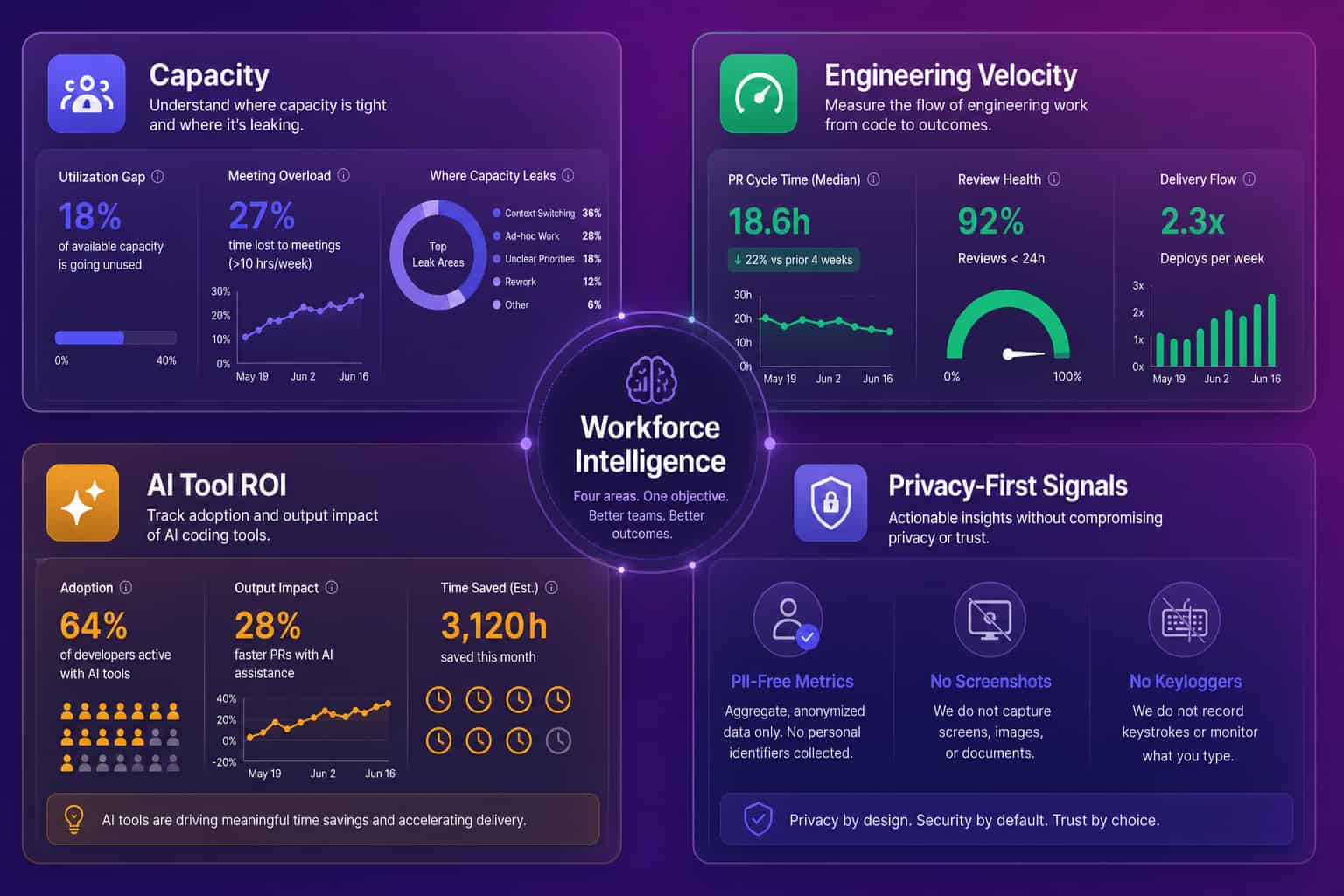
The capacity and velocity numbers are not abstractions. A 3,500-person enterprise came to us through a single cold email with the subject line "Quiet quitters at [Company]?" and ran a Google Workspace diagnostic to find attrition risk. A 400-person fintech started with capacity utilization across a distributed team and is now expanding into GitHub engineering intelligence. For the engineering-only view, our developer productivity metrics guide goes deeper on what to track and what to ignore.
Why employee monitoring fails as workforce intelligence
Employee monitoring tools fail at workforce intelligence because they answer the wrong question and damage trust doing it. ActivTrak, Insightful, Time Doctor, and Hubstaff install endpoint agents that capture screen activity and, depending on the product, screenshots, keystrokes, or screen recordings. That produces a feed of activity, not a measure of outcomes, and it triggers exactly the resistance you would expect. There is no evidence in the research that monitoring improves performance, per a Personnel Psychology meta-analysis, and 1 in 6 workers say they would quit over surveillance. So the monitoring buyer pays for a tool that does not move performance, costs them trust, and still cannot tell them whether their engineering team is faster or their AI tool spend is working. Workforce intelligence inverts that trade. Same visibility, better signal, no surveillance tax.
This is the part most vendors get backwards. They bolt a privacy story onto a surveillance architecture. Abloomify is PII-free by architecture: no email content, no message content, no file content, no screenshots. The device agents that some customers add collect aggregated usage by application category, not what was typed or read. That design is also why the platform is SOC 2 Type 2 certified and built to be EU AI Act and GDPR compliant. If you want the long version of measuring output without watching screens, see how to measure productivity without screenshots.
What to look for in a workforce intelligence platform
When you evaluate a workforce intelligence platform, weight five things: data breadth, privacy architecture, the AI layer, engineering depth, and time to a usable answer. Breadth means real integrations across project management, source code, office suite, CRM, and AI tools, not a single HRIS feed, because single-source data consistently under-proves value. Privacy architecture means PII-free by design, with no screenshots or keyloggers, so you can deploy without an employee revolt. The AI layer should answer questions in plain language, not just render more charts. Engineering depth matters if you have a real eng org, because PR cycle time and human versus AI contribution are signals most workforce tools simply do not have. And time to value should be measured in weeks, not quarters. The tools that win for midmarket leaders are the ones that turn a connection into a dollar-quantified finding fast.
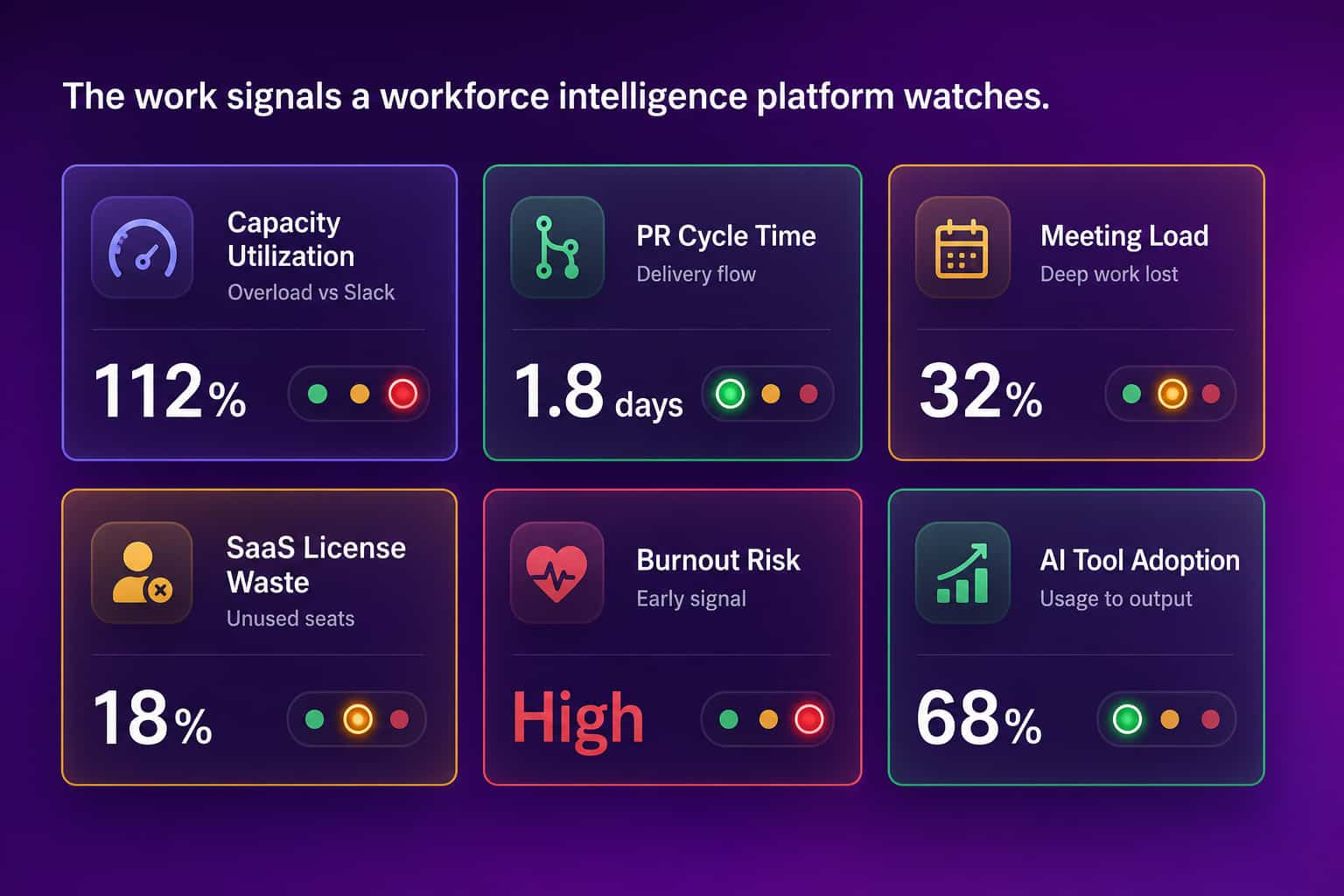
A practical filter: if the demo could have been given by ActivTrak, keep looking. The capability that separates a real platform is the combination, capacity plus velocity plus AI ROI plus risk, read from the same trusted work data. For the operations buyer, our view for operations leaders maps these signals to the COO's actual questions, and the engineering productivity analytics page does the same for VPs of Engineering.
How to get started with workforce intelligence
The fastest way to get value is to start narrow, prove a number, then expand. Abloomify's 30-Day Workforce Waste Assessment connects Google Workspace or M365 plus one additional source and returns an executive report with dollar-quantified waste findings, a capacity map, and recommended actions. The setup cost is about an hour of read-only access. There is no agent install required for the diagnostic, which is how a 3,500-person enterprise got through legal quickly and into a 30-day pilot. Engineering teams can run the parallel path, a 10-Day Engineering Velocity Pilot that connects GitHub plus optional Jira and AI coding tools, and returns a team health scorecard with a PR bottleneck map and a human versus AI agent contribution breakdown. Either way, you keep the report. Start with one painful question, answer it with real data, and let the result decide whether you go deeper.
Big platforms sell you a year-long rollout and a steering committee. Workforce intelligence should pay for itself in the first month. Start narrow. Prove the number.
FAQ
What is workforce intelligence?
Workforce intelligence is the practice of connecting signals from the tools a company already runs on, like GitHub, Jira, Google Workspace, and CRM, to show where work happens, where output leaks, and which tools create or destroy leverage. Abloomify does this privacy-first, with no screenshots or keyloggers.
What is the difference between workforce intelligence and workforce analytics?
Workforce analytics reports what already happened in dashboards and charts. Workforce intelligence adds AI on top of that work data to flag risks, recommend actions, and answer leadership questions in plain language. Analytics tells you the past. Intelligence helps you decide what to do next.
Is workforce intelligence the same as employee monitoring?
No. Employee monitoring tools install endpoint agents that can take screenshots, log keystrokes, or record screens. Workforce intelligence platforms like Abloomify connect to work tools via API and use PII-free signals only. There is no evidence monitoring improves performance, and 1 in 6 workers would quit over surveillance.
What does a workforce intelligence platform measure?
It measures capacity (utilization gaps, meeting overload), engineering velocity (PR cycle time, review health), AI tool ROI (adoption and output of Cursor, Copilot, Claude Code), and risk signals (burnout, disengagement, SaaS license waste), all from aggregated work data rather than screen surveillance.
How long does it take to get value from workforce intelligence?
With Abloomify, a 30-Day Workforce Waste Assessment connects Google Workspace or M365 plus one more source and returns a dollar-quantified report. A 3,500-person enterprise ran a 30-day pilot to identify quiet quitters, and a 400-person fintech gained capacity visibility across distributed teams.

Amir Tavafi
Co-Founder & CEO
Product leader and innovator with over 15 years of experience in the tech sector, grounded in AI and robotics. Previously led product development in fraud detection and AI solutions at Nasdaq Verafin.