What Is a Skip-Level Meeting? (2026 Guide for Managers)
August 28, 2026
Amir Tavafi
12 min read

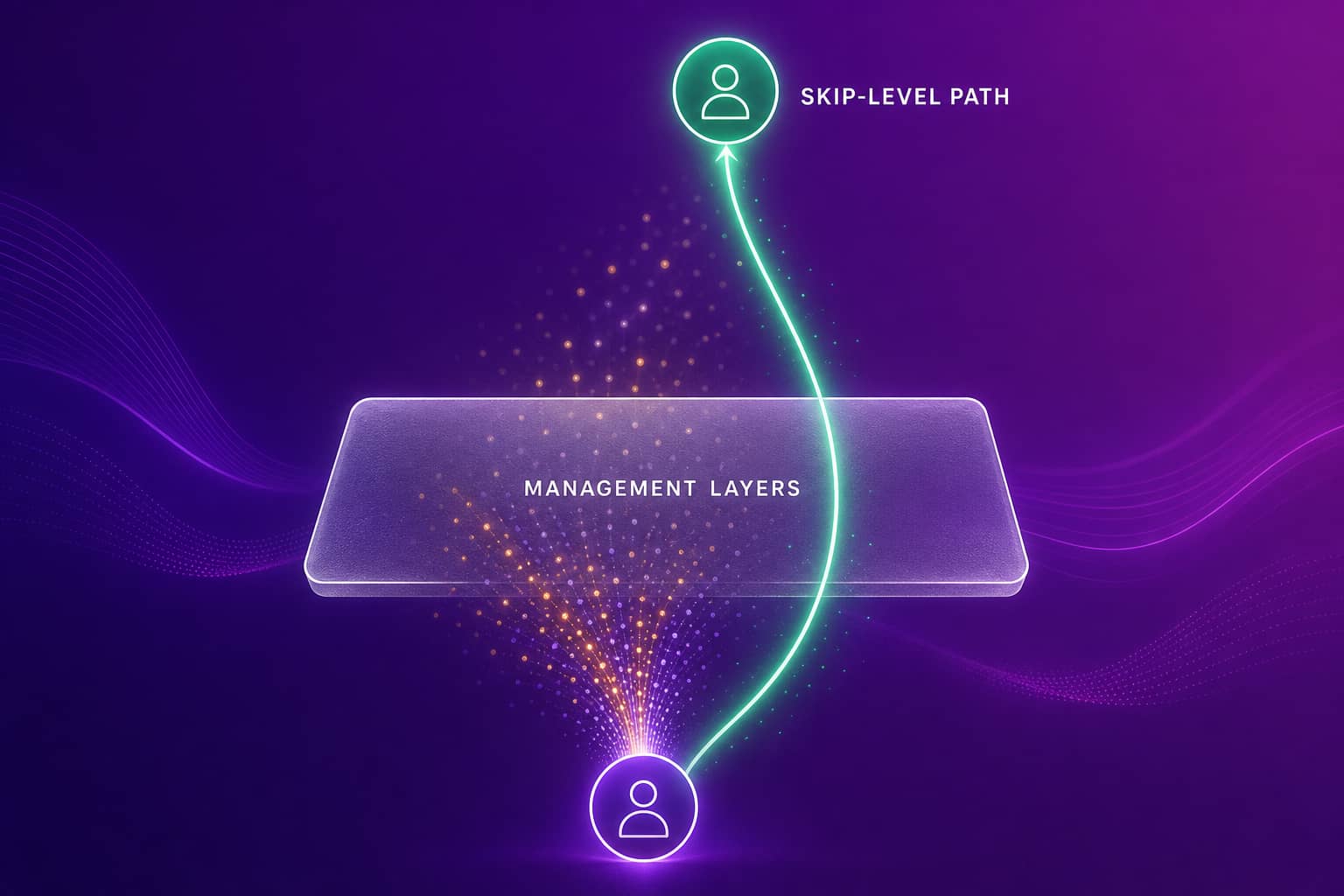
A skip-level meeting is a one-on-one between a leader and someone who does not report to them directly, usually their manager's direct report. It exists because information gets thinner the higher it climbs an org chart, and by the time a status update reaches a VP, most of the real signal has been rounded off. Abloomify builds tools for exactly this gap, what a leader actually knows about their team versus what they are told. Here is what a skip-level meeting is, why it works, and how to run one that surfaces truth instead of a rehearsed status check.
Key Takeaways
Q: What is a skip-level meeting?
A: A skip-level meeting is a one-on-one conversation between a leader and an employee who reports to someone else on their team, typically a direct report's direct report. The senior leader "skips" the management layer in between. It is not a group meeting and not a performance review. It is a direct channel for information and trust that would otherwise pass through a manager first.
Q: Are skip-level meetings good or bad?
A: Skip-level meetings are good when run with a clear purpose, and bad when they turn into a surprise interrogation or a way to route around a manager's authority. Done well, they build trust and surface problems early. Done badly, with no notice to the manager and questions that fish for complaints, they damage the exact relationship layer they were meant to strengthen.
Q: What is the purpose of a skip-level meeting?
A: The purpose is to give senior leaders a direct read on how work is actually going, without it passing through a manager's summary first. The further a signal travels through a hierarchy, the more it gets filtered and polished, so a skip-level shortens the path instead of trying to build a better filter.
Q: What questions should you ask in a skip-level meeting?
A: Ask about the work before asking about the manager: what is blocking progress, what tool or process wastes the most time, what would you fix if you ran this team for a week. Save manager-relationship questions for later in the conversation, and never open with "how is your manager doing," which puts the employee on the spot immediately.
Q: How often should you hold skip-level meetings?
A: Most tech companies run skip-levels every 6 to 8 weeks, in 45- to 60-minute blocks, longer and less frequent than a standard weekly 1:1. Quarterly works for larger orgs where a leader has 20 or more skip-level relationships to maintain across teams.
Q: What's the difference between a skip-level meeting and a skip-level interview?
A: A skip-level meeting is a recurring relationship-building conversation with someone already on the team. A skip-level interview is a one-time step in a hiring process, where a candidate meets their prospective manager's manager before an offer goes out. Same "skip" logic, different purpose: one builds an ongoing channel, the other vets a hire.
What Is a Skip-Level Meeting, Exactly?
A skip-level meeting is a scheduled one-on-one between a leader (a director, VP, or founder) and an employee who is two or more levels below them on the org chart, meaning at least one manager sits between them normally. The name comes from the org chart itself: the conversation "skips" a level of hierarchy. A VP of Engineering meeting directly with a senior engineer who reports to an engineering manager, without that manager in the room, is a skip-level. It is different from a regular 1:1, which happens between an employee and their direct manager, and different from a group skip-level or "town hall," where a leader talks to a whole team at once. A skip-level is one person, one leader, no manager present, and it is not where performance ratings or compensation get discussed. That belongs in the formal review cycle.
Skip-levels are optional in most companies, which is exactly why they get skipped. Nobody's calendar enforces them the way it enforces a weekly staff meeting. The tech companies that run them well treat them as a standing recurring event, not a one-off when something feels wrong. The tech companies that run them badly only schedule one after a resignation, which turns the whole exercise into damage control instead of a normal part of how information moves.
Why Skip-Level Meetings Matter
Skip-level meetings matter because organizations lose information at every layer of management, and nobody notices it happening in real time. A manager summarizing their team's status to their own manager naturally rounds off the sharp edges, not out of dishonesty but because summarizing is compression, and compression drops detail. By the time a concern travels through two or three layers, "we're behind because the API contract changed twice this sprint and nobody flagged it" has become "engineering is a little behind schedule." A skip-level gives a leader one unfiltered data point per employee, which is not the whole picture, but it is a real one instead of a summarized one.
The harder problem is that most leaders do not know which of their people are quietly struggling, quietly checked out, or quietly carrying the team, because the answer to "who is overloaded right now" usually requires digging across five different tools: a calendar, a project tracker, a Slack channel, and a manager's memory. Skip-levels help, but a once-a-quarter conversation cannot substitute for actually knowing the workload picture before you walk in.
How to Prepare for a Skip-Level Meeting
Preparing for a skip-level meeting means walking in with a specific reason to talk to this particular person, not a generic "checking in" agenda that could apply to anyone on the team. Five things make the difference: know one concrete thing about their recent work before the meeting (a project they shipped, a blocker they hit, a decision they made), tell their manager the meeting is happening and roughly when, pick 2 to 3 open questions instead of a scripted checklist, protect 45 to 60 minutes without interruptions, and write down one follow-up action within 24 hours so the conversation visibly goes somewhere. Skipping any one of these is what turns a skip-level into a pleasant chat that changes nothing.
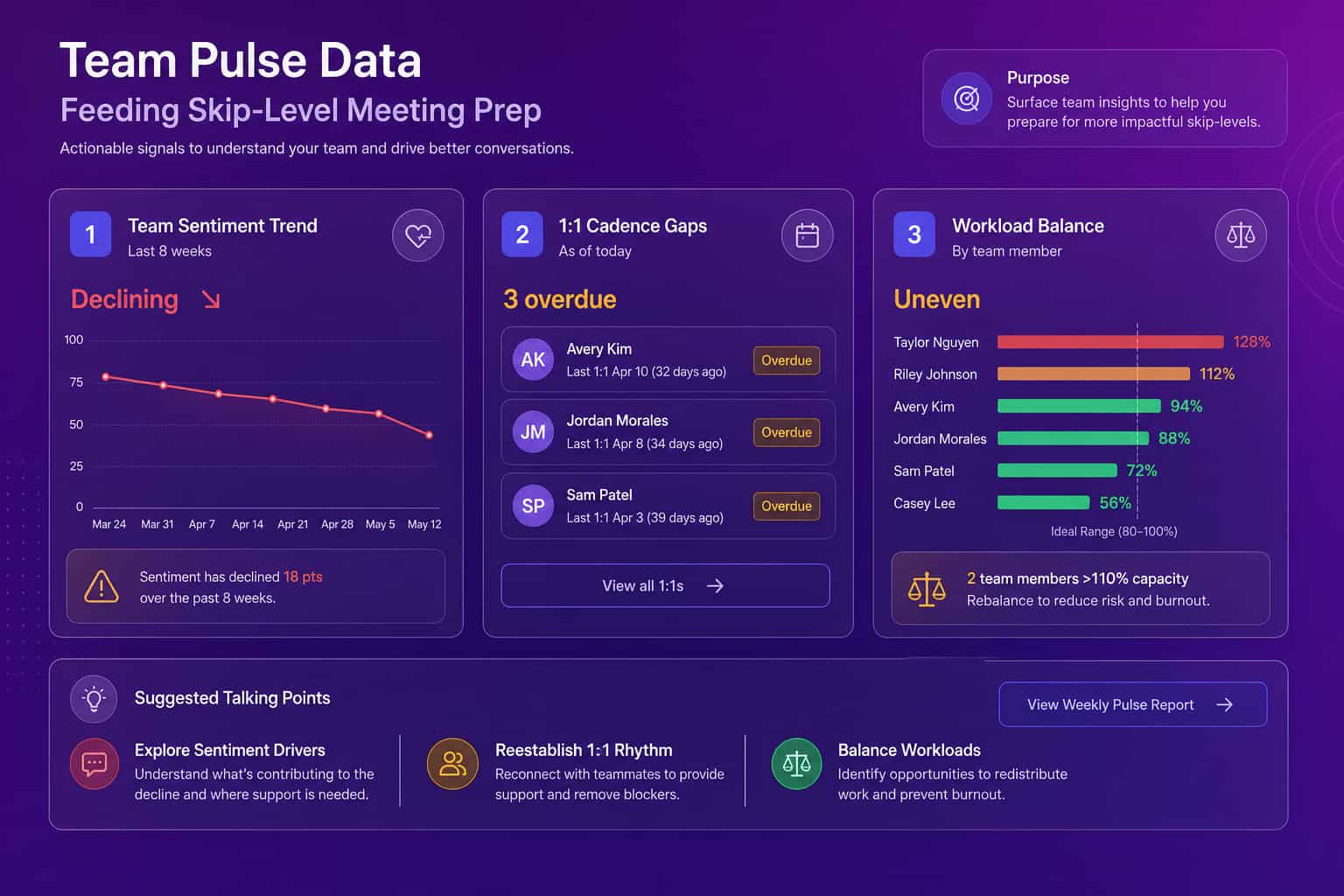
The preparation step most leaders skip is the data work. Reviewing a person's recent work pattern, not their output quality, but signals like whether their 1:1 cadence with their manager has slipped, whether their workload looks balanced against the rest of the team, or whether team sentiment has been trending down, gives a leader something concrete to ask about instead of "so, how's it going." Abloomify's AI People Manager pulls exactly this kind of context from connected tools so a leader is not reconstructing it by hand before every skip-level. The same prep discipline that makes a regular one-on-one agenda work applies here, just at a lower frequency and a wider scope, and the same 5-minute prep habit that works for weekly 1:1s scales down fine for a meeting you only run every 6 to 8 weeks.
What to Ask: Skip-Level Meeting Questions That Get Honest Answers
The best skip-level meeting questions start with the work and the team, not with the manager, and they ask for specifics instead of ratings. "What's the one thing slowing your team down that leadership doesn't see?" beats "how are things going?" because it forces a concrete answer instead of a pleasantry. "If you had to fix one process this quarter, what would it be?" surfaces operational friction without putting anyone on trial. "What's something your manager has done recently that you'd want more leaders to do?" is a positive-framed way to get honest signal about the management layer without an interrogation. Save any question about the direct manager's performance for the very end of the conversation, and only if the employee brings it up first or the relationship clearly supports it.
Questions to avoid entirely: anything that starts with "confidentially" (it signals you're building a case), anything that asks the employee to rate or grade their manager on a scale, and anything you would not be comfortable having the manager overhear afterward. A skip-level built on secrecy trains people to give you the safe answer, not the true one.
How Often to Run Skip-Levels (and the Mistakes That Kill Them)
Most tech companies run skip-level meetings every 6 to 8 weeks in 45- to 60-minute blocks, which is a lower frequency and a longer duration than a standard 30-minute weekly 1:1. That cadence works because a skip-level isn't meant to track day-to-day work, that's the manager's job, it's meant to build a relationship and catch things that only show up over a longer arc. Leaders with 15 or more skip-level relationships across multiple teams often move to a quarterly cadence instead, since 6 to 8 weeks per person becomes unsustainable at that scale.
The mistakes that kill skip-levels are consistent across companies. Running them only after something goes wrong, which turns every skip-level into a red flag the moment it's scheduled. Skipping the manager notification, which reads as going around them even when that's not the intent. Letting the meeting become a status update because nobody prepared a real question. Never following up on anything the employee raised, which teaches people that speaking up doesn't change anything. And treating it as a one-time event instead of a recurring one, which means you only build the relationship right when you need it most, during a crisis, instead of before one.
Skip-Level Meetings vs Other 1:1 Formats
A skip-level meeting is one of several formats that get lumped together as "checking in with the team," and picking the wrong one for the job is its own common mistake. The table below breaks down where each format fits.
| Format | Who's in the room | Typical frequency | Best for |
|---|---|---|---|
| Regular 1:1 | Manager + direct report | Weekly or biweekly | Day-to-day coaching, blockers, status |
| Skip-level meeting | Skip-level leader + employee (no manager) | Every 6-8 weeks or quarterly | Trust-building, unfiltered signal, relationship depth |
| Skip-level interview | Prospective manager's manager + candidate | Once, during hiring | Vetting a hire before an offer |
| Team all-hands | Leader + full team | Monthly or quarterly | Broad updates, not individual relationship building |
| 360 review | Manager + peers + reports (structured) | Annual or semi-annual | Formal performance input, not a standing relationship |
None of these formats substitutes for another. A team that only runs all-hands and regular 1:1s has no channel for the kind of unfiltered, individual signal a skip-level provides, and a leader who only runs skip-levels without a healthy regular 1:1 layer underneath is papering over a manager problem instead of fixing it. Meeting cost adds up fast across a growing org, so the format has to earn its slot on the calendar, and a skip-level earns it by doing something the other formats structurally cannot.
Big companies bring layers. Startups bring direct lines. The skip-level meeting is how a company holds onto that direct line as it grows past the size where a founder naturally talks to everyone.
FAQ
How long should a skip-level meeting be?
45 to 60 minutes is the standard length, longer than a typical 25 to 30 minute weekly 1:1 because there is more relationship-building context to cover and less shared history between the two people. Anything under 30 minutes tends to collapse into a status update. Anything over 60 loses focus.
Should a manager know their direct report is having a skip-level meeting?
Yes, always. A skip-level held in secret reads as going around the manager, which damages the relationship layer that matters most for daily work. Tell the manager it is happening and, where it fits your culture, share the general topics in advance, though not necessarily what the employee says in the room.
What should you avoid asking in a skip-level meeting?
Avoid opening with anything about the direct manager specifically, like "how is your manager treating you." It puts the employee on the spot immediately and can read as building a case against someone. Start with the work and the team, and let manager-relationship topics surface on their own if they are going to.
Do skip-level meetings replace regular one-on-ones?
No. A skip-level is additive, not a substitute. The regular manager 1:1 is where day-to-day coaching and feedback happen weekly or biweekly. The skip-level is a lower-frequency check from someone higher up who needs a wider view without micromanaging the team underneath them.
How does Abloomify help with skip-level meeting prep?
Abloomify's AI People Manager surfaces team sentiment, workload balance, and 1:1 cadence gaps from 100+ connected tools, so a leader preparing for a skip-level walks in with real signals, like an overdue check-in or an uneven workload split, instead of guessing what to ask. No screenshots or content capture, PII-free by architecture.

Amir Tavafi
Co-Founder & CEO
Product leader and innovator with over 15 years of experience in the tech sector, grounded in AI and robotics. Previously led product development in fraud detection and AI solutions at Nasdaq Verafin.