SaaS Management Platform: What It Does and How to Pick One
October 20, 2026
Amir Tavafi
10 min read

A SaaS management platform (SMP) is software that finds every SaaS app your company pays for, measures how much each seat actually gets used, and warns you before a contract auto-renews. That's the whole job. Everything else on a vendor's feature page is a variation of those three things, and most buying mistakes come from paying for the variations.
Key Takeaways
Q: What does a SaaS management platform actually do?
A: It does discovery (which apps exist), usage measurement (who uses them and how much), and renewal tracking (what's coming up and what it costs). Abloomify's SaaS license optimization covers those through 100+ API integrations, reading usage signals from the tools directly.
Q: How is an SMP different from software asset management?
A: Software asset management was built to prove license compliance to an auditor. An SMP is built to find waste in subscriptions that change monthly. If your problem is "we pay for 140 tools and nobody knows which ones matter," you have a usage problem.
Q: How much does the typical company waste on SaaS?
A: Abloomify has found $50K to $100K a year in unused SaaS licenses at mid-size tech companies. One customer's AI Chief of Staff, Bloomy, flagged $72K+ in SaaS cost optimization. The number grows with headcount and with how long since anyone reviewed the stack.
Q: What should I check before buying one?
A: Where the usage data comes from, how deep it goes, what it collects about your people, and who is supposed to act on the findings. Most platforms look the same in a demo. These four questions are where they differ.
What a SaaS management platform does
A SaaS management platform does four jobs: it discovers apps, measures seat usage, tracks renewals, and gives someone a way to act on what it finds. Discovery comes first because you can't manage what you can't see, and at most companies the real app count is higher than the procurement list because teams buy tools on a card and expense them later. Usage measurement is the part that produces savings, since an app with 100 seats and 55 active users is a conversation with the vendor. Renewal tracking matters because the savings window is the weeks before a contract auto-renews, and it closes quietly. The action layer is the part buyers underrate: a finding nobody owns is just a more expensive spreadsheet.
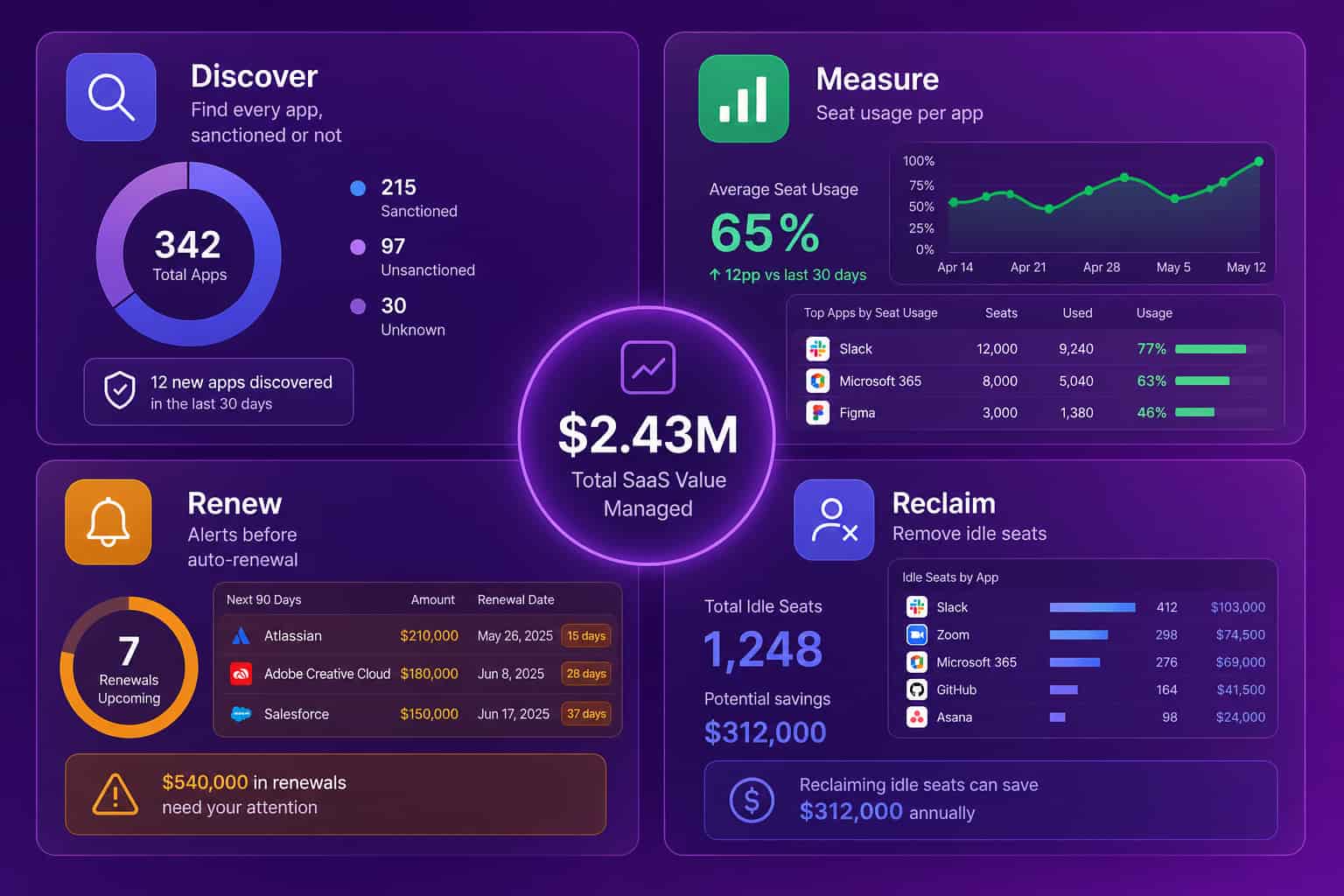
Put the four jobs in a loop and you get the useful mental model. Discover what exists. Measure what's used. Decide before the renewal date. Reclaim what isn't. A platform that does the first two well and skips the last two gives you a nice inventory and no savings.
Why a spreadsheet stops working
A spreadsheet stops working the moment tools are bought by individual teams instead of one procurement owner, because the sheet only contains what someone remembered to enter. It also has no usage data. The row says "Design tool, 50 seats, renews in June." It can't say that 11 of those seats haven't been opened in two months. So the finance person asks the team lead, the team lead says "we use it," and the contract renews. Nobody lied. Nobody had data.
I've watched this exact thing at Abloomify customers. One COO told us what they did manually this week in a spreadsheet was exactly what they thought the product should be doing automatically. That's the real trigger for buying an SMP. Somebody is already doing the work by hand, badly, once a quarter.
The other failure is staleness. A spreadsheet is accurate on the day someone last updated it. SaaS spend changes every week: new seats, a contractor's login that never got removed, a trial that quietly converted to a paid plan. A tool that reads usage through APIs stays current without anyone remembering to update it.
What to look for in a SaaS management platform
Judge a SaaS management platform on six questions, and notice that most of them are about data, not features. Where does the usage data come from? How deep does it go? What does it collect about people? Does it warn you before renewals? Who is supposed to act on the output? How long until you see a first finding? Two vendors can show the same dashboard in a demo and answer these six very differently, and those answers decide whether you find $5K or $80K. Ask them in the first call, before the pricing conversation, and write down the answers so you can compare the vendors side by side later.
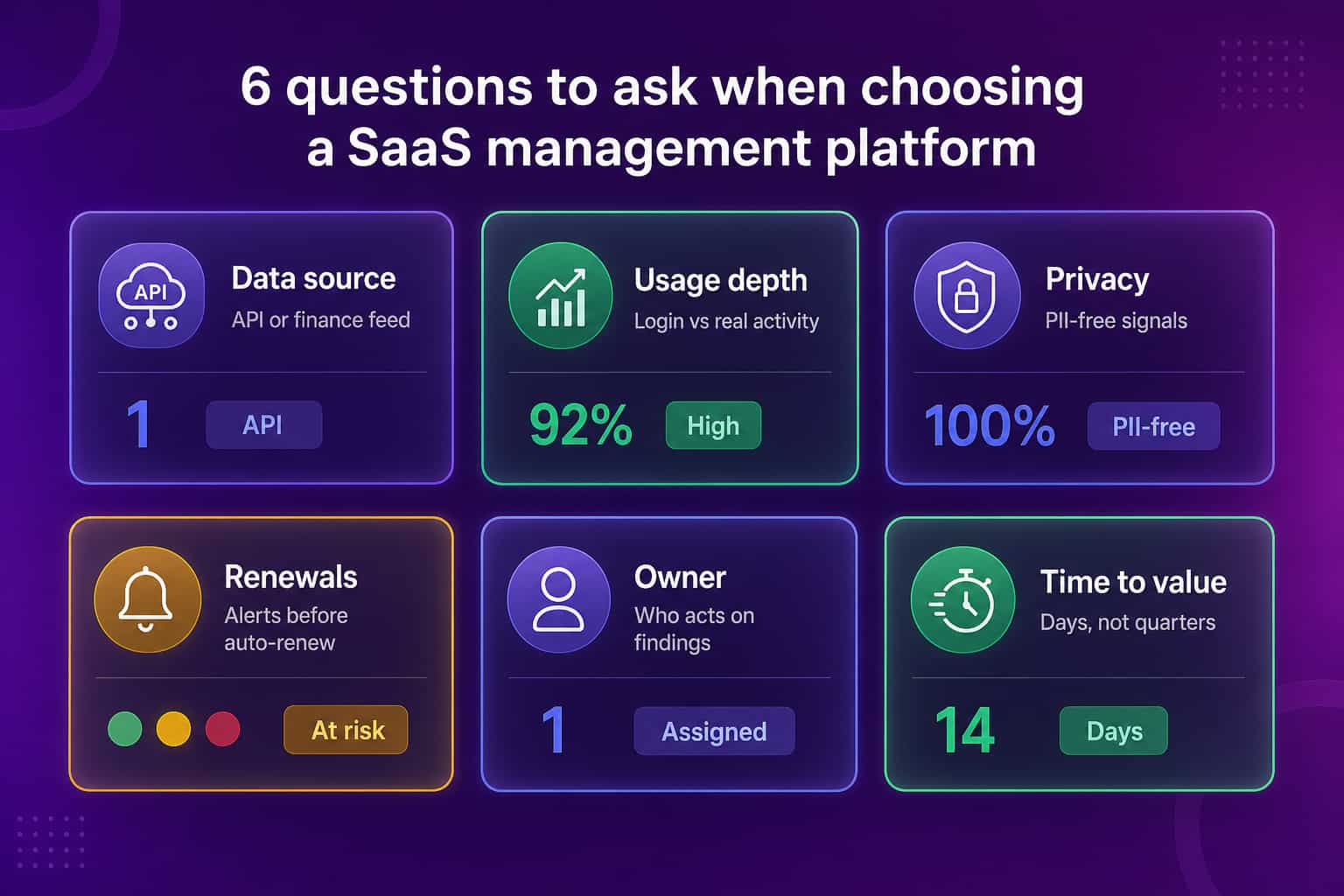
Data source. Finance feeds (cards, expenses, invoices) find apps and spend but can't see usage. SSO logs see logins but miss tools outside SSO. API integrations into the apps themselves see actual activity. The best setups combine them. If a vendor only has one, you'll have a blind spot, and you should know which one.
Usage depth. A login is a weak signal. People log in to a tool to dismiss a notification. Look for activity, not just access, and ask how the platform defines an "inactive" seat. The default threshold (30 days, 60 days, 90 days) changes the savings number a lot.
Privacy. This one gets skipped and shouldn't be. Some tools learn about usage by watching what employees do on their screens. Others read PII-free signals from the apps. If you're a tech company with engineers who'll find out what's installed, the first kind creates a trust problem you did not budget for. Abloomify leads with privacy-first, and the SaaS side runs on PII-free signals from API integrations. No screenshots, no keyloggers, no message or file content.
Renewals. You want alerts weeks before the auto-renew date, with the usage numbers attached. An alert on the day of renewal is a receipt.
Owner. Someone has to act. In every Abloomify engagement that started with SaaS waste, the COO has been the person who acts, because it's their budget line. If the platform assumes IT will chase every finding, check that IT has the time.
Time to first finding. Ask for a timeline in days. A platform that needs a quarter of implementation before it shows anything is a project, and projects get deprioritized.
Pure-play SaaS management platform
Abloomify SaaS license optimization
SMP, SAM, or something else
An SMP is the right call when your stack is mostly subscriptions and your problem is waste. Software asset management is the right call when you have on-prem enterprise agreements and an audit to survive. Plenty of companies need neither as a standalone purchase. If you're 50 to 500 people and already want visibility into capacity, engineering output and AI tool spend, a workforce intelligence platform that includes SaaS license usage may be the cheaper path, because you're not adding a seventh dashboard.
I'm biased here, since we build one of these. So take this as a map, not a verdict. If procurement workflows (approval chains, vendor contracts, purchase requests) are what you need, a dedicated SMP does that better than we do, and we don't pretend otherwise. Our SaaS license optimization is built for the usage question: which seats are idle, which tools overlap, which renewals to push back on. If you want the long version of the SAM comparison, we wrote it up in Software Asset Management in the SaaS Era.
How to roll one out without it becoming a project
Start with one renewal, not the whole stack. Pick the biggest contract coming up in the next 90 days, pull usage for it, and use the number in the vendor conversation. That single negotiation tends to pay for the tool, and it gives you a story to take to leadership. Then widen. A rollout that begins with "inventory everything" stalls on the long tail of tools that cost $200 a month.
Here is the order that works:
- Connect the apps you already know are expensive. Usage data from the API beats a survey every time.
- Set your inactivity threshold before you look at the results, so you don't argue yourself out of the answer. 30 days is a reasonable starting point for most tools.
- Assign an owner for each finding. A name, not a team.
- Review usage in the weeks before each renewal, not after it auto-renews.
- Check the overlap. Two project tools and three meeting recorders is common, and the cheapest saving is cancelling one.
If you want to size the problem first, the SaaS waste calculator gives a rough number from your headcount and tool count. For the detail on finding the seats themselves, see how to detect and eliminate SaaS license waste. And if tools nobody approved are part of the picture, shadow IT discovery platforms covers that side.
Honestly, the platform matters less than the habit. A cheap tool reviewed before every renewal beats an expensive one nobody opens.
FAQ
What is a SaaS management platform?
A SaaS management platform (SMP) discovers every SaaS app a company uses, tracks who holds a seat and how much they use it, and flags renewals so you don't pay for shelfware. The point is a list of subscriptions you can make decisions from, not another report that gets filed away.
What is the difference between an SMP and software asset management?
Software asset management (SAM) grew up around license compliance for on-prem software. An SMP is built for subscriptions that change monthly: discovery, seat usage and renewal timing. Many products blur the line now, so judge them by the question they answer, compliance or usage.
How much can a SaaS management platform save?
It depends on how long the stack has gone unreviewed. Abloomify has seen $50K to $100K a year in unused SaaS licenses at mid-size tech companies, and Bloomy identified $72K+ in SaaS cost optimization for one customer. Your own number scales with headcount and tool count.
Do I need a dedicated SMP or can I use a spreadsheet?
A spreadsheet works for a few dozen apps and one owner. It breaks when teams buy tools on their own cards, because the sheet only knows what someone wrote down, and it can't see usage. Once that happens you need usage data pulled from the tools themselves.
Does Abloomify replace a SaaS management platform?
Partly. Abloomify's SaaS license optimization finds unused licenses, tool overlap and renewal risk through 100+ API integrations, inside a privacy-first workforce intelligence platform. It is not a pure-play SMP with procurement workflows. If you want waste findings alongside capacity and AI tool ROI, it fits.

Amir Tavafi
Co-Founder & CEO
Product leader and innovator with over 15 years of experience in the tech sector, grounded in AI and robotics. Previously led product development in fraud detection and AI solutions at Nasdaq Verafin.