Professional Development Goals Employees Actually Keep (2026)
August 25, 2026
Amir Tavafi
10 min read

Most professional development goals are written once, during review season, and never opened again until the next one. "Get better at leadership" or "improve technical depth" sound like goals but function as decoration, because nobody, not the employee, not the manager, ever comes back to check whether either thing actually happened. Abloomify's goals and OKR module exists because growth that only gets discussed once a year isn't being managed. It's being remembered, badly.
Key Takeaways
Q: What is an example of a professional development goal?
A: A useful one names a skill, a way to prove it grew, and a deadline: "Lead the next payments-service migration end to end, with a senior engineer signing off on the design doc, by the end of Q3." A vague one just names a wish: "Get better at system design." Abloomify pulls the evidence, PRs led and docs reviewed, from GitHub and Jira automatically.
Q: How is a professional development goal different from a performance goal?
A: A performance goal measures output against the job someone has today. A development goal measures growth toward a job they don't have yet, leading, mentoring, going deeper on a skill. Abloomify tracks both inside the same goals module because the underlying evidence usually overlaps.
Q: How often should professional development goals be reviewed?
A: Monthly at minimum, and tied to real work, not a calendar nudge to reflect. A goal reviewed only once a year gets rebuilt from memory, which is closer to fiction than to tracking.
Q: Do development goals work the same way for ICs and managers?
A: No. An IC's goal usually proves itself through delivery: a harder system owned, a migration led. A manager's goal usually proves itself through other people's outcomes: a direct report promoted, a team's velocity moving into a band it couldn't reach before. Same framework, different evidence.
Q: Why do most professional development goals fail even when the employee is motivated?
A: Motivation is rarely the problem. Tracking is. The goal gets written once at review time and nobody revisits it, so by the next cycle the manager is reconstructing a year of growth from memory and a few old Slack threads.
What actually makes a professional development goal different from a performance goal
A performance goal and a professional development goal both want a specific outcome and a deadline, but they point in different directions: a performance goal measures how well someone does the job they have right now, and a development goal measures whether they're becoming capable of a job they don't have yet. "Reduce PR cycle time on the payments repo" is a performance goal. "Lead a migration end to end so you're ready to own the next system rewrite without a senior engineer co-piloting it" is a development goal built on the same kind of evidence. The mistake most companies make is writing development goals like performance goals minus the specificity, landing on "grow as a leader" instead of a real target. The fix isn't a different framework, just the same discipline, a named skill, proof it happened, a deadline, applied to growth instead of only output. Abloomify's performance management module runs goals, OKRs, and assessments together, because growth and output share the same evidence trail more often than people assume.
Professional development goal examples for engineers and technical ICs
The strongest professional development goals for engineers point at ownership and depth, not activity, because "read more about distributed systems" produces nothing a manager can point to six months later. A few that hold up: "Own the design and rollout of the new event-streaming pipeline end to end, with the architecture doc approved by a staff engineer, by the end of Q3." "Move from reviewing PRs on the auth service to being the primary reviewer, approving at least 70% of merged PRs on that repo within 90 days." "Give one internal tech talk on a system you built, recorded and shared with the wider engineering org, by November." "Mentor one junior engineer through their first production incident response, documented in a postmortem you co-author." Each one names a specific proof point that already lives somewhere: a merged PR, a review record, a shared doc, a postmortem. Nobody has to take anyone's word for whether it happened.
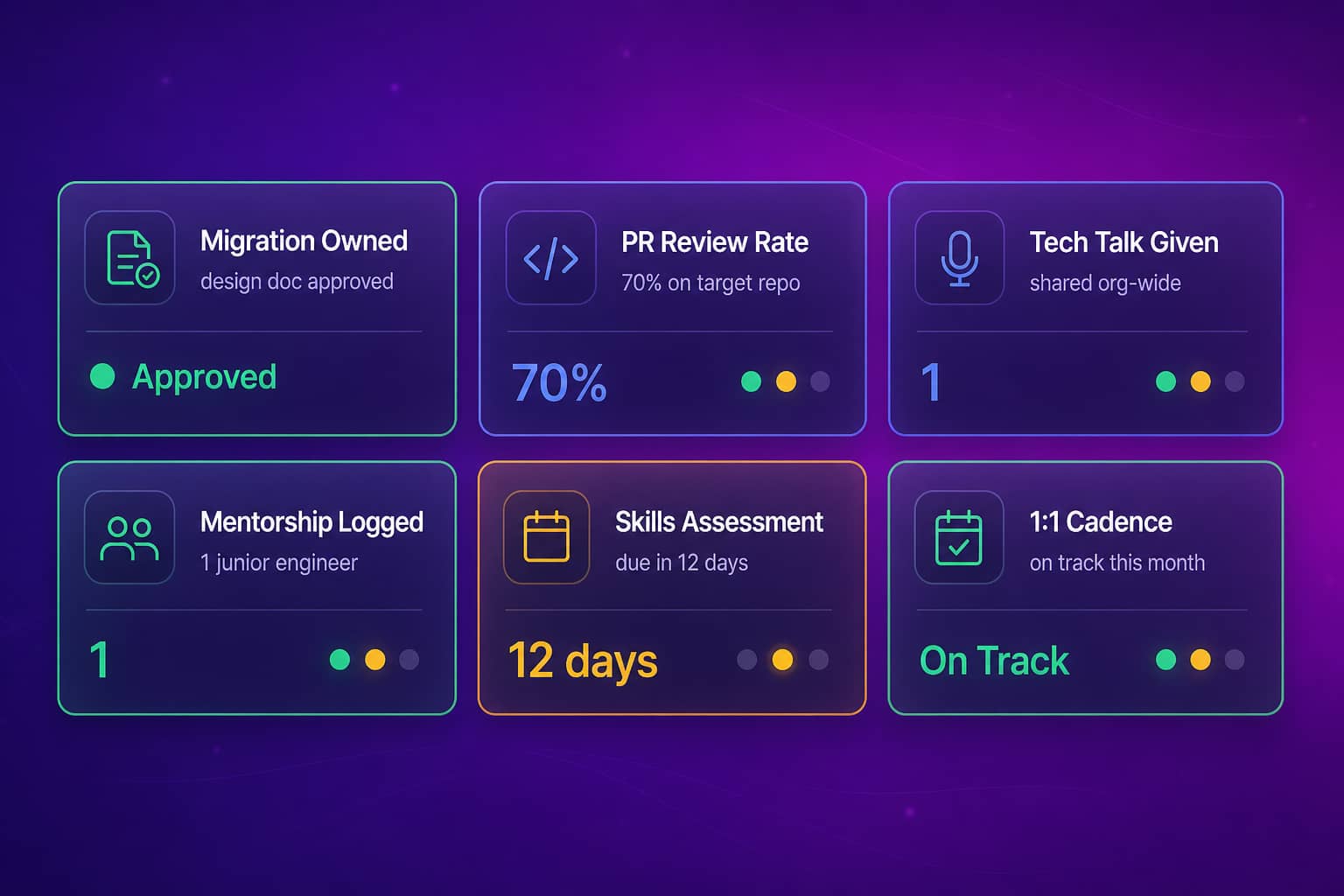
Because Abloomify already reads GitHub and Jira for engineering intelligence, a development goal like "own the next migration" has a real baseline (who currently owns similar systems, how long past migrations took) before anyone writes the target down, and an automatic update every time a relevant PR merges.
Professional development goal examples for managers and people leaders
A manager's professional development goals should prove themselves through what happens to other people, because a manager who is "developing" but whose team isn't improving is not actually developing. A few that work: "Get two direct reports promotion-ready this year, with documented growth plans and at least one stretch project each completed." "Reduce the team's average 1:1 no-show rate from 20% to under 5% over two quarters, tracked against calendar data." "Run a structured skip-level cycle across the department once a quarter, with themes documented and shared upward." "Take over quarterly capacity planning for the team from your director, owning the full cycle unsupervised by Q4." Every one of these fails the vague-vibes version of the goal ("be a better manager") and passes the concrete version, because there's a real record, a promotion packet, a calendar, a planning doc, that either exists or doesn't.
Why most professional development goals die in the annual review folder
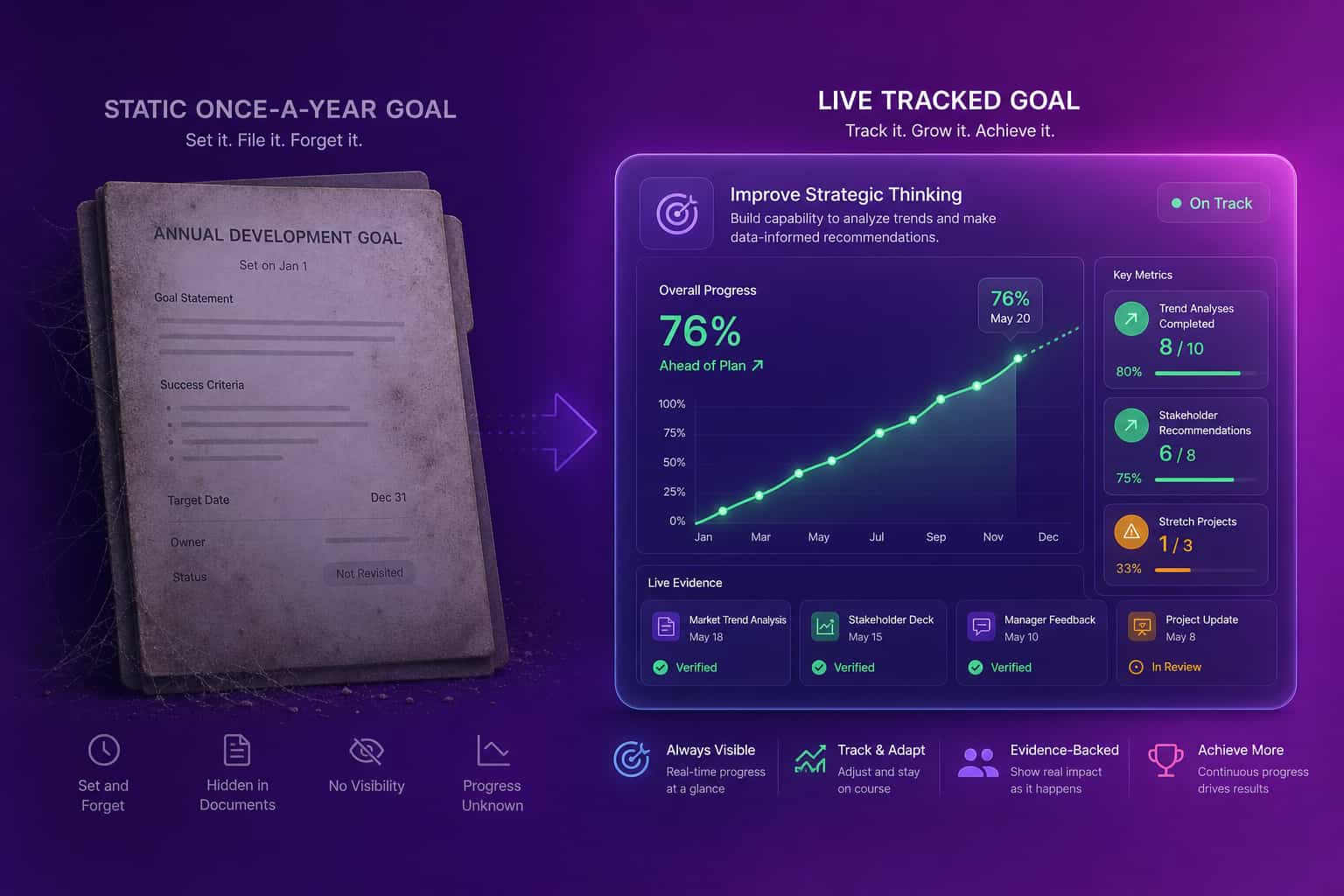
Most professional development goals die in the annual review folder because the framework only covers how a goal gets written, and writing was never the hard part. The hard part is what happens for the eleven months after. When we started building Abloomify, I assumed the job was giving managers better AI tools for reviews. The longer we've shipped, the clearer it's gotten that most of a manager's week is admin dressed up as leadership: chasing people for goal updates, digging across five tools to see whether someone finished the stretch project they committed to, copy-pasting last quarter's notes into a fresh doc because nobody wrote anything down in between. A development goal is supposed to prevent that scramble. Left in a doc from review season, it just becomes one more tab nobody opens, and by the next cycle the manager is reconstructing a year of someone's growth from a hallway conversation and whatever they can remember, which is close to nothing specific.
That reconstruction is where the goal quietly stops being real. The employee remembers doing more than they can prove. The manager remembers less than actually happened. Recency bias fills the rest, and the calibration conversation ends up arguing about impressions instead of a record either side can point to. It's the same evidence problem that shows up later in performance improvement plans built from memory instead of data, just earlier and with lower stakes, before it compounds into something that actually threatens someone's job.
How to write a professional development goal that survives past Q1
Writing a development goal that survives starts with naming the evidence before naming the target, because a growth goal with no proof attached to it is a hope, not a goal. Name the specific skill or capability, not the vague direction: "own database migrations" beats "get better technically." Attach a real proof point that already exists somewhere, a merged PR, a promotion packet, a calendar record, a shared doc, instead of inventing a new tracking ritual just for this goal. Set a real deadline, because "this year" is not a deadline, it's a permission to forget. Put a check-in on the calendar every four to six weeks, not because the goal needs a meeting but because a goal checked once at the deadline is being graded, not developed. Then connect the goal to wherever the evidence already lives instead of a manual update ritual.
- Name the specific capability, not the direction. "Own database migrations end to end" beats "get better technically." The first has a finish line. The second doesn't.
- Attach a proof point that already exists. A merged PR, a promotion packet, a calendar record. Don't invent a new tracking ritual for one goal.
- Set a real deadline. "This year" isn't a deadline. It's permission to forget until December.
- Check in every four to six weeks. A goal reviewed once, at the deadline, is being graded after the fact, not developed along the way.
- Connect the goal to where the evidence already lives. Abloomify's goals and OKR tracking pulls progress from GitHub, Jira, calendars, and 100+ other connected tools, so the evidence updates itself instead of someone chasing it down before a 1:1.
A professional development goal written once during review season and never revisited is a wish with a deadline stapled to it. One tied to live evidence is just a goal, and it's the only kind worth writing.
FAQ
What is an example of a professional development goal?
A useful one names a skill, a way to prove it grew, and a deadline: "Lead the next payments-service migration end to end, with a senior engineer signing off on the design doc, by the end of Q3." A vague one just names a wish: "Get better at system design."
How is a professional development goal different from a performance goal?
A performance goal measures output against the job someone has today. A development goal measures growth toward a job they don't have yet, leading, mentoring, or going deeper on a skill. Abloomify tracks both inside the same goals module because the evidence usually overlaps.
How often should professional development goals be reviewed?
Monthly at minimum, tied to real work rather than a calendar nudge to reflect. A goal reviewed only at the annual cycle gets rebuilt from memory eight months later, which is closer to fiction than to tracking.
Do development goals work the same way for individual contributors and managers?
No. An IC's goal usually proves itself through delivery evidence: a harder system owned, a migration led. A manager's goal usually proves itself through other people's outcomes: a report promoted, a team's velocity moving into a band it couldn't reach before.
Why do most professional development goals fail even when the employee is motivated?
Motivation is rarely the problem. Tracking is. The goal gets written once at review time and nobody revisits it, so by the next cycle the manager is reconstructing a year of growth from memory and a few old Slack threads instead of a record.

Amir Tavafi
Co-Founder & CEO
Product leader and innovator with over 15 years of experience in the tech sector, grounded in AI and robotics. Previously led product development in fraud detection and AI solutions at Nasdaq Verafin.