Manager Effectiveness: How to Measure It Without a Popularity Contest
November 16, 2026
Amir Tavafi
12 min read

Manager effectiveness is the variable that explains more about a team than almost any other, and most companies measure it with a once-a-year survey asking whether people like their boss. Gallup found managers account for at least 70% of the variance in employee engagement across business units. At Abloomify we build workforce intelligence, so my bias is obvious: I think the evidence lives in the work.
Key Takeaways
Q: What is manager effectiveness?
A: Manager effectiveness is how well a manager gets a team to deliver good work over time without burning it out or losing the people they want to keep. It belongs to the team's results and health, so you measure it at team level across quarters, not by asking whether people like their boss.
Q: How do you measure manager effectiveness?
A: Use a short upward survey for how the team experiences the manager, then check team-level work signals: delivery against plan, review wait time, focus hours, meeting load, after-hours work, and regretted attrition. Abloomify computes those from Jira, GitHub, calendars, and HRIS, PII-free.
Q: Why are upward surveys not enough?
A: They measure likability, which overlaps with effectiveness but is not the same thing. A manager who avoids every hard conversation can score well for a year while the team's delivery slips. Surveys also arrive late, usually after the behaviour they describe has already set into habit.
Q: Does measuring managers mean monitoring their teams?
A: No. The useful signals are team-level and already sit in the tools people use. Screenshots and keystroke logs add risk without adding signal: a Personnel Psychology meta-analysis found no evidence that monitoring improves performance, and 2026 survey research found 1 in 6 workers would quit over surveillance.
Q: What is the fastest way to improve manager effectiveness?
A: Take admin off the manager's plate before sending them to training. Most managers I talk to lose hours a week to status chasing, deck building, and review paperwork. Give that time back, then coach on the specific signal that is off for their team.
What is manager effectiveness?
Manager effectiveness is how reliably a manager turns a team into good outcomes over a sustained period, meaning the team ships what it committed to, the quality holds, people have enough focus time to do hard work, nobody is quietly running at sixty hours a week to make the numbers look fine, and the people the company most wants to keep are still there a year later. That definition has two halves on purpose. Output without health is a manager borrowing against next quarter. Health without output is a pleasant team that misses dates. Google's Project Oxygen made the same point years ago when it set out to prove managers did not matter and ended up listing the behaviours that made good ones good.
Two things follow from this. First, manager effectiveness is a team-level measure, so you read it from team data, never from one engineer's activity. Second, it only makes sense against scope. A manager running a platform team through a migration and a manager running a stable product team should not be judged against the same delivery curve.
Why upward surveys miss most of it
Upward feedback surveys capture how a team experiences its manager, which is real and worth knowing, but on their own they reward the manager who shields people from every hard call, they arrive months after the behaviour they describe, and they ask employees to rate the person who writes their review, which means the teams where candour is lowest are the teams whose answers you can trust least. I am not anti-survey. If a team says its manager never makes time for them, believe it. The problem is treating the score as the whole verdict.
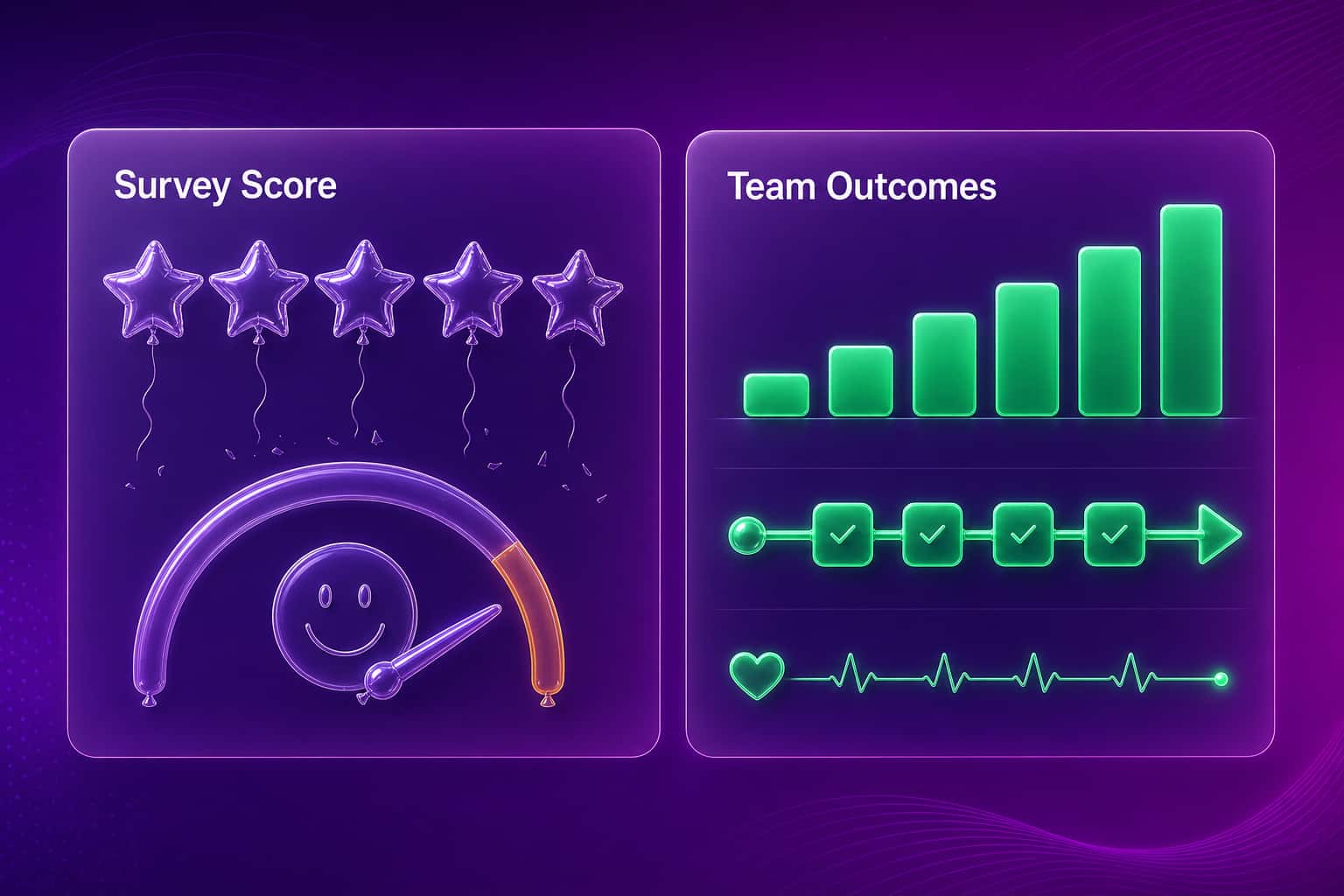
The pattern I watch for is the gap. A manager with glowing upward scores whose team keeps missing commitments is often avoiding a performance conversation. A manager with middling scores whose team ships steadily and keeps its senior people may just be direct, and direct is not a defect. Neither case shows up if the survey is the only instrument.
There is also a trap on the data side, and I would rather name it than pretend we solved it. One of our customers, a 3,500-person enterprise, tried to read team health from Google Workspace data alone. Their COO told us: "We are still trying to correlate the data with our internal performance metrics and candidly are seeing low correlation." One source under-proves things about people. Use several, and use them alongside the survey.
Manager effectiveness metrics that hold up
The manager effectiveness metrics worth tracking are the ones a manager cannot improve by squeezing the team harder, which rules out raw ticket counts, hours logged, and lines of code, and leaves a short set that pairs output with health: delivery against what the team committed to, flow measures like time to first review and cycle time for engineering teams, focus hours per person, meeting load, the after-hours trend, and regretted attrition. Read every one of them at team level, as a trend over at least a quarter, and next to the team's scope. A single week tells you nothing.
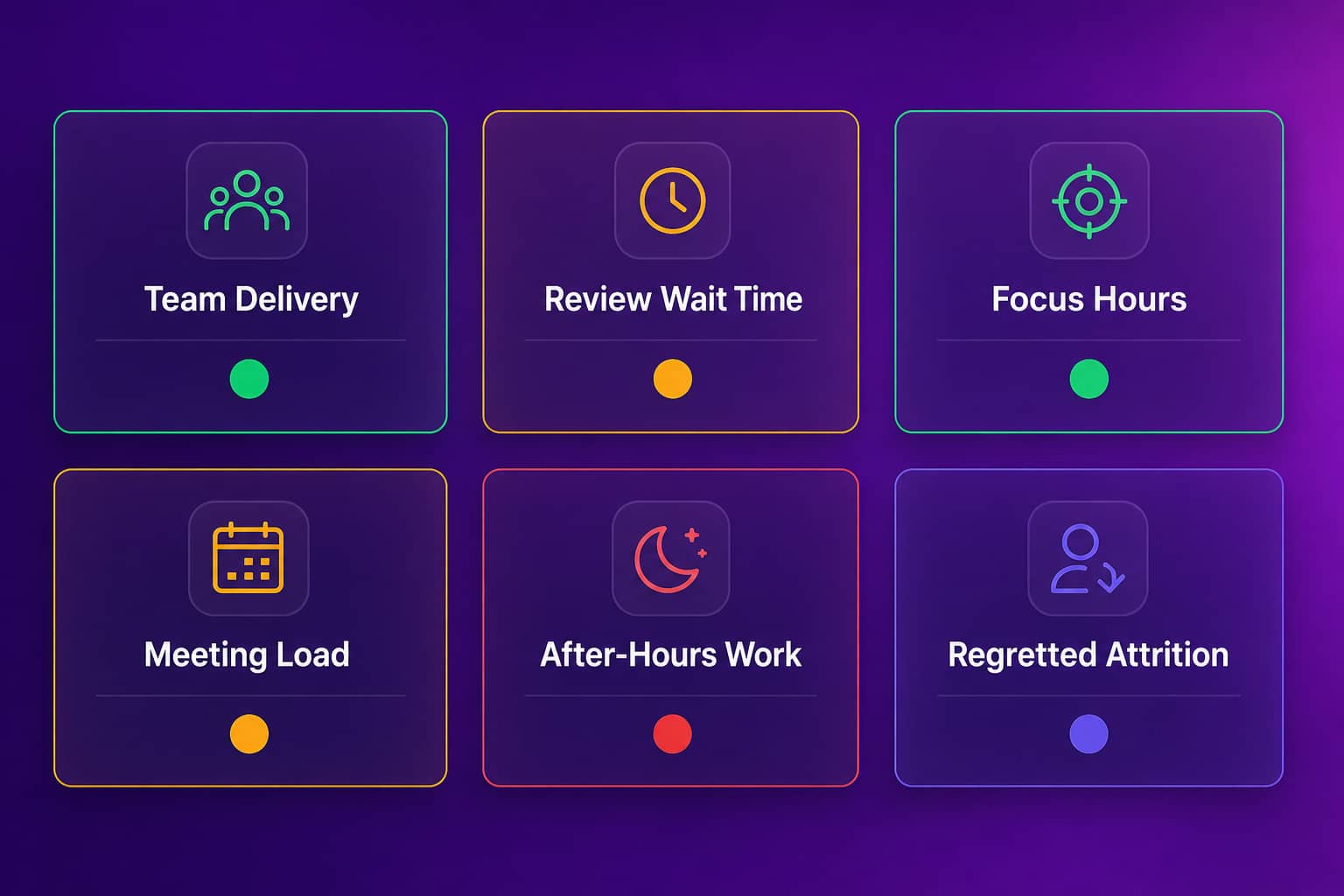
Here is how I would read each one:
- Delivery against commitments. Did the team ship what it said it would, at the quality it promised? This beats velocity, which teams can inflate without shipping more.
- Time to first review and cycle time. Slow reviews usually mean the manager has not set a norm or has let review pile onto two people.
- Focus hours. If nobody on the team gets a two-hour block, the manager is either in too many meetings or pulling people into them.
- Meeting load. Watch the manager's own calendar too. A manager at 25 meeting hours a week has no attention left for the team.
- After-hours trend. A team that only hits dates by working evenings is being managed by deadline, and it shows up in burnout detection signals long before anyone resigns.
- Regretted attrition. Losing people you wanted to keep is the most expensive signal on the list, and the latest to arrive.
Span matters for every number above. A manager with 14 direct reports is running a different job from one with six, and our piece on span of control covers how to set that with data instead of an org-chart rule of thumb.
The delivery and health grid
The simplest way to read manager effectiveness across a whole org is a two-by-two that puts team delivery on one axis and team health on the other, because it sorts managers into four situations that each need a different response, and it stops leadership from collapsing a two-dimensional problem into one score that hides which half is broken. Effective managers sit top right: the team delivers and stays healthy. Burning the team is high delivery with falling health, usually rising after-hours work and shrinking focus time. Comfortable is a healthy team that misses dates. Struggling is both low.
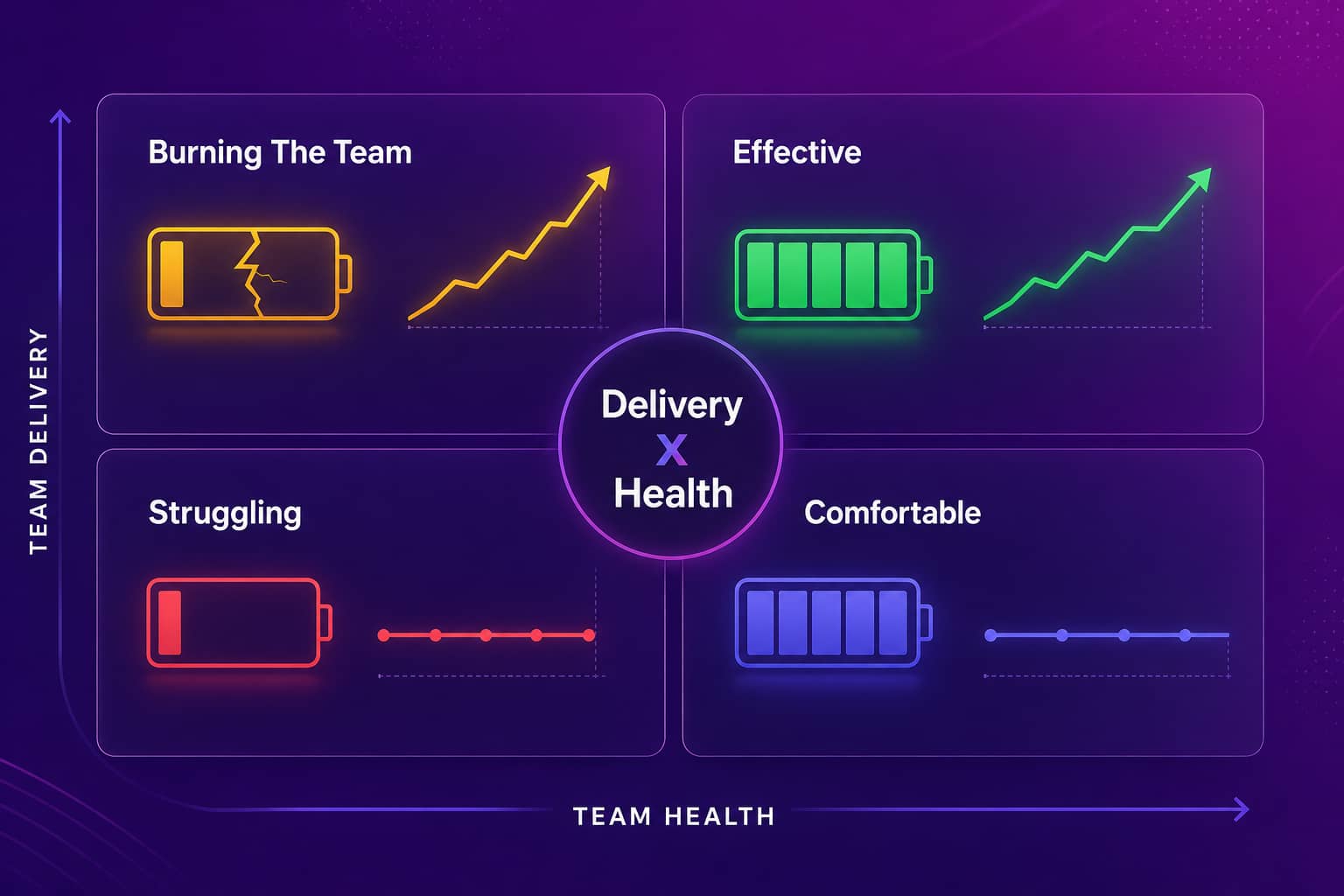
The quadrant that worries me most is burning the team, because it looks great on a delivery dashboard. Leadership praises the manager, the manager keeps doing it, and the bill arrives as two resignations in the same month. Comfortable is easier to spot and easier to fix, usually with clearer goals and one honest conversation.
How to measure manager effectiveness without surveillance
To measure manager effectiveness without surveillance, connect the systems where team work already happens (the project tracker, the code host, calendars, and the HRIS), compute team-level signals from them without reading any content, combine those with a short upward survey every quarter, and show each manager the same view leadership sees, so the measurement becomes something they use to improve rather than something done to them. Monitoring software adds nothing useful here. A screenshot of someone's desktop tells you nothing about whether their manager set clear goals, and installing it tells the team you expect the worst.
This is the work Abloomify is built for. Two data layers: 100+ API integrations (Jira, GitHub, GitLab, Google Workspace, Microsoft 365, Slack, BambooHR, Workday, and more) that read PII-free signals, meaning no email content, no message content, and no file content, plus optional privacy-first device agents that report aggregated usage with no screenshots, no keyloggers, and no screen recording. Role-aware permissions control who sees which team.
The AI People Manager then puts those signals in front of the manager where they are useful: one-on-one prep, team pulse, wellbeing alerts, and review drafts grounded in what actually happened during the period. That last part matters for fairness. A review built from work data is harder to bend toward whoever was most visible in the last month, which is the bias we wrote about in how to build fair performance reviews.
How to improve manager effectiveness
The fastest way to improve manager effectiveness is to give managers their time back before you give them more training, because most managers already know what good management looks like and simply do not have the hours to do it after chasing updates, copying metrics into decks, turning meeting notes into action items, and filling in review forms with things they already know. When we started Abloomify I thought we were building AI for managers. The more we ship, the clearer it gets that the real job is killing the low-value chores that quietly own a manager's calendar.
Once the time is back, coach on the specific signal that is off, not on management in general:
- Review wait time climbing? Set a first-review norm, something like inside one working day, and rotate reviewers.
- Focus hours collapsing? Audit the team's recurring meetings and kill the status ones. Async updates usually cover them.
- After-hours trend rising? Cut scope before the next sprint, out loud, so the team sees it happen.
- Upward scores low while delivery is fine? Look at the one-on-ones. Our guide to prepping one-on-ones in five minutes is a practical place to start.
- Regretted attrition in one team? Talk to the people still there before you talk to the manager.
Bloomy can also run this check for you on a schedule. Ask for a Monday brief on each team's delivery, review health, and meeting load, and it lands in your inbox with a conversation attached so you can ask the follow-up questions. Dashboards you check. Bloomy checks in on you.
None of this replaces judgment. The data gets you to the right conversation in week two instead of at the exit interview. You still have to have it.
If you want to see these signals for your own managers on real data, book a demo and we will walk through it with you.
FAQ
What is manager effectiveness?
Manager effectiveness is how well a manager gets a team to deliver good work over time without burning it out or losing the people they most want to keep. It is a property of the team's results and health, so you measure it at team level, across quarters, rather than by asking whether people like their boss.
How do you measure manager effectiveness?
Combine a short upward survey with team-level work signals: delivery against plan, review wait time, focus hours, meeting load, after-hours work, and regretted attrition. Read them as trends next to the team's scope. Abloomify pulls these from GitHub, Jira, calendars, and HRIS through API integrations, PII-free, with no screenshots or keyloggers.
What are good KPIs for managers?
Pick a small set that covers output and health together: delivery against commitments, cycle time or time to first review for engineering teams, focus hours per person, meeting load, after-hours trend, and regretted attrition. Avoid KPIs a manager can hit by squeezing the team, like raw ticket counts or hours logged.
Is an upward feedback survey enough to evaluate a manager?
It is useful and incomplete. Upward surveys tell you how the team experiences a manager, which matters. They also reward managers who shield the team from hard calls. Pair the survey with work data, and pay most attention when the two disagree, because that gap is where the real story usually sits.
Can you measure manager effectiveness without monitoring employees?
Yes. Everything that matters here is team-level and already lives in the tools people use: Jira, GitHub, calendars, HRIS. Abloomify reads PII-free signals through 100+ API integrations, with optional device agents that report aggregated usage and never take screenshots or log keystrokes. Nobody's messages get read.
Amir Tavafi
Co-Founder & CEO
Product leader and innovator with over 15 years of experience in the tech sector, grounded in AI and robotics. Previously led product development in fraud detection and AI solutions at Nasdaq Verafin.