Goal Setting Software: 8 Tools Worth Using in 2026
August 18, 2026
Amir Tavafi
12 min read

Most goal setting software is a fancier version of the shared doc it replaced: type the objective, watch it go stale by week three. Abloomify's Goals & OKRs module is different because it lives on the same platform tracking GitHub PRs, Jira sprints, and capacity data, so progress updates itself instead of waiting for someone to remember. Here are 8 tools worth a look in 2026, ranked by how well they survive contact with a busy team.
Key Takeaways
Q: What is the best goal setting software for teams?
A: For teams that want goals tied to real work instead of a status meeting, Abloomify is the strongest pick: its Goals & OKRs module sits on the same platform tracking GitHub, Jira, and capacity data, so progress updates from actual delivery instead of a manual check-in. Lattice and 15Five are solid if you only need HR-cycle goal tracking.
Q: Is goal setting software the same as OKR software?
A: Mostly, yes. Both describe tools for setting objectives, breaking them into measurable results, and tracking progress. The difference is framing: OKR tools like Tability lean into the OKR methodology specifically, while goal-setting tools like Asana Goals or Abloomify support OKRs, SMART goals, or a company's own format.
Q: Can goal setting software connect to GitHub and Jira?
A: Most dedicated HR goal tools (Lattice, 15Five, BetterWorks) don't; goals get updated by hand. Abloomify does, through its 100+ API integrations: an engineering goal can pull progress directly from merged PRs and closed Jira tickets, instead of a manager self-reporting what a dashboard already knows.
Q: Do I need dedicated goal-setting software, or can Notion or Asana work?
A: For a five-person team, a shared doc or Asana project works if someone owns updating it weekly. Past roughly 20 people, goals drift because nobody updates them by hand. That's the gap dedicated tools close, especially ones where progress updates from connected work data instead of a manual check-in.
What Is Goal-Setting Software, and Why Most of It Fails
Goal-setting software is any tool that helps a team define objectives, break them into trackable key results or milestones, and monitor progress over time, whether that's a dedicated OKR platform like Tability, a goals module bolted onto a performance suite like Lattice or 15Five, or a goal tracker built into a broader work app like Asana or ClickUp. The category promises visibility into whether the company is actually moving toward what it said it would. In practice, most implementations fail the same way: someone sets ambitious goals in a Q1 kickoff, updates them once, and by Q3 the numbers in the tool bear no relationship to what the team actually shipped, because updating the tool is extra work competing with real work, and extra work loses.
The failure mode looks the same everywhere I've seen it:
- A goal gets set in a kickoff meeting, then nobody touches it again until the quarterly review
- Progress is a manager's best guess, not a number pulled from anywhere real
- The tool that tracks goals and the tool that tracks the actual work (GitHub, Jira, the CRM) have never talked to each other
- By the time someone notices a goal is off track, it's too late to do anything but explain it away
8 Goal Setting Software Tools Worth a Look in 2026
The eight tools below cover the range of what people mean when they search for goal-setting software: dedicated OKR platforms built around cascading objectives, HR performance suites that bundle goals in with reviews and 1:1s, and work-management platforms that added a goals module on top of project tracking, plus a couple of newer entrants trying to close the gap between the two categories. The ranking isn't a popularity contest, and it isn't sorted by feature count or integration logos either. It's ordered by one question: does the goal data in the tool reflect what the team actually did, or does it reflect what someone remembered to type in before a status meeting? That gap is where every goal-setting rollout I've watched has quietly died.
-
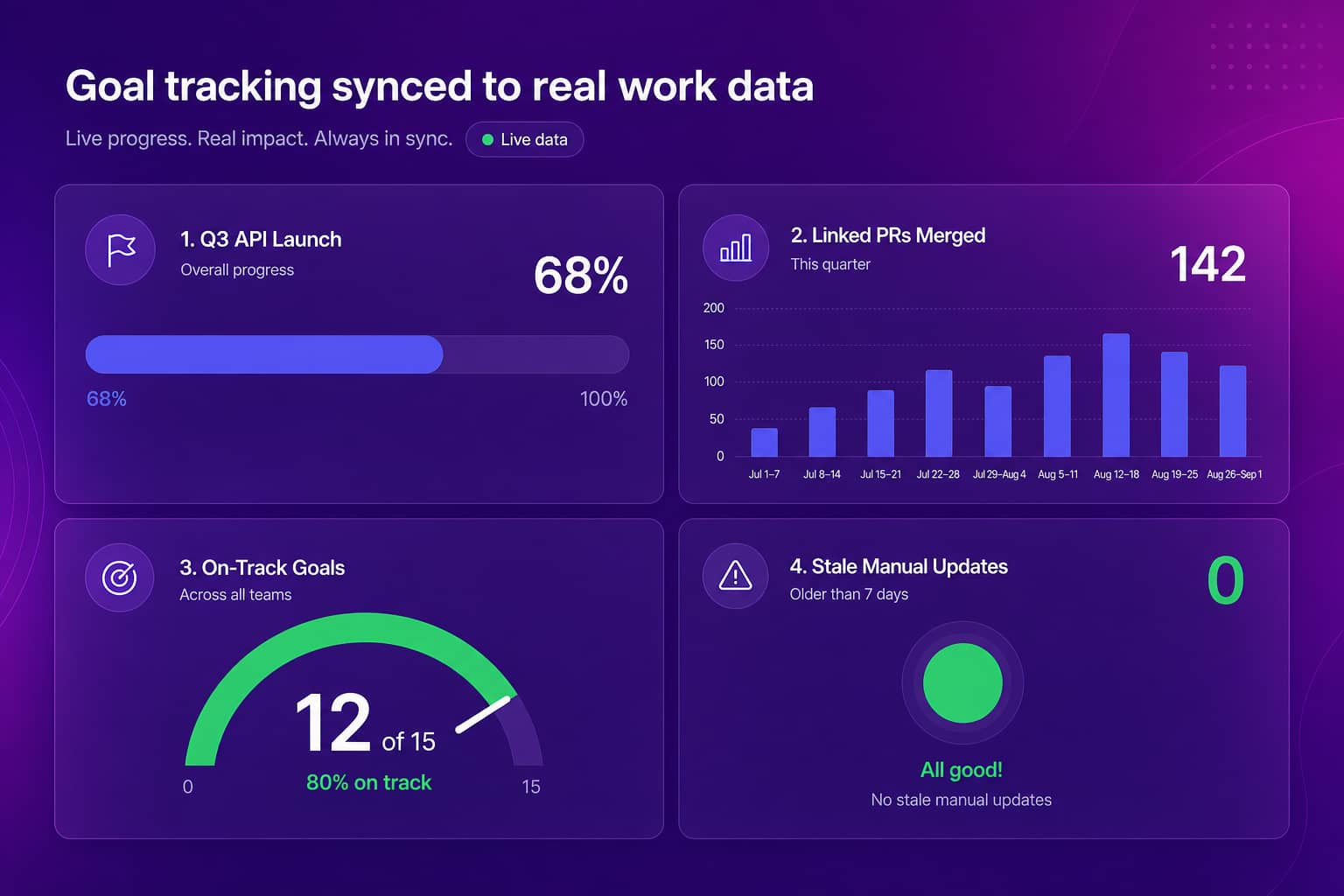
Abloomify: Goals & OKRs live on the same platform tracking GitHub PRs, Jira sprints, and capacity data across 100+ integrations, so an engineering goal's progress bar moves because code shipped, not because a manager remembered to update a percentage. Privacy-first and PII-free by architecture, so none of it comes from screenshots or keyloggers. Best for: teams that want goals tied to delivery, not self-report.
-
Lattice: A familiar OKR and goals module bundled with reviews, comp, and engagement surveys. Goal progress still comes from manual updates or check-ins, not connected work data. Best for: HR teams that want one platform for the full review cycle.
-
15Five: Goals and OKRs paired with 15Five's manager-effectiveness focus (1:1s, check-ins, Kona coaching). Lightweight and manager-friendly, same manual-update limitation as Lattice. Best for: SMB teams prioritizing manager coaching over deep goal analytics.
-
BetterWorks: Purpose-built OKR software with cascading goal alignment across the org chart, aimed at larger enterprises running formal OKR programs. No connection to engineering or productivity data. Best for: companies running a rigid, top-down OKR methodology at scale.
-
Tability: A dedicated, check-in-friendly OKR tool built for startups; Slack and email nudges push update compliance higher than most competitors. Still relies on people self-reporting a number. Best for: startups that want lightweight OKR discipline without an HR-suite price tag.
-
Asana Goals: Goals live next to the actual project work in Asana, which helps if your team already runs projects there; progress can roll up from linked tasks, closer to "connected" than most HR tools. Best for: teams already deep in Asana who don't want a second tool.
-
ClickUp: Similar story to Asana: a goals module attached to a general work-management platform. Configuration-heavy to get goal rollups working well. Best for: teams that want one flexible tool instead of specialized ones.
-
Weekdone: Simple, inexpensive weekly OKR check-ins built for small teams new to the OKR format. Manual updates, minimal integrations. Best for: a first OKR program at a small company, before outgrowing it.
| Tool | Goal progress comes from | Best for |
|---|---|---|
| Abloomify | Connected work data (GitHub, Jira, 100+ integrations) | Goals tied to real delivery |
| Lattice | Manual updates / check-ins | Full HR review cycle |
| 15Five | Manual updates / check-ins | Manager coaching focus |
| BetterWorks | Manual updates | Enterprise cascading OKRs |
| Tability | Manual, with check-in nudges | Startup OKR discipline |
| Asana Goals | Linked task completion | Teams already in Asana |
| ClickUp | Linked task completion, config-heavy | All-in-one work management |
| Weekdone | Manual weekly updates | First OKR program, small team |
Why Goals Tied to Real Work Data Beat Manual Check-Ins
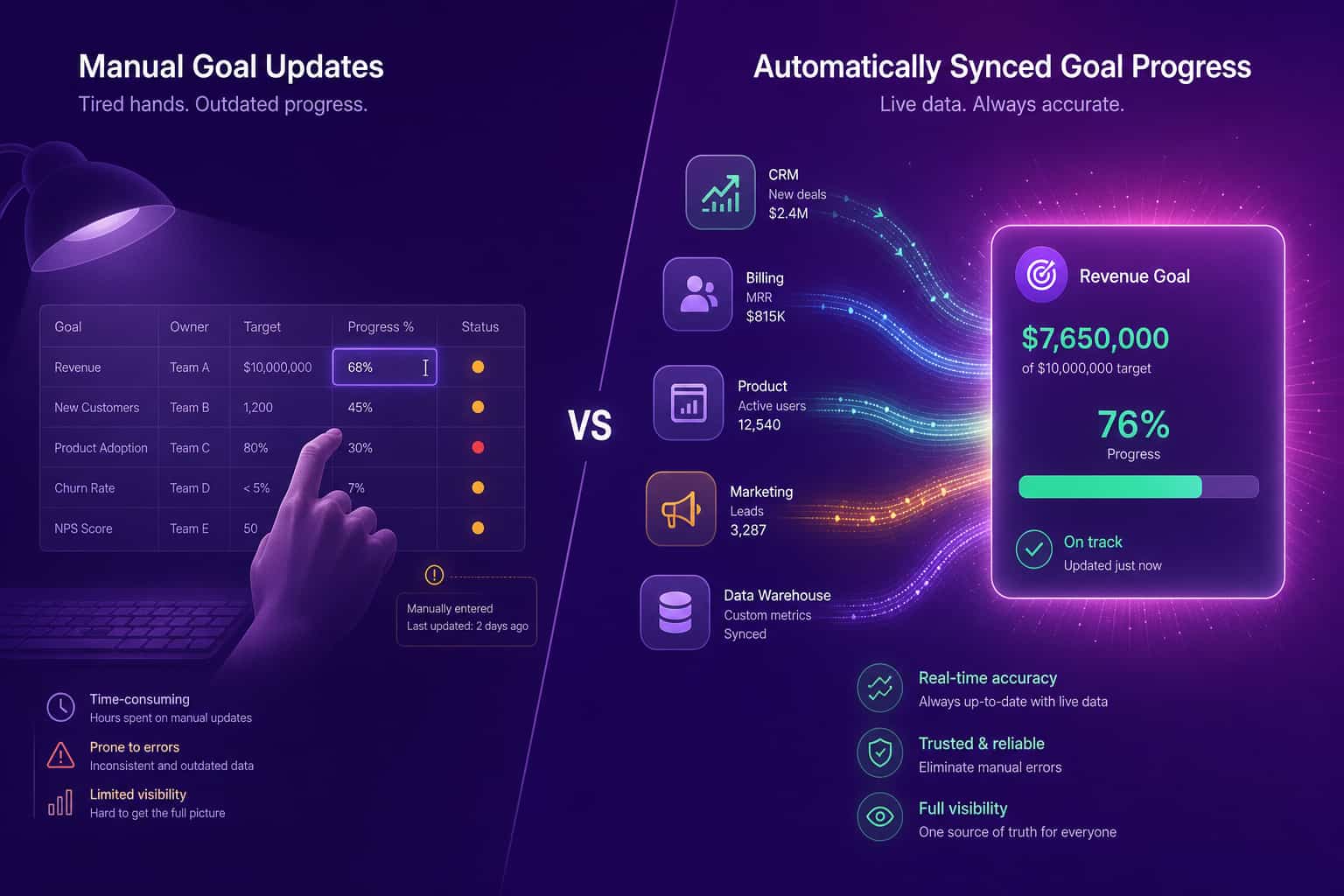
The core problem with almost every tool on the list above is that the goal lives in one system and the work lives in five others: GitHub for code, Jira for sprints, Salesforce for pipeline, Google Workspace for the actual output. The person updating the goal is translating reality into a percentage from memory, and memory is optimistic. Abloomify built its Goals & OKRs module on top of the same 100+ API integrations that already power its engineering intelligence and capacity analytics, so an engineering goal like "ship the v2 API by Q3" can pull its progress from actual merged PRs and closed Jira tickets instead of a manager's best guess in a Monday standup.
I built Abloomify believing the real leadership problem was "we need AI for managers." It turned out to be simpler: killing the busywork that quietly owns a leader's calendar, chasing people for goal updates, digging across five tools to answer "are we actually on track," copy-pasting a number into a deck before a board meeting. A goal tool that can't answer that on its own isn't saving anyone time. It's just moving the busywork into a nicer-looking dashboard.
Goal Setting Software vs OKR Software vs Full Performance Suites
"Goal setting software," "OKR software," and "performance management software" get used almost interchangeably in search results and in vendor marketing pages, but they describe three overlapping circles, not three separate categories. Goal-setting software is the broadest term, covering any tool that tracks objectives and progress, from a shared spreadsheet to a purpose-built platform. OKR software is goal-setting software that specifically enforces the Objectives and Key Results framework, cascading company goals down to team and individual key results with a defined scoring model. Performance management software (Lattice, 15Five, Abloomify) usually includes a goals or OKR module bundled with reviews, feedback, and 1:1s, because goals without a review cycle to check them against tend to drift within a quarter.
Where that leaves a buyer:
- Just need OKR cascading with no review cycle → Tability or BetterWorks
- Want goals plus a full review suite in one place → Lattice, 15Five, or Abloomify
- Want goals connected to what the team actually shipped → Abloomify is the only one on this list built that way
How to Choose Goal Setting Software (the Questions That Actually Matter)
Most buying guides for goal-setting software list features, integrations, and pricing tiers, but the questions that actually predict whether a rollout survives past Q1 are different. Who is going to update this thing every week, and does the update require someone to leave the tool they already work in? What happens the first time a goal falls behind: does the tool surface that automatically, or does it wait for someone to notice in a meeting that already ran long? Can leadership see goal health without asking a manager to compile it first? A tool that only shows what people remember to enter is measuring diligence, not progress.
- Who updates this every week, and what happens if they don't?
- Does it require a second login, or does it live where the work already happens?
- Can a VP see goal health without asking a manager to compile a status update first?
- If you're an engineering team, does "goal progress" mean a merged PR, or someone's best guess?
The Real Test: Does Anyone Still Update It in Week Three
Every goal-setting tool demos well in week one: objectives are typed in, key results look tidy, the dashboard is satisfying to look at. The real test isn't the demo, it's week three, when the initial enthusiasm has worn off, three other fires need putting out, and updating the goal tracker competes directly with actual work for the same fifteen minutes. The tools that survive that test are the ones where updating isn't a separate task at all, where the goal reflects a PR that already got merged or a deal that already closed, because asking a busy team to do double-entry on their own progress is asking them to lose.
Goals that update themselves get trusted. Goals that need chasing get ignored.
FAQ
What's the difference between goal-setting software and OKR software?
Goal-setting software is the broader category; OKR software specifically structures goals around Objectives and Key Results, cascading from company to team to individual. Tability and BetterWorks are OKR-specific. Abloomify, Lattice, and 15Five support OKRs as one format inside a broader goals module.
Is Asana or Notion good enough for tracking team goals?
For a small team with someone willing to update it weekly, yes. Past roughly 20-30 people, goals in a general work tool tend to drift because nobody owns keeping them current, which is the gap dedicated goal-setting or performance platforms are built to close.
Can goal-setting software connect to GitHub and Jira automatically?
Most HR-focused tools (Lattice, 15Five, BetterWorks, Tability) can't; someone updates progress by hand. Abloomify can, because its Goals & OKRs module runs on the same 100+ API integrations, including GitHub and Jira, used across its engineering intelligence features.
How much does goal-setting software cost?
It depends on the vendor: some price goal and OKR tracking as a standalone product, others bundle it inside a broader performance suite. Abloomify includes Goals & OKRs on every plan alongside reviews, feedback, and workforce analytics; see pricing for current plan details.
Does Abloomify replace Lattice or 15Five for goal tracking?
For goal and OKR tracking specifically, yes. Abloomify includes cascading goals, OKRs, and progress tracking on every plan. The difference is what the goal data connects to: Abloomify's Goals & OKRs module runs on the same platform as its engineering intelligence and workforce analytics, so progress can reflect real delivery instead of a manual update.
Abloomify's performance suite, including Goals & OKRs, comes on every plan alongside reviews, feedback, and recognition, and it's a direct alternative if you're comparing it to Lattice or 15Five. If your team is already thinking about goals in terms of SMART criteria, SMART goals examples for real teams is a useful companion read.

Amir Tavafi
Co-Founder & CEO
Product leader and innovator with over 15 years of experience in the tech sector, grounded in AI and robotics. Previously led product development in fraud detection and AI solutions at Nasdaq Verafin.