GDPR-Compliant Employee Monitoring Software: A 2026 Buyer's Guide
July 20, 2026
Amir Tavafi
11 min read

GDPR-compliant employee monitoring software is a harder promise to keep than the checkbox on a vendor's pricing page suggests. Under GDPR, the question is not whether a tool can hide data from a report. It is whether the data should have been collected at all. Abloomify takes the second path: privacy-first workforce intelligence that is PII-free by architecture, so there is nothing to minimize after the fact.
Key Takeaways
Q: What makes employee monitoring software GDPR-compliant?
A: GDPR compliance rests on lawful basis, transparency, and data minimization (Article 5). Employee monitoring software is compliant only when it collects the minimum data a stated purpose requires. Tools that capture everything and then hide it in reports still hold the data, which is exactly where DPIAs and works councils object.
Q: Is employee monitoring legal under GDPR in 2026?
A: Yes, with limits. Monitoring needs a lawful basis, a documented DPIA for high-risk processing, and proportionality. Screenshot capture and keystroke logging are hard to defend as proportionate. Regulators have fined excessive monitoring: H&M paid €35.3 million, and Amazon France paid €15 million, a decision upheld on appeal.
Q: Which employee monitoring tools are GDPR-compliant?
A: No tool is compliant on its own; compliance depends on configuration and lawful basis. ActivTrak, Insightful, Time Doctor, and Hubstaff can be configured for the EU, but their agents still capture activity before any report filter applies. Abloomify is PII-free by architecture, so approved signals are the only data that ever exists.
Q: What is data minimization in employee monitoring?
A: Data minimization (GDPR Article 5(1)(c)) means collecting only what a purpose requires. In practice it splits two designs: collect broadly then restrict access, or never collect outside an allowlist. Abloomify enforces an application allowlist at capture on the device, so non-approved activity is never written or transmitted.
Q: Does Abloomify replace employee monitoring software?
A: For most tech companies, yes. Abloomify is not an employee monitoring tool. It is a privacy-first workforce intelligence platform that measures capacity, engineering velocity, and AI tool ROI from 100+ integrations and aggregated device signals, with no screenshots, keyloggers, or screen recording, SOC 2 Type II certified.
What makes employee monitoring software GDPR-compliant?
GDPR-compliant employee monitoring software is software that collects only the employee data a specific, stated purpose requires, holds it on a lawful basis with clear notice, and can prove all of that in a Data Protection Impact Assessment, which means the compliance question starts long before the dashboard and lives in what the tool captures at the point of capture rather than what it chooses to show a manager later, because under Article 5 of the GDPR the principles of lawfulness, purpose limitation, and data minimization apply to the act of processing itself, so a product that records screenshots, keystrokes, or full browsing history and then hides most of it behind report-level visibility settings has still processed that data, still has to justify it, and still has to defend it to a works council or a regulator who asks why it was collected in the first place.
Three GDPR principles do the heavy lifting for employee monitoring: lawful basis, purpose limitation, and data minimization. A monitoring tool can satisfy the first two with a policy and a notice. Data minimization is where most tools quietly fail, because minimization is an architecture decision, not a settings decision.
The practical test a Data Protection Officer applies is simple. What does the agent write to disk and send to the server before any human configures a report? If the answer is everything, then everything has to be justified. If the answer is only the approved signals, the conversation is short. That gap is the whole difference between a tool that clears procurement and one that stalls in legal review, and it is why privacy-first workforce analytics treats capture, not display, as the compliance surface.
Why most "GDPR-compliant" monitoring tools still fail a DPIA
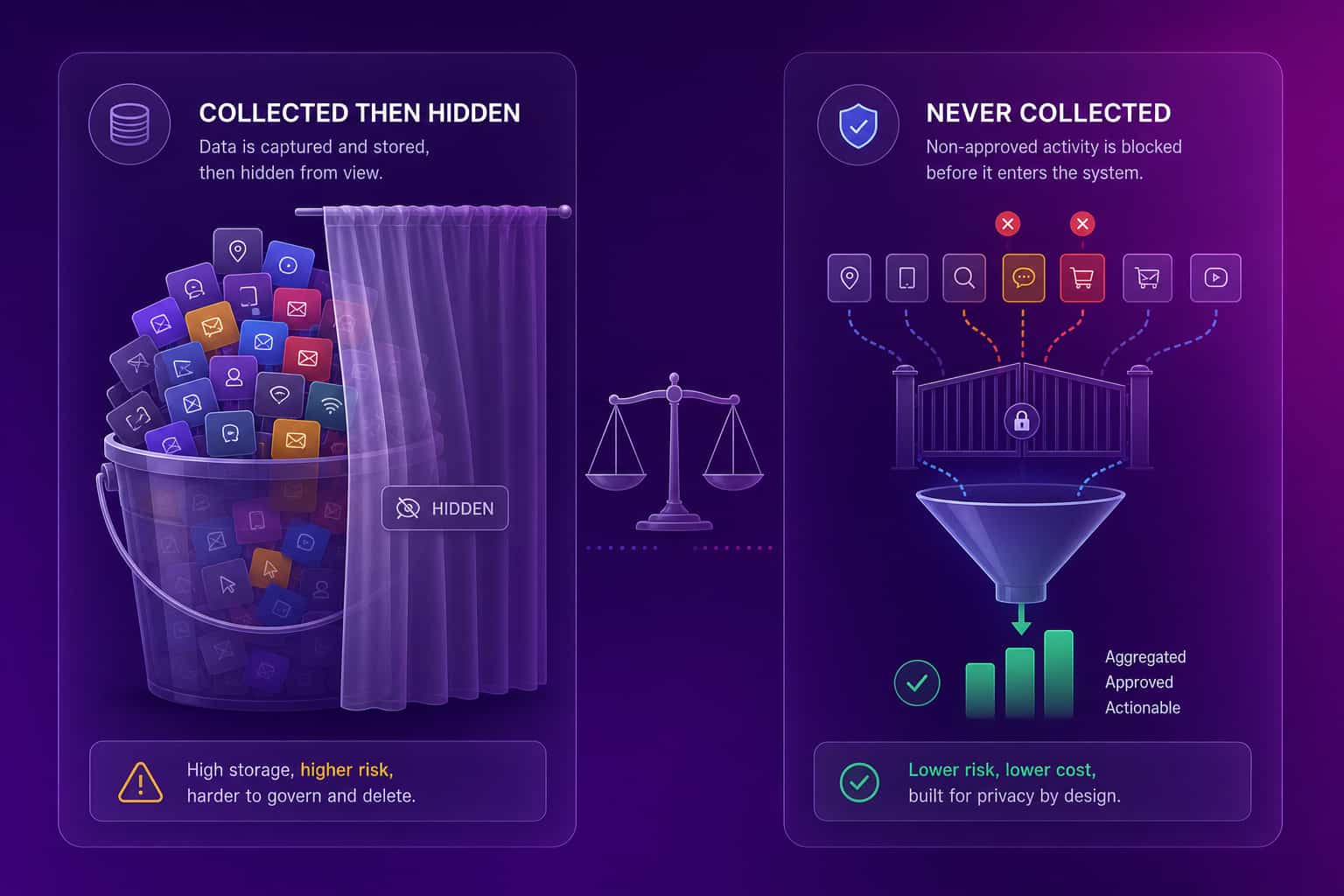
Most monitoring tools marketed as GDPR-compliant fail a serious Data Protection Impact Assessment for one structural reason: they are built to collect employee activity broadly and then restrict who can see it, which regulators treat as a very different legal posture from not collecting it at all, because GDPR attaches obligations to the moment data is processed, and processing includes collection, so hiding a URL history or a bank of screenshots behind an admin permission does nothing to change the fact that the data was gathered, stored, and now must be lawful, proportionate, retained no longer than necessary, and defensible if a works council, a data subject access request, or a regulator comes asking, which is exactly the scenario where collect-everything architectures come apart and where fines have already landed against companies that treated employee data as something to gather first and justify later.
The enforcement record is not hypothetical. In 2020, Germany's Hamburg data protection authority fined H&M €35.3 million for excessively logging employee personal details. France's CNIL fined Amazon France Logistique €15 million for a workplace monitoring system regulators found disproportionate, a decision upheld on appeal. Italy's Garante has repeatedly penalized companies for retaining employee browsing logs longer than any purpose justified.
None of those cases turned on a missing report setting. They turned on collecting the data in the first place.
The compliant architecture: data minimization at capture
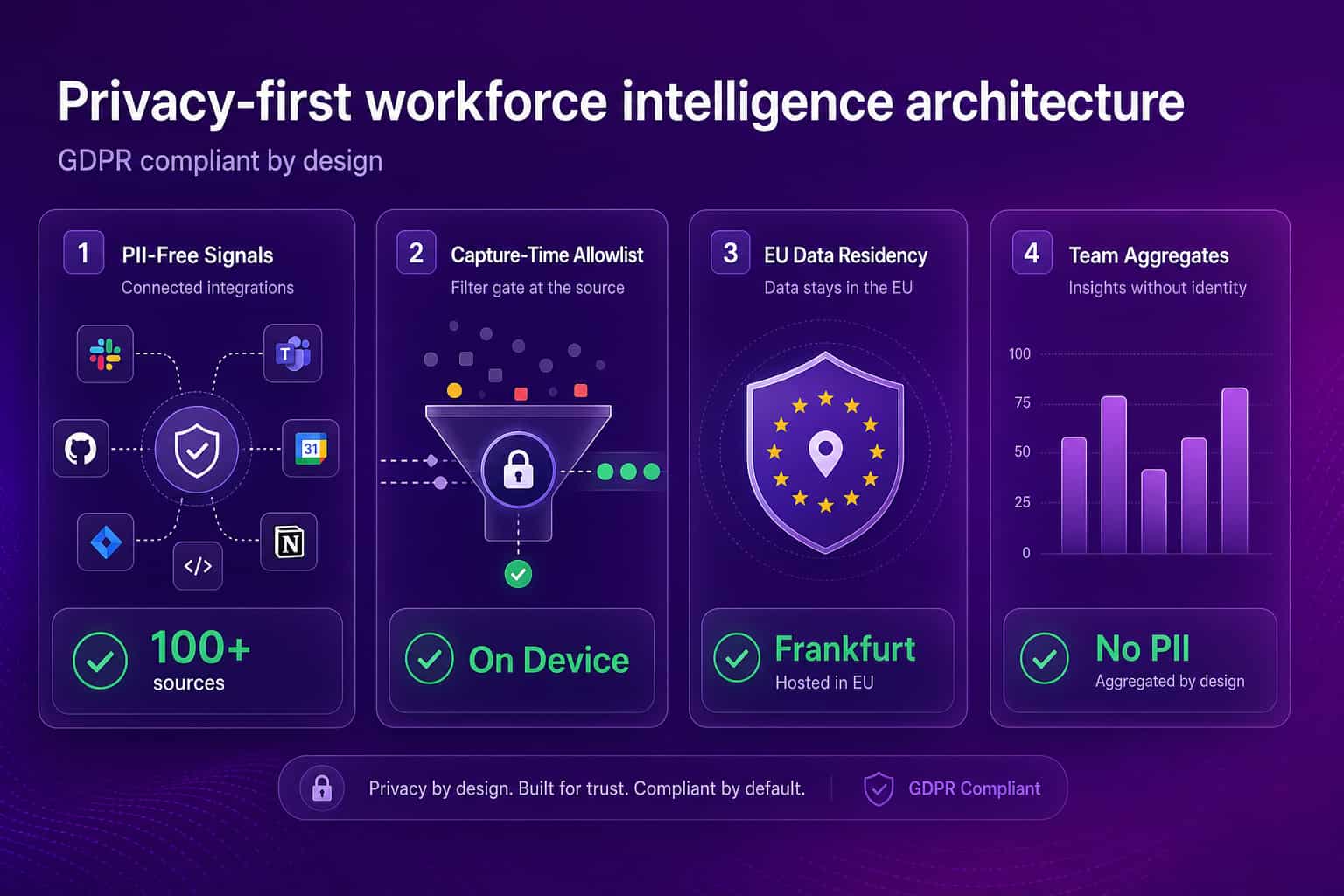
The architecture that actually survives a DPIA is data minimization enforced at the point of capture, which means the software decides what it is allowed to collect before anything is written to disk or sent to a server, rather than collecting an entire stream of employee activity and trimming it afterward, and Abloomify implements this in two layers: first, 100+ API integrations that pull only PII-free signals from the tools a company already runs, with no email content, no message content, and no file content ever ingested, and second, an optional privacy-first device agent for Mac and Windows that enforces an application allowlist at capture, so any activity outside the approved applications is never logged and never transmitted, which is the practical, technical meaning of GDPR data minimization and the reason there is nothing to hide in a report because the non-approved data never existed.
This is what changes the DPIA conversation. A Data Protection Officer reviewing Abloomify is not asked to trust a permission setting. They are shown a capture-time allowlist: the exact set of applications and signals the agent will ever record, with everything else excluded by design.
For teams that cannot send workforce data outside the EU, Abloomify runs a Frankfurt instance where telemetry, database, analytics, and AI processing all stay in the EU. That closes the data-residency question in writing, before procurement. Regulated finance and public-sector buyers can also deploy in a single-tenant private cloud in their own AWS, Azure, or GCP environment. Abloomify is SOC 2 Type II certified and PII-free by architecture, which is why it can measure productivity, capacity, and engineering velocity without the surveillance layer that creates the compliance risk in the first place.
GDPR-compliant monitoring vs privacy-first workforce intelligence
The clearest way to choose is to hold the two categories side by side, because GDPR-compliant employee monitoring software and privacy-first workforce intelligence answer different questions and carry different compliance weight: a monitoring tool, even a well-configured EU deployment of ActivTrak, Insightful, Time Doctor, or Hubstaff, is designed to observe individual activity on a device and then govern who sees it, which means the compliance burden scales with everything the agent captures, while a privacy-first workforce intelligence platform is designed to measure outcomes and patterns from connected work systems and aggregated signals, which means there is far less personal data in scope to begin with, and for a 100 to 500-person tech company whose real questions are about capacity, delivery velocity, and AI tool ROI rather than what a named engineer's screen shows at 2pm, the second category usually delivers more useful answers with a fraction of the legal exposure.
EU-configured monitoring tools
Abloomify
If you want the full category picture before you shortlist, the honest read on the best computer monitoring software in 2026 ranks the standard tools and where each one fits, and the side-by-side with ActivTrak shows how a monitoring agent and a privacy-first platform diverge on exactly the data a DPO cares about.
How to choose GDPR-compliant employee monitoring software
To choose GDPR-compliant employee monitoring software without inheriting a compliance problem, evaluate tools on what they collect at capture rather than what they display, and run every candidate through the same five questions a Data Protection Officer will eventually ask: what personal data does the agent write and transmit before any report is configured, is there an application-level allowlist enforced on the device or only report-level visibility settings, where does the data physically live and is EU residency guaranteed in writing for analytics and AI processing rather than storage alone, has the vendor produced a DPIA-ready pack that documents exactly what is and is not collected, and does the tool actually answer the operational questions leadership cares about, because a tool that clears the compliance bar but only tells you who had Slack open has passed the wrong test for a modern tech company.
Run this checklist before you sign:
- Capture, not display. Ask what the agent records before any report setting. If the answer is broad activity, the compliance burden is broad too.
- Allowlist at capture. Prefer an application allowlist enforced on the device over report-level visibility toggles.
- Residency in writing. For EU teams, require full-stack EU residency, analytics and AI processing included, not just storage.
- DPIA-ready documentation. A vendor that cannot hand your DPO a clear list of what is and is not collected is not ready for procurement.
- Answers, not activity. Confirm the tool measures the outcomes leadership actually reports on: capacity, velocity, AI tool ROI, and retention risk.
The instinct in a compliance review is to ask which monitoring tool has the best privacy settings. The better question is why you are collecting the data those settings exist to hide. Minimize at capture, and the DPIA gets short. Collect everything and filter later, and the fine gets large.
FAQ
Is employee monitoring GDPR-compliant?
It can be, within limits. GDPR requires a lawful basis, transparency, proportionality, and a DPIA for high-risk monitoring. Broad screenshot or keystroke capture is hard to defend as proportionate, which is why regulators have fined companies like H&M (€35.3 million) for excessive employee data collection. Privacy-first workforce intelligence avoids the problem by not collecting employee content at all.
What is the most GDPR-compliant way to monitor employee productivity?
Measure outcomes and aggregated patterns instead of individual screens. Abloomify connects to 100+ work systems for PII-free signals and uses an optional device agent with a capture-time allowlist, so only approved, aggregated metrics are ever collected. No screenshots, no keyloggers, no screen recording, SOC 2 Type II certified, and EU residency available in Frankfurt.
Do ActivTrak, Time Doctor, and Hubstaff comply with GDPR?
They can be configured for EU use with notices and data controls, and each documents privacy features. The structural issue is that their agents capture device activity before any report-level setting applies, so the data exists and must be justified. For EU teams facing works councils, that capture-first design is where DPIAs stall.
What is a DPIA and when do I need one for employee monitoring?
A Data Protection Impact Assessment is a documented risk analysis GDPR requires before high-risk processing, which employee monitoring usually is. It records what data you collect, why, the lawful basis, retention, and safeguards. If a tool collects broad activity, the DPIA is long and contestable. If it minimizes at capture, the DPIA is short.
Is Abloomify an employee monitoring tool?
No. Abloomify is a privacy-first workforce intelligence platform. It measures productivity, capacity, engineering velocity, and AI tool ROI from connected systems and aggregated device signals, with no screenshots, keyloggers, or screen recording. It gives leaders the visibility monitoring tools promise without the surveillance layer that creates GDPR risk.

Amir Tavafi
Co-Founder & CEO
Product leader and innovator with over 15 years of experience in the tech sector, grounded in AI and robotics. Previously led product development in fraud detection and AI solutions at Nasdaq Verafin.