Feedback Questions for Employees That Beat Manager Memory
August 21, 2026
Amir Tavafi
10 min read

Feedback questions for employees only work when the answer comes from something real, not a manager's memory of the last visible thing that happened. Most lists hand you 40 questions and call it a framework. Abloomify customers who ground reviews in actual delivery and collaboration data cut prep time by 75%. Here are 15 questions worth asking, and what to bring into the room before you ask them.
Key Takeaways
Q: What are good feedback questions to ask employees?
A: The best ones are specific and forward-looking: what shipped well this month, what's been slowing you down, what skill you want to use more next year. Vague prompts like "how are you feeling about work" invite vague answers. Abloomify's AI People Manager drafts sharper prompts from real delivery and collaboration data, not memory.
Q: How often should managers ask feedback questions?
A: Monthly beats quarterly, and quarterly beats an annual form. Abloomify customers running feedback through the AI People Manager instead of a once-a-year cycle cut review prep time by 75%, because the evidence is already assembled between 1:1s instead of reconstructed from memory right before the deadline.
Q: What is wrong with most employee feedback question lists?
A: Most hand you 30 to 60 questions with no way to answer any of them accurately, because a manager's memory of the last quarter is thin and recency-biased. Fifteen good questions asked with real delivery and collaboration data on hand beat sixty questions asked from a mental highlight reel.
Q: Can feedback questions replace a formal performance review?
A: No, and they should not try to. Feedback questions work best asked often, in 1:1s and right after specific pieces of work, while the formal review stays the place decisions like comp and promotion get made, ideally pulling from the same underlying evidence instead of a fresh set of impressions.
Q: How does Abloomify help managers answer feedback questions accurately?
A: Abloomify connects to 100+ tools (GitHub, Jira, Google Workspace, Microsoft 365) and surfaces delivery, collaboration, and capacity patterns PII-free: no screenshots, no keyloggers, no content capture. The AI People Manager pulls that into 1:1 and review prep so a manager walks in with evidence instead of guessing.
Why most feedback questions for employees fail before the meeting starts
Feedback questions for employees fail for a boring reason: the manager asking them is working from memory, and memory is a bad instrument for this job, because it over-weights whatever happened most recently, whatever felt dramatic at the time, and whatever the manager happened to notice while walking past a desk or scrolling Slack that week, while quietly erasing the unglamorous stretch of solid work that filled the other eleven weeks of the quarter. That means the question gets asked as a generic prompt fishing for whatever the manager can half-remember, instead of a specific, answerable question grounded in what actually happened. The employee on the other side of the table can tell the difference immediately. A question built on real evidence produces a real conversation. A question built on recall produces a shrug and a safe, forgettable answer that neither person believes.
I have sat on both sides of this. The pattern I keep coming back to: how much of a manager's week is actually spent on the work that matters, and how much is spent digging across five tools to answer a basic question like "what did this person actually ship this month," right before a 1:1 they should have walked into already knowing. Good questions do not fix that. They just make the gap in preparation more obvious.
The feedback questions for employees that actually work
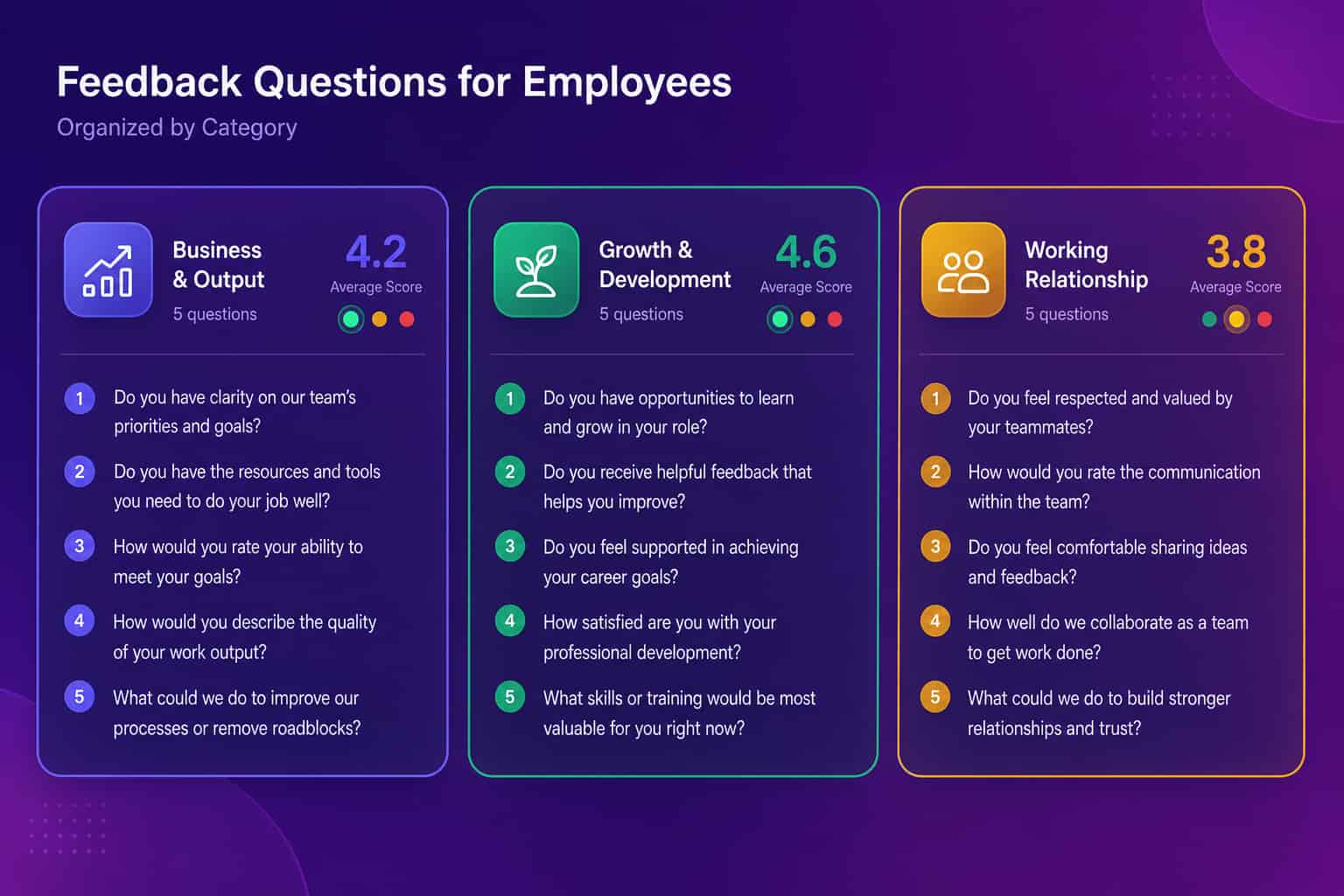
The first sentence rule holds here too: the fifteen questions below work because each one is specific enough to require a real answer, not because there are fifteen of them. Most feedback question lists on the first page of Google run 30 to 60 questions deep, organized by category, with the implicit promise that more coverage means better feedback. It does not. A manager who asks sixty questions from memory gets sixty vague answers. A manager who asks five of these with the last month of real work in front of them gets five conversations worth having. Pick the ones that fit the person and the moment, not the whole list at once.
Business and output questions (best asked with delivery data on hand, not from memory):
- What is the best piece of work you shipped this month, and what made it good?
- Where did you get stuck longer than you expected to, and why?
- What is one thing slowing you down that leadership could actually remove?
- If you had two extra hours a week, what would you spend them on?
- What is a call I made that you would have made differently?
Growth and development questions:
- What skill do you want to be using more a year from now?
- What is something you learned recently that nobody has asked you about yet?
- Where do you feel like you are coasting on what you already know?
- What kind of work makes you lose track of time?
- What feedback have you been sitting on that you have not said out loud?
Working-relationship questions:
- What is one thing I do that makes your job harder?
- When was the last time you felt unseen for something you did well?
- What do you wish I asked you more often?
- Is there a decision you are waiting on from me right now?
- What would make our 1:1s more useful to you?
How to walk in with evidence instead of guessing
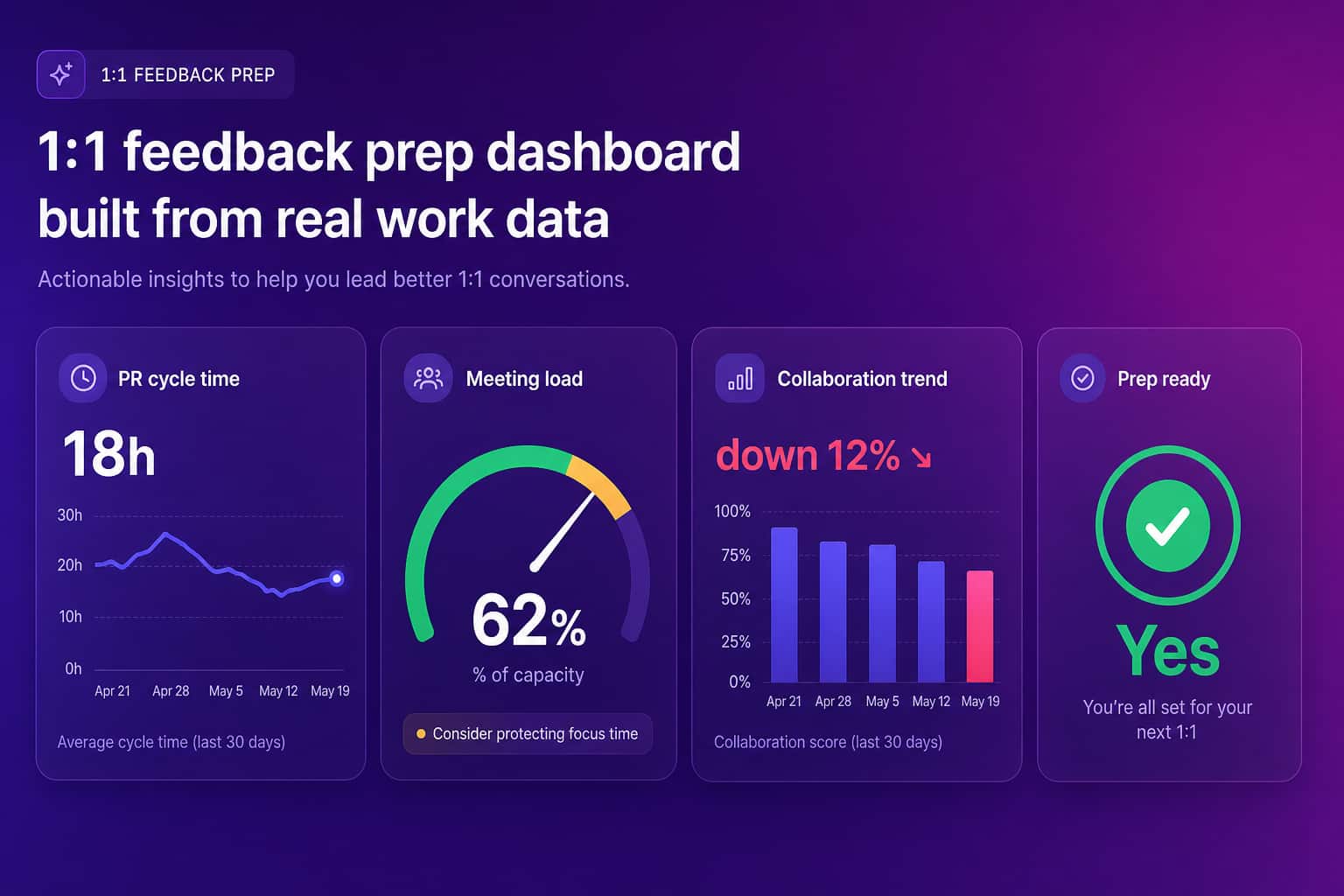
The difference between a feedback question that lands and one that gets a shrug is almost never the wording. It is whether the manager already knows the answer's ballpark before asking, meaning they have seen the PR that shipped late and why, the meeting load that quietly doubled, or the Slack thread where the person solved something nobody thanked them for, so the question becomes a chance to add color to something real rather than a cold open the manager hopes gets filled in for them. That is the actual skill gap in most feedback conversations. It is not that managers do not care. It is that the evidence lives scattered across GitHub, Jira, Google Workspace, and a dozen Slack channels, and rebuilding it from scratch before every 1:1 is a chore nobody has time for, so most managers stop trying and default to memory instead.
One of our earliest customers, a 50-person Canadian SaaS company, put this exactly right after seeing their own manual process mirrored back automatically: "What I did manually this week in a spreadsheet is exactly what I think Abloomify should be doing automatically." That is the feedback problem in one sentence. The manual version of this work already exists in every good manager's head, it is just slow, incomplete, and gone by the time the next review cycle rolls around.
Abloomify's AI People Manager pulls this together automatically: 1-on-1 prep drawn from delivery and collaboration signals across 100+ integrations, PII-free by architecture, no screenshots, no keyloggers, no content capture. It is not reading anyone's messages. It is noticing the pattern in the work itself, the way a good manager would if they had the time to look at everything at once.
A cadence that keeps the questions from going stale
An annual review is the worst possible cadence for any of these questions, because by the time the form opens, the evidence a manager needs is a year old and the specific moment worth discussing has been buried under fifty other things that happened since, which is why the same fifteen questions asked monthly, in a 1:1 that already has a month of real delivery and collaboration data loaded into it, produce sharper answers than the identical questions asked once a year with nothing but a manager's fading impression to go on. Monthly beats quarterly. Quarterly beats an annual form nobody remembers filling out honestly. The cadence matters more than the question wording, because a good question asked cold still gets a cold answer, and a mediocre question asked with real context still gets somewhere.
Our performance management product builds this cadence in directly, and the AI People Manager handles the prep so a manager opens the 1:1 already knowing what happened instead of asking a question and hoping the employee fills in the blanks. Our guide on building fair performance reviews covers the same idea at the formal review layer.
Turning answers into action
A feedback question that gets a good answer and then goes nowhere trains the employee to stop giving good answers, which is the quiet failure mode most feedback programs never notice until engagement scores drop and nobody can point to why. The fix is not a bigger form or a longer question list. It is closing the loop: writing down what came up, checking it in the next 1:1, and following up on the one thing the person said was slowing them down. Big companies solve this with a feedback platform, a survey cadence, and a slide about culture at the next all-hands. A manager who actually closes the loop on three questions a month beats a manager running a perfect fifteen-question form once a year.
Our one-on-one agenda piece covers how to structure the meeting these questions belong in, and our for HR leaders page covers the retention and engagement signals that show up when managers act on what they hear instead of filing it away. See how Abloomify preps feedback conversations from real work data →
FAQ
What are good feedback questions to ask employees?
The best ones are specific and forward-looking: what shipped well this month, what has been slowing you down, what skill you want to be using more a year from now. Vague prompts like "how are you feeling about work" invite vague answers. Abloomify's AI People Manager drafts sharper prompts from a person's actual delivery and collaboration data instead of a manager's memory.
How often should managers ask feedback questions?
Monthly beats quarterly, and quarterly beats an annual form. Abloomify customers running feedback through the AI People Manager instead of a once-a-year cycle cut review prep time by 75%, because the evidence is already assembled between 1:1s instead of reconstructed from memory right before the deadline.
What is wrong with most employee feedback question lists?
Most hand you 30 to 60 questions with no way to answer any of them accurately, because a manager's memory of the last quarter is thin and recency-biased. Fifteen good questions asked with real delivery and collaboration data on hand beat sixty questions asked from a mental highlight reel.
Can feedback questions replace a formal performance review?
No, and they should not try to. Feedback questions work best asked often, in 1:1s and right after specific pieces of work, while the formal review stays the place decisions like comp and promotion get made, ideally pulling from the same underlying evidence instead of a fresh set of impressions.
How does Abloomify help managers answer feedback questions accurately?
Abloomify connects to 100+ tools (GitHub, Jira, Google Workspace, Microsoft 365) and surfaces delivery, collaboration, and capacity patterns PII-free: no screenshots, no keyloggers, no content capture. The AI People Manager pulls that into 1:1 and review prep so a manager walks in with evidence instead of guessing.

Amir Tavafi
Co-Founder & CEO
Product leader and innovator with over 15 years of experience in the tech sector, grounded in AI and robotics. Previously led product development in fraud detection and AI solutions at Nasdaq Verafin.